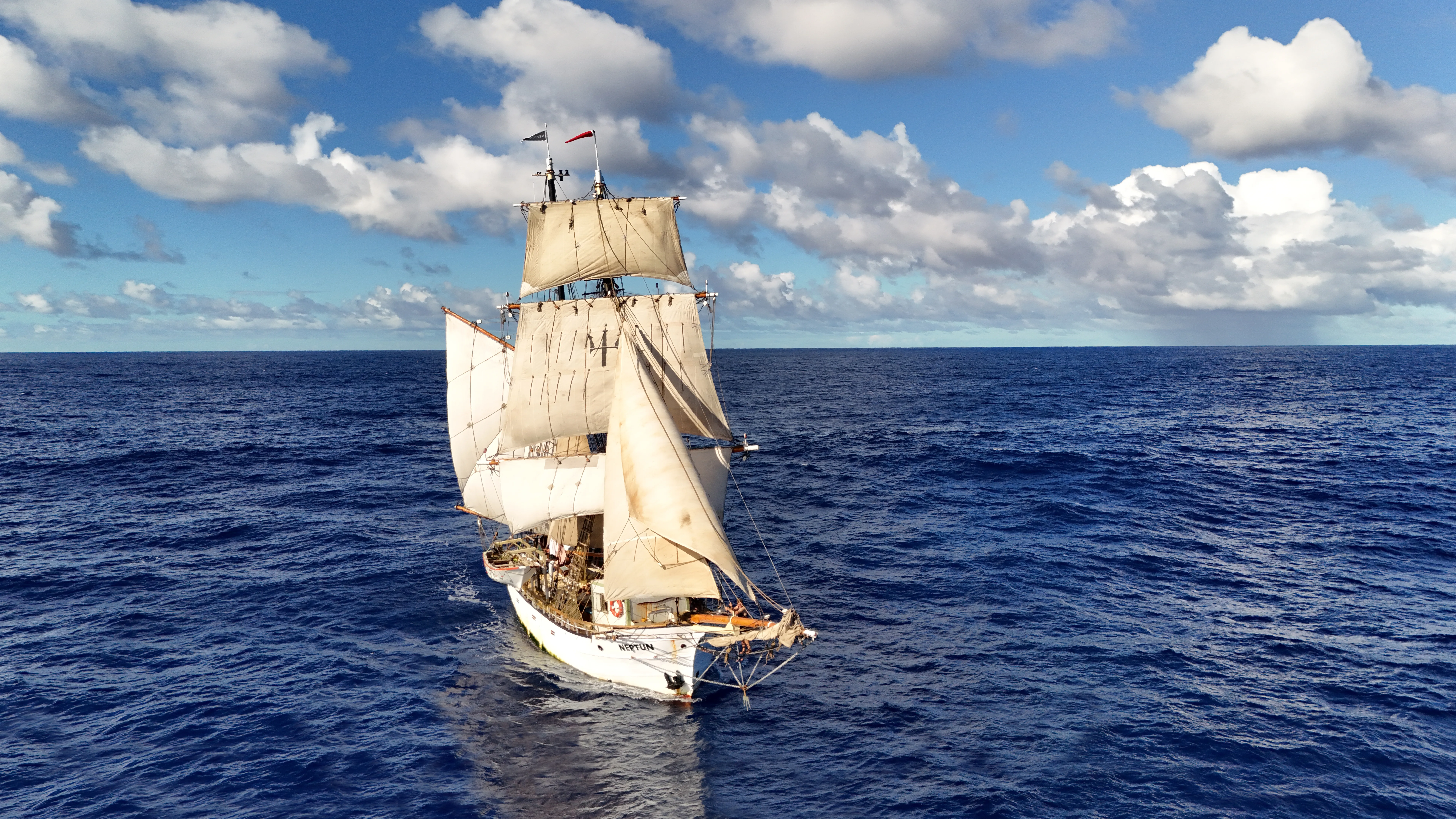
The king neptune ceremony sailing tradition is what happens when a working ship crosses the equator: the first-timers, the pollywogs, are summoned before King Neptune, charged with "crimes against the sea", put through something messy but safe, and inducted as shellbacks on the far side of 00°00'. It is one of the oldest continuously practised rituals in seafaring.
This short piece covers four things: what the line crossing ceremony actually is, where it came from, what happens on a modern sail-training tall ship, and why, 500 years on, a working brigantine like NEPTUN still holds one every time she crosses the line. When we sail Leg 5 from Saldanha to Fortaleza in early 2027, a fresh batch of shellbacks will be minted at sunrise somewhere around 00°00'N, 030°W.
Planning your own leg?
The 2026–2027 itinerary is live, nine legs, one continuous voyage. Browse the route and pick the passage that fits your dates.
On this page
- What is the king neptune ceremony?
- Where the line-crossing ceremony came from
- Shellbacks, pollywogs, and the Royal Court
- How the navy, merchant ships and cruise lines do it
- Other lines worth crossing
- Why this ritual is still worth keeping
- FAQ
- Read also
What is the king neptune ceremony?
The king neptune ceremony is a shipboard ritual held when a sailor crosses the equator for the first time. The trainee, a pollywog, is brought before King Neptune, charged with silly "crimes against the sea", put through a short, messy but safe ordeal, and inducted as a shellback: a proper seafarer who has crossed the line. The tradition goes back at least 500 years.
Four characters do the work:
King Neptune
Ruler of the deep. Crown, trident, improvised beard. Presides over the court.
Queen Amphitrite
Neptune's consort. Judges the pollywogs alongside him and usually hands out the certificates.
Davy Jones
The prosecutor. Reads the charges. The pollywog is always guilty.
The Royal Baby
Traditionally the largest, hairiest crew member. The pollywog is required to kiss the Baby's belly.
Where the line-crossing ceremony came from
The ritual predates any single navy. The first written mentions appear in the late 1400s aboard Portuguese and Spanish ocean-going vessels, men who were sailing south of the equator for the first time in recorded European history and wanted to mark it.
By the 1700s it had been formalised as a British Royal Navy tradition, with the theatrical "Court of Neptune" we still recognise today. Charles Darwin, aboard HMS Beagle in 1832, wrote a bemused account of the ceremony as practised on a scientific expedition, his own pollywog dunking included.
Two theories compete for why it exists. One is religious in origin: you appease Neptune before entering his domain, so he grants the ship safe passage. The other is practical: a passage across the equator is long, hot, and tedious. A ritual that tests the crew, and gives them something to plan, build, and laugh about, keeps morale up on a ship that cannot call for help. Both are probably true. For a general reference, the Line-crossing ceremony entry gathers the sources in one place.
Timeline of the ceremony, from 17th-century Royal Navy to modern tall-ship version
Late 1400s, First written accounts
Portuguese and Spanish sailors record crossing rituals on the Africa-route voyages, the oldest documented ancestors of the modern ceremony.
1700s, Royal Navy formalisation
The British Royal Navy codifies the "Court of Neptune", charges, ordeals, certificate, as a rite of passage for every new rating crossing the line.
1832, Darwin on HMS Beagle
Charles Darwin records his own pollywog ducking in a scientific expedition log, giving us the clearest first-person account of the ceremony in its classical form.
1940s, Global wartime adoption
Through the Second World War the ceremony spreads to the US Navy, Commonwealth navies, and merchant marine fleets in every ocean.
1980s–1990s, Hazing reforms
After serious hazing incidents in several navies, the ordeal is scaled back. Participation is made voluntary and the ceremony shifts from trial to theatre.
2020s, Sail-training version
On modern tall ships like NEPTUN the ceremony is fully theatrical, opt-in, and built around teaching the tradition to a new generation of shellbacks.
Shellbacks, pollywogs, and the Royal Court
The ceremony has its own vocabulary, and the rest of the article reads more cleanly once you have it:
- Pollywog (or Slimy Pollywog), a sailor who has never crossed the equator.
- Shellback (also Trusty Shellback, Son of Neptune), has crossed before, and is expected to help run the ceremony for the next batch.
- Golden Shellback, has crossed at the intersection of the equator and the 180th meridian (rare, Pacific only).
- Blue Nose, has crossed the Arctic Circle.
- Golden Dragon, has crossed the International Date Line.
You can accumulate titles across a sailing career. An officer with thirty years on deep-water ships may have all five.
The line they are all talking about.
How the navy, merchant ships and cruise lines do it
The ceremony looks different depending on who is running it.
Navy version
Full Court of Neptune, prosecutor, formal charges, ordeals, the Royal Baby. Scaled back from the 1990s onwards in response to hazing reforms; now voluntary and supervised.
Merchant marine
Shorter and good-humoured. A proper theatrical entrance for Neptune, a handful of charges, a certificate for the ship's officer to sign. Under an hour start to finish.
Cruise lines
A passenger-facing show on the pool deck. Elaborate costumes, volunteer "pollywogs" from the guests, photos for purchase after. Theatre without ordeal.
Want to cross the line yourself?
Leg 5 (Saldanha → Fortaleza) is the equator-crossing passage of the 2026–2027 voyage. Three weeks at sea, one ceremony at 00°00'.
On a tall ship
The ceremony on a modern sail-training brigantine
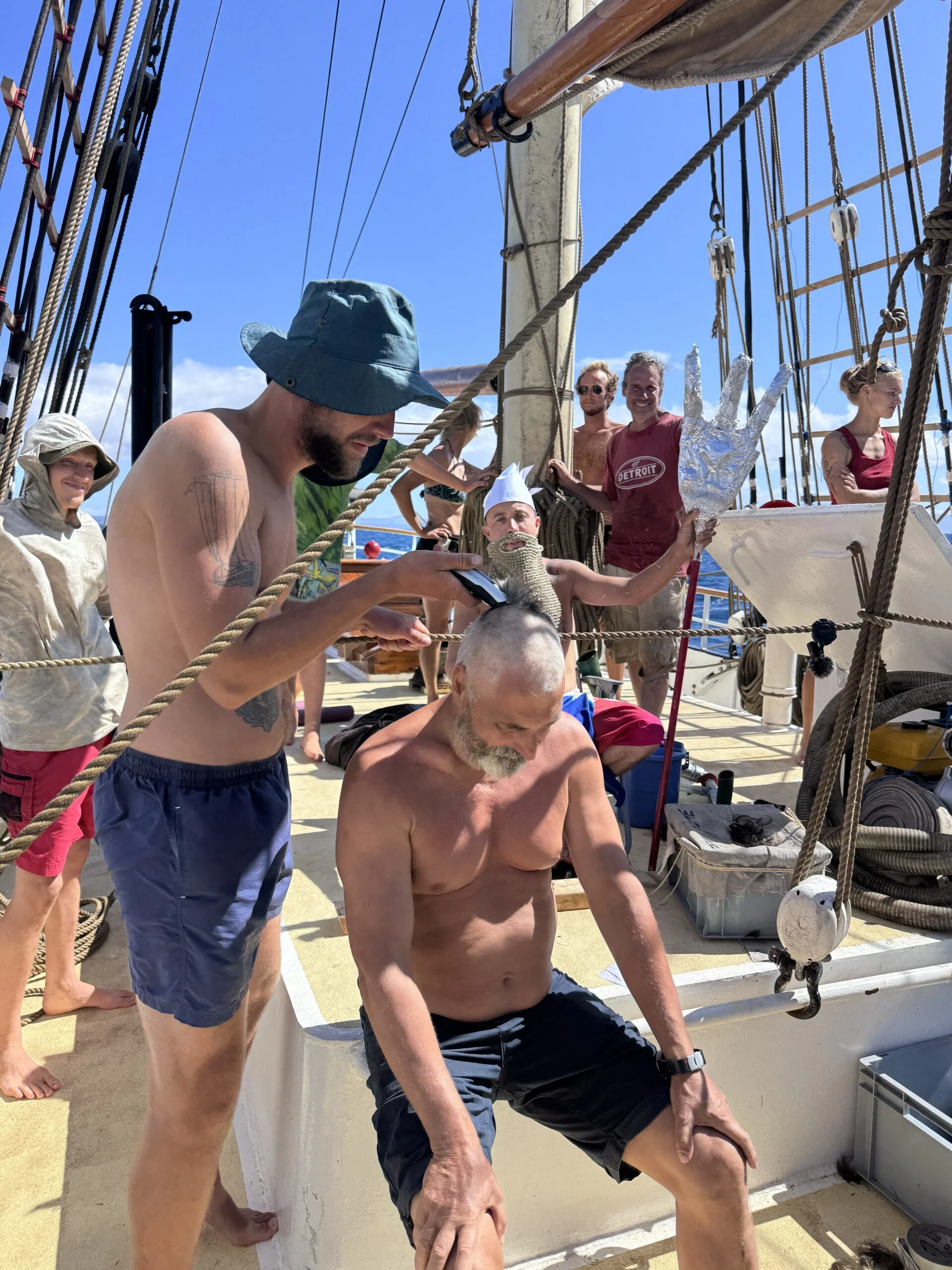
Other lines worth crossing
The equator is the famous one, but it is not the only line in blue-water sailing. Each crossing has its own title and its own small ceremony in the same Neptune family.
Why this ritual is still worth keeping
A ship is a small, self-contained society. It needs its own rites to mark the transitions that matter, because no one ashore is watching. A trainee who has crossed the line feels different from one who has not, and looks at the chart differently for the rest of their sailing life. That is worth preserving, which is partly why we still run the ceremony every time we cross, and partly why we teach the history first. The crew that comes off Leg 5 will carry it forward into the 2026–2027 world voyage and beyond.
Ready for the full 2026–2027 voyage?
Nine legs, 482 days, one continuous passage from Bali back to Kiel, with the equator crossing in the middle.
Frequently asked questions
What is the King Neptune ceremony?
The King Neptune ceremony is a shipboard ritual held when a sailor crosses the equator for the first time. The trainee, a pollywog, is brought before King Neptune, charged with playful crimes against the sea, put through a short theatrical ordeal, and inducted as a shellback: a sailor who has crossed the line.
What happens when you cross the equator on a ship?
The shellbacks on board prepare the deck the night before. At dawn the navigator calls 00°00' over the radio. King Neptune, Amphitrite and Davy Jones come aboard over the bow. Pollywogs are summoned, charged with silly crimes, put through a messy-but-safe ordeal, sworn in as shellbacks, and given a certificate, with the log entry signed in a different colour of ink.
Who was King Neptune and why do sailors celebrate him?
Neptune is the Roman sea-god, Poseidon in Greek myth, ruler of everything below the waterline. Sailors have always wanted his favour, and a theatrical court held at the moment of crossing his equator is a way of asking for it while having a laugh about the whole thing.
What is the difference between a pollywog and a shellback?
A pollywog is any sailor who has not yet crossed the equator at sea. A shellback is one who has. The ceremony is the moment of transition, and once you have crossed you are expected to help run the ceremony for the next generation of pollywogs.
Is the line-crossing ceremony still practised today?
Yes. Navies run it in scaled-back, voluntary form. Merchant ships run a short officer-led version. Cruise lines run a pool-deck show for passengers. Sail-training tall ships, including NEPTUN, run a theatrical version on every equator crossing.
Does NEPTUN do the King Neptune ceremony?
Yes, every equator crossing. The next one is on Leg 5 (Saldanha → Fortaleza) in early 2027. The ceremony on NEPTUN is fully theatrical, fully opt-in, and nobody is hazed.
What certificate do you get after crossing the line?
A shellback certificate signed by the captain, kept by the trainee. The ship also records the crossing in the log, and shellbacks sign the log entry in a different colour of ink, as the tradition requires.
Read also
- Leg 5: Saldanha → Fortaleza, the equator-crossing leg
- Day at sea aboard a tall ship
- Trade winds and the classic sailing routes
- Square sails explained
- Apply for a berth on a tall-ship voyage
The full 2026–2027 voyage
All nine legs of NEPTUN's circumnavigation, pick the passage that fits your dates.
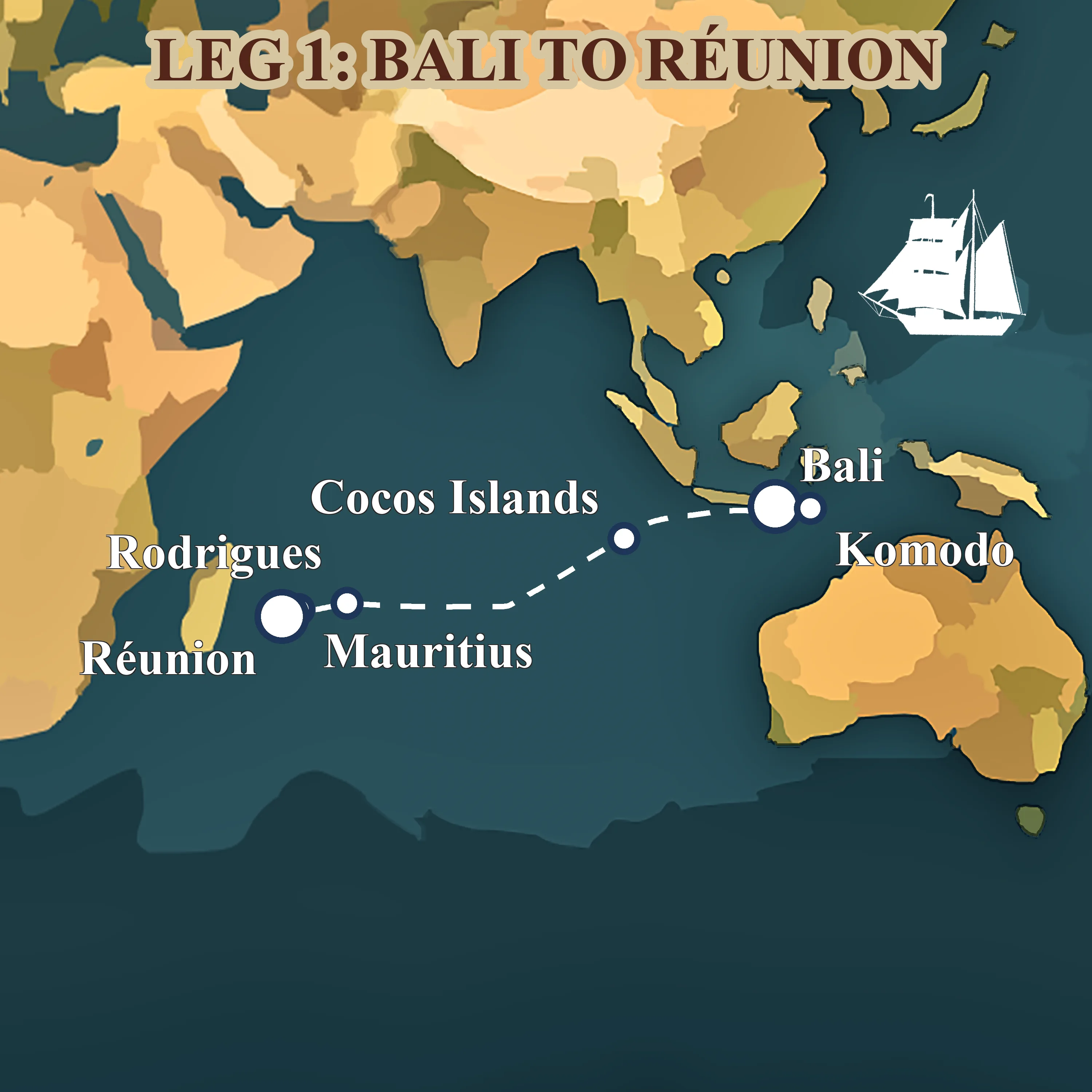
Leg 1: from Bali to Réunion across the Indian Ocean
May 2026 — Aug 2026 · Bali, Indonesia → Réunion, France
The opening chapter of Neptun's 482-day world voyage, a 4,078-nm trade-wind passage from the temples of Bali to the volcanic cliffs of Réunion.
Read more about this leg → about Leg 1: from Bali to Réunion across the Indian Ocean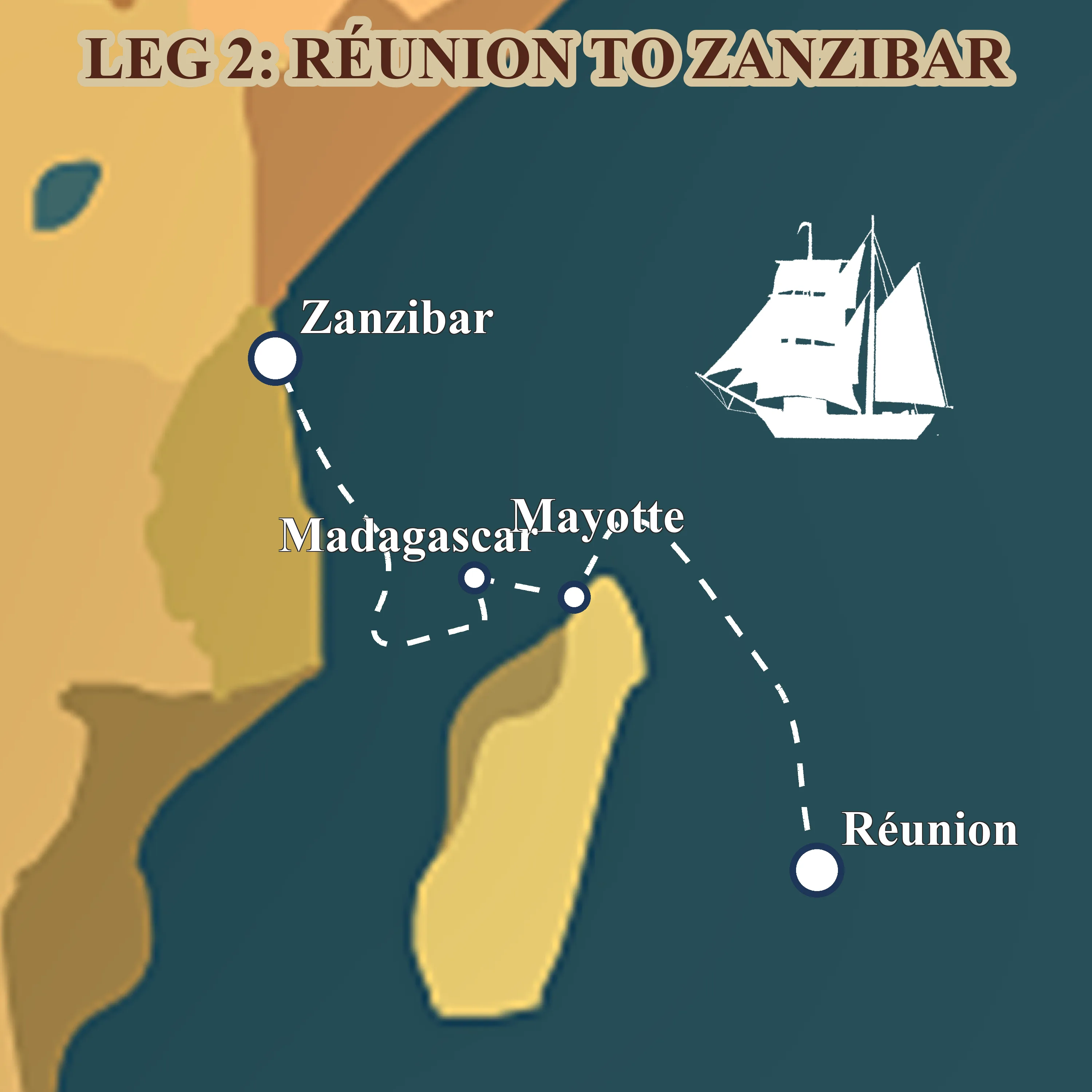
Leg 2: from Réunion to Zanzibar via Madagascar
Aug 2026 — Sept 2026 · Réunion, France → Zanzibar, Tanzania
Forty days across the western Indian Ocean, volcanic Réunion, lemur-haunted Nosy Be, the Mozambique Channel, and the spice-scented stone alleys of Zanzibar.
Read more about this leg → about Leg 2: from Réunion to Zanzibar via Madagascar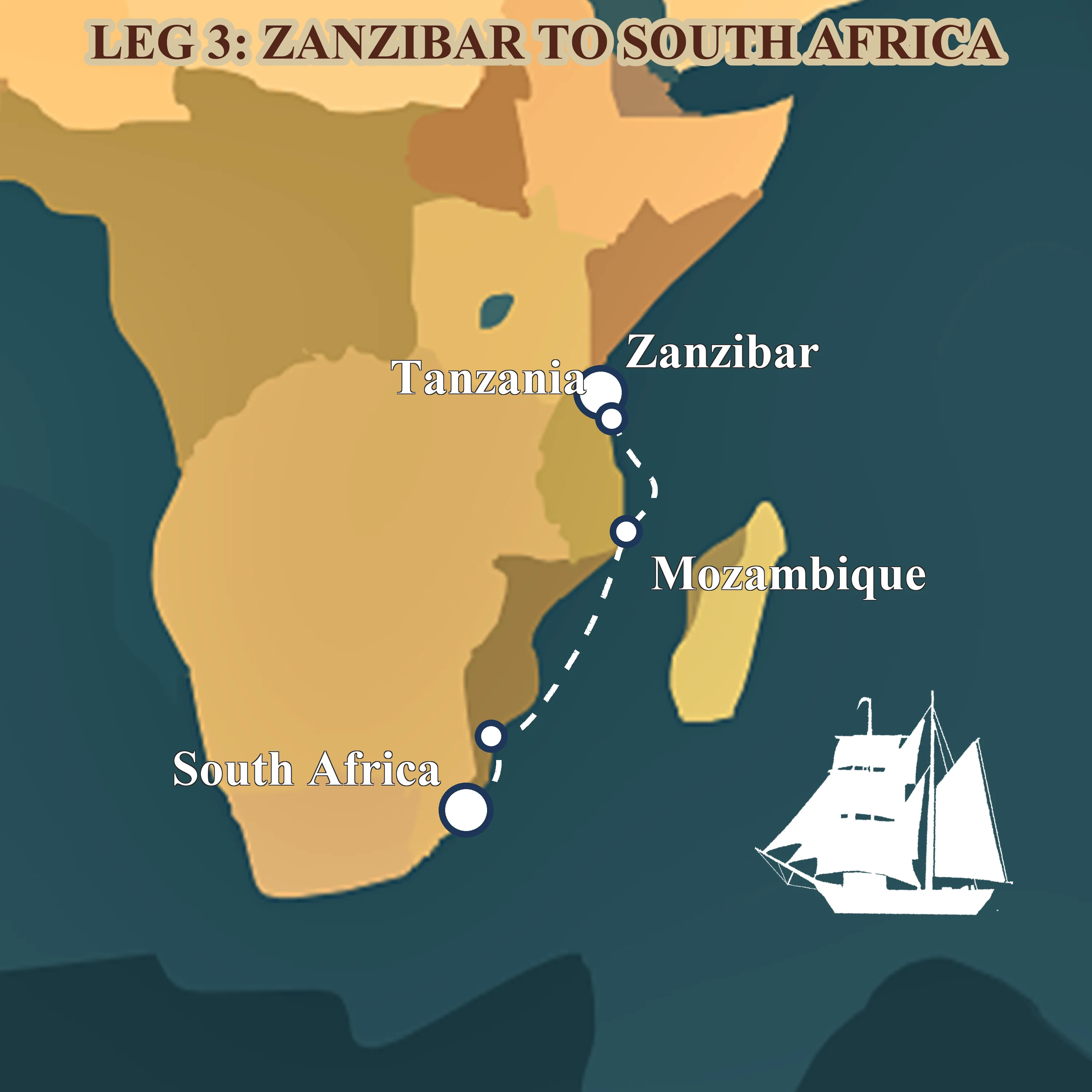
Leg 3: from Zanzibar to Durban down the Mozambique Channel
Sept 2026 — Nov 2026 · Zanzibar, Tanzania → Durban, South Africa
Sixty-three days coasting the African shore, spice islands, mangrove anchorages, Portuguese praças and the long trade-wind run down the Mozambique Channel to Durban.
Read more about this leg → about Leg 3: from Zanzibar to Durban down the Mozambique Channel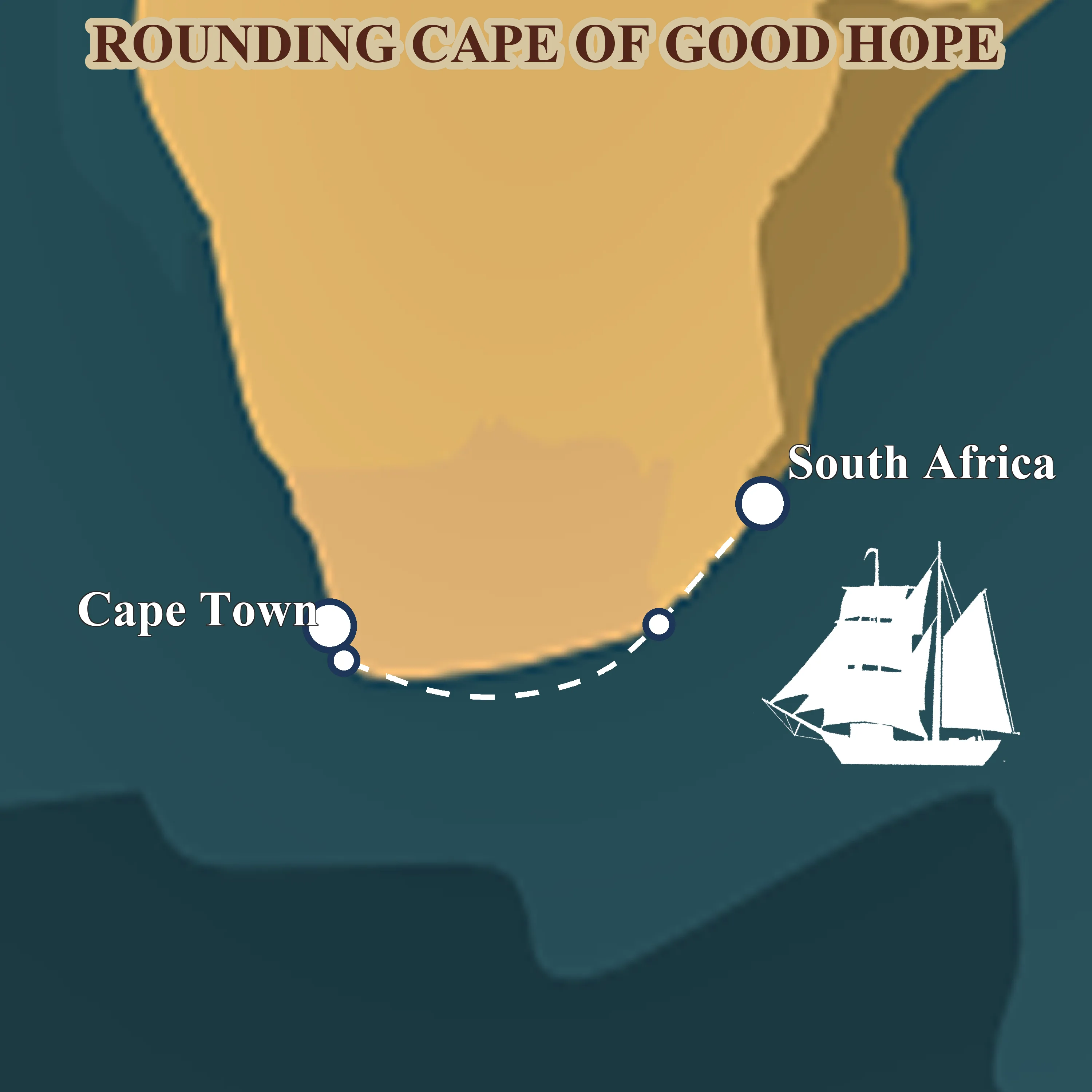
Leg 4: from Durban around the Cape of Good Hope
Nov 2026 — Dec 2026 · Durban, South Africa → Cape Town, South Africa
Thirty-eight days of serious seamanship, the Agulhas current, the Cape of Good Hope and the Southern Ocean at the tip of Africa, finishing quietly in Cape Town for Christmas.
Read more about this leg → about Leg 4: from Durban around the Cape of Good Hope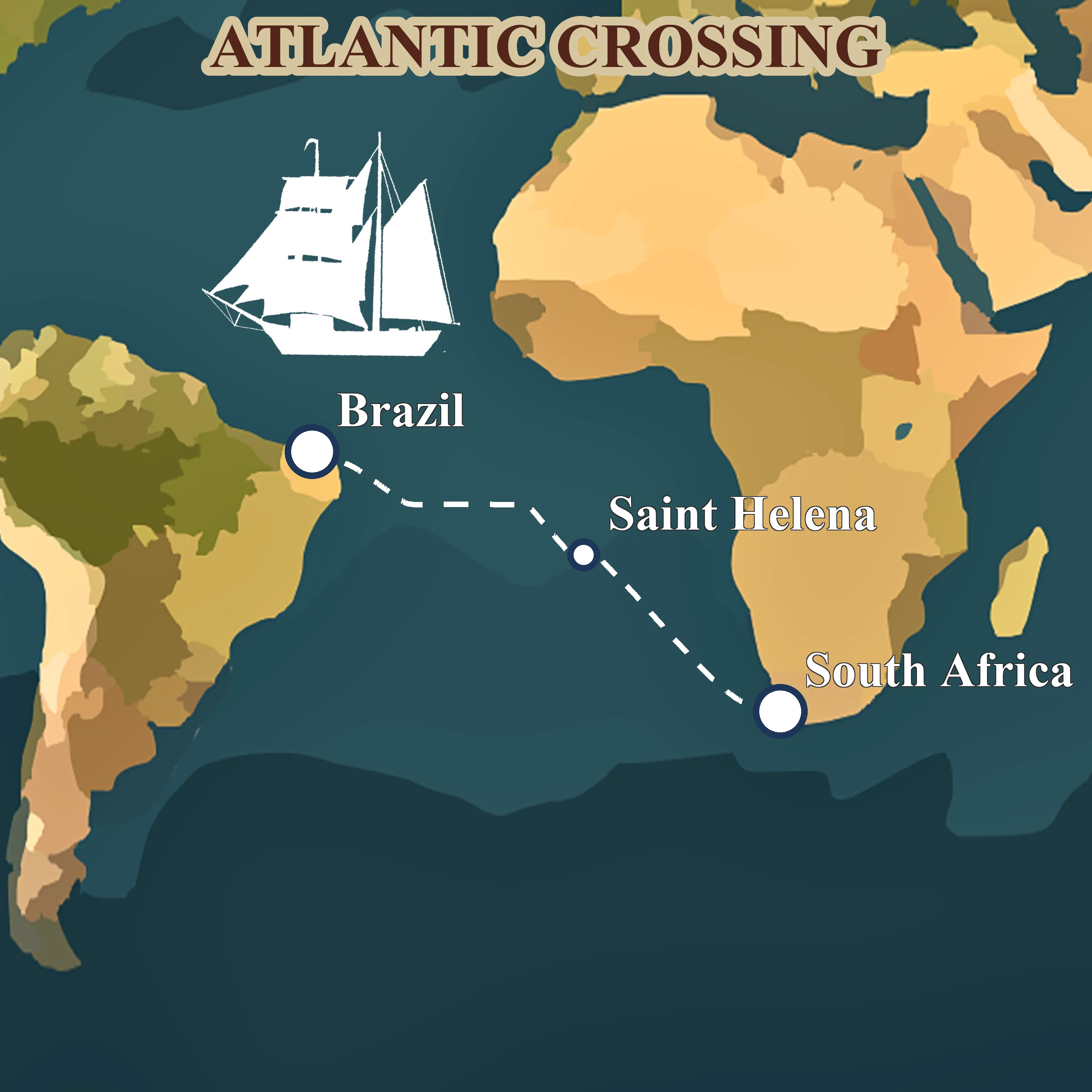
Leg 5: across the South Atlantic from Saldanha to Fortaleza
Jan 2027 — Mar 2027 · Saldanha Bay, South Africa → Fortaleza, Brazil
Forty-four days before the southeast trades, Napoleon's exile at St. Helena, the equator crossing, and landfall in tropical Brazil. The ocean chapter of the voyage.
Read more about this leg → about Leg 5: across the South Atlantic from Saldanha to Fortaleza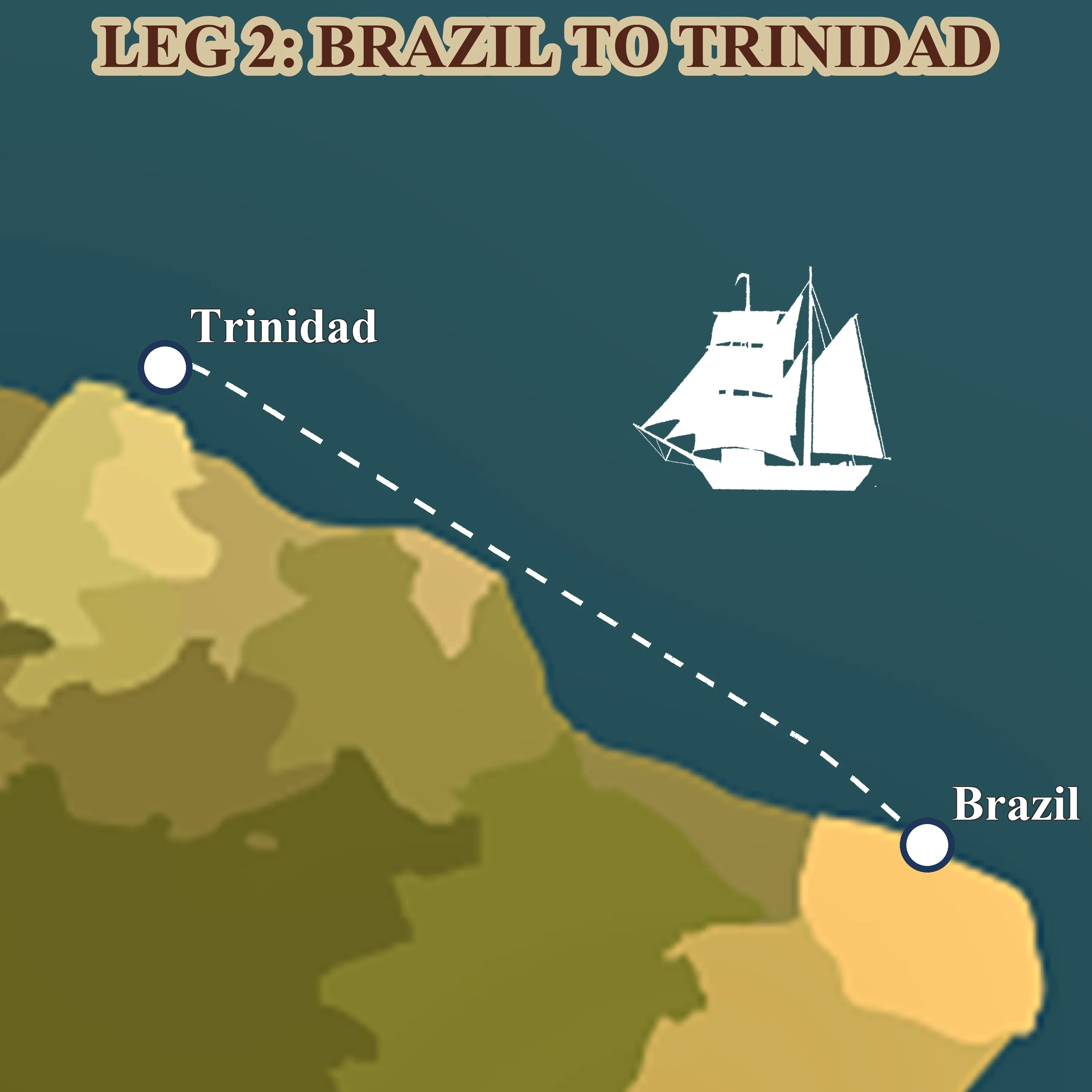
Leg 6: from Fortaleza to Trinidad along South America
Mar 2027 — Apr 2027 · Fortaleza, Brazil → Trinidad
A thousand miles of downwind trade running, the Amazon's brown water under the hull, the Guianas smudged on the horizon, and Trinidad's steelpan waiting at the end.
Read more about this leg → about Leg 6: from Fortaleza to Trinidad along South America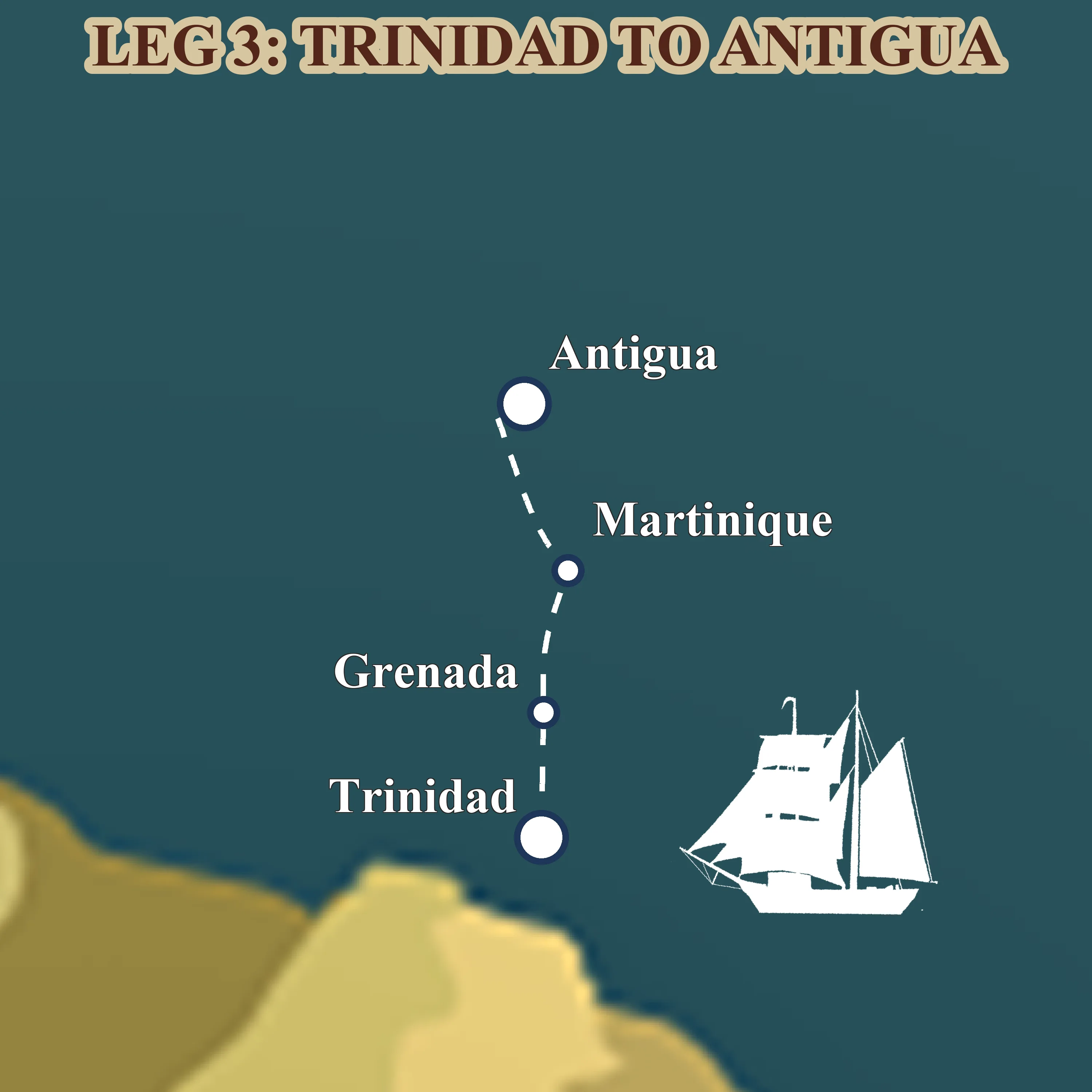
Leg 7: through the Windward Islands from Trinidad to Antigua
Apr 2027 — May 2027 · Trinidad → Antigua
Four weeks of short trade-wind daysails through the Lesser Antilles, turquoise anchorages, rum shops on the sand, French-Creole Martinique and the tall-ship scene in Antigua.
Read more about this leg → about Leg 7: through the Windward Islands from Trinidad to Antigua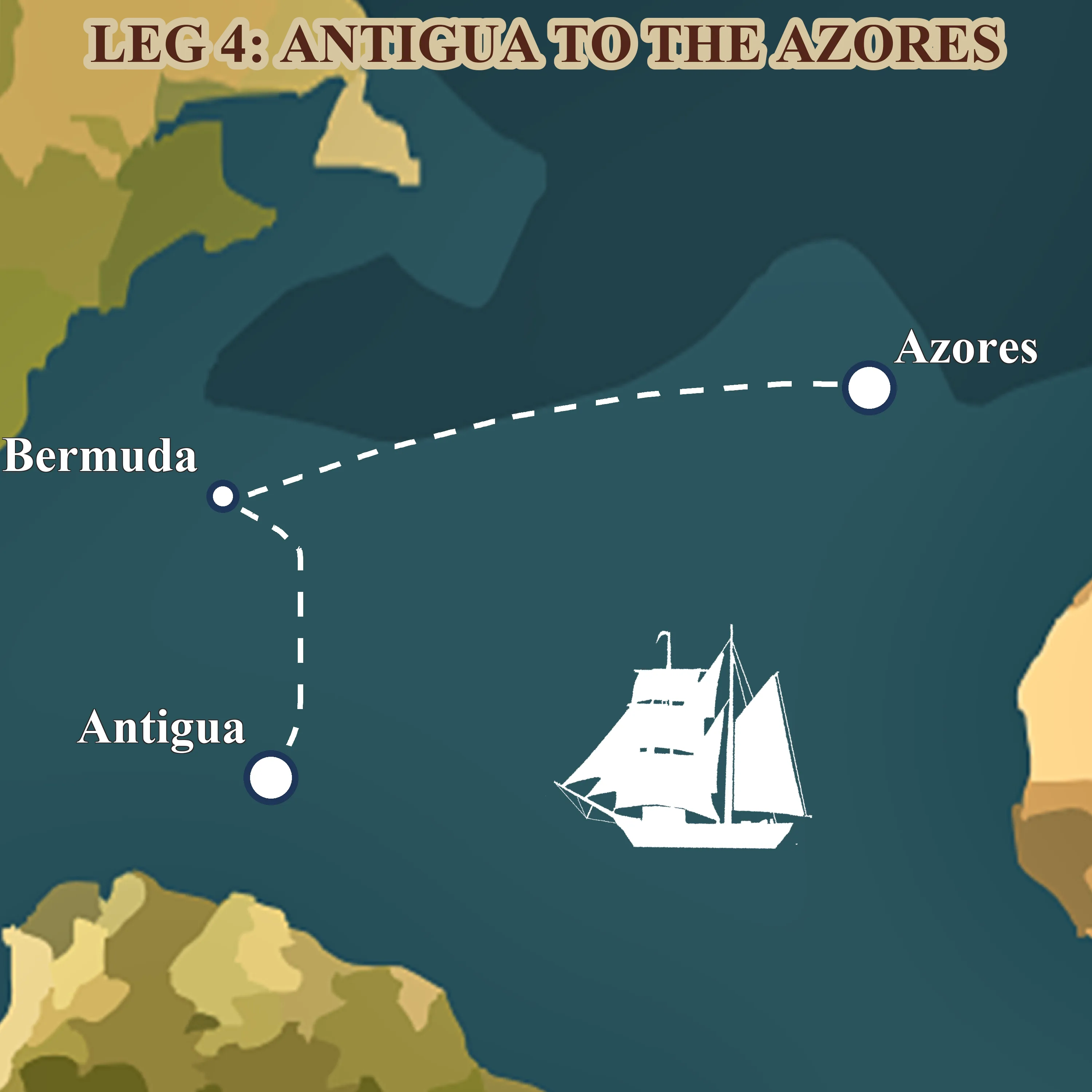
Leg 8: across the North Atlantic from Antigua to the Azores
May 2027 — Jul 2027 · Antigua → Ponta Delgada, Azores
Fifty-six days on the classic spring tall-ship route home, Antigua, a long reach to Bermuda's pink sand, then three weeks of open ocean to the volcanic Azores.
Read more about this leg → about Leg 8: across the North Atlantic from Antigua to the Azores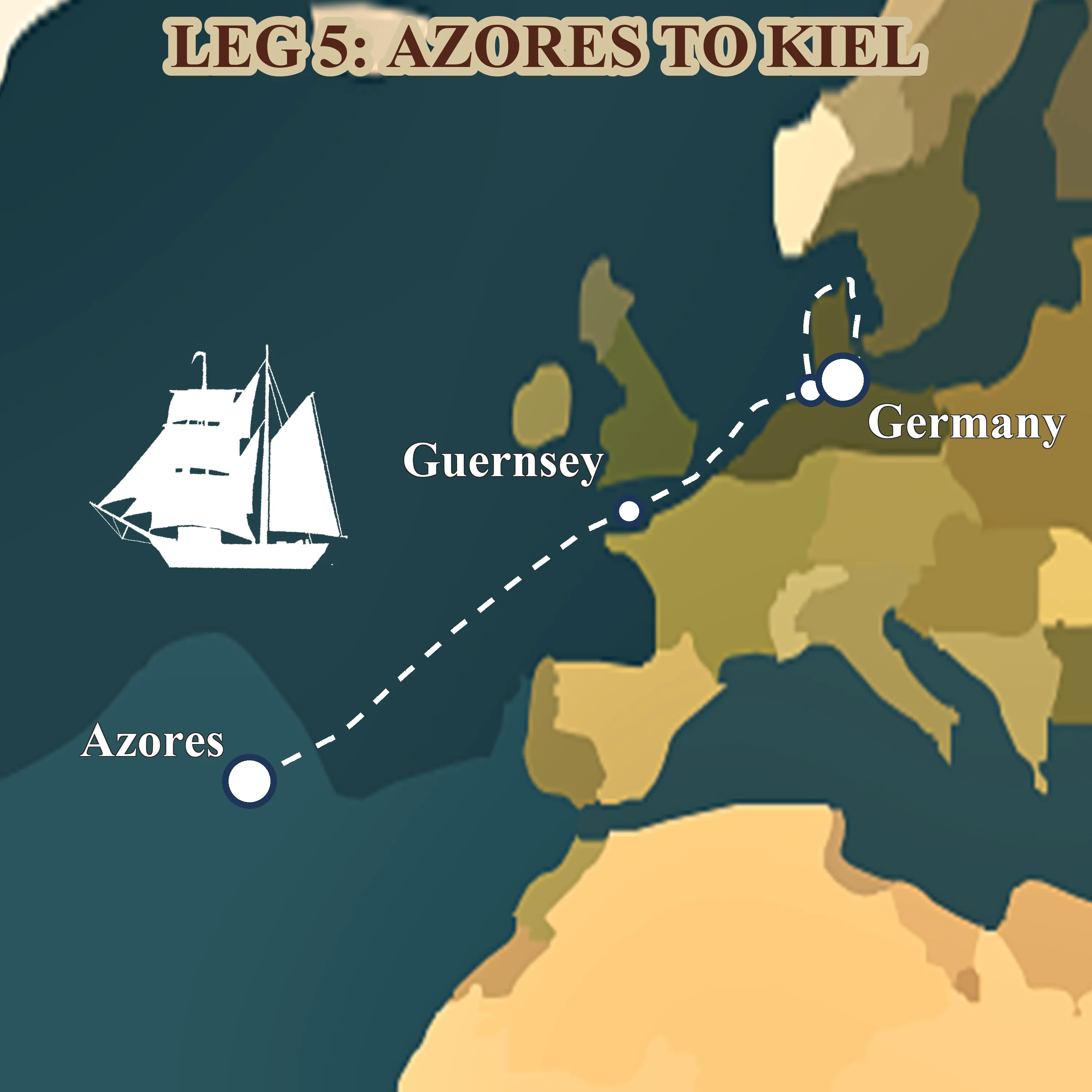
Leg 9: homecoming from the Azores to Kiel
Jul 2027 — Aug 2027 · Ponta Delgada, Azores → Kiel, Germany
The final 1,878 nm, from volcanic São Miguel to the Baltic, up the English Channel through the Dover TSS, past Helgoland's red cliffs and home to Kiel.
Read more about this leg → about Leg 9: homecoming from the Azores to KielWant to sail with us? Brigantine NEPTUN is a non-profit training ship, every voyage takes crew through real ocean sailing, no experience needed. Apply for a berth or read the Leg 5 itinerary first.
Cross the line with us in 2027
One application, three weeks at sea, one ceremony at the equator. The rest of your logbook is coloured differently after that.