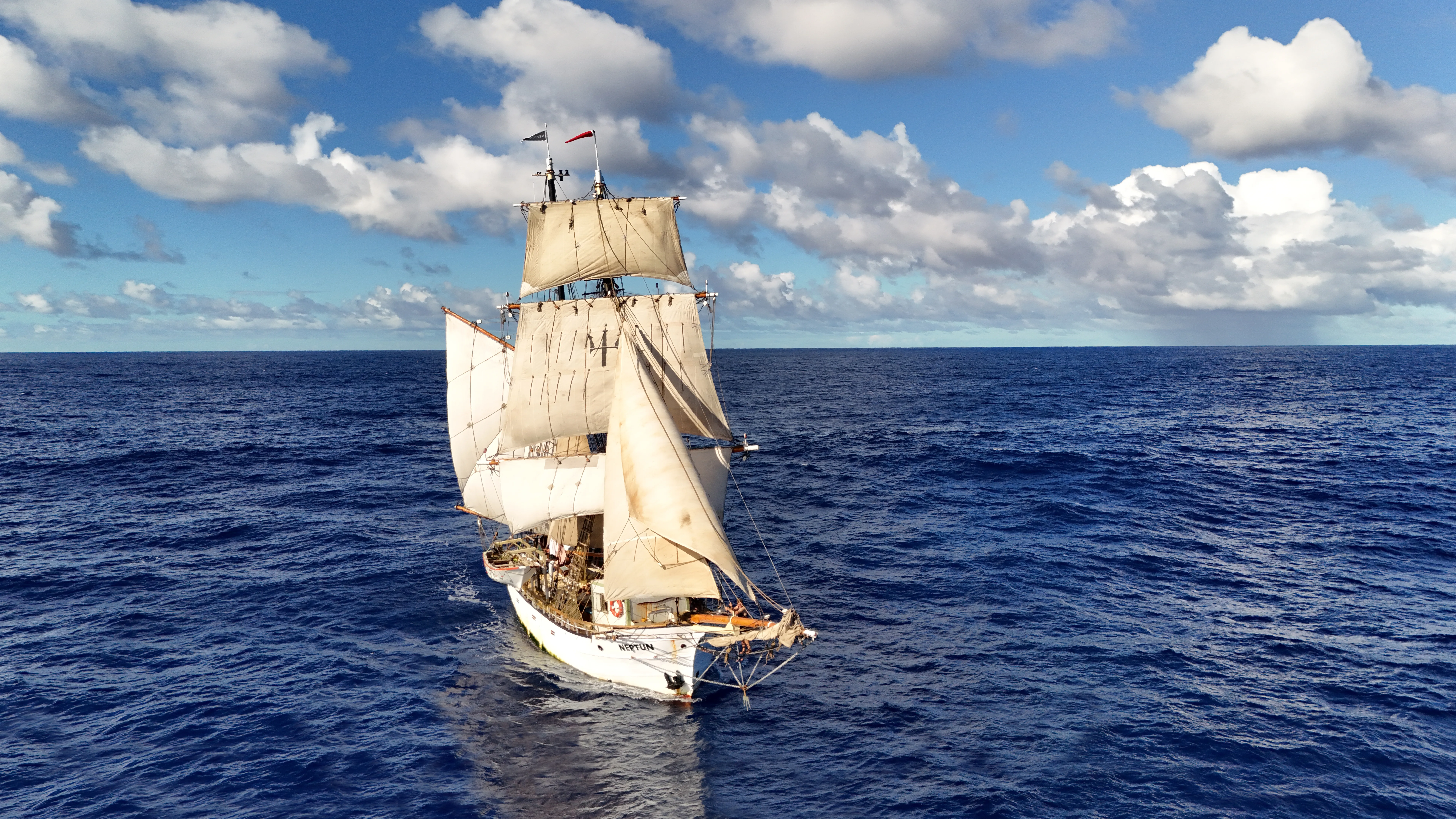
An Atlantic crossing sailing passage on a tall ship takes between fifteen and thirty-five days of continuous sea time, depending on the route, the season, and the wind. You are out of sight of land for most of it. The ship sails day and night. You stand watches, you eat with the crew, you sleep in short intervals, and somewhere in the second week the rhythm of the voyage takes over and stops feeling strange. This guide covers what a transatlantic sailing passage on Brigantine NEPTUN actually involves, the two real routes we sail, the daily rhythm, the weather, what to pack, and how to sign up for a 2027 leg.
Table of contents
- What an Atlantic crossing actually is
- The two Atlantic crossings on NEPTUN
- Daily life at sea
- The weather and what to expect
- What you should pack and prepare
- Physical and mental demands
- How to sign up for an Atlantic leg
- FAQ
What an Atlantic crossing actually is
An Atlantic crossing by sail is a passage of roughly 2,000 to 4,000 nautical miles across one of the world's three major oceans, made under sail with only incidental engine use for port manoeuvring. On a traditional tall ship averaging four to six knots, that works out to fifteen days for a fast trade-wind run and thirty-five days for a slow one. Three to five weeks at sea is typical.
Distance on the chart does not translate directly to time. A tall ship sails where the wind lets her sail. A crossing that looks like a straight line on a world map is actually a long curve following the weather systems, south to catch the trades, then west, then north toward the destination.
You cannot predict the weather for a full transatlantic sailing passage in advance. Modern weather routing gives a reliable seven- to ten-day forecast, and we use it. Beyond that, the ship sails into whatever the Atlantic produces. That uncertainty is part of the bargain.
An Atlantic crossing on NEPTUN is also not a delivery trip. You are trainee crew, not a passenger. You stand a watch, you set and strike sails, you cook and clean, and by the time you land you have a couple of thousand ocean miles in a logbook. That is the whole point.
The two Atlantic crossings on NEPTUN
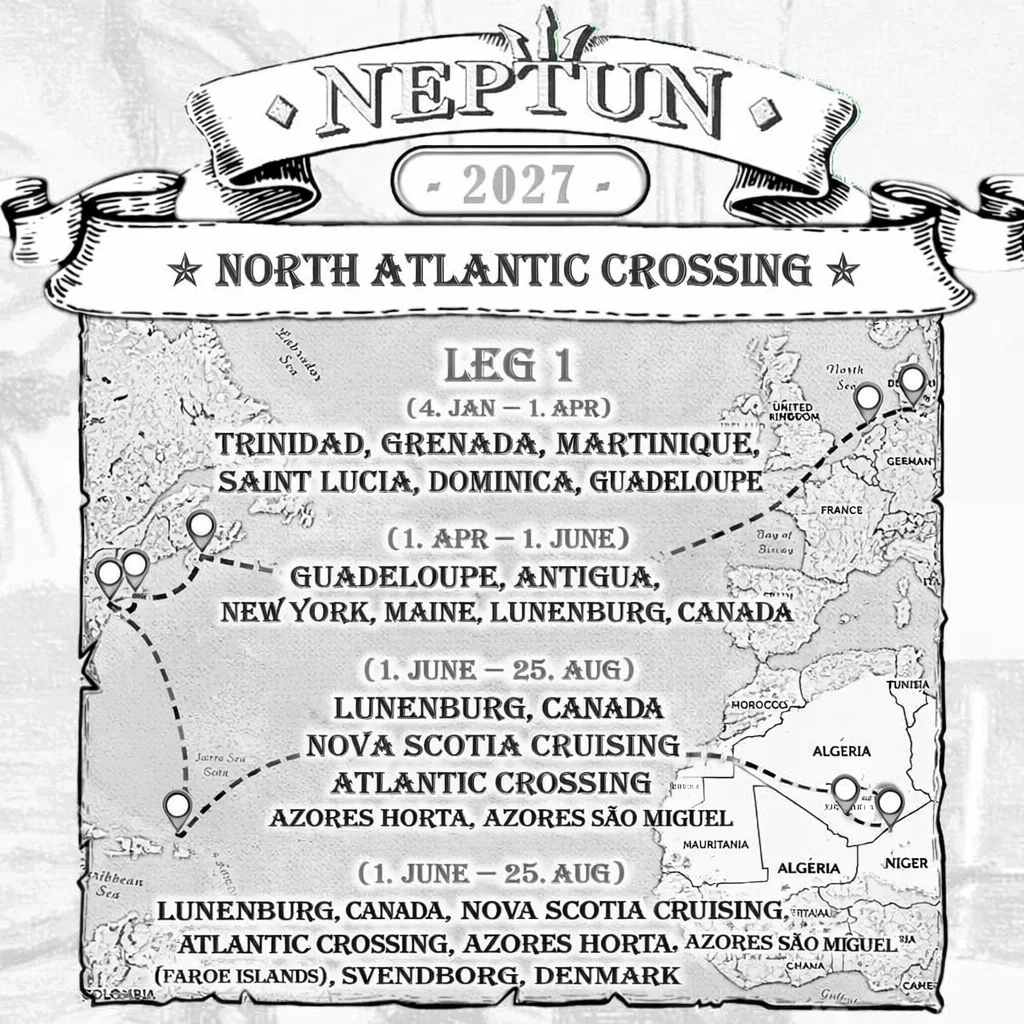
NEPTUN crosses the Atlantic twice during the 2026–2027 world voyage, and the two passages are genuinely different experiences. If you are choosing between them, the answer depends on how much open ocean you want and how much weather you are comfortable with.
South Atlantic, Leg 5, 2 January to 14 March 2027. Saldanha Bay (north of Cape Town) to Saint Helena to Fortaleza, Brazil. Distance: 3,739 nautical miles; around 44 sailing days. A trade-wind route: steady southeast winds push the ship northwest for most of the passage, the sailing is warm and downwind, and it is famous for its ease. The longer crossing and the more remote, but mechanically the easier passage. Flying fish on deck at dawn. The equator crossed somewhere around day twenty.
North Atlantic, Leg 8, 20 May to 15 July 2027. Antigua to Bermuda (about eleven days), six nights in Bermuda, then twenty-three days of open ocean to the Azores. Distance: 2,876 nautical miles. The classic spring homecoming route. Weather is more variable: stretches of gentle reaching, occasional calms, and the near-certainty of at least one proper North Atlantic gale. Colder by the end. Landfall on green volcanic islands in the mid-ocean.
Leg 9 closes the voyage from the Azores through the English Channel to Kiel, coastal sailing, not a pure ocean crossing, but trainees who want to arrive in Europe by keel often book Legs 8 and 9 back to back. See the 2027 voyage page for full itineraries and pricing.
Daily life at sea
The moment you leave port, the ship enters a twenty-four-hour operating rhythm and your life reshapes around it. The watch system is the spine.
Watches. On NEPTUN the standard rotation is four hours on, eight hours off, repeated three times a day. You are assigned to one of three watches for the whole passage, and your watch has the deck for the same four-hour slots every day. That sounds rigid. In practice it is what makes an ocean passage liveable, you know exactly when you are working and when you are sleeping, and so does everybody else. Read more about how tall ship watches work.
On watch you steer, trim sails, keep lookout, log the ship's position, and do whatever the mate decides needs doing. Sail changes happen when the weather changes, which is often. Night watches tend to be quieter; you spend a lot of them looking at stars.
Off watch you sleep. That is not a suggestion. A crossing is one of the few situations in adult life where sleep is a job, a tired watch-keeper is a dangerous watch-keeper, and everyone protects the off-watch rest by staying quiet below.
Meals. The cook runs three hot meals a day plus snacks, staggered around the watch rotation. Food on NEPTUN is solid and varied, the galley plans six weeks of menus before a long leg, and fresh produce lasts longer at sea than people expect. By week three you are eating tinned and dried, and you still eat well.
The rhythm. Days of the week stop meaning much around day four. Most trainees find the first week hard, the second week settles, and from the third week the ocean feels weirdly like home. You start sleeping better at sea than you did on land. For a broader picture, see life onboard.
The weather and what to expect
A transatlantic sailing passage means weeks at sea, and the one guarantee is that you will see every kind of weather the season can produce.
Trade winds. On the South Atlantic leg you spend most of the passage in the southeast trades, a near-constant wind between ten and twenty-five knots from behind the ship. This is steady, warm, fast sailing. Square sails drawing, flying fish on deck at dawn, afternoon squalls that arrive fast and pass in ten minutes.
Calms. The doldrums sit roughly along the equator, and every trade-wind crossing slows in them. A day or two of flat calm, sails slatting. Uncomfortable but brief.
North Atlantic weather. The spring route from Bermuda to the Azores is the more volatile crossing. You usually get gentle reaching, a stretch of heavier weather, and at least one day that qualifies as a proper gale. NEPTUN is a steel brigantine built for ocean work, and our captains route around the worst windows. A gale at sea is loud and uncomfortable; it is not dangerous on a well-found ship.
Weather routing in practice means the captain reads three- to ten-day forecast models daily, adjusts course to stay in favourable wind, and briefs the crew at the morning meeting. By the end of week two you will know what "heading north to stay ahead of this low" means.
What you should pack and prepare
Pack for one trip, for three climate zones, and for getting wet. A six-week crossing can start warm and end cold, or the reverse, and your gear needs to cover the range.
Clothing. Layering is everything, base layer, mid layer, and a genuinely waterproof outer layer. The outer layer matters most: sailing foul-weather gear (jacket and salopettes), not a hiking rain shell. For warm sailing, quick-dry shorts, light long-sleeved shirts, a wide-brimmed hat. For cold sailing, wool base layers, a proper warm hat, waterproof gloves. Boots with non-slip soles; no open shoes on deck.
Sleeping gear. A sleeping bag rated slightly colder than you think you need, plus a liner. Bunks are fitted but you bring your own bag. Earplugs and an eye mask, you will sleep in short intervals in shared space.
Health. Prescription medicines in original packaging, a supply of motion-sickness medication (scopolamine patches work well for some people), reef-safe sunscreen, a small personal first-aid kit.
Insurance. You need offshore-qualified travel and medical insurance that covers remote-ocean repatriation. Standard holiday insurance is not enough, your cover must explicitly include sailing as crew on a training vessel. We confirm exact requirements once you book. For a fuller breakdown, see the ocean voyage packing list.
Physical and mental demands
An Atlantic crossing is not a fitness test. NEPTUN takes trainees from eighteen to seventy-plus, and most of them are not athletes. What matters is not your lift capacity but your willingness to be tired, wet, or uncomfortable for a while and keep working.
You do need to be able to climb a companionway ladder unassisted, stand a four-hour watch without collapsing, and carry your own kit on and off the ship. You do not need to be able to go aloft, that is optional on NEPTUN, and plenty of trainees never leave the deck. See getting fit for a voyage for the practical preparation we recommend in the months before you sail.
The mental side is real. Weeks of the same twenty-three people, shared space, limited privacy, no escape from the weather. Most people adjust in the first week. A few find the confinement harder than expected. Honest self-assessment matters more than any fitness metric: if you genuinely cannot spend a month in close company without a door that closes, a tall ship is not the right boat.
How to sign up for an Atlantic leg
The process is short. Start on the Atlantic crossing cluster page to see the two 2027 legs in context, then pick the leg that fits your calendar on the 2027 voyage page. Fill in the apply form, it takes about ten minutes, and we will come back to you within a week with availability, full pricing, and the medical and insurance requirements. You become a member of Foreningen Neptun (the nonprofit that owns the ship, €67 / 75 USD per year), pay a deposit to confirm the berth, and from there the boarding pack takes over.
Atlantic legs in 2027 are selling now. If you are thinking seriously about a crossing, apply early, berths on both legs usually fill by autumn the year before.
FAQ
How long does an Atlantic crossing actually take?
Between fifteen and thirty-five days of continuous sea time, depending on route and wind. NEPTUN's South Atlantic leg is forty-four days total including one port stop, and the North Atlantic leg is about fifty-six days including Bermuda. Most trainees count a crossing as three to six weeks away from shore, depending on how many port calls you include.
Do I need sailing experience to join a crossing?
No. NEPTUN is a sail training ship, the passage is how you learn. You will stand watch under experienced crew from day one, pick up line handling and helm in the first week, and build up to setting square sails and reading weather as the crossing goes on. See sailing without experience for the longer answer.
What happens if I get seasick?
Most people who get seasick feel rough for two or three days and then adapt. NEPTUN carries standard anti-nausea medication, and the watch system means an unwell trainee can rest without leaving the crew short-handed. If you are prone, talk to us before you apply, we can advise on leg choice and on the seasickness guide. It is very rare for anyone to stay sick the whole passage.
What happens in a storm?
You ride it out. NEPTUN is a steel brigantine built for ocean work, with professional captains who route around the worst weather and shorten sail well before a front arrives. Watches keep running, the ship is battened down below, non-essential work stops. It is loud and uncomfortable. The ship is in her element.
Can I do both Atlantic crossings?
Yes. Several trainees each year book Leg 5 (South Atlantic) and Leg 8 (North Atlantic) with a Caribbean leg in between. That gives you six months at sea and something like 9,500 nautical miles in a logbook. See the full sail-with-us pillar for how to stack legs.
How much does it cost?
The 2027 Atlantic legs run around €79 per day inclusive, berth, all meals, every nautical mile. Full leg prices are on the 2027 voyage page. Membership in Foreningen Neptun is a separate €67 (75 USD) per year.
Read also
- Sail Across the Atlantic as Crew, the cluster page with full detail on both 2027 crossings
- World Voyage 2027, the five 2027 legs, pricing, and dates
- Sail With Us, the broader picture of joining NEPTUN as crew
- Life Onboard, what daily life looks like at sea
- Sailing Without Experience, the long answer to the most common question
- Farewell in Palau, a first-person dispatch from a recent long ocean crossing
Want to cross the Atlantic as crew? Brigantine NEPTUN is a non-profit training ship, both 2027 Atlantic crossings take trainee crew through real ocean sailing, no experience required. Start on the Atlantic crossing page or the 2027 voyage page, then apply for a berth. If you are still working out whether a tall ship is the right boat, read about sailing with us first.