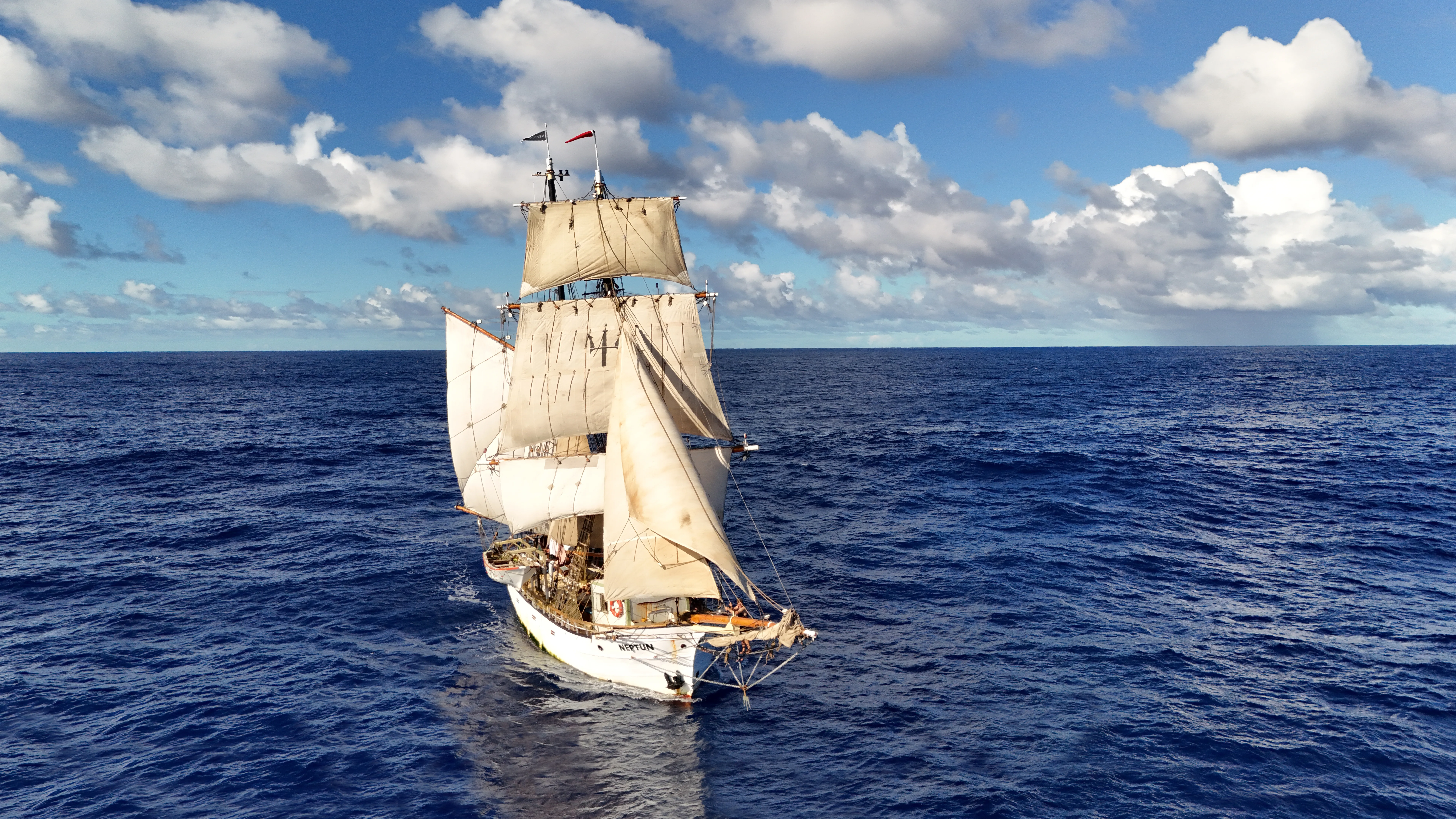
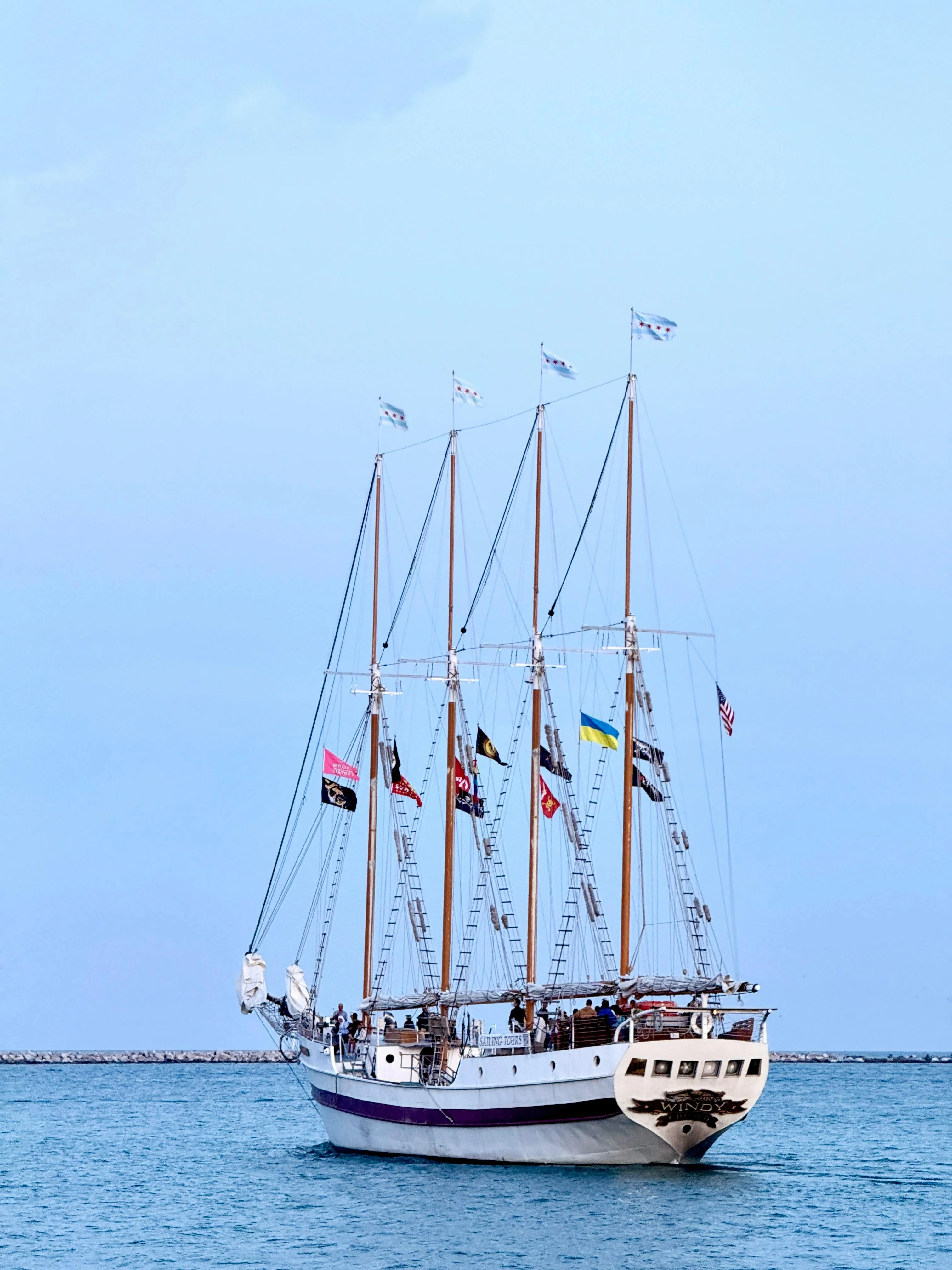
At midnight in the middle of the Indian Ocean, a brigantine sails the same way it sails at noon, because five minutes before the hour, the next watch is already on deck. That is the entire premise of watch system sailing: the sea never stops, the ship cannot stop, and so the crew divides into rotating teams that carry the vessel through every hour of every day. This article compares the common patterns (3/3, 4/4, 4/8, Swedish), explains why a tall ship runs three watches instead of two, and shows what 4-on/8-off actually feels like. If a watch diagram is what you came for, it lives in Section 7. If you are curious enough to try it yourself, you can apply for a berth before you finish reading, the rest of this post is for the people who want to understand why.
Curious about the legs where you could stand these watches yourself? The full 2026-2027 itinerary is live, browse the nine legs and pick the one that fits your dates. That is where theory becomes a Tuesday at sea.
On this page
- Why a ship must keep a 24-hour watch
- The common watch systems, compared
- Why a tall ship uses three watches, not two
- A 24-hour schedule on a brigantine
- What 4-on / 8-off actually feels like
- The STCW rest-hour rules
- FAQ
- Read also
Why a ship must keep a 24-hour watch
Wind shifts do not wait. A squall line on the radar, an AIS target closing at a combined 30 knots, a fix that needs taking, a sheet that has chafed, none of these events respect bedtime. A coastal motorboat can anchor at sunset and sleep through the night; an ocean-passage sailing vessel cannot. The ship is always in motion, and that motion has to be supervised by someone awake, dressed, and on deck.
The word "watch" does two jobs in maritime English. It names a period of time (the four hours from 00:00 to 04:00 is the midwatch), and it names the team of people standing that period (the midwatch also refers to the three or four sailors on deck). Both meanings matter, because the fundamental knob you turn when designing a rotation is the ratio between the two: how many hours each sailor is on, and how many teams you split the crew into to cover twenty-four hours. That ratio determines life onboard more than almost any other single decision.
The numbers behind a 24-hour watch
The common watch systems, compared
Four patterns dominate ocean sailing. Each solves the coverage problem differently, and each makes a different trade-off between crew size, sleep quality, and operational tempo.
4-on / 4-off (two-watch)
The classic short-handed yacht and merchant-marine pattern. Crew splits into port and starboard watches, each standing twelve hours on deck per day in four-hour blocks. Works when the crew is small (two to six) and the passage is short. Drawback: sleep periods are short, and without dog watches you are stuck on the same hours night after night.
4-on / 4-off with dog watches
The traditional Royal Navy rotation. Five four-hour watches plus two two-hour dog watches (16:00–18:00 and 18:00–20:00). The dog watches produce an odd number of periods per day, which rotates the crew so no single team is trapped on the midwatch forever. Still used on many merchant ships for officer rotation.
Three-watch (4-on / 8-off)
Crew splits into three teams, commonly Red, White, and Blue, or named after ports or watch leaders. Each watch stands four hours on deck, then has eight hours off before its next turn. Gives a rested crew with meaningful sleep. Standard on sail-training vessels, larger naval ships, and any tall ship with ten or more trainees.
Swedish watch system
A 6-6-4-4-4 rotation with longer daytime watches and shorter night watches. Used on offshore racing boats and some delivery crews where performance during daylight matters more than equal sleep. Not used on tall ships, the equality of the three-watch is preferred over racing-optimised asymmetry.
| System | Watches / 24h | Hours on | Hours off | Typical crew | Typical use |
|---|---|---|---|---|---|
| 4-on / 4-off | 6 | 12 | 12 | 2–6 | Short-handed yacht, short passage |
| 4-on / 4-off + dog watches | 7 | 12 | 12 | 6–20 | Merchant / navy watch-officer rotation |
| Three-watch (4/8) | 6 | 8 | 16 | 10+ | Tall ships, sail training, larger navies |
| Swedish | 5 | ~10 | ~14 | 4–8 | Offshore racing, delivery crews |
Nine legs, 2026-2027
See which leg suits your schedule
Every leg is sailed under a three-watch rotation. Pick dates and a route, the rest is learning by doing.
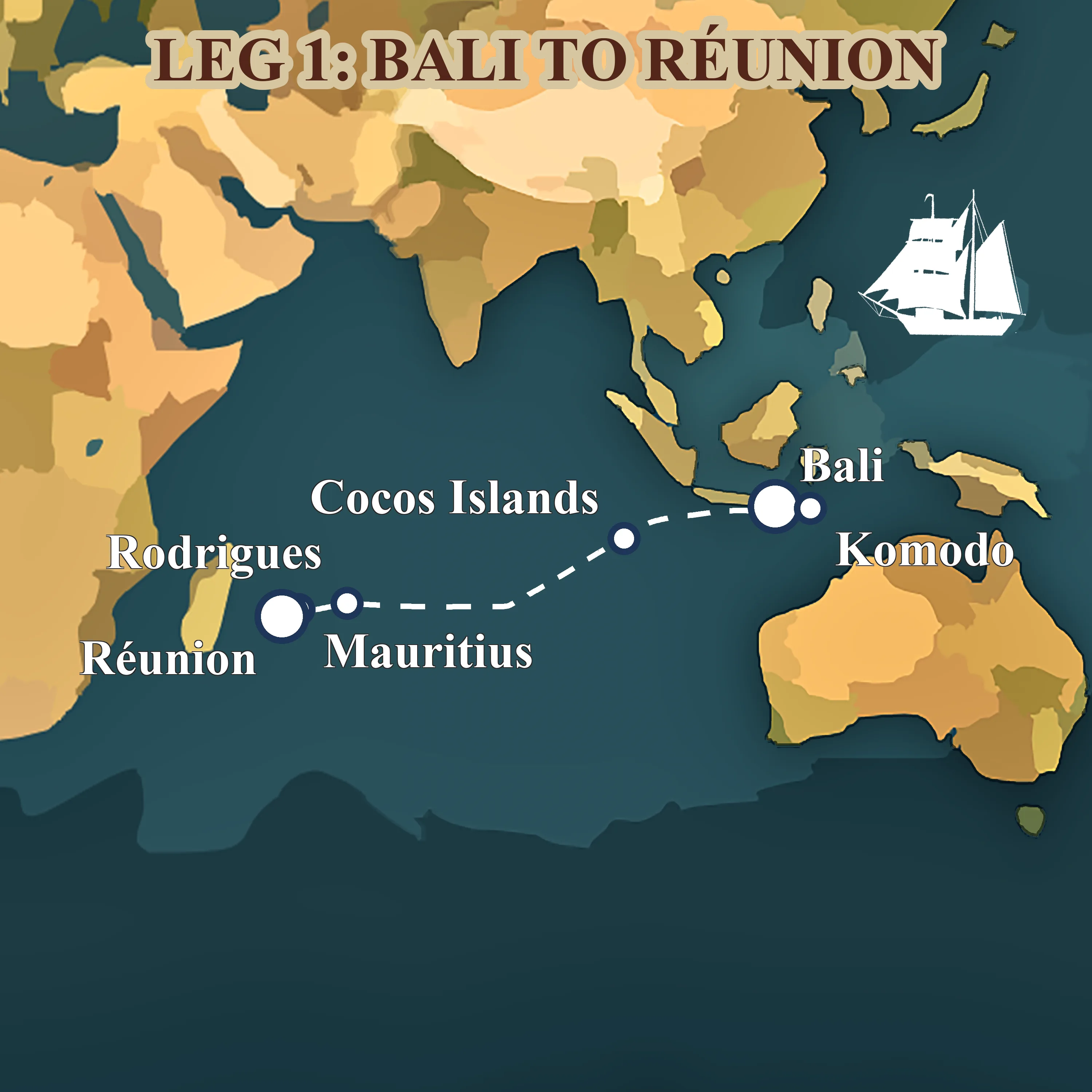
Leg 1: from Bali to Réunion across the Indian Ocean
May 2026 — Aug 2026 · Bali, Indonesia → Réunion, France
The opening chapter of Neptun's 482-day world voyage, a 4,078-nm trade-wind passage from the temples of Bali to the volcanic cliffs of Réunion.
Read more about this leg → about Leg 1: from Bali to Réunion across the Indian Ocean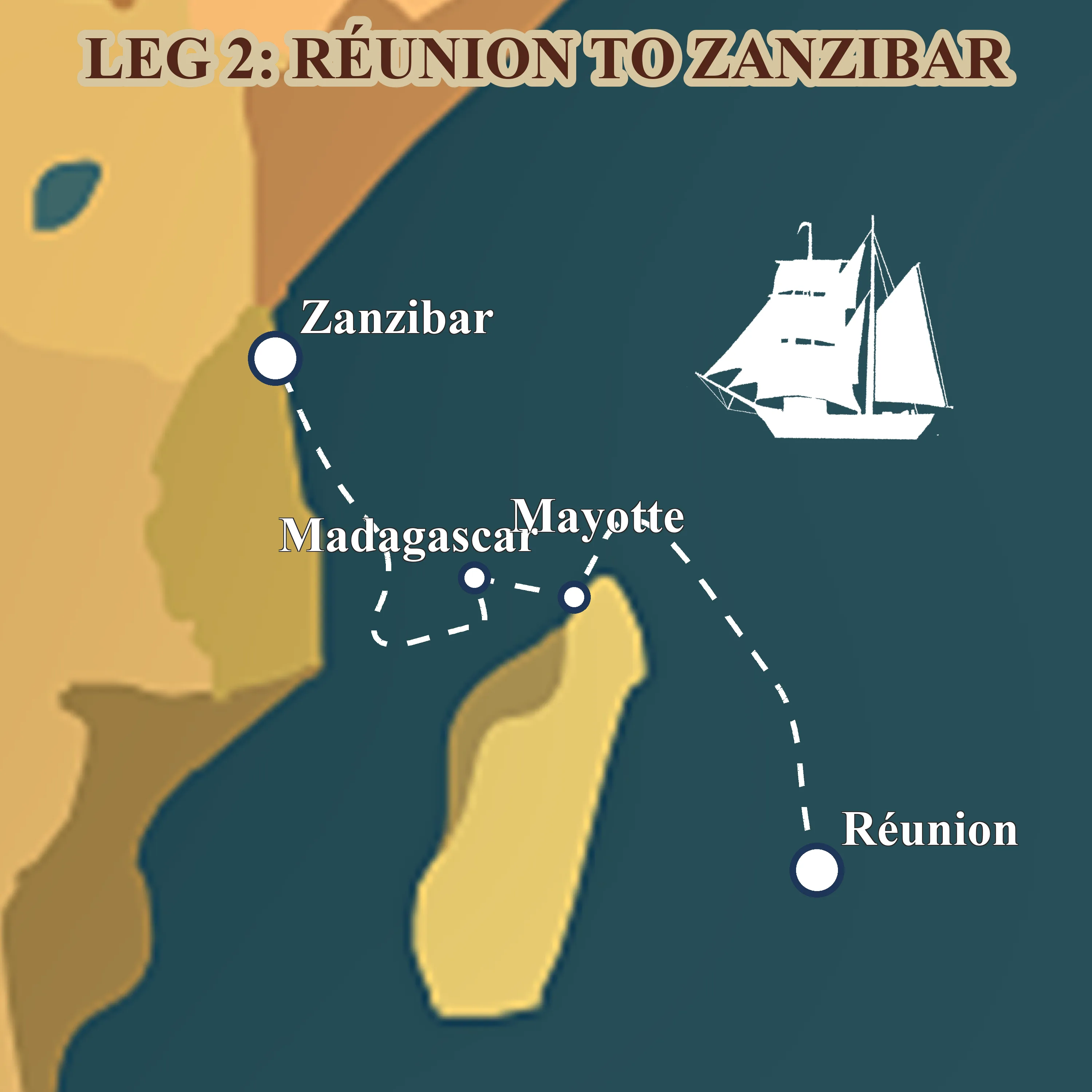
Leg 2: from Réunion to Zanzibar via Madagascar
Aug 2026 — Sept 2026 · Réunion, France → Zanzibar, Tanzania
Forty days across the western Indian Ocean, volcanic Réunion, lemur-haunted Nosy Be, the Mozambique Channel, and the spice-scented stone alleys of Zanzibar.
Read more about this leg → about Leg 2: from Réunion to Zanzibar via Madagascar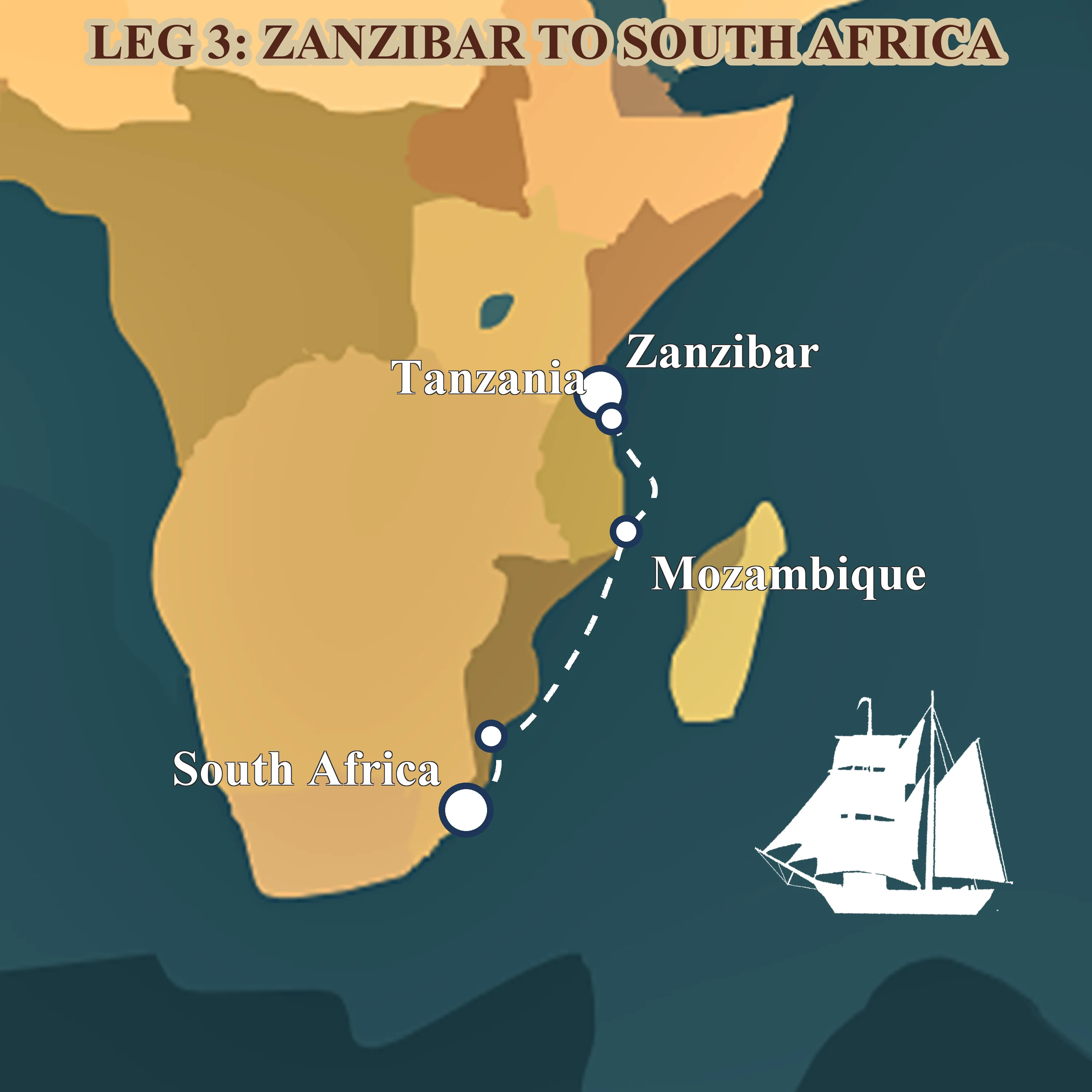
Leg 3: from Zanzibar to Durban down the Mozambique Channel
Sept 2026 — Nov 2026 · Zanzibar, Tanzania → Durban, South Africa
Sixty-three days coasting the African shore, spice islands, mangrove anchorages, Portuguese praças and the long trade-wind run down the Mozambique Channel to Durban.
Read more about this leg → about Leg 3: from Zanzibar to Durban down the Mozambique Channel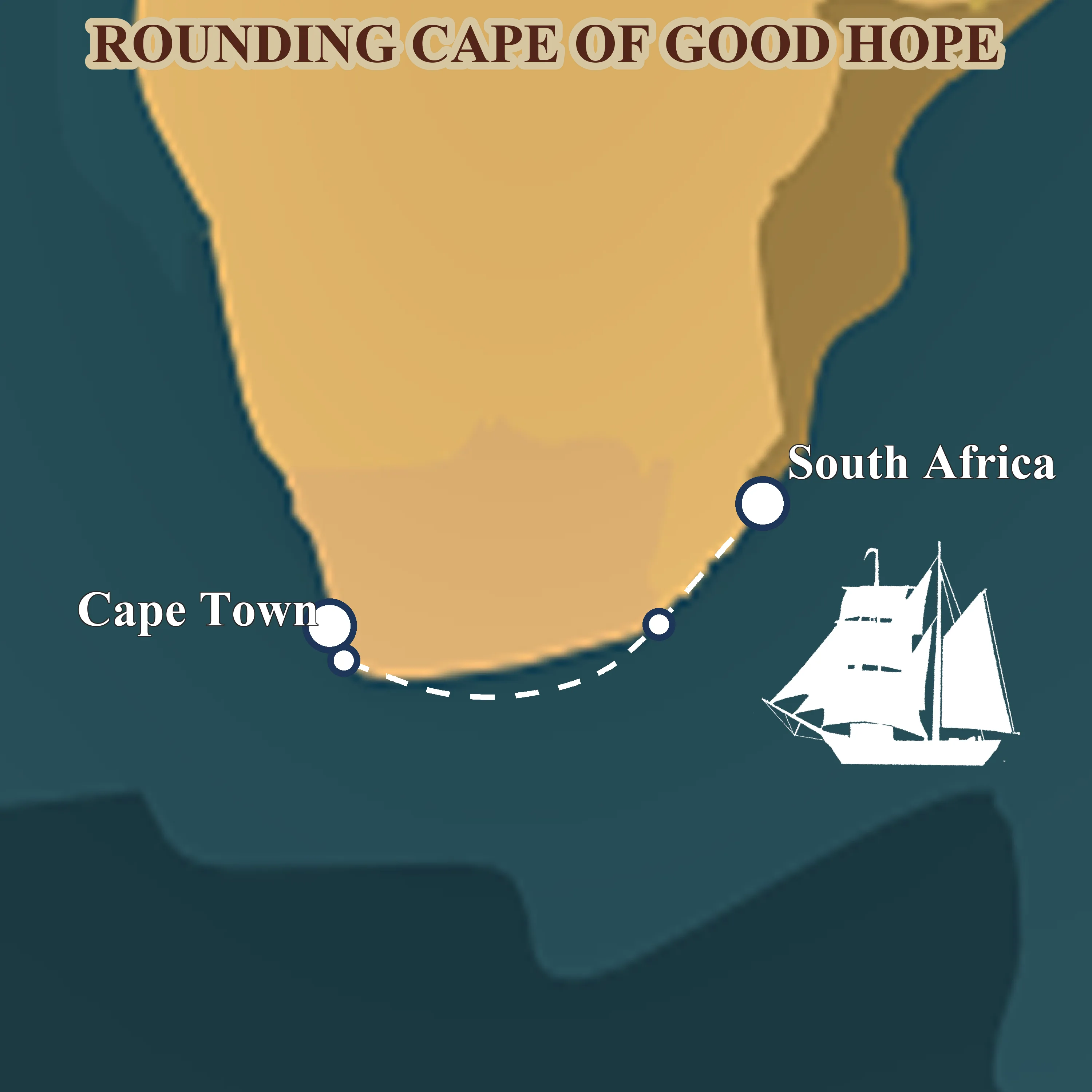
Leg 4: from Durban around the Cape of Good Hope
Nov 2026 — Dec 2026 · Durban, South Africa → Cape Town, South Africa
Thirty-eight days of serious seamanship, the Agulhas current, the Cape of Good Hope and the Southern Ocean at the tip of Africa, finishing quietly in Cape Town for Christmas.
Read more about this leg → about Leg 4: from Durban around the Cape of Good Hope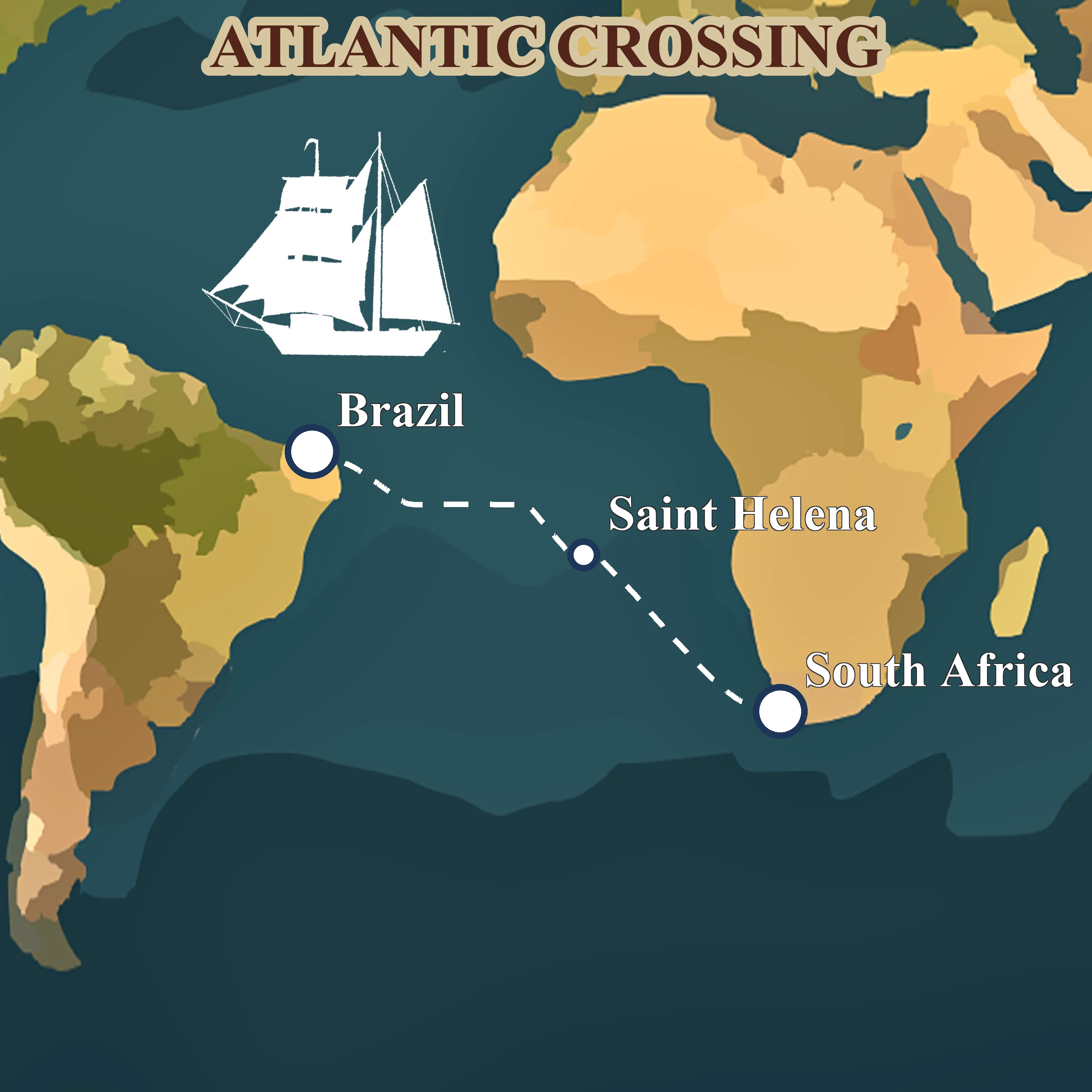
Leg 5: across the South Atlantic from Saldanha to Fortaleza
Jan 2027 — Mar 2027 · Saldanha Bay, South Africa → Fortaleza, Brazil
Forty-four days before the southeast trades, Napoleon's exile at St. Helena, the equator crossing, and landfall in tropical Brazil. The ocean chapter of the voyage.
Read more about this leg → about Leg 5: across the South Atlantic from Saldanha to Fortaleza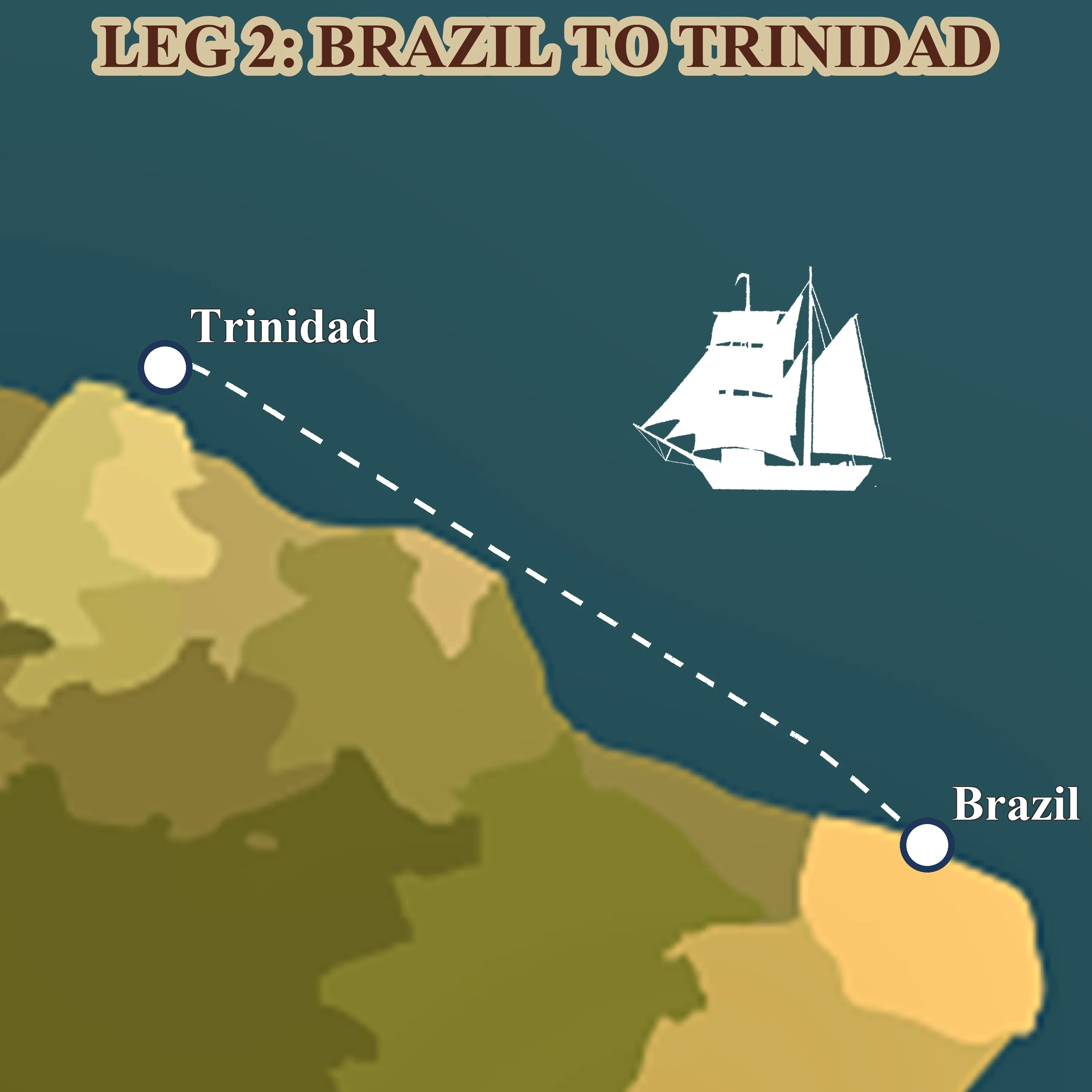
Leg 6: from Fortaleza to Trinidad along South America
Mar 2027 — Apr 2027 · Fortaleza, Brazil → Trinidad
A thousand miles of downwind trade running, the Amazon's brown water under the hull, the Guianas smudged on the horizon, and Trinidad's steelpan waiting at the end.
Read more about this leg → about Leg 6: from Fortaleza to Trinidad along South America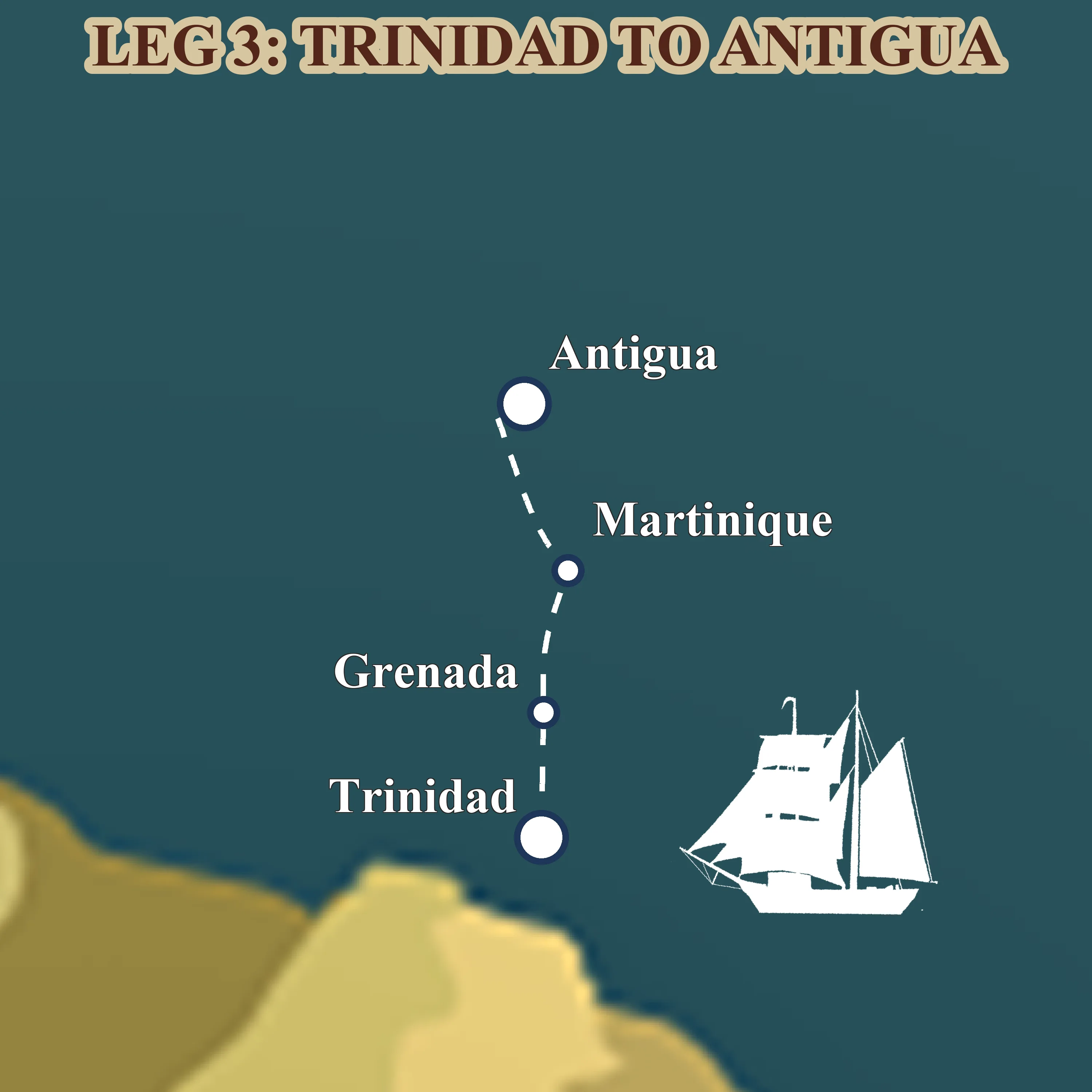
Leg 7: through the Windward Islands from Trinidad to Antigua
Apr 2027 — May 2027 · Trinidad → Antigua
Four weeks of short trade-wind daysails through the Lesser Antilles, turquoise anchorages, rum shops on the sand, French-Creole Martinique and the tall-ship scene in Antigua.
Read more about this leg → about Leg 7: through the Windward Islands from Trinidad to Antigua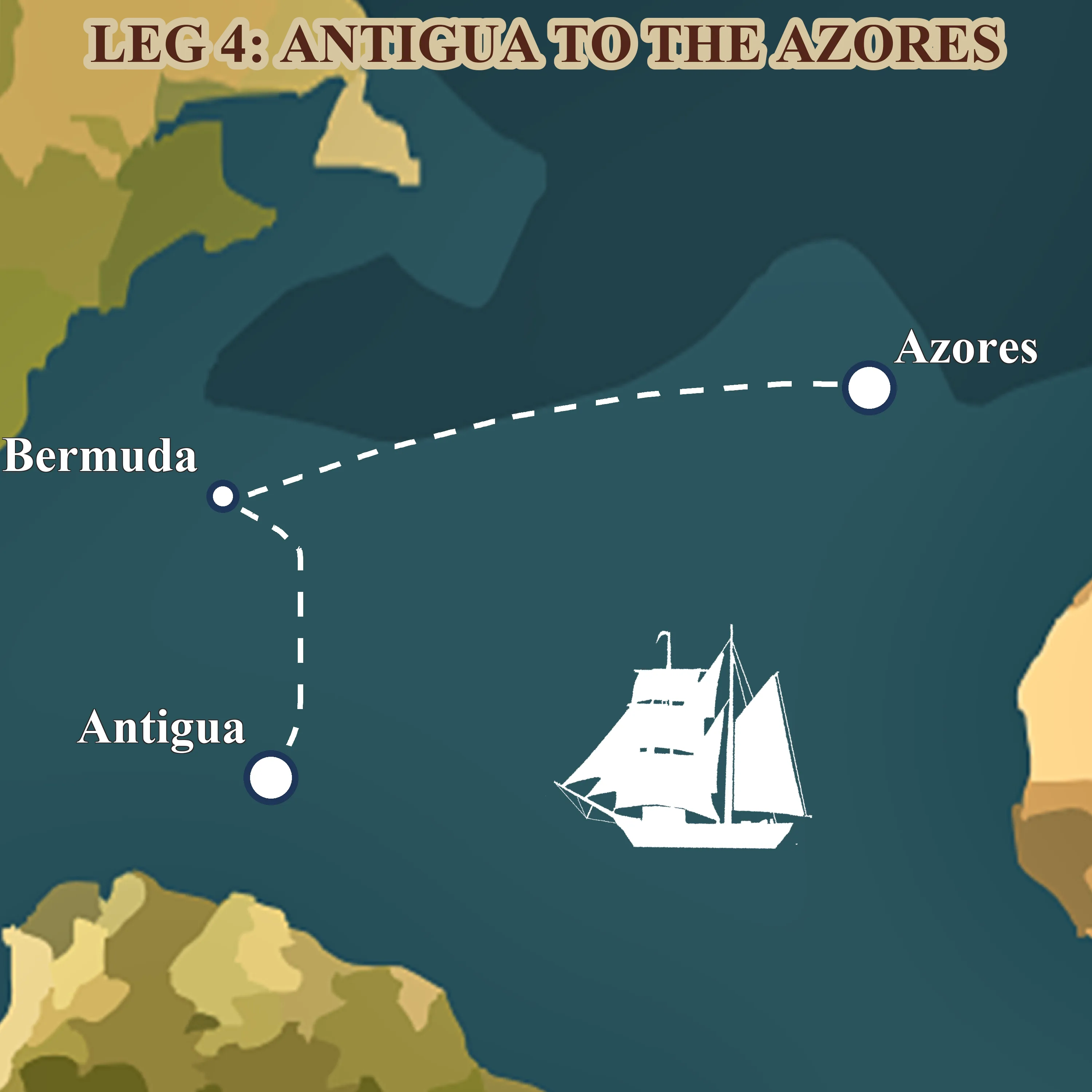
Leg 8: across the North Atlantic from Antigua to the Azores
May 2027 — Jul 2027 · Antigua → Ponta Delgada, Azores
Fifty-six days on the classic spring tall-ship route home, Antigua, a long reach to Bermuda's pink sand, then three weeks of open ocean to the volcanic Azores.
Read more about this leg → about Leg 8: across the North Atlantic from Antigua to the Azores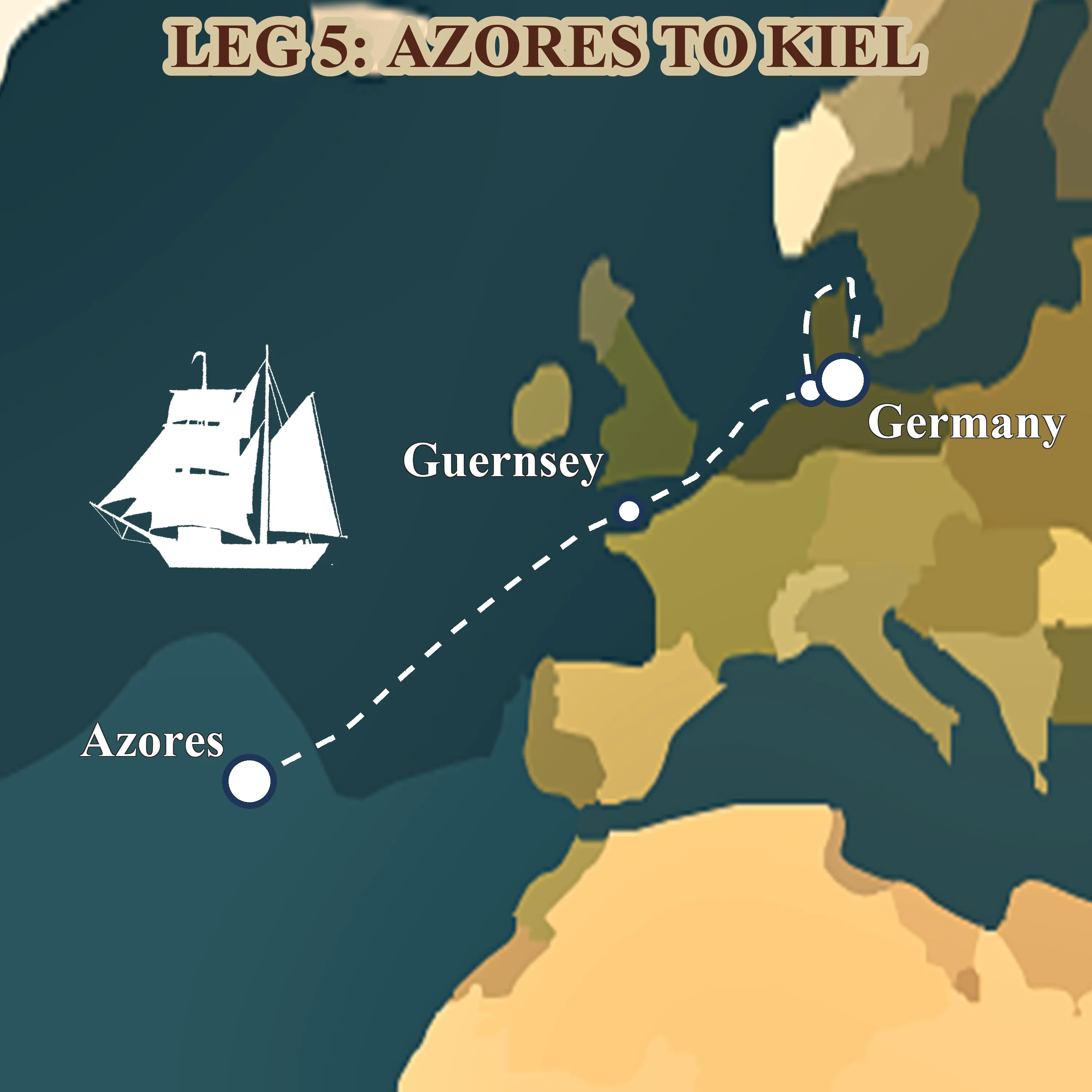
Leg 9: homecoming from the Azores to Kiel
Jul 2027 — Aug 2027 · Ponta Delgada, Azores → Kiel, Germany
The final 1,878 nm, from volcanic São Miguel to the Baltic, up the English Channel through the Dover TSS, past Helgoland's red cliffs and home to Kiel.
Read more about this leg → about Leg 9: homecoming from the Azores to KielWhy a tall ship uses three watches, not two
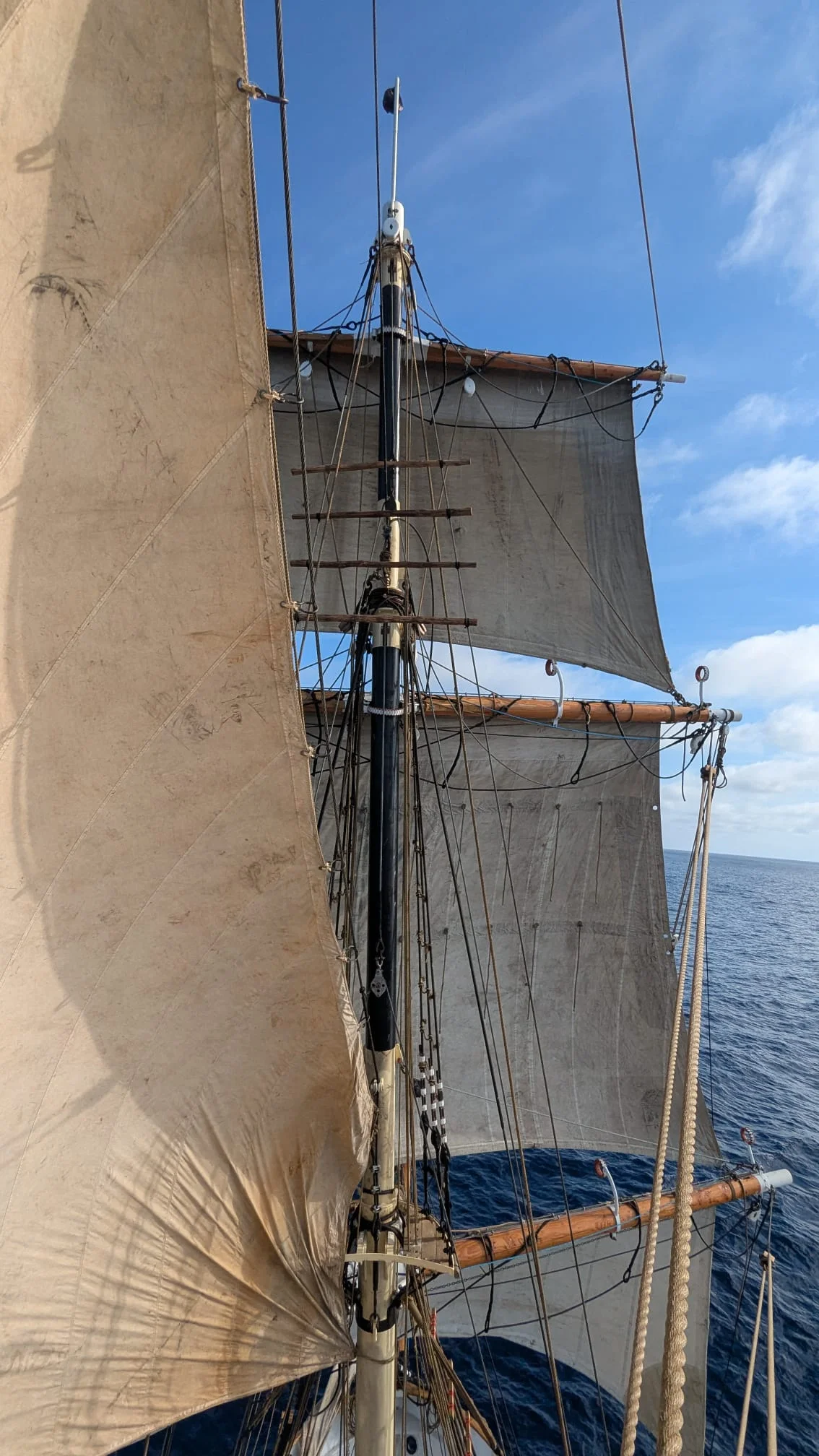
A tall ship carries more canvas and more people than a yacht, and square-sail handling at night, reefing topsails, bracing yards, taking in a jib, cannot be done by two people. It needs a team. That is the first reason the two-watch answer, which works fine for a cruising couple on a fortnight's passage, stops working once the rig has yards on it.
The second reason is arithmetic. With ten or more trainees plus permanent crew, you can actually staff three watches and still have enough hands on each for a real manoeuvre. A two-handed Atlantic crossing has no such option, there are only two people, so the rotation is forced into 4-on/4-off. A brigantine with fifteen people on board has room for a different answer.
The third reason is rest. A 4-on/8-off pattern leaves eight clear hours between watches; a 4-on/4-off pattern leaves four. In those extra four hours a trainee eats, sleeps, showers, repairs kit, and recovers. Over a long passage the difference compounds, fatigue is not linear, and a rested crew handles a 03:00 sail change safely where a tired crew makes mistakes. Fourth, redundancy: if one watch is pulled on deck for an all-hands manoeuvre, a tall ship with three watches still has a rested team waiting for the next rotation. Three watches is a safety feature, not a luxury.
On watch
The helm, where the watch is led
A three-watch rotation means there is always a rested team at the helm and a rested officer setting the course. Steering the ship is the quiet half of watch-keeping, course, sail trim, horizon, traffic, and a running conversation with the mate.
On watch
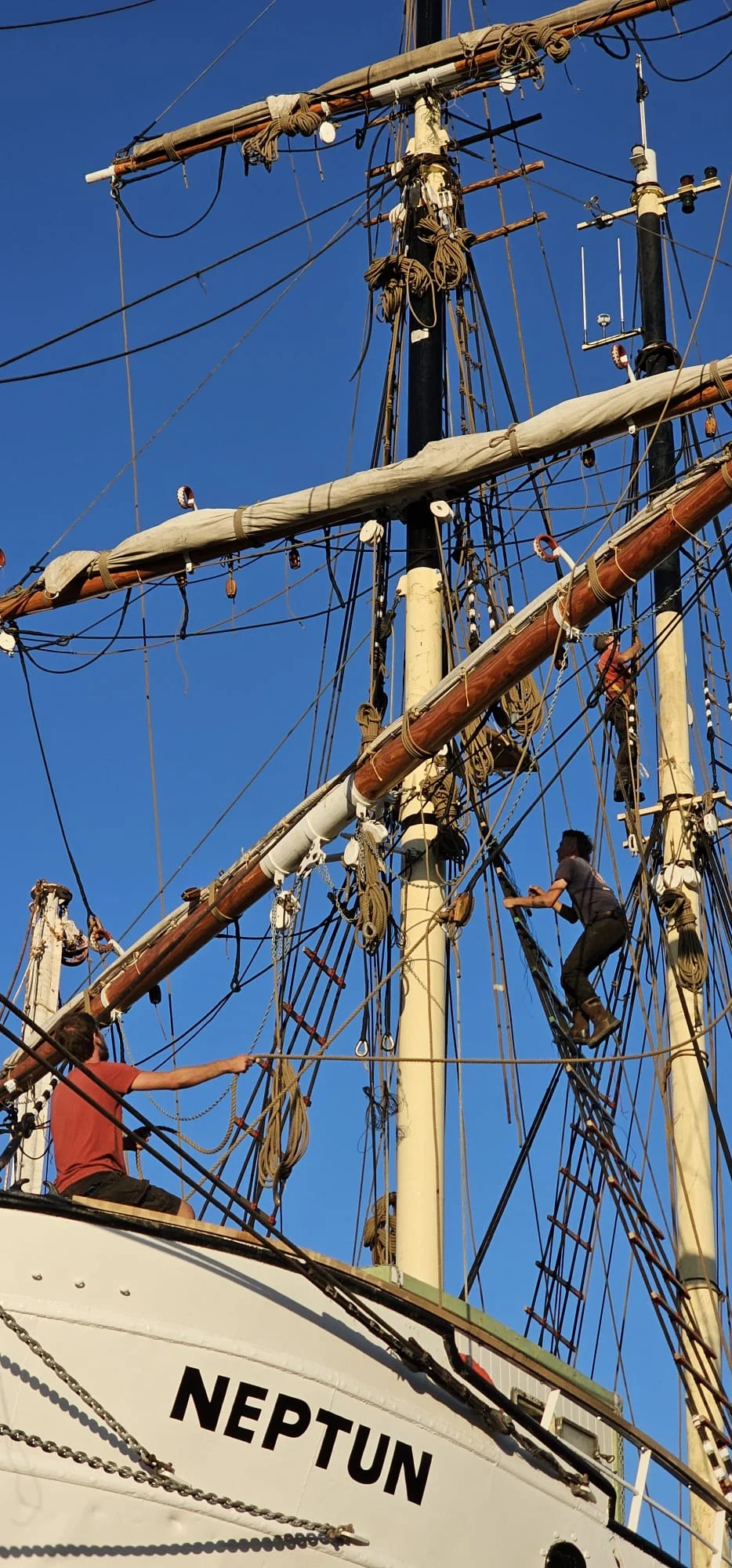
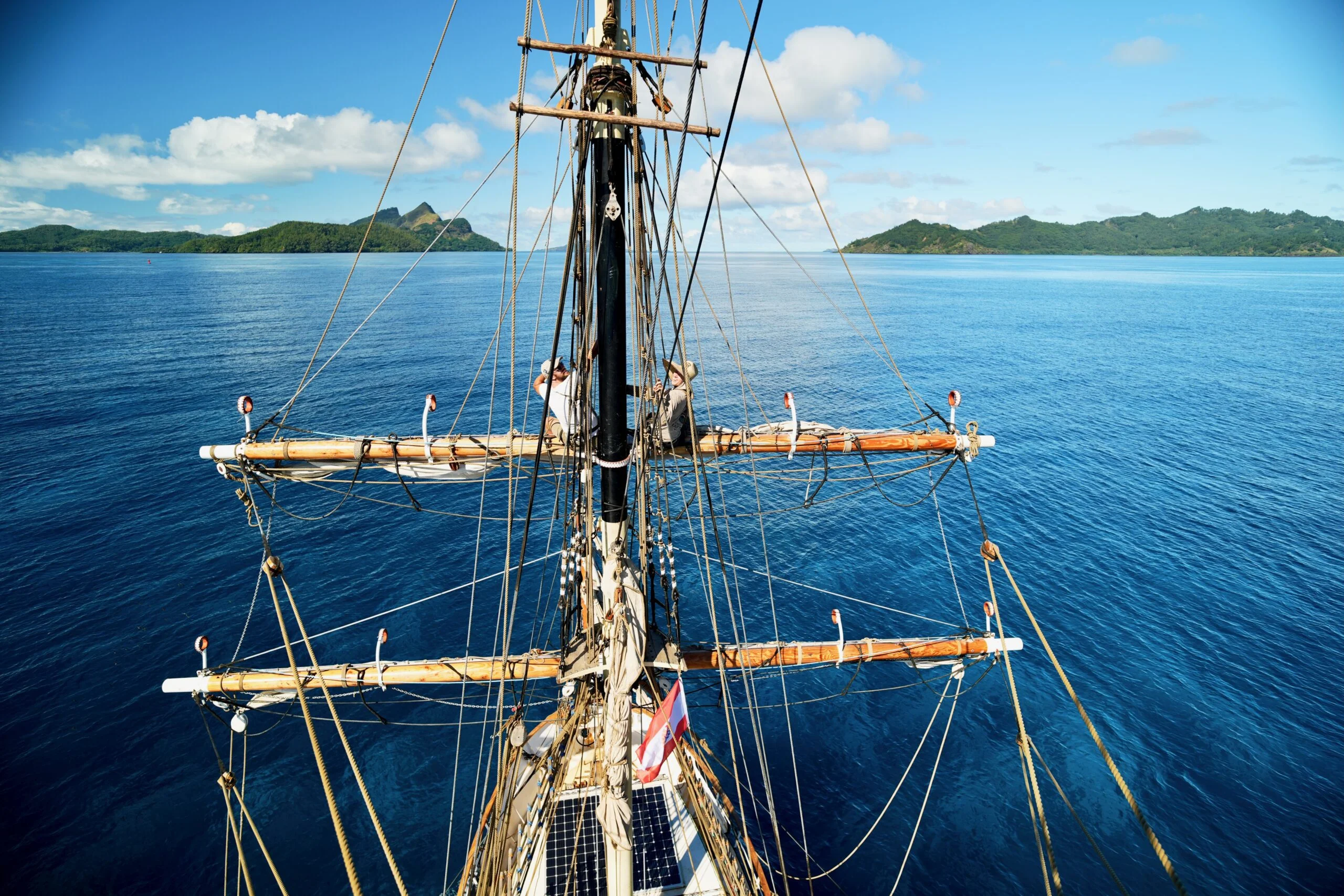
The foredeck, where the watch earns its coffee
When a squall line hits at 02:30, the foredeck is where the rig gets handled. Three watches means the team on deck is awake, fed, and fresh, and the off-going watch has actually slept. That is what the extra rotation buys you.
A 24-hour schedule on a brigantine
Walk through one day with Red, White, and Blue watch. At 00:00 Red is on deck, this is the midwatch, the quiet four hours where most of the ship is asleep and the off-watch lies in bunks listening to the hull. Red steers, checks the sails, logs a position every hour, and runs the 02:00 coffee. At 04:00 White comes up. The 10-minute handover is the glue of the whole system: the oncoming watch arrives early, receives the briefing (wind direction, last course change, sail set, traffic, anything expected in the next four hours), and the off-going watch leaves only once the new team has the ship. Red climbs below and sleeps.
White stands 04:00 to 08:00, dawn watch, which most trainees learn to love. The light changes for forty-five minutes; the galley wakes up; breakfast is rigged. At 08:00 Blue takes the deck. Blue works morning watch through 12:00, which usually means a sail change if the wind has shifted overnight and a long spell of trimming through the first thermal gusts. Red, having slept from roughly 05:00 to 11:00, is now up again, fed, and handling ship's work: rigging inspection, sail repair, galley duty, a turn learning to take a sight. Red takes the afternoon watch at 12:00, standing until 16:00.
White comes up at 16:00 for the first evening watch, and hands to Blue at 20:00, the second evening watch, which runs to 00:00 and closes the loop back to Red's midwatch. Each watch has stood exactly eight hours, in two four-hour blocks twelve hours apart. The ship has not been alone for a single minute.
Bells still mark the half-hours on many tall ships: one bell at the first half-hour of a watch, two bells at the hour, and so on up to eight bells, which signals the end of the watch. Readers who grew up on Patrick O'Brian will recognise the rhythm. The rest of the rig, parts of a tall ship, has vocabulary of its own. If this is the rotation you want to stand, the simplest route is to join our 2026 world voyage.
00:00, Red watch on deck
Midwatch. Quiet ship, log a position, check lights and AIS.
04:00, White watch on deck
Dawn handover. The light turns on over forty-five minutes.
08:00, Blue watch on deck
Morning watch. Sail trim, ship's work begins below.
12:00, Red watch on deck
Afternoon watch. Usually the hottest four hours.
16:00, White watch on deck
First evening watch. Wind often steadies; sunset prep.
20:00, Blue watch on deck
Second evening watch. Stars come out; last hot meal served.
00:00, Red watch on deck (again)
Cycle repeats. Each watch has stood 8 hours in 24.

What 4-on / 8-off actually feels like
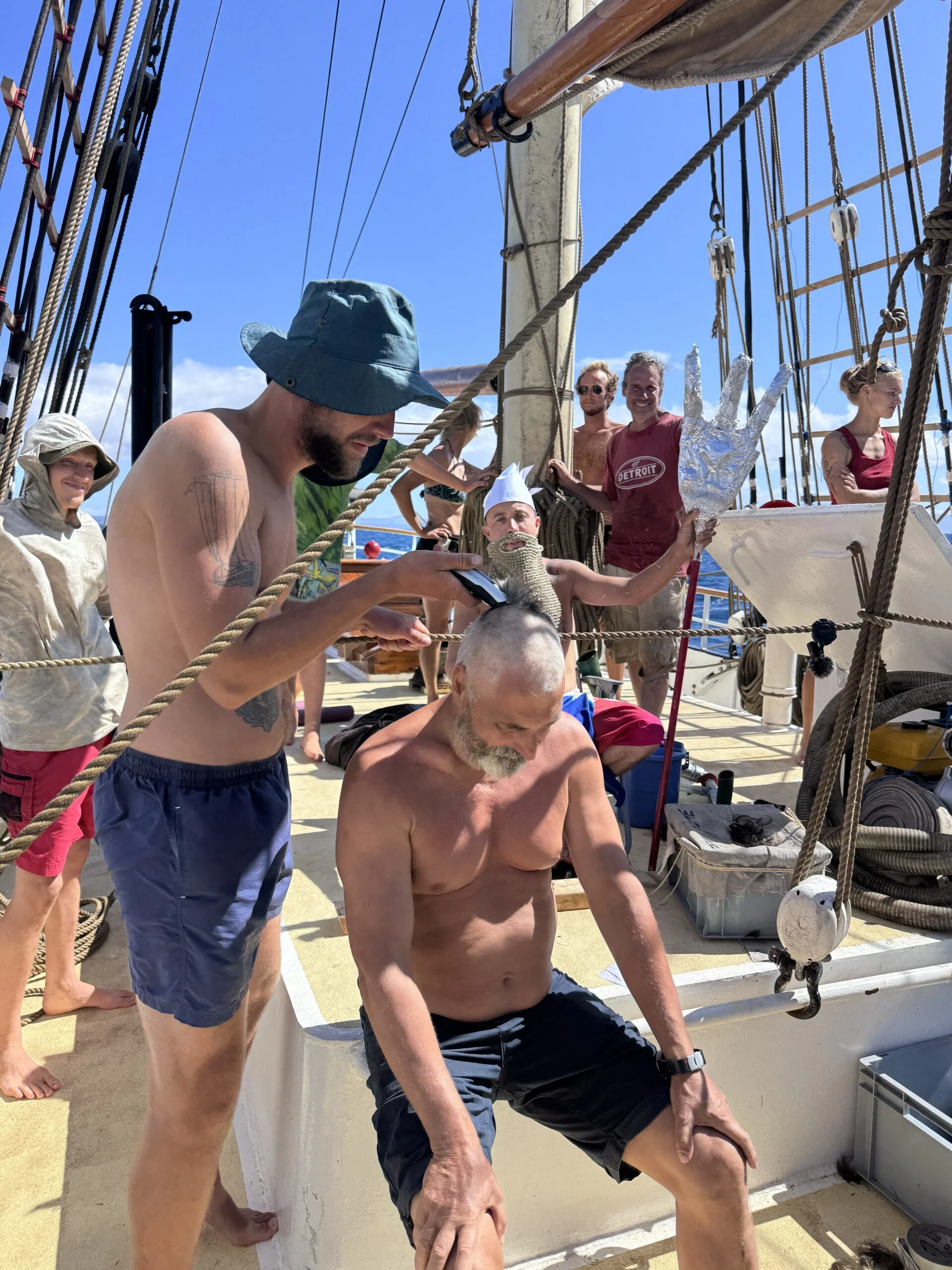
The first forty-eight hours are the hardest. Meals arrive at odd times. Sleep is uneven. The body does not yet believe that 05:00 is bedtime and 13:00 is normal. By day three or four most trainees report that sleep locks onto the new rhythm, twenty minutes before a watch they wake before being called; off-watch they can sleep through meals, through a squall, through shipmates laughing in the galley two metres away.
The eight hours off is not eight hours of sleep. It is food, laundry, a turn in the galley, sail repair, reading, sometimes the full rig-climb on a calm afternoon. Trainees typically land on about six to six and a half hours of actual sleep in two shifts, usually one longer block of four to five hours and one shorter block of ninety minutes. It works. Bodies are more flexible than most people expect.
The hardest watch is subjective. Some crew find the 00:00–04:00 midwatch restorative, empty sea, empty deck, the ship sliding through black water. Others hate it and spend the whole four hours counting down to the dawn handover. By the end of a long leg, most of the crew have strong opinions about which watch they want and which they do not. Interestingly, the rhythm of watch-keeping also helps with seasickness on a long passage: the body gets something predictable to hang on to, and sea-motion tolerance noticeably improves after a few days on the rotation.
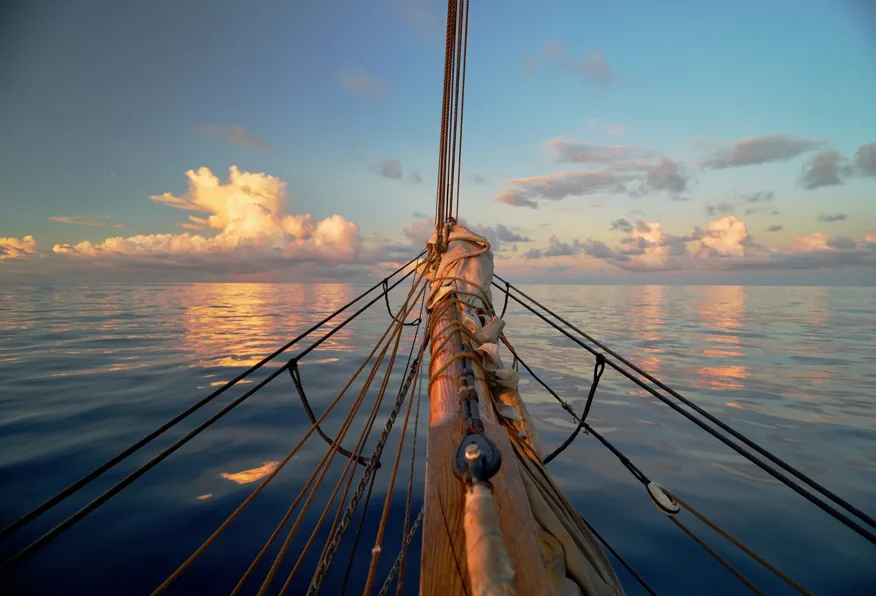
The quiet of a night watch is not emptiness, it is the ship listening.
The STCW rest-hour rules
A professional ship cannot simply run whatever schedule it feels like. The STCW Convention, Standards of Training, Certification and Watchkeeping for Seafarers, sets rest minimums for anyone with watch duties. Three numbers do most of the work. A seafarer must have a minimum of 10 hours rest in any 24-hour period, which can be divided into no more than two blocks, one of which must be at least 6 hours continuous. Over any 7-day period, the minimum is 77 hours of rest.
That 77-hour number is the one most often cited, and it is worth knowing that it was raised from 70 hours in the 2010 Manila amendments, a deliberate tightening after a series of fatigue-related groundings. Commercial ships now keep daily rest logs to prove compliance, and port-state inspectors can ask to see them. A brigantine running a three-watch system clears these numbers comfortably: 8 hours on and 16 hours off translates to 16 hours rest per 24 and 112 hours rest per 7 days, well above the floor. A two-handed yacht on the same passage, running 4-on/4-off, is sitting almost exactly on the STCW minimum with no weather margin. That is one reason the two categories of vessel are regulated differently, and one reason tall ships train the way they do. For a good practical summary of how working sailors actually think about watch-keeping in practice, see this overview of watch-keeping at sea.


2026 & 2027 legs
Pick a leg and join a real watch
Every leg in 2026 and 2027 runs the three-watch rotation described above. Sign up for one and stand it yourself.
Leg 1: from Bali to Réunion across the Indian Ocean
May 2026 — Aug 2026 · Bali, Indonesia → Réunion, France
The opening chapter of Neptun's 482-day world voyage, a 4,078-nm trade-wind passage from the temples of Bali to the volcanic cliffs of Réunion.
Read more about this leg → about Leg 1: from Bali to Réunion across the Indian OceanLeg 2: from Réunion to Zanzibar via Madagascar
Aug 2026 — Sept 2026 · Réunion, France → Zanzibar, Tanzania
Forty days across the western Indian Ocean, volcanic Réunion, lemur-haunted Nosy Be, the Mozambique Channel, and the spice-scented stone alleys of Zanzibar.
Read more about this leg → about Leg 2: from Réunion to Zanzibar via MadagascarLeg 3: from Zanzibar to Durban down the Mozambique Channel
Sept 2026 — Nov 2026 · Zanzibar, Tanzania → Durban, South Africa
Sixty-three days coasting the African shore, spice islands, mangrove anchorages, Portuguese praças and the long trade-wind run down the Mozambique Channel to Durban.
Read more about this leg → about Leg 3: from Zanzibar to Durban down the Mozambique ChannelLeg 4: from Durban around the Cape of Good Hope
Nov 2026 — Dec 2026 · Durban, South Africa → Cape Town, South Africa
Thirty-eight days of serious seamanship, the Agulhas current, the Cape of Good Hope and the Southern Ocean at the tip of Africa, finishing quietly in Cape Town for Christmas.
Read more about this leg → about Leg 4: from Durban around the Cape of Good HopeLeg 5: across the South Atlantic from Saldanha to Fortaleza
Jan 2027 — Mar 2027 · Saldanha Bay, South Africa → Fortaleza, Brazil
Forty-four days before the southeast trades, Napoleon's exile at St. Helena, the equator crossing, and landfall in tropical Brazil. The ocean chapter of the voyage.
Read more about this leg → about Leg 5: across the South Atlantic from Saldanha to FortalezaLeg 6: from Fortaleza to Trinidad along South America
Mar 2027 — Apr 2027 · Fortaleza, Brazil → Trinidad
A thousand miles of downwind trade running, the Amazon's brown water under the hull, the Guianas smudged on the horizon, and Trinidad's steelpan waiting at the end.
Read more about this leg → about Leg 6: from Fortaleza to Trinidad along South AmericaLeg 7: through the Windward Islands from Trinidad to Antigua
Apr 2027 — May 2027 · Trinidad → Antigua
Four weeks of short trade-wind daysails through the Lesser Antilles, turquoise anchorages, rum shops on the sand, French-Creole Martinique and the tall-ship scene in Antigua.
Read more about this leg → about Leg 7: through the Windward Islands from Trinidad to AntiguaLeg 8: across the North Atlantic from Antigua to the Azores
May 2027 — Jul 2027 · Antigua → Ponta Delgada, Azores
Fifty-six days on the classic spring tall-ship route home, Antigua, a long reach to Bermuda's pink sand, then three weeks of open ocean to the volcanic Azores.
Read more about this leg → about Leg 8: across the North Atlantic from Antigua to the AzoresLeg 9: homecoming from the Azores to Kiel
Jul 2027 — Aug 2027 · Ponta Delgada, Azores → Kiel, Germany
The final 1,878 nm, from volcanic São Miguel to the Baltic, up the English Channel through the Dover TSS, past Helgoland's red cliffs and home to Kiel.
Read more about this leg → about Leg 9: homecoming from the Azores to KielFAQ
What is a watch system in sailing?
A rotation schedule that divides the crew into teams so the ship is safely sailed 24 hours a day. The word "watch" means both a period of time and the group of people standing it. The two most common systems at sea are the two-watch (port/starboard, 4-on/4-off) and the three-watch (4-on/8-off) rotation used on most tall ships and sail training programmes.
Why do ships use a three-watch system instead of two?
Three watches means each sailor stands eight hours on deck per day instead of twelve, with eight hours off between watches instead of four. That produces real sleep, makes night sail changes safer, and leaves a rested reserve team for emergencies. It is only possible once the crew is large enough to staff three teams, which is why tall ships use it and short-handed yachts cannot.
What is 4-on / 8-off in sailing?
Four hours on watch, eight hours off, repeated three times in 24 hours. It is the standard rotation on sail-training tall ships. Some larger naval vessels use a 3-on / 9-off variant for even more rest. If you want to try one, joining a tall ship crew is the straight route.
How do sailors sleep on long passages?
In short shifts aligned with the watch rotation. Most trainees take 48 to 72 hours to adjust, then lock on to about 6 to 6.5 hours of actual sleep in two blocks per day. The off-watch is not pure sleep, it includes meals, maintenance, laundry, and ship community, but bodies adapt more quickly than most people expect.
What is a dog watch and why does it exist?
Two two-hour periods, 16:00–18:00 and 18:00–20:00, that split a normal four-hour slot. The point is arithmetic: they create an odd number of watches per day, which rotates the crew so no single team is stuck on the midwatch every night. The pattern dates to the Royal Navy and is still used in officer rotations on many merchant ships.
What does STCW require for rest hours at sea?
A minimum of 10 hours rest in any 24-hour period (in at most two blocks, one of which must be 6 hours continuous), and a minimum of 77 hours rest per 7-day period. The weekly minimum was raised from 70 to 77 hours in the 2010 Manila amendments. A three-watch tall-ship rotation sits well above these numbers; a two-handed yacht running 4-on/4-off sits almost exactly on them.
Read also
- Learn traditional seamanship, the wider skill set the watch sits inside.
- Parts of a tall ship, vocabulary for the bells, the helm, and the rig.
- How to join a tall ship crew, from curiosity to a signed berth.
- Seasickness on a long passage, why the rhythm of the rotation helps your body settle.
- Life onboard, what the 16 hours off actually looks like.
- The 2026 world voyage, nine legs, all running the three-watch rotation.
Want to sail with us?
Brigantine NEPTUN is a non-profit training ship, every voyage takes 10 crew members through real ocean sailing, no experience needed.