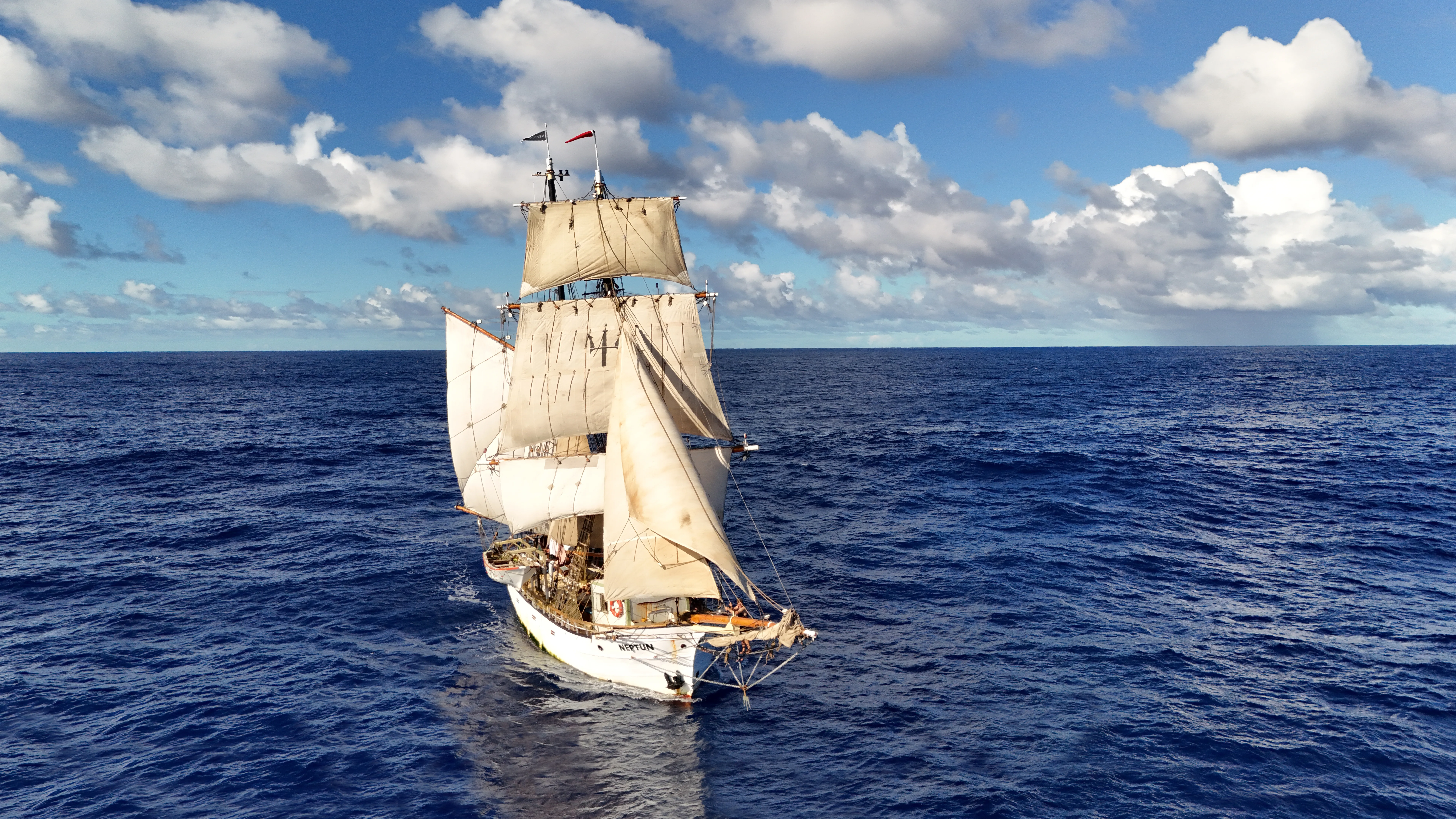
The georg stage training ship is a 54-metre, three-masted, full-rigged ship that has carried Danish teenagers to sea every summer for more than ninety years, and it is the second ship to do so under that name. The first Georg Stage, built in Copenhagen in 1882, served until 1934, when she was sold to the Australian sailor and writer Alan Villiers, renamed Joseph Conrad, sailed around the world, and ended up where she still sits today: alongside the dock at Mystic Seaport, Connecticut.
Two ships, one name, one purpose: teaching young people the sea on a square-rigged sailing ship. This article covers the story behind the name, what happened to the 1882 original, what the 1934 successor does today, and why a working Danish training ship matters to a non-profit brigantine like NEPTUN.
Want to sail a tall ship yourself?
Brigantine NEPTUN is the modern non-profit version of the same idea, a working square-rigger that teaches sailing to anyone willing to learn. Nine legs, 482 days, no experience required.
On this page
- The story behind the name
- Georg Stage I (1882–1934), the original, now Joseph Conrad
- Georg Stage II (1934–present), the current ship
- The cadet model: 80 teenagers, one summer
- The Foundation: Stiftelsen Georg Stages Minde
- Why this ship matters to NEPTUN
- How to see Georg Stage today
- FAQ
- Read also
The story behind the name
The ship is not named for a captain or a king. It is named for a young man who never went to sea.
Frederik Stage was a wealthy Copenhagen shipowner in the second half of the 1800s, the era when Danish merchant sail was at its peak. His son, Carl Frederik Georg Stage, died in 1880, age 22, of tuberculosis. Two years later, in 1882, Frederik and his wife Thea funded the construction of a small full-rigged ship to be used as a training vessel for Danish boys who wanted to go to sea. They named it after their son, and they wrote the founding deed of an independent foundation, Stiftelsen Georg Stages Minde (the Georg Stage Memorial Foundation), to operate the ship in perpetuity.
The Foundation has done exactly that for more than 140 years. Two ships have carried the name. The same charter has run them both. For a general reference and a list of dimensions, see the Wikipedia entry on Georg Stage.
Important: The story is sometimes mis-told as a drowning. It was not. Carl Frederik Georg Stage died on land, of an illness. The ship is a memorial in the Victorian sense, a charitable institution funded in his name to do something useful in the world.
Georg Stage I (1882–1934), the original, now Joseph Conrad
The first Georg Stage was built in Copenhagen and launched in 1882. She was small for a full-rigged ship, about 100 feet on deck, 118 feet sparred, and was deliberately designed at that scale so a deck full of boys could actually run her. She trained roughly 80 cadets at a time, on six-month courses in the Baltic and the North Sea, for the next half-century.
Two events from her career are worth remembering.
The first is the night of 25 June 1905, when she was run down in fog by the British steamship Ancona off the Danish coast and sank in minutes. Twenty-two cadets went down with her. The Foundation raised the wreck, repaired the ship, and put her back into service the following year, but the loss is the founding tragedy of organised Danish sail-training and is still commemorated.
The second is what happened to her in 1934, when the Foundation replaced her. She was about to be broken up. Instead, she was bought by Alan Villiers, Australian writer, photographer, and sail-training visionary, who flew the British flag, renamed her Joseph Conrad after the Polish-British novelist and former master mariner, and took her on a 58,000-mile circumnavigation lasting more than two years with a crew of green amateurs. That voyage, and Villiers' book The Cruise of the Conrad, helped launch the entire modern sail-training movement.
After Villiers, the ship sailed under three flags before being permanently moored at Mystic Seaport Museum in Connecticut on 9 July 1947, where she remains as a museum and shoreside training vessel. You can walk her decks today.
The lineage
From Copenhagen 1882 to Connecticut 1947
Georg Stage II (1934–present), the current ship
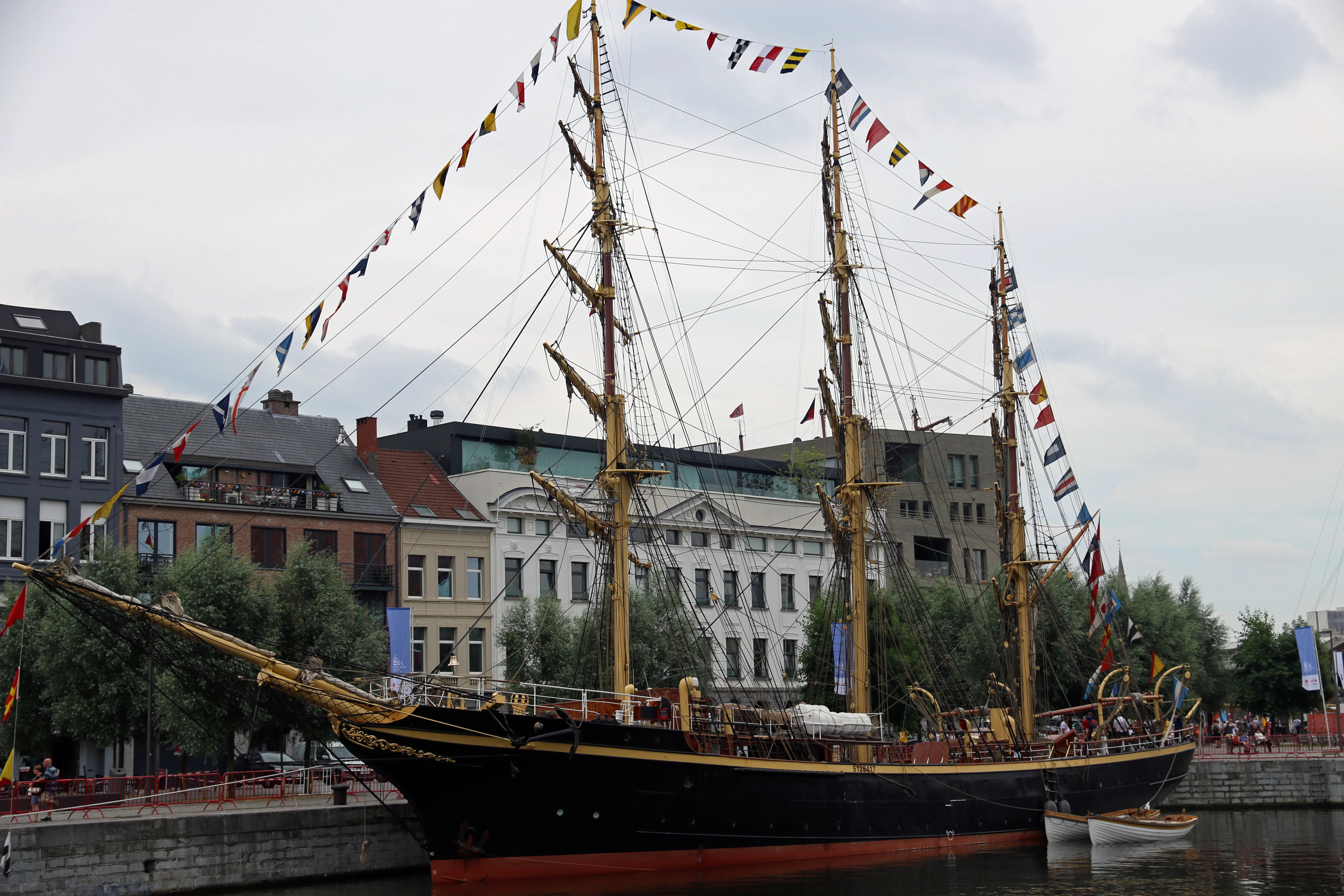
The ship most Danes today think of as Georg Stage is the second of that name. Built in five months in 1934 at Frederikshavn Værft og Flydedok in northern Jutland, she launched the same year the original was sold. Her first cadet voyage sailed on 24 April 1935.
She is built of steel, not iron, that is the obvious upgrade, and she is slightly larger than the 1882 ship, but her purpose is identical. She carries Danish teenagers, in batches, on summer cruises in the Baltic and the North Sea. Off-season she sits in Copenhagen at the Foundation's berth.
The rig is what makes her special. A full-rigged ship carries square sails on all three masts, fore, main, and mizzen. There are perhaps a dozen full-rigged sailing ships still working anywhere in the world; Georg Stage is one of them, and she is the smallest. The Danish merchant marine kept the type alive long after most countries had abandoned it, and the Foundation's commitment to the rig is part of why the ship matters internationally.
A Volvo Penta diesel of 368 kW (493 hp) was installed in 2007, for harbour manoeuvring, light-air motoring, and safety. Under sail in a working breeze she still does her training under canvas alone.
Voyages: where she goes
Most years Georg Stage runs three or four cadet cruises between April and September, mostly in Danish, Norwegian, Swedish, German, and British waters. The classic pattern is a Baltic loop in summer (Copenhagen → southern Sweden → German Baltic ports and back), interleaved with a North Sea leg to Norway, the Faroes, or the British Isles. Longer overseas voyages are rare but do happen, she made her first Atlantic crossing in 1989, and has appeared at Tall Ships Races events across northern Europe.
If you want to know what a "real" sail-training cruise looked like in the 1880s, this is approximately what one looks like in 2026, same waters, same rig, same idea. Read also: trade winds and the classic sailing routes.
The Danish training-ship tradition continues
Georg Stage trains 16-22-year-old Danish cadets. NEPTUN, a non-profit brigantine, extends the same idea to anyone, of any age, anywhere in the world. Same square rig, same hands-on standard, longer voyages.
The cadet model: 80 teenagers, one summer
The whole point of the ship is the cadet programme. The shape of it is impressive in its consistency, it has barely changed in structure since 1882.
Roughly 80 on board
A typical voyage carries about 63 cadets and 10 permanent crew. The ratio of trainees to professionals is intentionally high, the cadets run the ship.
Age 17.5 to 22
Cadets are mostly Danish 17- to 19-year-olds, many on a gap year, many heading into Danish merchant marine training afterwards. Females have been admitted since 1981.
Months at sea
Each cruise lasts several months between April and September. Cadets stand watches, climb the rig, work the deck, and learn the basics of seamanship under sail.
Baltic + North Sea
Most legs stay in Danish, Swedish, Norwegian, German, and occasionally British waters. Atlantic crossings happen, but rarely.
The ship is not a cruise. Cadets work. They steer, they reef, they polish brass, they cook, they keep watch in the small hours, and they go aloft. The Foundation's stated aim, first lesson in practical seamanship for young people who want to go to sea, is taken literally.
Where Georg Stage cadets end up
Many go on into the Danish merchant marine, the Foundation has formal links with Danish maritime training institutions, and a Georg Stage cruise counts toward the practical-training requirements for several Danish maritime certificates. Others go to the Royal Danish Navy. A meaningful minority decide they want nothing more to do with the sea ever again, which is also a useful thing to learn at 18.
That filtering function, find out, for sure, whether the sea is for you, before you commit a career to it, is what training ships have always been for.
The Foundation: Stiftelsen Georg Stages Minde
The ship is owned and operated by Stiftelsen Georg Stages Minde, the Georg Stage Memorial Foundation, an independent Danish foundation established in 1882. It is not a state-run vessel. It is not a private business. It is a charitable trust whose sole purpose is to keep a sailing training ship at sea for the benefit of Danish young people.
1880, Carl Frederik Georg Stage dies
The 22-year-old son of Copenhagen shipowner Frederik Stage dies of tuberculosis. The family begins planning a memorial in his name.
1882, Foundation established + Georg Stage I launched
Frederik and Thea Stage establish Stiftelsen Georg Stages Minde and fund the construction of a 100-foot full-rigged training ship in Copenhagen.
1905, The Ancona collision
Georg Stage I is run down by the British steamship Ancona in fog and sinks rapidly. 22 cadets are lost. The Foundation raises and repairs her; she returns to service in 1906.
1934, Sale to Alan Villiers + Georg Stage II launched
The original ship is retired and sold to Alan Villiers, who renames her Joseph Conrad. The same year, the Foundation commissions a new ship from Frederikshavn Værft og Flydedok.
1947, Joseph Conrad arrives at Mystic Seaport
After three flag changes and a circumnavigation under Villiers, the original Georg Stage is moored permanently at Mystic Seaport Museum in Connecticut, where she remains.
1981, Female cadets admitted
The Foundation amends its programme to admit female cadets, ending nearly a century of all-male crews.
2026, 144 years and counting
Georg Stage II continues the programme her predecessor began in 1882. Stiftelsen Georg Stages Minde still operates her under the original 1882 charter.
The Foundation is funded through a mix of fees, Danish state contributions, private donations, and voyage grants. It is, in structural terms, the model that organisations like Brigantine NEPTUN are built on: an independent charity that owns and runs a working sailing ship for an educational purpose. Different ship, different country, same legal shape. We have written about our own crew and organisation elsewhere.
Why this ship matters to NEPTUN
Georg Stage matters to anyone who cares about square-rigged sail-training, because she is one of the few continuous traditions left. Most of the great training ships of the late 1800s have been broken up, lost, or converted into floating restaurants. Georg Stage's foundation has, against the odds, kept doing the same thing for 144 years.
For NEPTUN specifically, the lineage is direct.
NEPTUN is a non-profit brigantine, two-masted, square-sailed on the foremast. She is smaller than Georg Stage and rigged differently, but the operating idea is the same: a working tall ship under a charitable foundation, carrying ordinary people through real ocean sailing as crew, not as passengers. We are the modern, international, age-blind cousin of the Georg Stage model.
There are differences. Georg Stage focuses on Danish 17- to 19-year-olds; NEPTUN takes anyone over 18 who is willing to commit to a leg, regardless of nationality or experience. Georg Stage's voyages stay mostly in northern European waters; NEPTUN is currently mid-circumnavigation on a 482-day world voyage. Georg Stage cadets pay a state-subsidised fee; NEPTUN crew pay a non-profit voyage contribution.
But the core is shared: a square-rigger, a foundation, a deckhand-led training programme, and a long view of what teaching the sea actually means. When we talk about Danish maritime tradition on board NEPTUN, Georg Stage is part of what we mean.
The Georg Stage tradition continues, sail with NEPTUN
All nine legs of NEPTUN's 2026–2027 circumnavigation. The square-rigger training-ship idea, extended from the Baltic to the rest of the world.
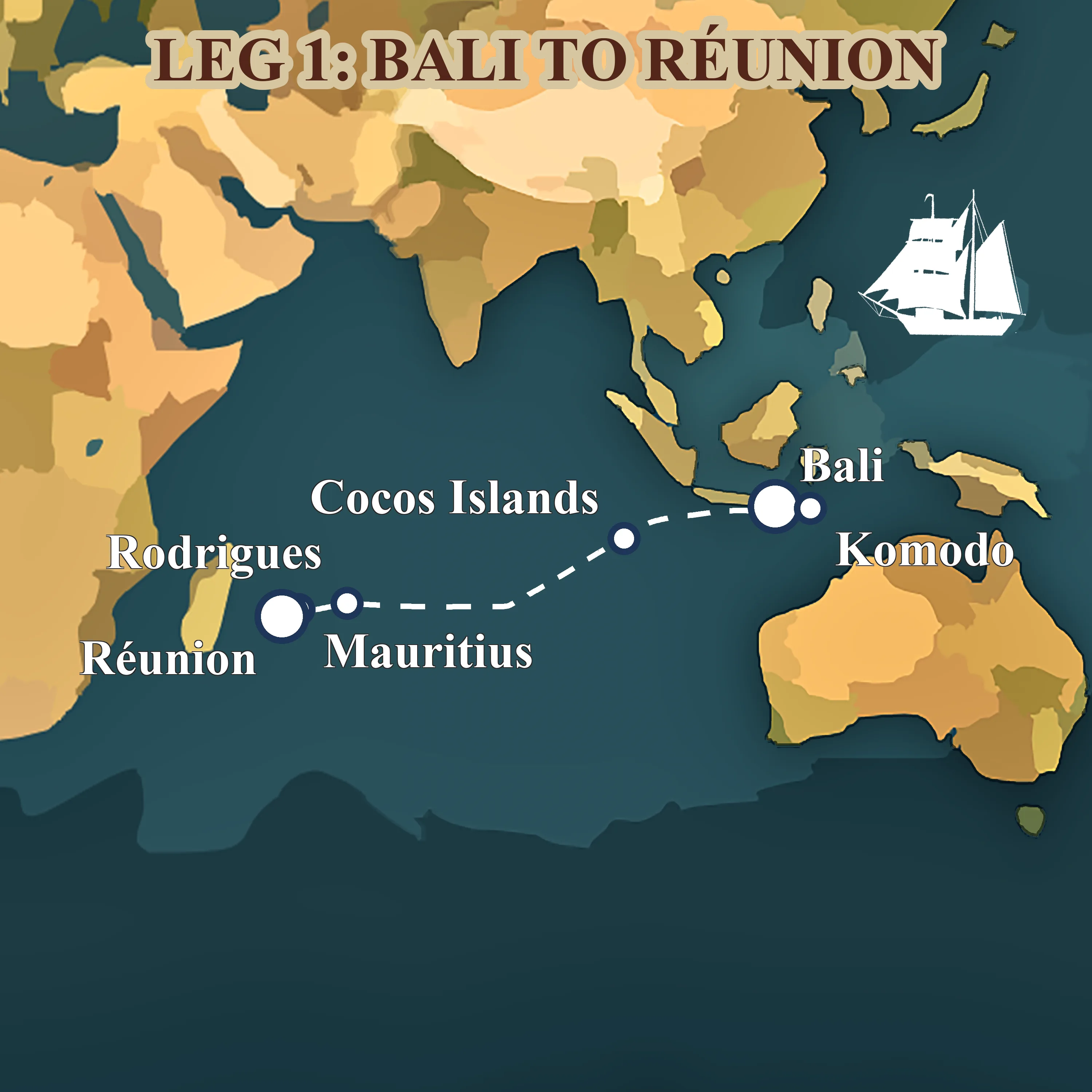
Leg 1: from Bali to Réunion across the Indian Ocean
May 2026 — Aug 2026 · Bali, Indonesia → Réunion, France
The opening chapter of Neptun's 482-day world voyage, a 4,078-nm trade-wind passage from the temples of Bali to the volcanic cliffs of Réunion.
Read more about this leg → about Leg 1: from Bali to Réunion across the Indian Ocean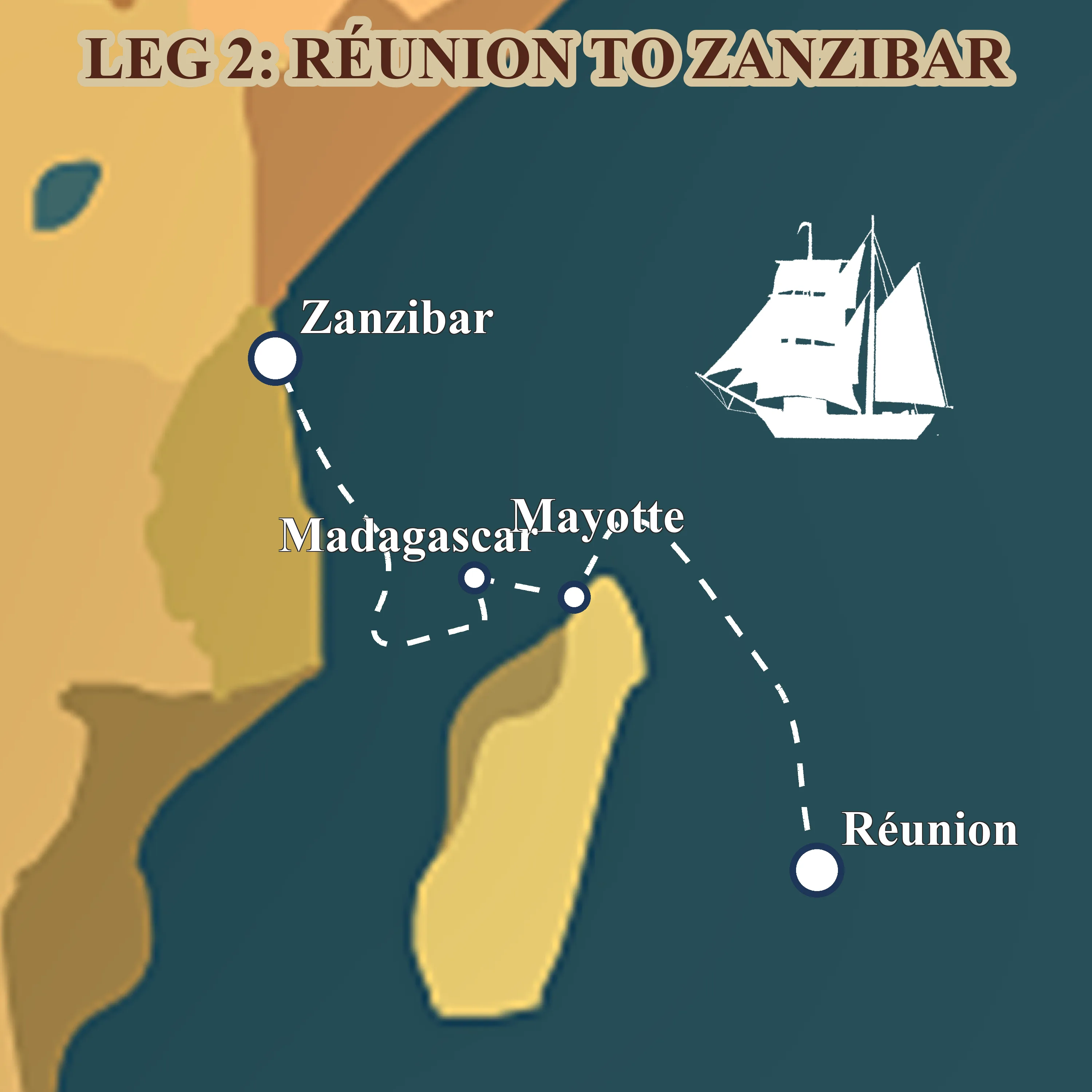
Leg 2: from Réunion to Zanzibar via Madagascar
Aug 2026 — Sept 2026 · Réunion, France → Zanzibar, Tanzania
Forty days across the western Indian Ocean, volcanic Réunion, lemur-haunted Nosy Be, the Mozambique Channel, and the spice-scented stone alleys of Zanzibar.
Read more about this leg → about Leg 2: from Réunion to Zanzibar via Madagascar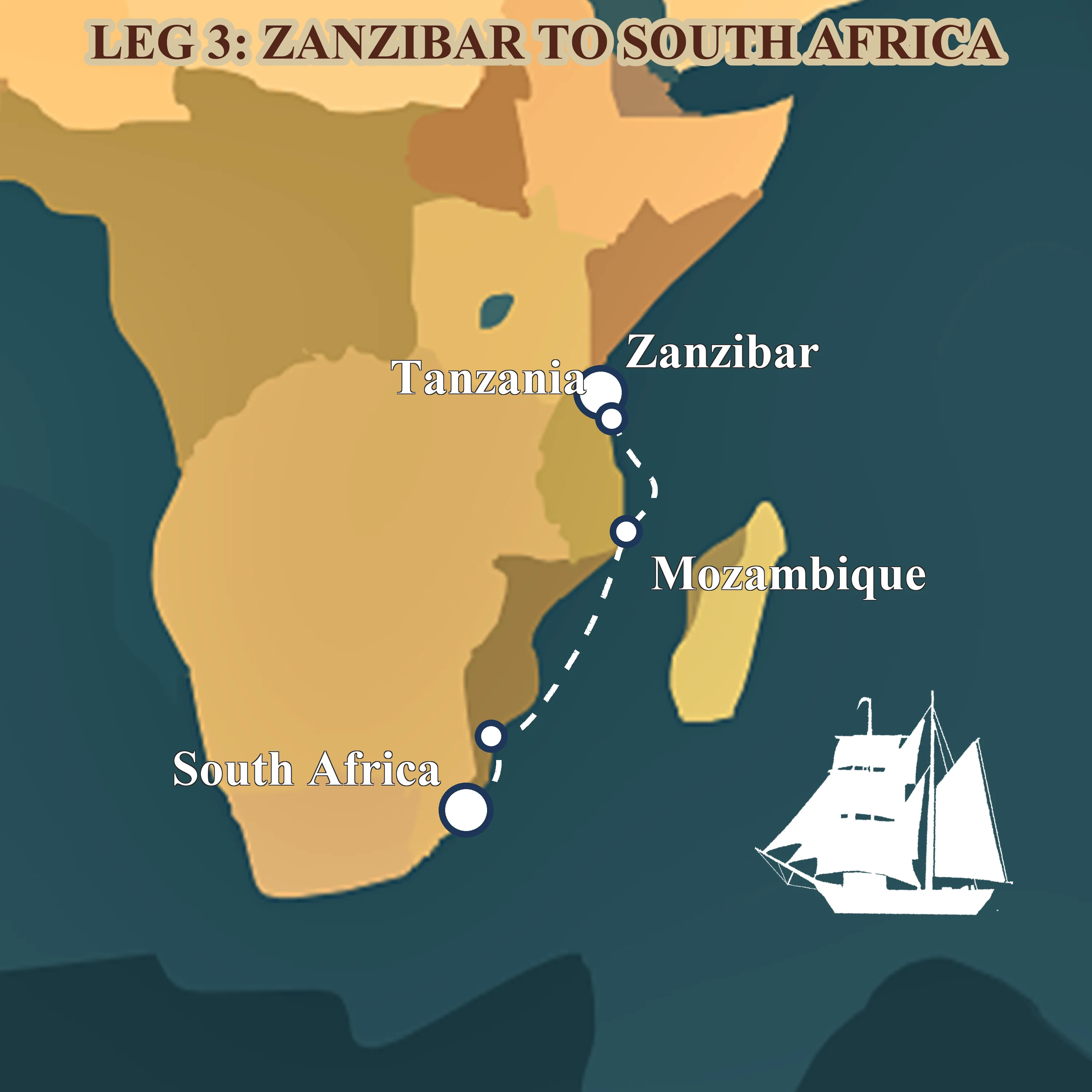
Leg 3: from Zanzibar to Durban down the Mozambique Channel
Sept 2026 — Nov 2026 · Zanzibar, Tanzania → Durban, South Africa
Sixty-three days coasting the African shore, spice islands, mangrove anchorages, Portuguese praças and the long trade-wind run down the Mozambique Channel to Durban.
Read more about this leg → about Leg 3: from Zanzibar to Durban down the Mozambique Channel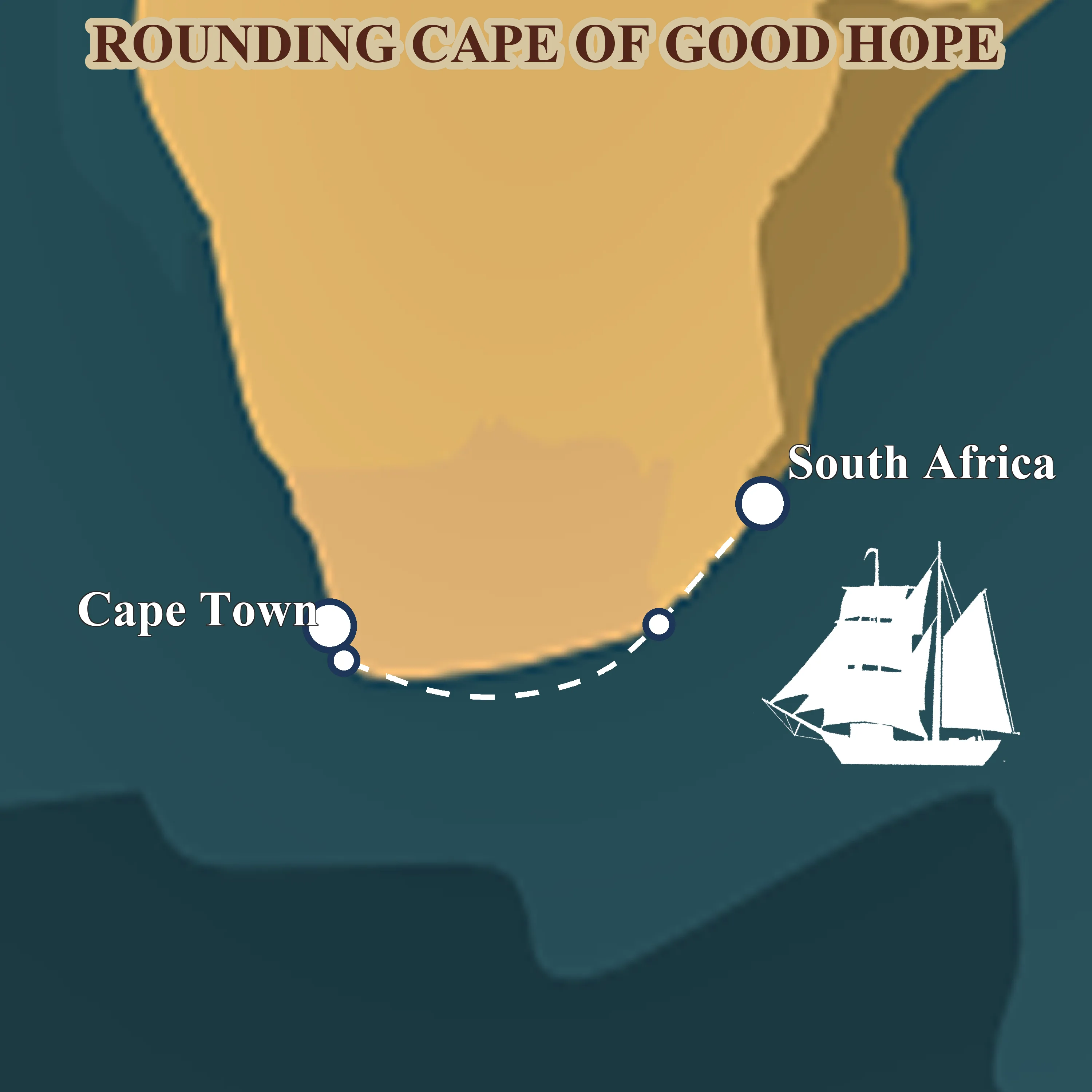
Leg 4: from Durban around the Cape of Good Hope
Nov 2026 — Dec 2026 · Durban, South Africa → Cape Town, South Africa
Thirty-eight days of serious seamanship, the Agulhas current, the Cape of Good Hope and the Southern Ocean at the tip of Africa, finishing quietly in Cape Town for Christmas.
Read more about this leg → about Leg 4: from Durban around the Cape of Good Hope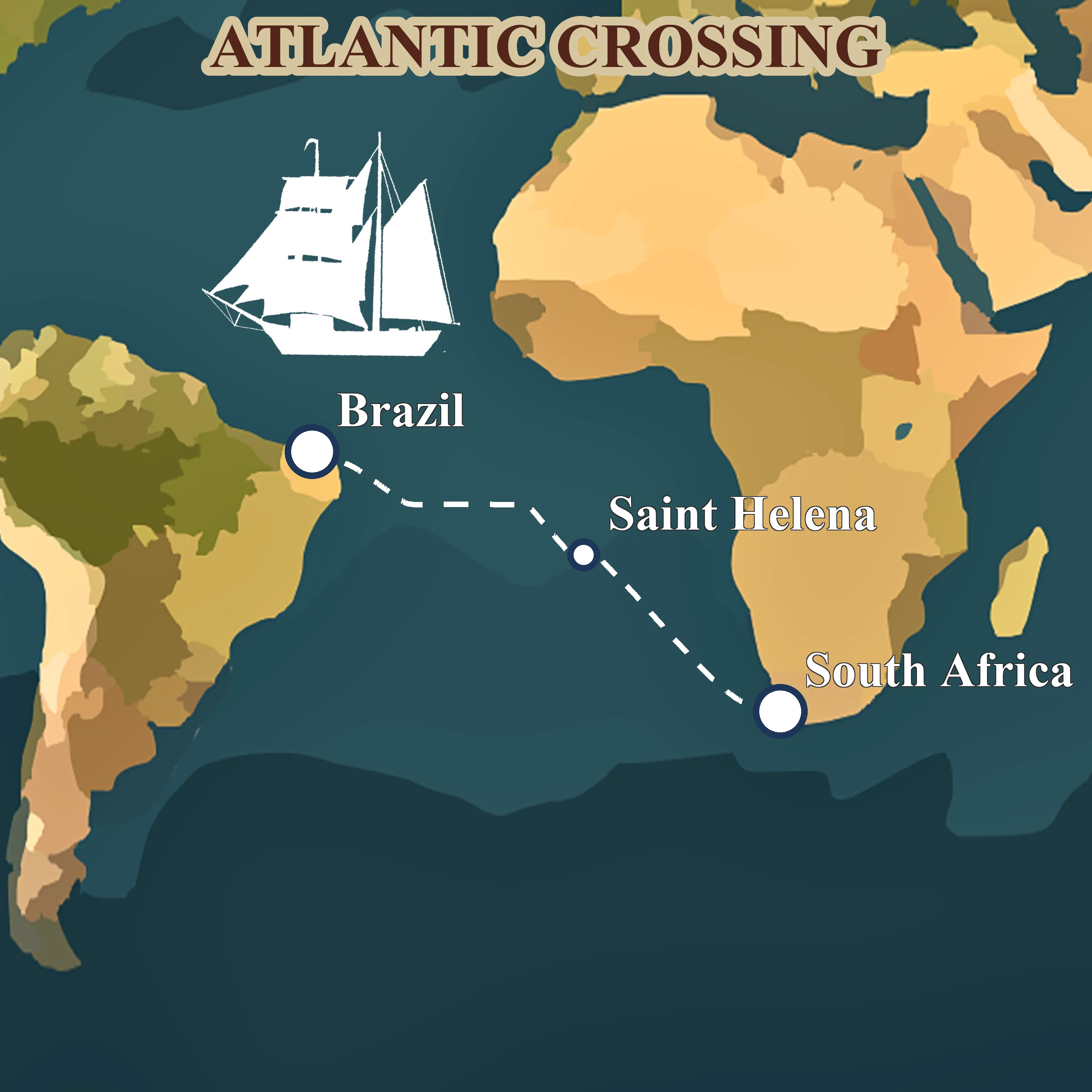
Leg 5: across the South Atlantic from Saldanha to Fortaleza
Jan 2027 — Mar 2027 · Saldanha Bay, South Africa → Fortaleza, Brazil
Forty-four days before the southeast trades, Napoleon's exile at St. Helena, the equator crossing, and landfall in tropical Brazil. The ocean chapter of the voyage.
Read more about this leg → about Leg 5: across the South Atlantic from Saldanha to Fortaleza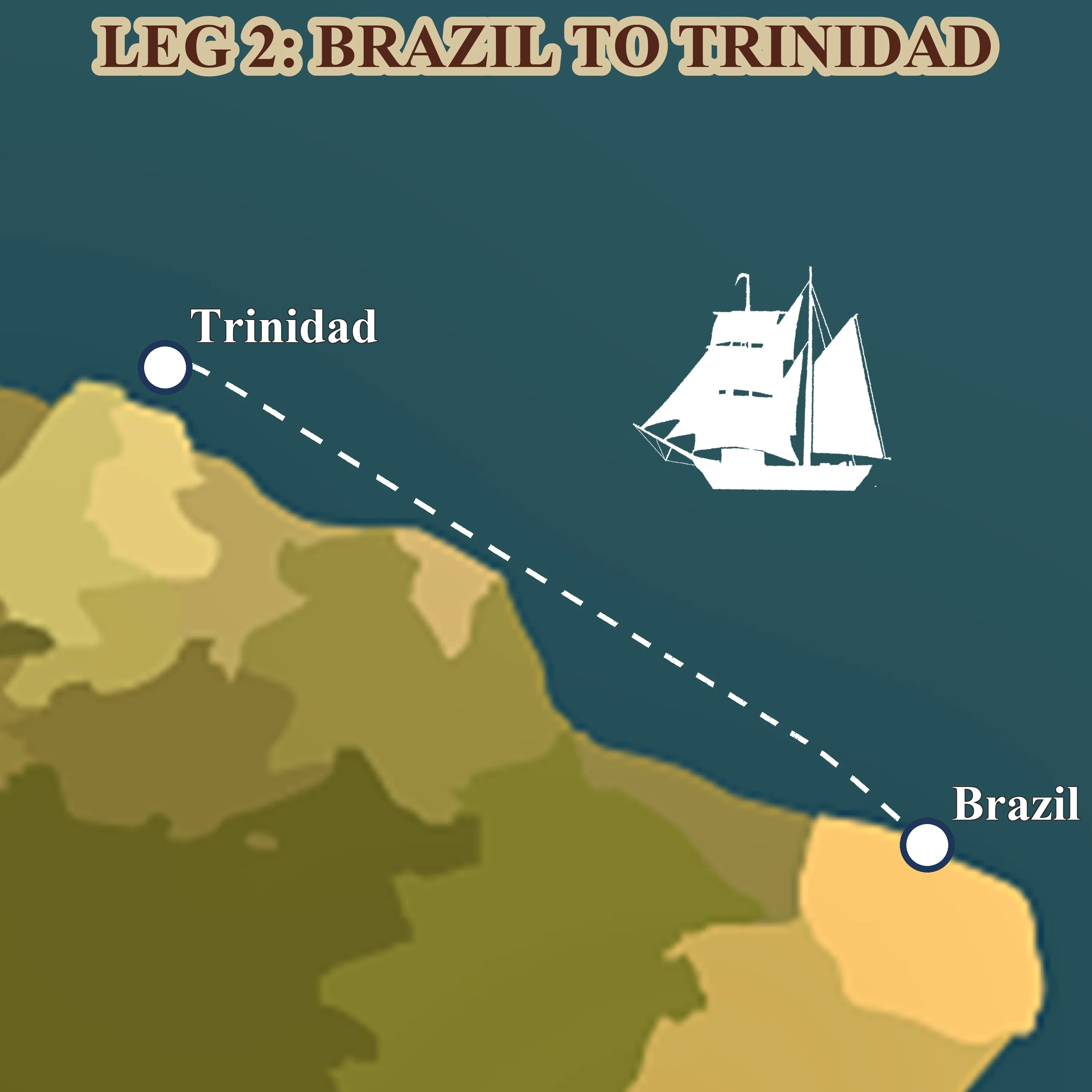
Leg 6: from Fortaleza to Trinidad along South America
Mar 2027 — Apr 2027 · Fortaleza, Brazil → Trinidad
A thousand miles of downwind trade running, the Amazon's brown water under the hull, the Guianas smudged on the horizon, and Trinidad's steelpan waiting at the end.
Read more about this leg → about Leg 6: from Fortaleza to Trinidad along South America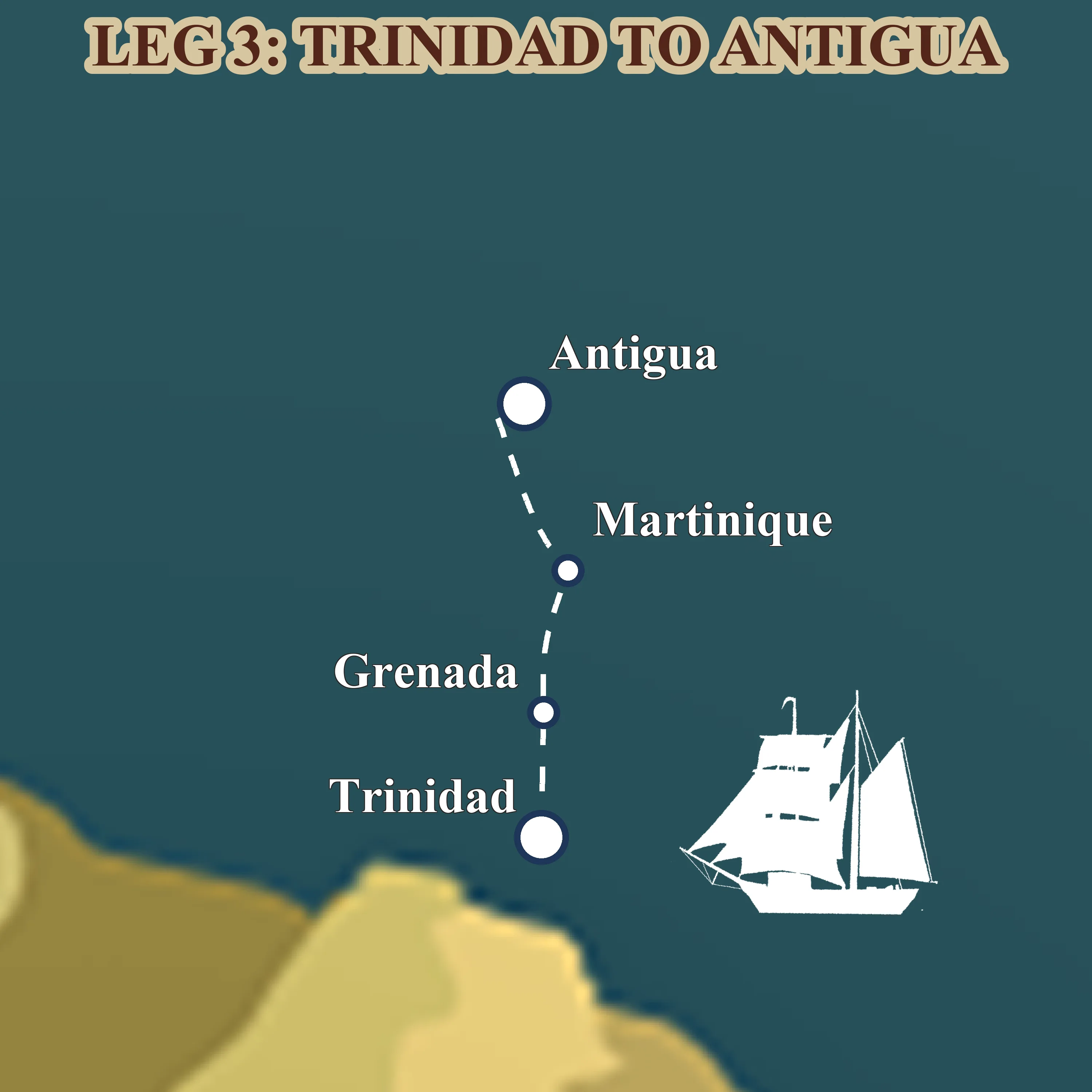
Leg 7: through the Windward Islands from Trinidad to Antigua
Apr 2027 — May 2027 · Trinidad → Antigua
Four weeks of short trade-wind daysails through the Lesser Antilles, turquoise anchorages, rum shops on the sand, French-Creole Martinique and the tall-ship scene in Antigua.
Read more about this leg → about Leg 7: through the Windward Islands from Trinidad to Antigua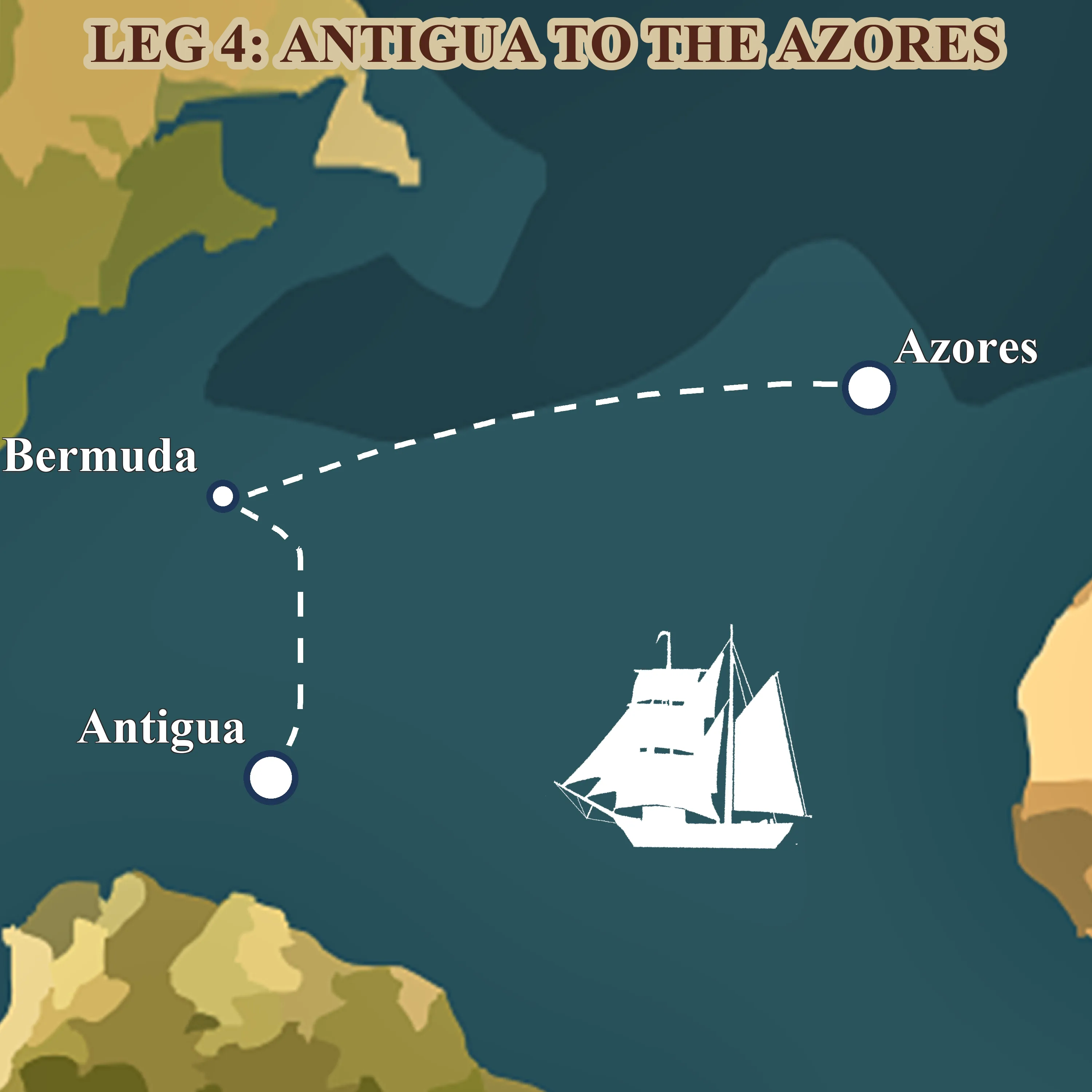
Leg 8: across the North Atlantic from Antigua to the Azores
May 2027 — Jul 2027 · Antigua → Ponta Delgada, Azores
Fifty-six days on the classic spring tall-ship route home, Antigua, a long reach to Bermuda's pink sand, then three weeks of open ocean to the volcanic Azores.
Read more about this leg → about Leg 8: across the North Atlantic from Antigua to the Azores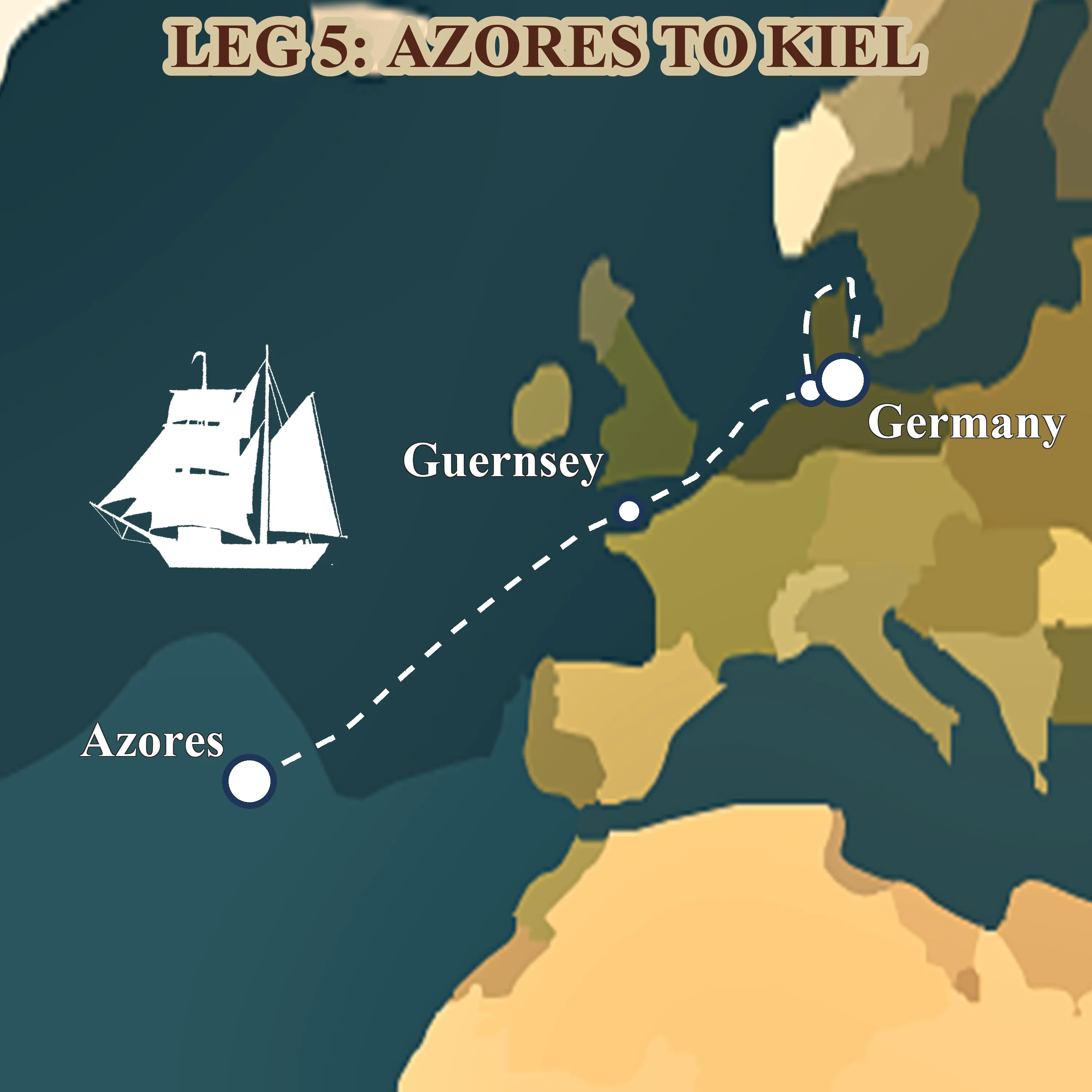
Leg 9: homecoming from the Azores to Kiel
Jul 2027 — Aug 2027 · Ponta Delgada, Azores → Kiel, Germany
The final 1,878 nm, from volcanic São Miguel to the Baltic, up the English Channel through the Dover TSS, past Helgoland's red cliffs and home to Kiel.
Read more about this leg → about Leg 9: homecoming from the Azores to KielHow to see Georg Stage today
If you want to see the ships in the flesh, both are reachable.
Georg Stage II lives at Krudtløbsvej on Refshaleøen in Copenhagen when she is not at sea, and her summer schedule and port-of-call dates are published on georgstage.dk. She frequently appears at Tall Ships Races events around northern Europe, sailtraininginternational.org publishes the 2026 Tall Ships Races schedule, and she is open to public tours when she is in Danish home ports.
Georg Stage I (now Joseph Conrad) has been at Mystic Seaport Museum in Mystic, Connecticut since 1947. She is permanently moored as a museum exhibit, free to walk aboard with museum admission. The National Maritime Historical Society and Mystic Seaport Museum both publish background. If you are anywhere in New England and care about sail-training history, she is worth the detour.
A short list of other tall ships still working, including her sister-in-spirit, the Danish merchant-navy training ship Danmark, is in our famous tall ships still sailing overview.
Sail your own training-ship voyage
NEPTUN takes 10 trainee crew per leg. No experience required. Real ocean sailing, real square-rigged seamanship, on a non-profit ship in the same tradition.
Frequently asked questions
What is the Georg Stage training ship?
Georg Stage is a 54-metre, three-masted, full-rigged Danish sail-training ship built in 1934. She is operated by an independent charitable foundation, Stiftelsen Georg Stages Minde, and trains roughly 63 Danish cadets at a time on summer cruises in the Baltic and North Sea.
Are there really two ships named Georg Stage?
Yes. Georg Stage I was built in 1882 and trained Danish cadets until 1934, when she was sold to Alan Villiers, renamed Joseph Conrad, and eventually moored permanently at Mystic Seaport in 1947, where she still is. Georg Stage II was built in 1934 to replace her and is the ship sailing today.
What happened to the original 1882 Georg Stage?
After 52 years of training Danish cadets, including a near-fatal collision with the steamship Ancona in 1905, the original Georg Stage was retired in 1934. She was bought by Australian sail-training pioneer Alan Villiers, renamed Joseph Conrad, sailed around the world, and is now a museum ship at Mystic Seaport Museum in Connecticut, USA. Read more in our Alan Villiers and Joseph Conrad article.
Who is the ship named after?
Carl Frederik Georg Stage, the son of Copenhagen shipowner Frederik Stage, who died of tuberculosis in 1880 at the age of 22. His parents Frederik and Thea funded the original 1882 ship as a memorial and established Stiftelsen Georg Stages Minde, the Georg Stage Memorial Foundation, to operate it. The Foundation has run a Danish training ship continuously ever since.
How old do you have to be to sail on Georg Stage?
Cadets are typically between 17.5 and 22 years old, and most are Danish, though the Foundation does take international applicants. If you are older than that, or non-Danish, sail-training opportunities exist on other tall ships, including Brigantine NEPTUN, which has no upper age limit and takes crew of any nationality.
Where does Georg Stage sail?
Most cruises stay in Danish, Swedish, Norwegian, German, and occasionally British waters, a Baltic and North Sea pattern that has been the norm since 1882. Atlantic crossings and longer voyages are rare; she made her first Atlantic crossing in 1989 and continues to appear at Tall Ships Races events around Europe.
Can I visit Georg Stage?
Yes, both ships. Georg Stage II is based in Copenhagen at Krudtløbsvej on Refshaleøen and is often open during home-port stops; her schedule is at georgstage.dk. Georg Stage I, now Joseph Conrad, is permanently moored at Mystic Seaport Museum in Connecticut and is open to museum visitors.
Read also
- Alan Villiers and Joseph Conrad, what became of the original Georg Stage
- Skoleskibet Danmark, Denmark's other training ship
- Famous tall ships still sailing in 2026
- What sail-training costs, fees, contributions, scholarships
- How to join a tall-ship crew
- Apply for a berth on Brigantine NEPTUN
- About NEPTUN, the ship and the foundation
The 2026 season, first half of the world voyage
Five legs from Bali through the Indian Ocean to South Africa, then the South Atlantic crossing. The first chance in 2026 to sail a working square-rigger as crew.
Leg 1: from Bali to Réunion across the Indian Ocean
May 2026 — Aug 2026 · Bali, Indonesia → Réunion, France
The opening chapter of Neptun's 482-day world voyage, a 4,078-nm trade-wind passage from the temples of Bali to the volcanic cliffs of Réunion.
Read more about this leg → about Leg 1: from Bali to Réunion across the Indian OceanLeg 2: from Réunion to Zanzibar via Madagascar
Aug 2026 — Sept 2026 · Réunion, France → Zanzibar, Tanzania
Forty days across the western Indian Ocean, volcanic Réunion, lemur-haunted Nosy Be, the Mozambique Channel, and the spice-scented stone alleys of Zanzibar.
Read more about this leg → about Leg 2: from Réunion to Zanzibar via MadagascarLeg 3: from Zanzibar to Durban down the Mozambique Channel
Sept 2026 — Nov 2026 · Zanzibar, Tanzania → Durban, South Africa
Sixty-three days coasting the African shore, spice islands, mangrove anchorages, Portuguese praças and the long trade-wind run down the Mozambique Channel to Durban.
Read more about this leg → about Leg 3: from Zanzibar to Durban down the Mozambique ChannelLeg 4: from Durban around the Cape of Good Hope
Nov 2026 — Dec 2026 · Durban, South Africa → Cape Town, South Africa
Thirty-eight days of serious seamanship, the Agulhas current, the Cape of Good Hope and the Southern Ocean at the tip of Africa, finishing quietly in Cape Town for Christmas.
Read more about this leg → about Leg 4: from Durban around the Cape of Good HopeWant to sail with us? Brigantine NEPTUN is a non-profit training ship, every voyage takes 10 crew members through real ocean sailing, no experience needed. Apply for a berth or browse the nine legs first.
The training-ship tradition is still alive
Georg Stage has been doing this for 144 years. NEPTUN is doing it now, internationally, with no age limit. One application is all it takes to be on the next leg.