There are roughly a thousand sailing vessels around the world that fly the "tall ship" label, from gaff schooners under twenty metres to four-masted barques over a hundred. Most are private, retired or rarely seen at sea. The ten famous tall ships in this guide are different. They are the ones that still sail real ocean miles in 2026: cadet ships under naval ensigns, non-profit trainee ships taking paying crew, and a handful of working square-riggers that have outlasted three or four owners and the entire age of steam.
This roundup is curated for trainees, not cruise passengers. For each ship we cover build year, builder, rig, dimensions, operator and what the ship is actually doing in 2026, including whether you can sail on her. The sequence is roughly oldest first; it is not a ranking. NEPTUN appears alongside the others as one ship in the canon, same lineage, same trade.
Want to sail on a tall ship rather than just read about them? Brigantine NEPTUN takes ten trainees per leg of her 2026-2027 world voyage. Apply for a berth or browse the nine legs first.
On this page
- 1. Sørlandet (1927), Norway's full-rigged elder
- 2. Statsraad Lehmkuhl (1914), Norway's largest barque
- 3. Picton Castle (built 1928, re-rigged 1996), Lunenburg's circumnavigator
- 4. Amerigo Vespucci (1931), the Italian Navy's full-rigged ship
- 5. Skoleskibet Danmark (1932), Denmark's seagoing classroom
- 6. USCG Eagle (1936), America's only square-rigger
- 7. Christian Radich (1937), Norway's "White Lady"
- 8. Brigantine NEPTUN (1947), Denmark's non-profit trainee ship
- 9. Bark Europa (built 1911, re-rigged 1994), the Antarctica barque
- 10. Stad Amsterdam (2000), the modern clipper
- Famous tall ships at a glance
- FAQ
- Read also
A short note on what counts. Every ship below has three masts or more, carries square sails on at least one mast, and is regularly under way in 2026. Replicas count if they are sailed offshore, Stad Amsterdam earns her place because she crosses oceans, not because of her launch year. Museum ships permanently moored, however venerable, do not.
Ten famous tall ships, eight flag states, three rigs
1. Sørlandet (1927), Norway's full-rigged elder
Sørlandet is the world's oldest full-rigged ship still in active service. She was launched in May 1927 from Høivolds Mekaniske Verksted in Kristiansand, on Norway's south coast, and was funded by the bequest of shipowner Ole Anonsen Tobiassen Skjelbred to train young sailors for the Norwegian merchant marine.
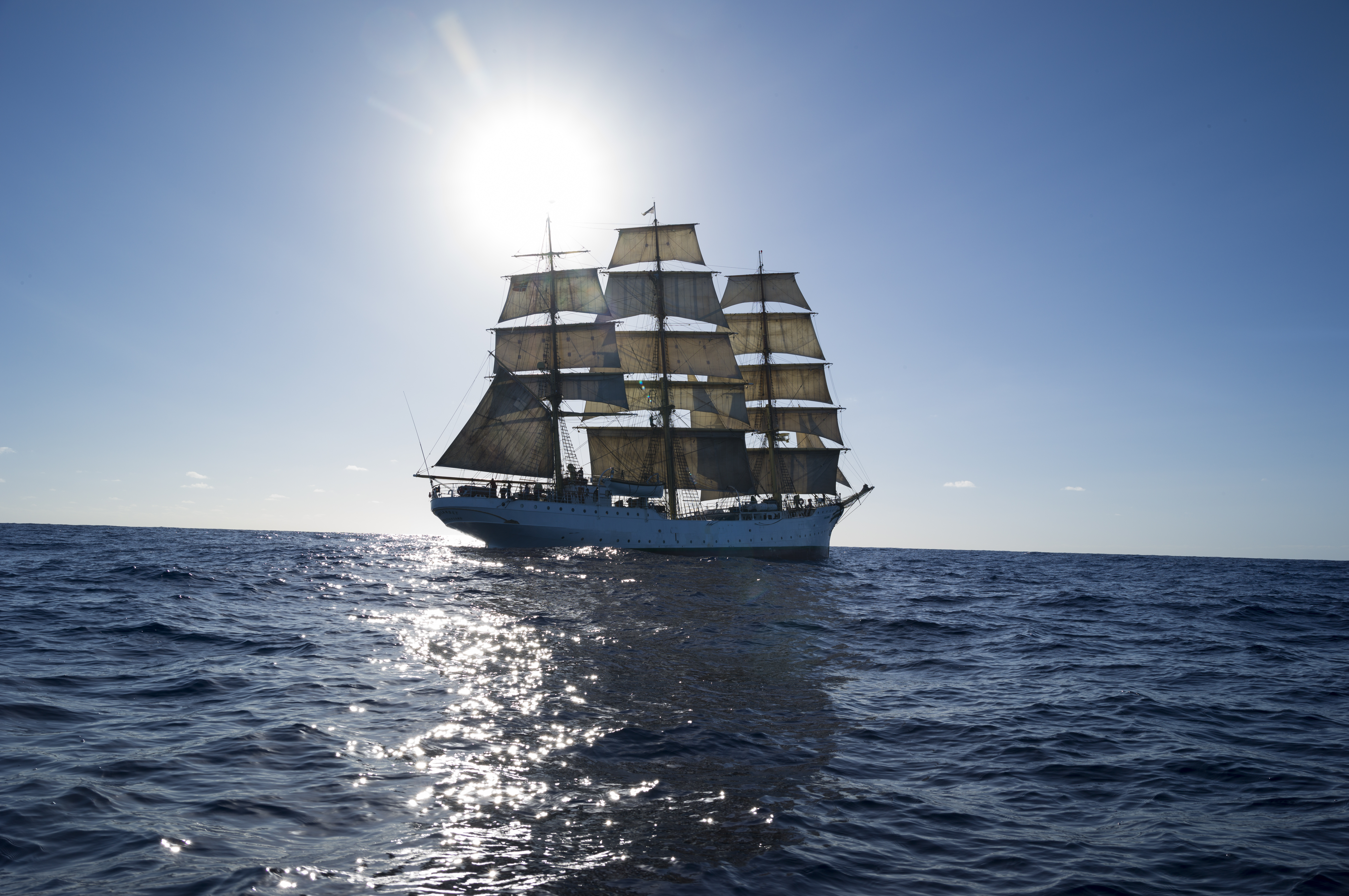
She is a steel-hulled three-master measuring 56.7 m on the hull (64 m including the bowsprit), with a beam of 8.9 m, a draft of 4.5 m, and 27 sails covering roughly 1,240 m². The mainmast tops out at 35 m above the waterline. Original auxiliary power came late, she was built without an engine and only had one fitted in 1947.
Her career has read like a small history of the twentieth century. She was seized by German forces in April 1940 at Horten and served the war as an accommodation vessel for German submariners; she emerged in poor condition and was not restored to sailing until 1948. Since 1981 she has been operated by the Stiftelsen Fullriggeren Sørlandet foundation. Today she most often sails as the platform for A+ World Academy, a residential international high school whose cadets circumnavigate the globe over an academic year. She remains very much active.
The square-rig story didn't start with Sørlandet, but it nearly ended without ships like her. The full chain runs from the great square-riggers of the windjammer era through to the ten ships in this guide.
2. Statsraad Lehmkuhl (1914), Norway's largest barque
Statsraad Lehmkuhl was launched in 1914 at the C. Tecklenborg yard in Geestemünde, Germany, as the Grossherzog Friedrich August, a school training ship for the German merchant marine. She was taken in 1921 as part of post-war reparations and bought by Kristofer Lehmkuhl, a former Norwegian cabinet minister whose title, Statsråd, she still carries.
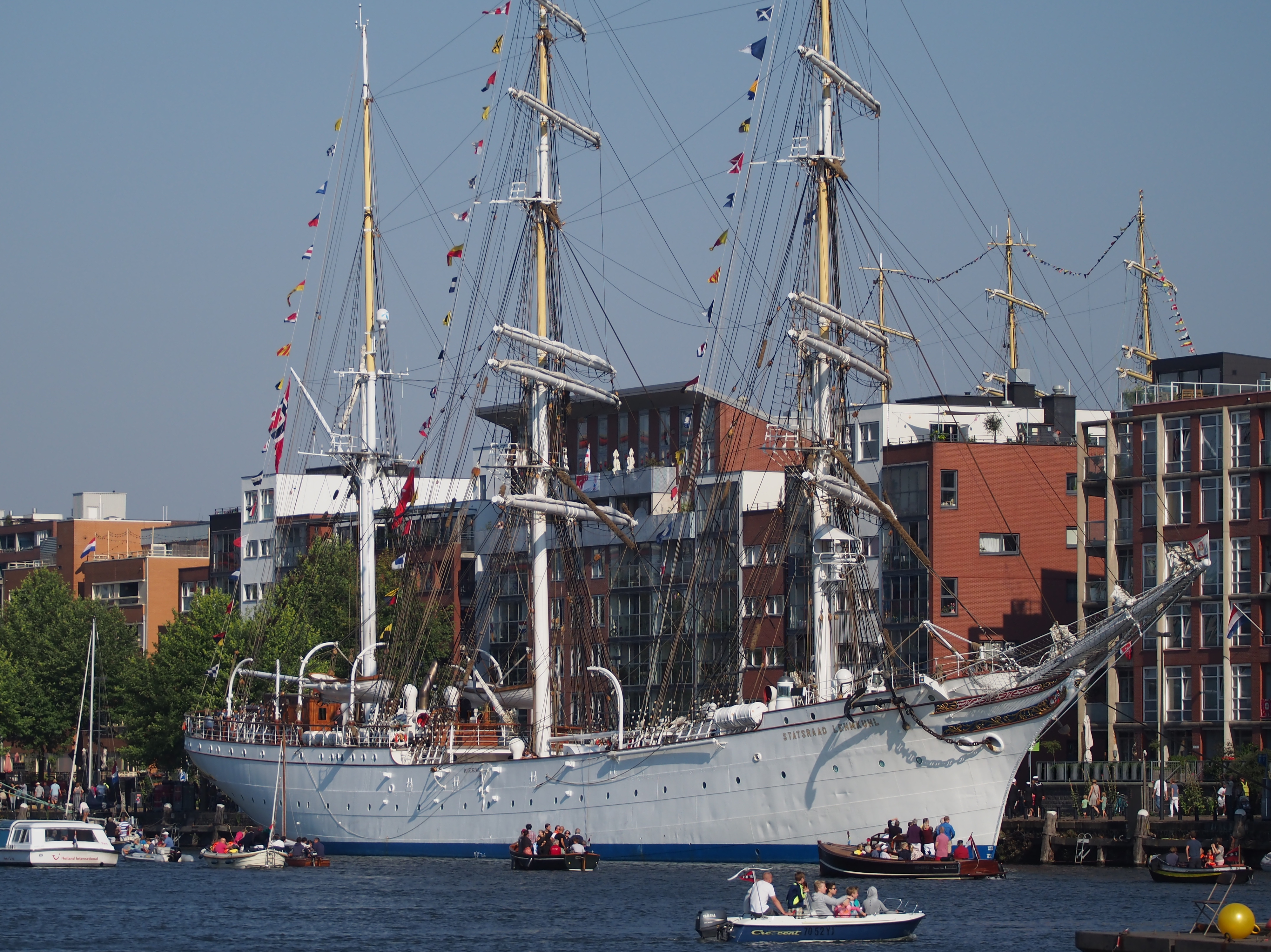
She is a three-masted barque, 98 m overall with a 12.6 m beam and a 48 m mainmast, carrying 22 sails for a total area of 2,026 m². She accommodates 150 trainees plus around 30 permanent crew, which puts her in the largest class of ships still routinely taking unqualified people to sea.
Her recent voyage history is unusually visible. From August 2021 to April 2023 she sailed the One Ocean Expedition, a 19-month UN-affiliated circumnavigation collecting oceanographic data, microplastics counts, eDNA samples, plankton trawls, CO₂ and salinity profiles, between every port. A second One Ocean Expedition for 2025-2026 is currently under way. She continues to sail under the Norwegian flag from her home port of Bergen.
3. Picton Castle (built 1928, re-rigged 1996), Lunenburg's circumnavigator
Picton Castle began as a steam trawler launched in 1928 in Selby, Yorkshire. She fished the North Sea, served as a Royal Navy minesweeper in the Second World War, fished again after 1945, and lay derelict by the 1990s when American captain Daniel Moreland bought her, sailed her across the Atlantic, and refitted her in Lunenburg, Nova Scotia as a three-masted barque. Her first voyage as Picton Castle was in 1997.
She is 55 m overall, with a riveted steel hull, steel masts, wooden and steel yards and 1,160 m² of sail across her three masts. Lunenburg, the wooden-shipbuilding capital of Atlantic Canada, has been her home port for the entire current career.
Her claim to the canon is volume of blue water. Since 1997 she has completed seven full circumnavigations, with an eighth currently in progress at the time of writing, a total of well over 300,000 nautical miles. Her programme is unusual among square-riggers: long world voyages of twelve to fourteen months, taking on roughly forty paying trainees per voyage who learn the work as they sail. She flies the Cook Islands flag and continues to sail in 2026.
4. Amerigo Vespucci (1931), the Italian Navy's full-rigged ship
Amerigo Vespucci is, by reputation, the most beautiful ship in the world. The line dates to a 1962 encounter in which the US aircraft carrier USS Independence passed her in the Mediterranean and signalled across asking who she was; the reply was Amerigo Vespucci, Italian Navy training ship; the Independence signalled back "You are the most beautiful ship in the world." The story has been told often enough that the Italian Navy treats it as official history.
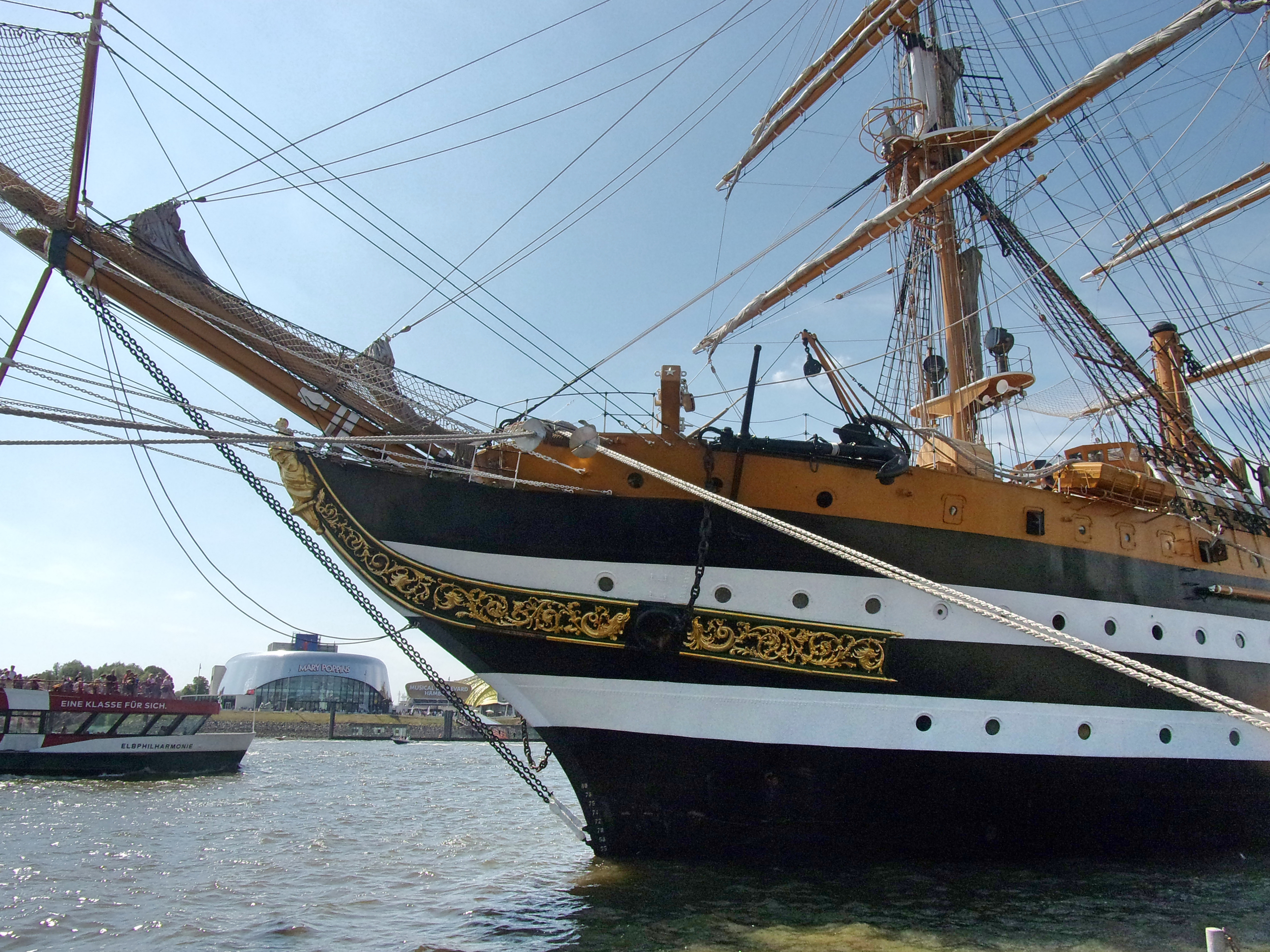
She was launched on 22 February 1931 at the Royal Naval Shipyard of Castellammare di Stabia in Naples, designed in deliberate homage to a 74-gun ship of the Napoleonic era. She is a steel-hulled, three-masted, full-rigged ship: 82.4 m on the hull, 101 m including the bowsprit, with a beam of 15.5 m and 26 sails totalling 2,824 m². Her hull is painted black with white bands echoing the gun ports of her wooden ancestors.
She has trained Italian Navy officer cadets continuously since her commissioning, a stretch of almost a century broken only by service constraints during the Second World War. In 2023 she set out on a world tour to mark the seventieth anniversary of her postwar service, calling at thirty ports on five continents over twenty months, a voyage that returned to Genoa in 2025. She remains in active service with the Italian Navy.
Different ship, same craft
The Vespucci trains naval officers; NEPTUN trains anyone willing to learn. The square sails, the watch system, the celestial sights, the work is the same.
5. Skoleskibet Danmark (1932), Denmark's seagoing classroom
Skoleskibet Danmark, the school-ship Denmark, was built at Nakskov Skibsværft on Lolland, launched in November 1932 and commissioned in June 1933 as a state-owned cadet training ship for the Danish merchant marine. She has held that role almost without interruption for nine decades and is a fixture of Danish maritime culture.
She is a full-rigged three-master with a steel hull, 77 m overall, 9.8 m beam, 5.2 m draft, carrying 26 sails for a total area of 1,632 m². Her mainmast reaches 39 m above the deck. She is operated today by the Danish Maritime Authority's training department, skoleskibet.dk, and is based in Frederikshavn.
Her best-known chapter is wartime. Danmark was on a goodwill voyage to the New York World's Fair when Germany invaded Denmark in April 1940. Unable to return home, she was placed at the disposal of the United States and, between 1942 and 1945, trained roughly five thousand US Coast Guard cadets under the designation USCGC Danmark (WIX-283). The success of that programme directly motivated the US acquisition of USCG Eagle as a war prize in 1946 (see entry 6). She was returned to Denmark in 1945 and resumed Danish merchant-marine training. Read the full story in Skoleskibet Danmark, Denmark's seagoing classroom since 1932.
6. USCG Eagle (1936), America's only square-rigger
The barque USCGC Eagle was launched on 13 June 1936 at Blohm & Voss in Hamburg as Horst Wessel, a sail training ship for the new Kriegsmarine. She was one of three sister ships, the others being Albert Leo Schlageter (now Portugal's Sagres) and Gorch Fock I (now Ukraine's Tovarishch, retired). She is 90 m overall, with a steel hull, three masts and 2,070 m² of sail.
She was taken by the United States as a war prize in 1946. The American experience of training cadets aboard Skoleskibet Danmark in Connecticut between 1942 and 1945 (see entry 5) was a direct precedent for acquiring her. Her first transatlantic passage under American command, Bremerhaven to New London, Connecticut, was sailed in May and June 1946 by a mixed crew: Commander Gordon McGowan with sixty-one US Coast Guardsmen, alongside the original German captain Kapitänleutnant Barthold Schnibbe and many of his original crew, who stayed aboard to teach the Americans how to handle her. The handover and crossing are documented in McGowan's memoir The Skipper and the Eagle.
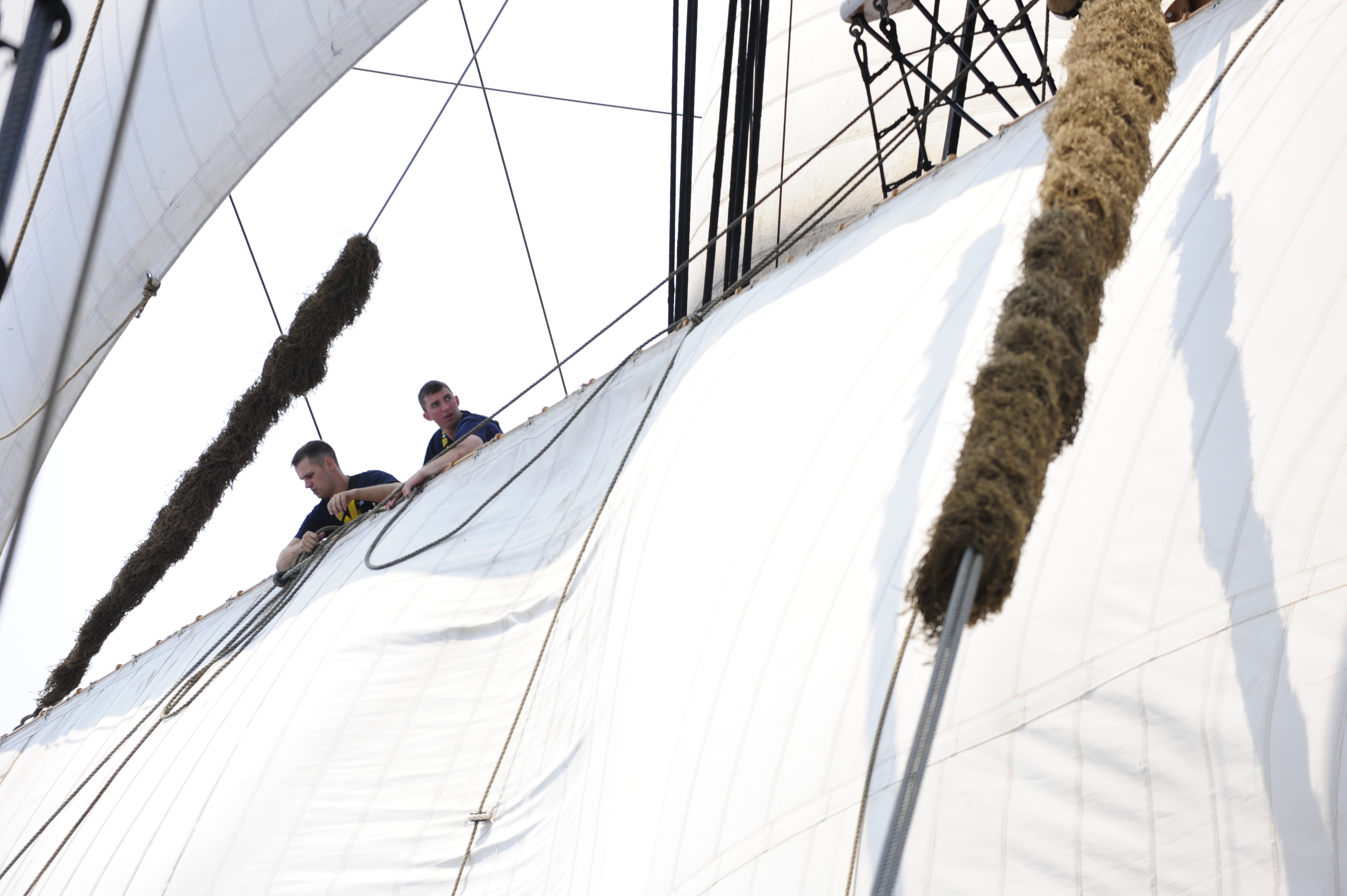
Since 1946 she has served as the cadet training ship of the US Coast Guard Academy, sailing every summer with cadets aboard for between six and twelve weeks of practical seamanship. She is the only active square-rigger in US government service. Her home port is New London, Connecticut, and she remains in commission with the Coast Guard Academy.
7. Christian Radich (1937), Norway's "White Lady"
Christian Radich was launched in February 1937 at the Framnæs shipyard in Sandefjord, funded by a bequest from shipowner Christian Radich for the training of young Norwegian sailors. She is a full-rigged three-master, 62.5 m on the hull, 73 m including the bowsprit, with a 9.7 m beam, a 37.7 m mainmast and 27 sails covering 1,360 m², slightly smaller than Sørlandet, slightly larger than Picton Castle. Her hull is painted gloss white, which is where the nickname "White Lady" comes from.
The Second World War interrupted her training career: she was captured by German forces and was recovered after the war in damaged condition. After a major refit she returned to service in 1947.
For most readers her cultural fingerprint is the 1958 Cinemiracle film Windjammer: The Voyage of the Christian Radich, which followed cadets on a transatlantic voyage and was, briefly, the highest-grossing widescreen documentary ever made. She also features in the 1970s BBC series The Onedin Line. Today she is operated by the Christian Radich Sail Training Foundation as a charter and trainee vessel out of Oslo, with a typical complement of eighteen permanent crew and up to eighty-eight trainees or charter guests.
8. Brigantine NEPTUN (1947), Denmark's non-profit trainee ship
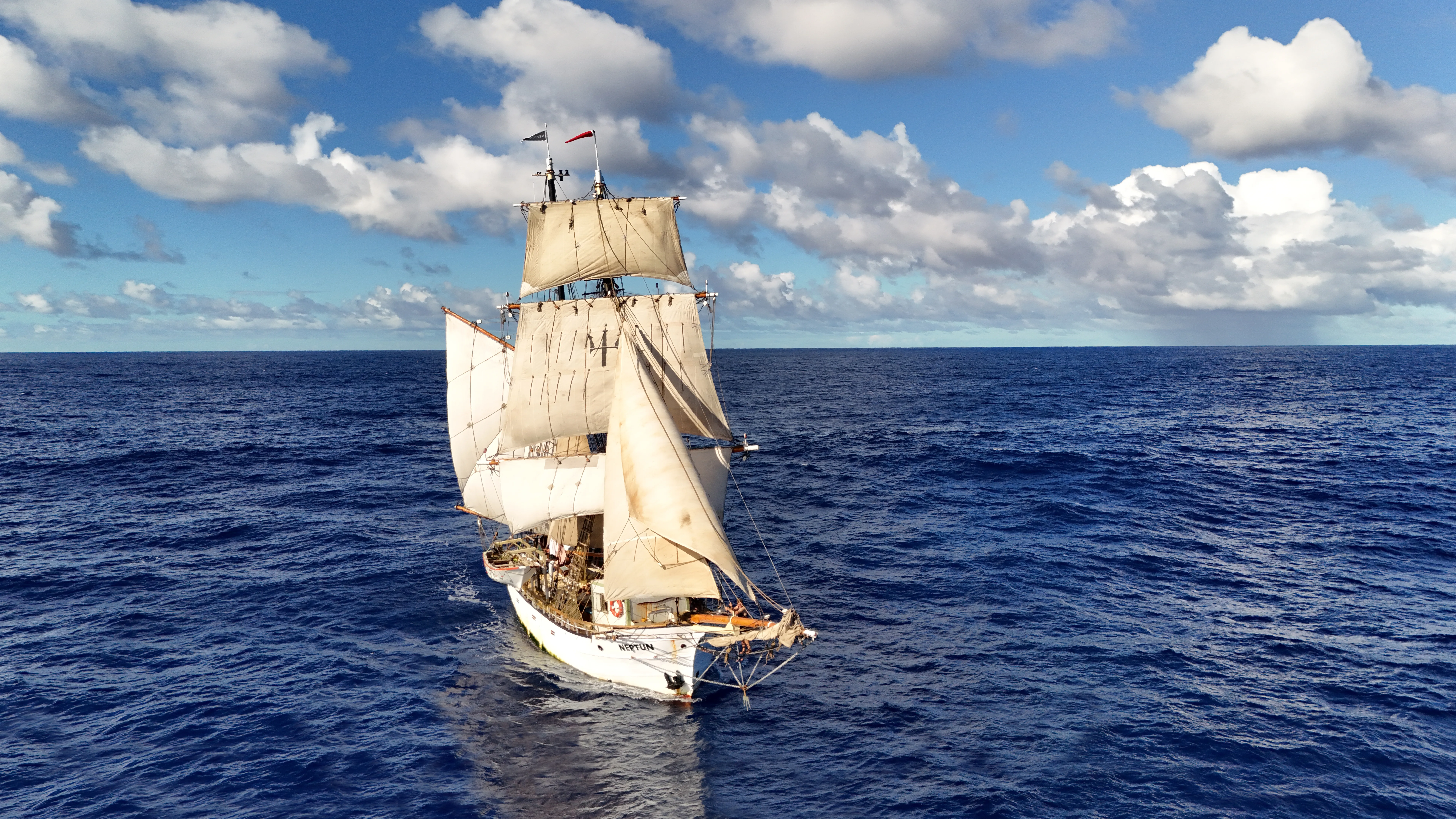
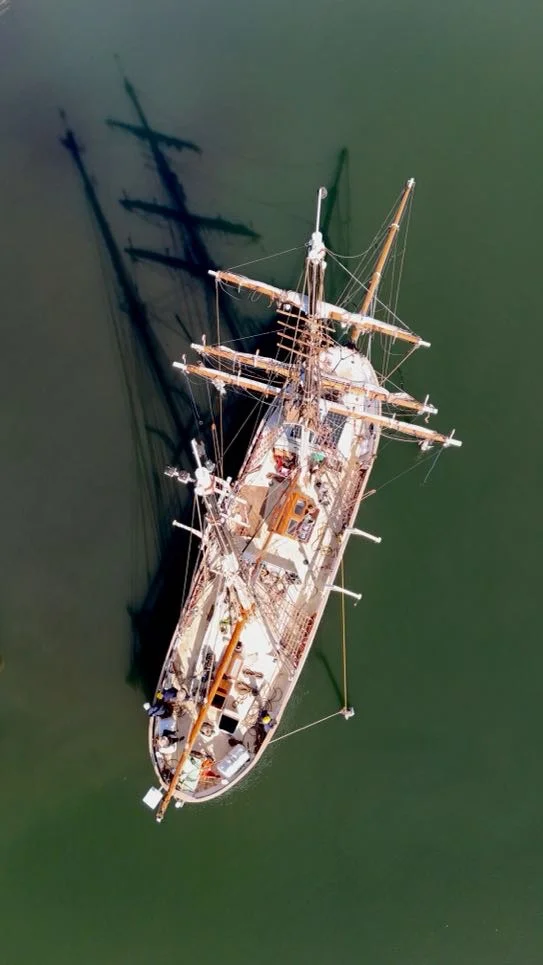
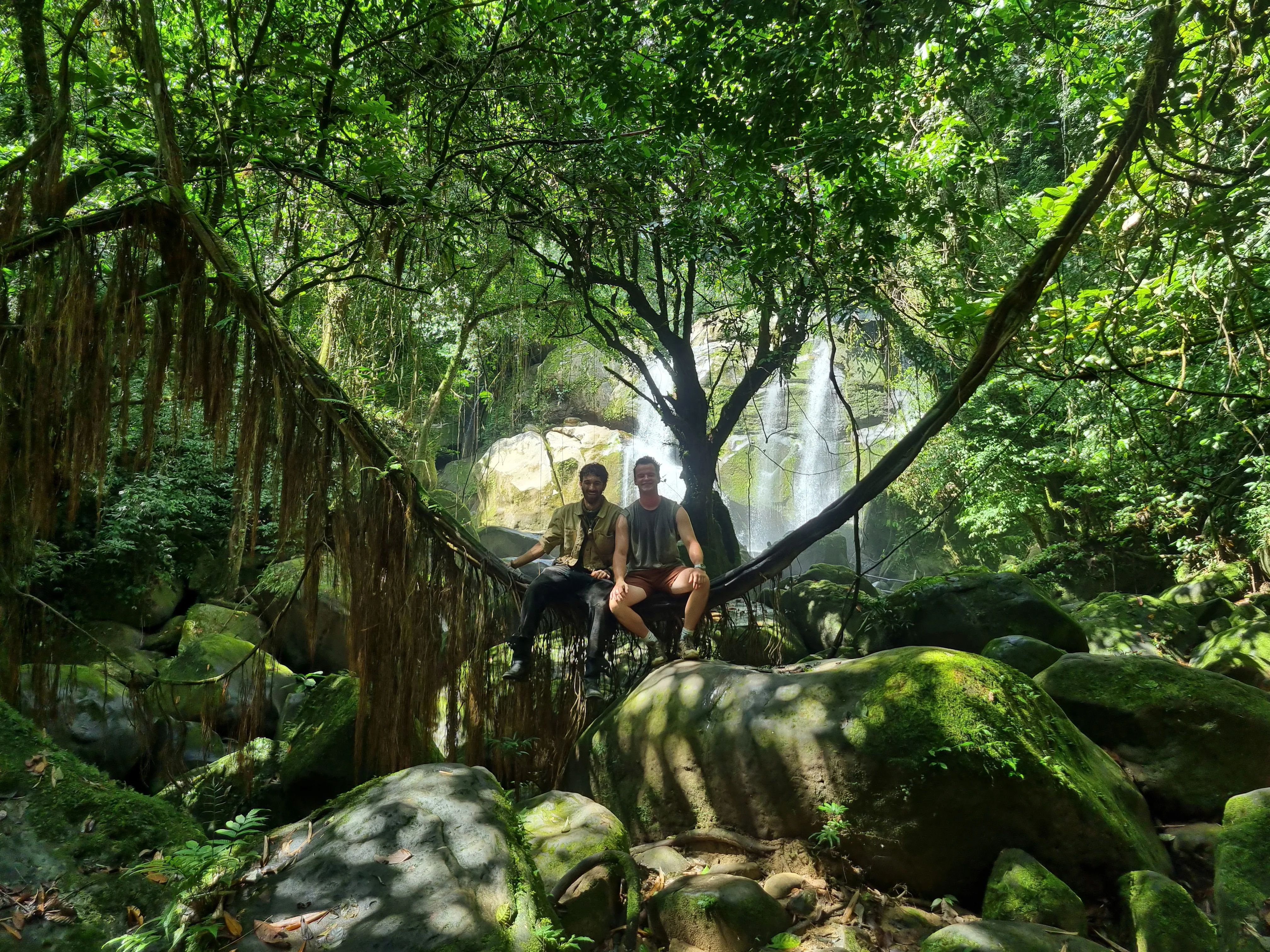
Brigantine NEPTUN was built in 1947 at the D. W. Kremer Sohn yard in Elmshorn, just north of Hamburg, originally as a riveted-steel fishing vessel ordered by F. Laeisz of Hamburg, the same shipping family that owned the great Flying P-Liner barques. She fished, then was rebuilt as a coaster, then refitted as a small training vessel, before passing in 2022 to the Danish non-profit Foreningen Neptun.
In 2025 she completed her conversion to a brigantine, square sails on the foremast, fore-and-aft sails on the main, and now carries 16 sails covering 290 m² across a 24 m mainmast. She is 29 m overall, 5.5 m in beam, 3.3 m draft, and her main engine is a 1961 Sulzer 300 hp diesel. Her flag is Danish; her home port is Marstal on Ærø.
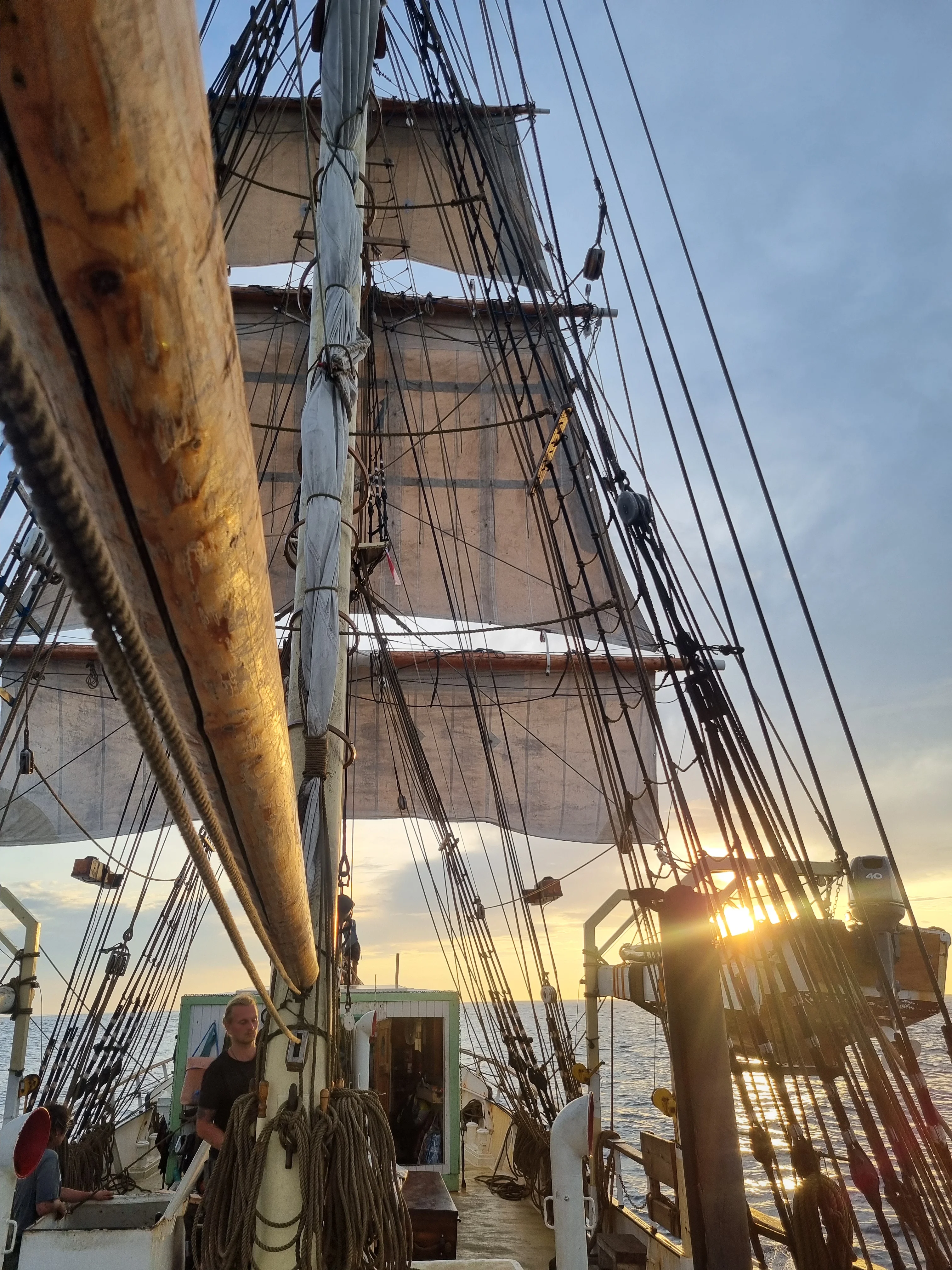
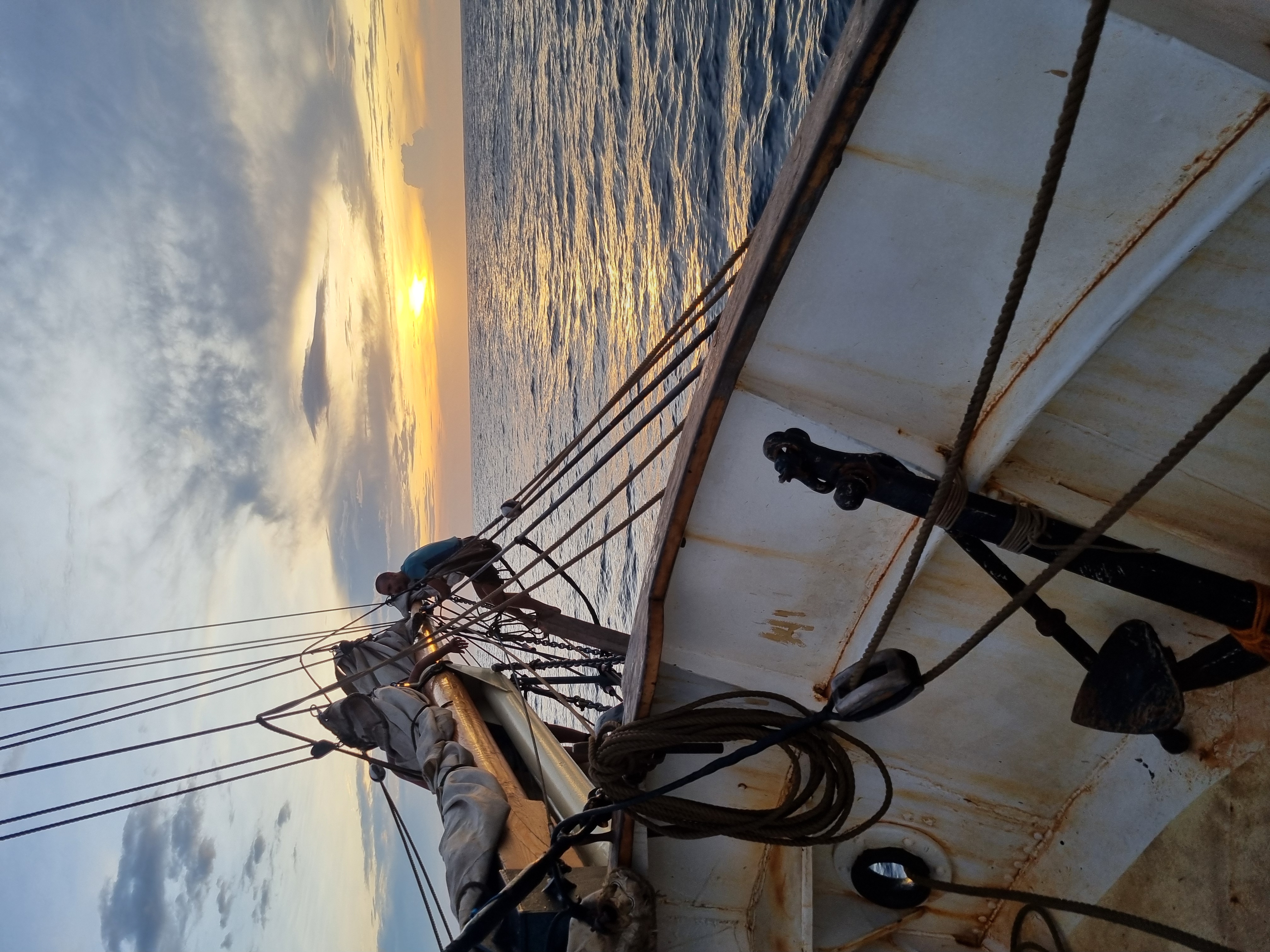
What sets her apart from the other ships in this list is the operating model. NEPTUN is non-profit. Every leg of her 2026-2027 world voyage takes ten paying trainees alongside the permanent crew, an arrangement closer to Picton Castle than to Sørlandet or the naval ships, but at smaller scale and with a non-commercial structure. Trainees stand watches, climb the rig, take celestial sights, and leave with logged sea miles toward RYA Yachtmaster qualifications. The full ship-and-crew profile is on our about page; the history page covers the seventy-eight years from Elmshorn to Marstal.
Want to sail on her? Apply for a berth on a 2026 leg, or browse the full nine-leg itinerary.
9. Bark Europa (built 1911, re-rigged 1994), the Antarctica barque
The hull that became bark Europa was launched in 1911 at the H.C. Stülcken & Sohn yard in Hamburg as the lightship Senator Brockes, marking the entrance to the river Elbe. She served in that role until 1977, when modern aids to navigation made the manned-lightship station obsolete.
She was bought to the Netherlands and converted between 1986 and 1994 into a three-masted barque, with iron masts and 1,250 m² of sail across roughly 30 sails (including six studding sails when set). Her dimensions today are 56 m overall (44.5 m hull length per Sail Training International), with a 33 m mainmast. She is operated by Rederij Bark EUROPA out of Scheveningen and flies the Dutch flag.
Her current programme is the strongest claim to the canon. Each southern summer she sails from the Falklands or Cape Town to the Antarctic Peninsula, taking trainee crew through the Drake Passage and along the ice, one of very few sailing vessels to make the southern crossing routinely. She has rounded Cape Horn multiple times and completed a world circumnavigation in 2013-2014. She remains active in 2026.
10. Stad Amsterdam (2000), the modern clipper
Stad Amsterdam is the youngest ship in this list and the most controversial inclusion, built brand-new at the Damen shipyard in Amsterdam and launched in 2000, at a time when no major sailing ship had been built from scratch in Europe in close to a century.
She is a three-masted clipper of 76 m overall with a 10.5 m beam, 1,038 t displacement, and 31 sails covering 2,200 m². She was designed by Gerard Dijkstra and modelled on the mid-nineteenth-century clipper Amsterdam, though she is not a strict replica. Her hull is steel and her masts are aluminium. Christened by Rita Kok at Sail Amsterdam 2000, she was developed by the City of Amsterdam, the Randstad employment agency and the Dutch shipyard sector together, the goal was both a working ship and a maritime training platform.
Her best-known voyage is the 2009-2010 Beagle re-enactment, in which she retraced Charles Darwin's route from Plymouth around South America and back, broadcast as a Dutch television documentary series. She continues to sail under charter and corporate-event bookings, and to take small numbers of paying trainees on offshore legs. Her home port is Amsterdam.
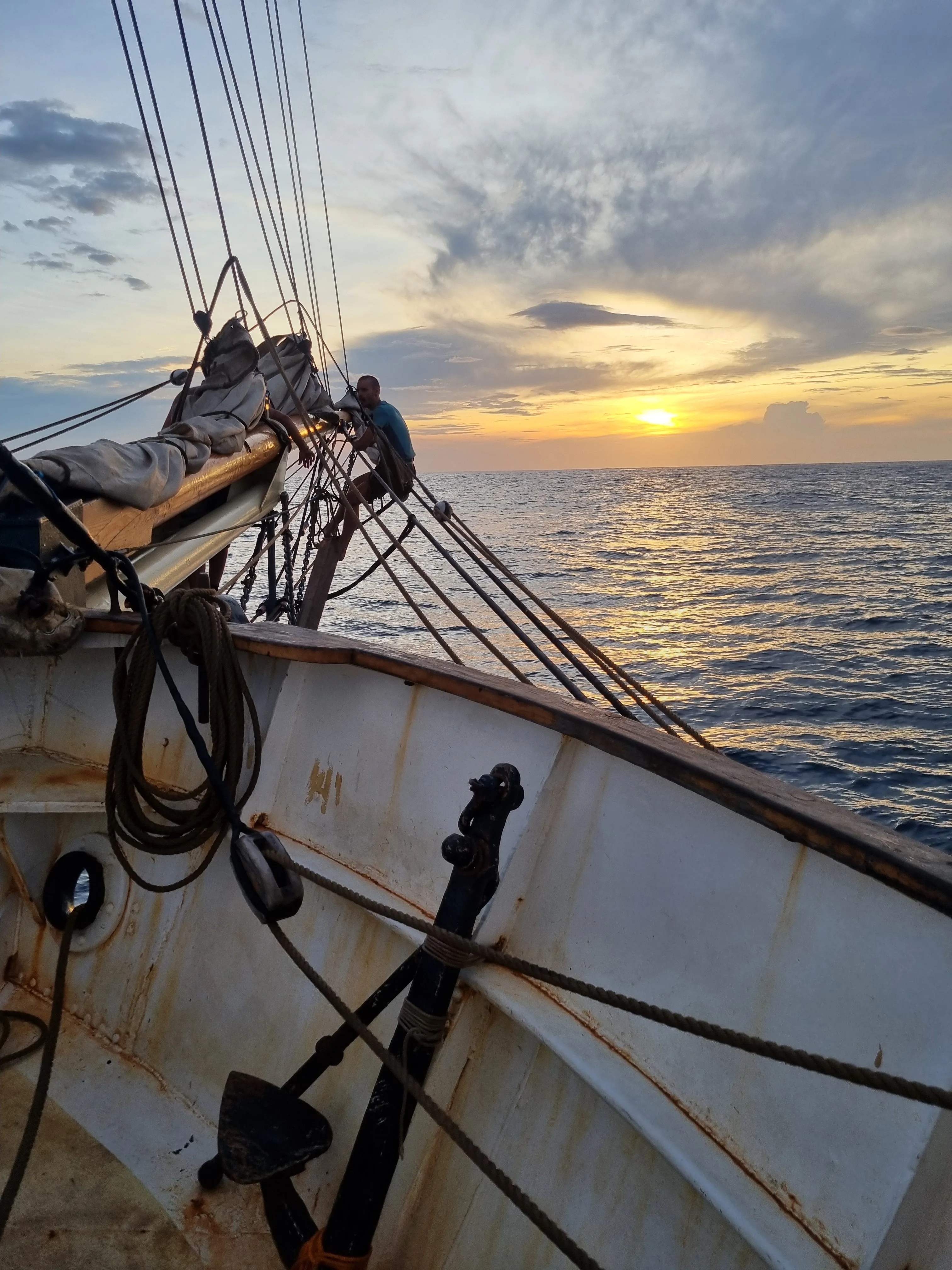
Ten ships, three centuries of seamanship, and the work is unchanged.
Famous tall ships at a glance
A fast reference summary of the ten ships above, country of registry, build year, rig type. Use this when you need to remember which is which.
Sørlandet
Norway · 1927 · Full-rigged ship. Oldest full-rigger still in service. Operated by Stiftelsen Fullriggeren Sørlandet.
Statsraad Lehmkuhl
Norway · 1914 · Three-masted barque. 98 m, 150 trainees. UN One Ocean Expedition flagship.
Picton Castle
Cook Islands · 1928 (re-rigged 1996) · Three-masted barque. Eight world circumnavigations and counting.
Amerigo Vespucci
Italy · 1931 · Full-rigged ship. Italian Navy cadet trainer. "Most beautiful ship in the world."
Skoleskibet Danmark
Denmark · 1932 · Full-rigged ship. Danish merchant-marine cadet training. Trained 5,000 US Coast Guard cadets in WWII.
USCG Eagle
USA · 1936 · Three-masted barque. Built as Horst Wessel, taken as war prize 1946. US Coast Guard Academy.
Christian Radich
Norway · 1937 · Full-rigged ship. The "White Lady". Star of Windjammer (1958).
Brigantine NEPTUN
Denmark · 1947 (re-rigged 2025) · Brigantine. Non-profit trainee ship; 10 trainees per leg.
Bark Europa
Netherlands · 1911 (re-rigged 1994) · Three-masted barque. Antarctic specialist; multiple Cape Horn roundings.
Stad Amsterdam
Netherlands · 2000 · Three-masted clipper. Modern build; sailed Darwin Beagle re-enactment 2009-2010.
Tall ships you can sail today, including NEPTUN
Nine legs you can join in 2026-2027
The other ships above run their own programmes. NEPTUN's nine-leg world voyage takes ten trainees per leg, pick the one that fits your dates.
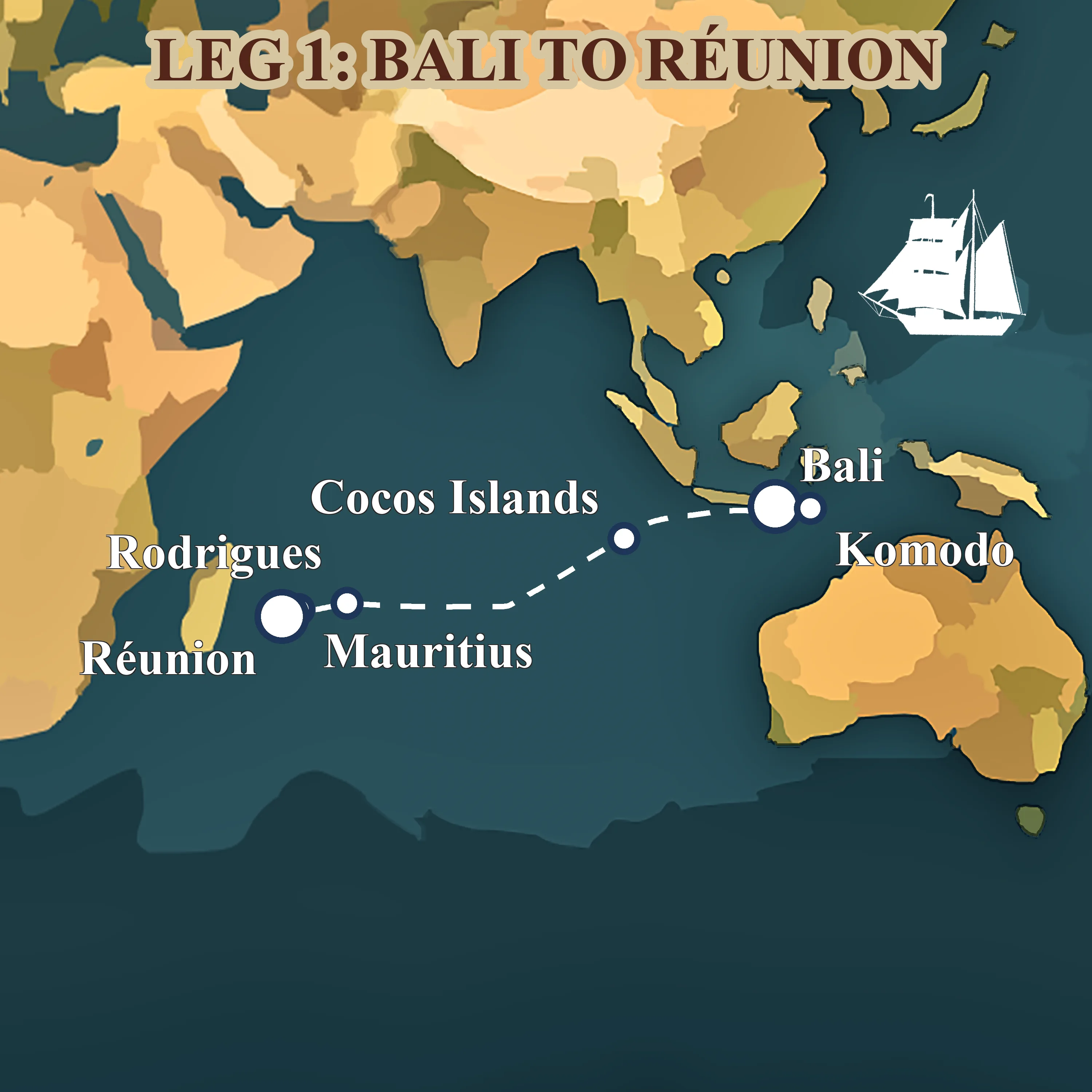
Leg 1: from Bali to Réunion across the Indian Ocean
May 2026 — Aug 2026 · Bali, Indonesia → Réunion, France
The opening chapter of Neptun's 482-day world voyage, a 4,078-nm trade-wind passage from the temples of Bali to the volcanic cliffs of Réunion.
Read more about this leg → about Leg 1: from Bali to Réunion across the Indian Ocean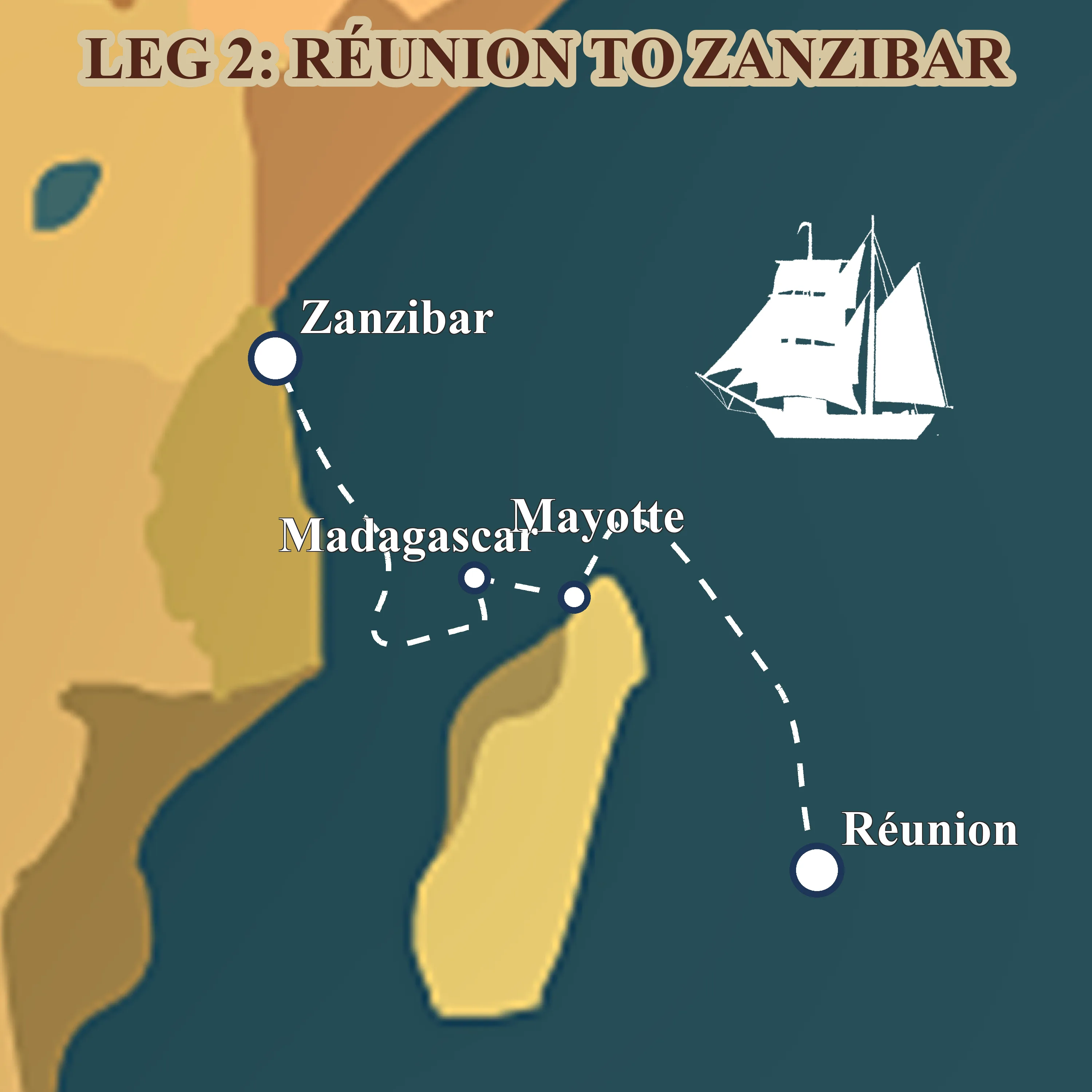
Leg 2: from Réunion to Zanzibar via Madagascar
Aug 2026 — Sept 2026 · Réunion, France → Zanzibar, Tanzania
Forty days across the western Indian Ocean, volcanic Réunion, lemur-haunted Nosy Be, the Mozambique Channel, and the spice-scented stone alleys of Zanzibar.
Read more about this leg → about Leg 2: from Réunion to Zanzibar via Madagascar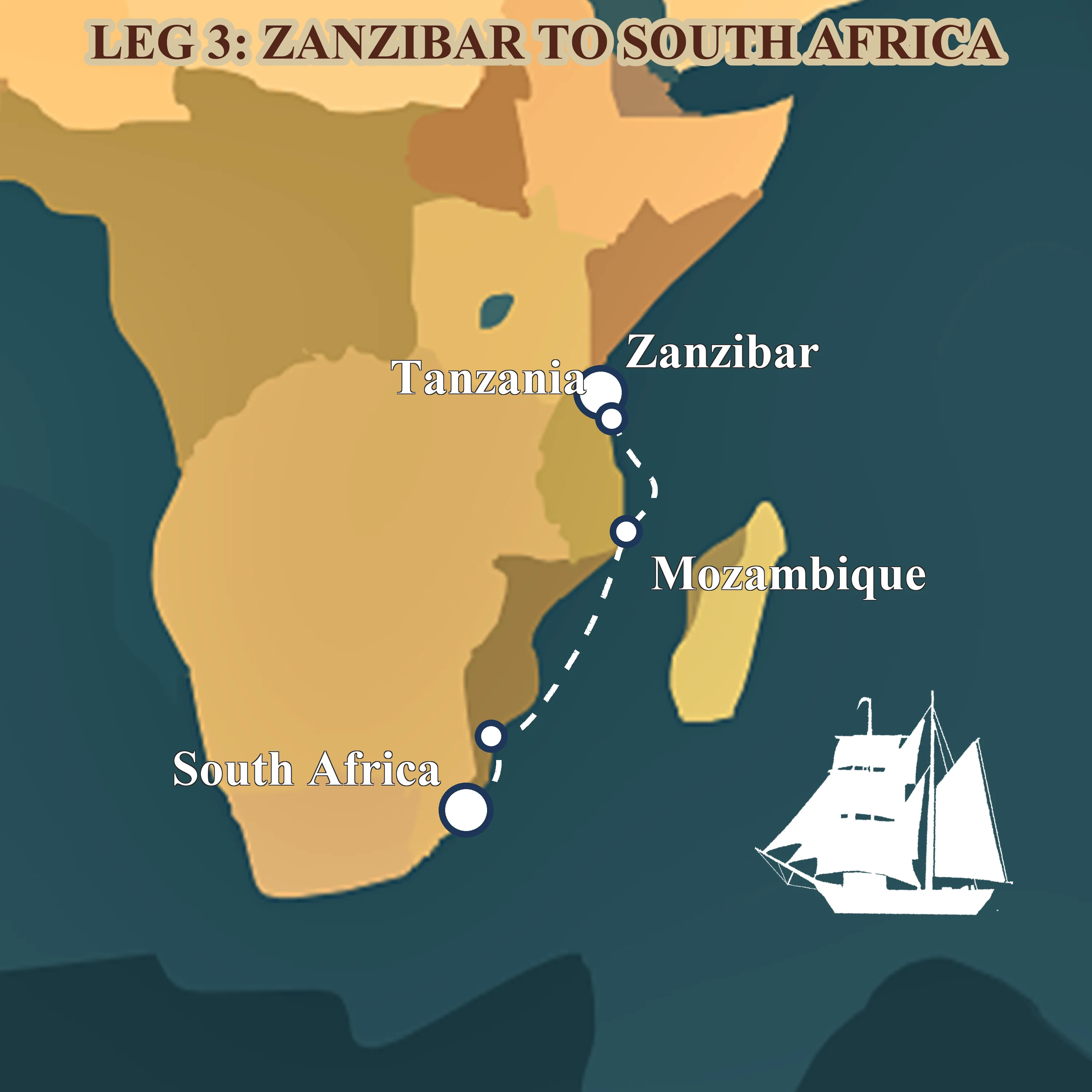
Leg 3: from Zanzibar to Durban down the Mozambique Channel
Sept 2026 — Nov 2026 · Zanzibar, Tanzania → Durban, South Africa
Sixty-three days coasting the African shore, spice islands, mangrove anchorages, Portuguese praças and the long trade-wind run down the Mozambique Channel to Durban.
Read more about this leg → about Leg 3: from Zanzibar to Durban down the Mozambique Channel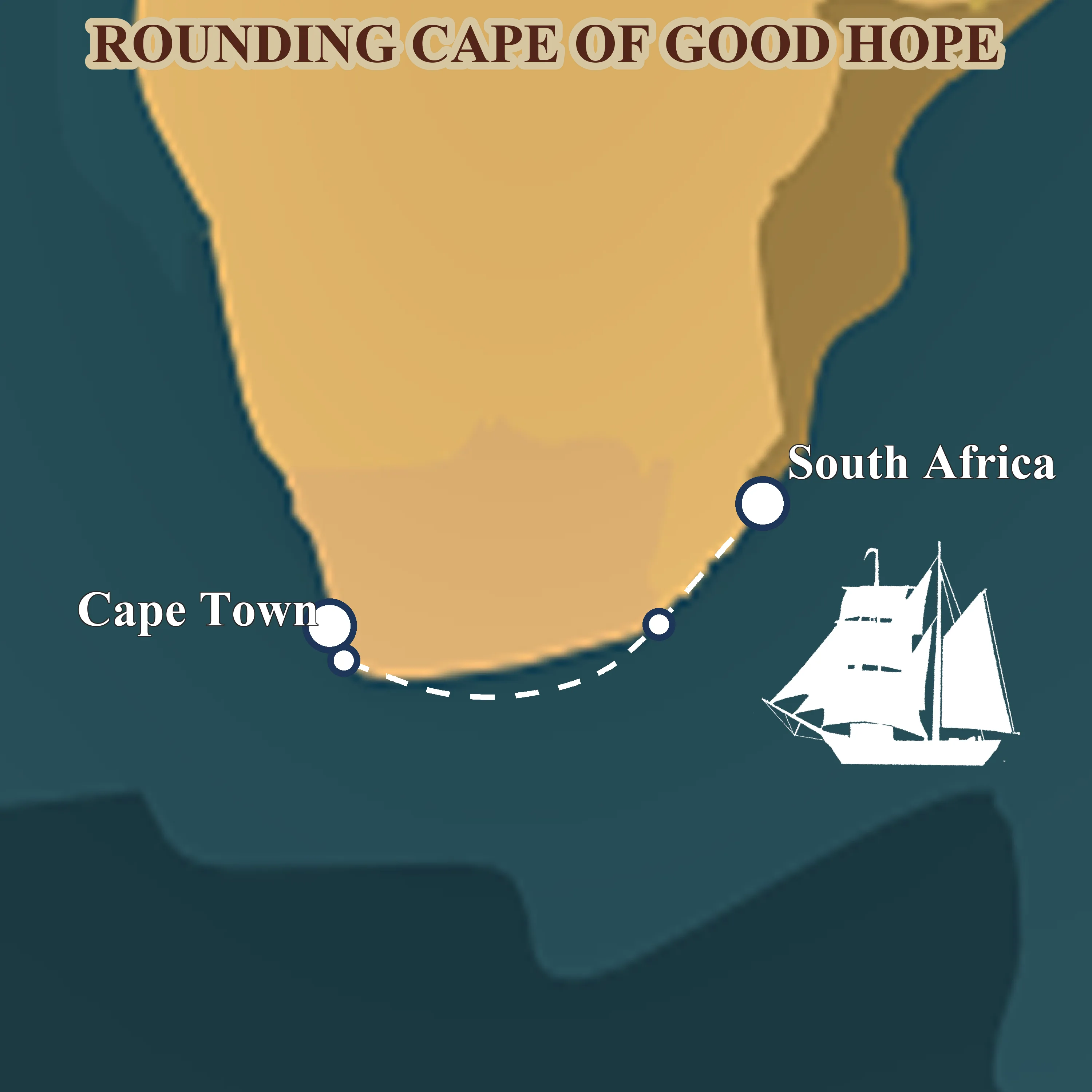
Leg 4: from Durban around the Cape of Good Hope
Nov 2026 — Dec 2026 · Durban, South Africa → Cape Town, South Africa
Thirty-eight days of serious seamanship, the Agulhas current, the Cape of Good Hope and the Southern Ocean at the tip of Africa, finishing quietly in Cape Town for Christmas.
Read more about this leg → about Leg 4: from Durban around the Cape of Good Hope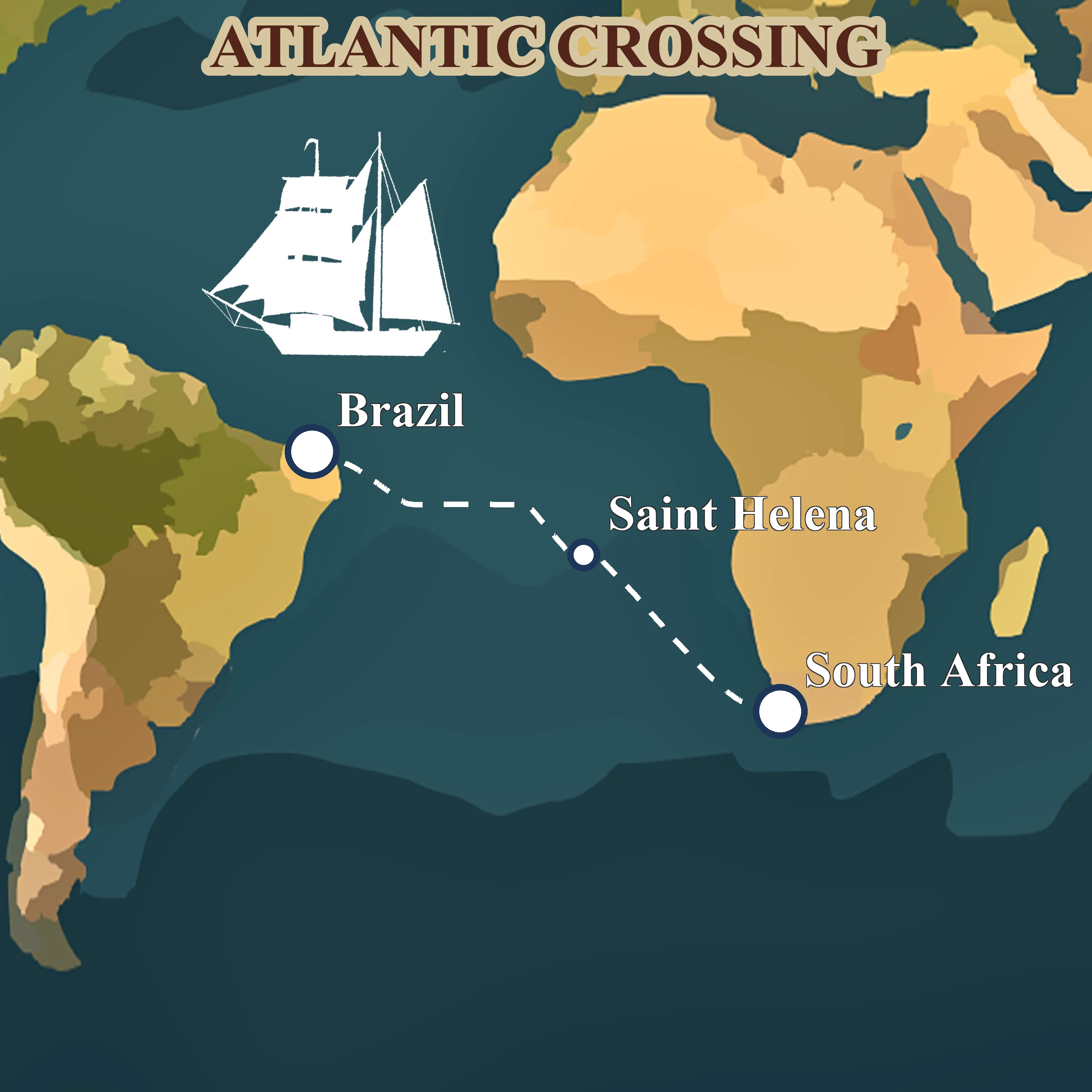
Leg 5: across the South Atlantic from Saldanha to Fortaleza
Jan 2027 — Mar 2027 · Saldanha Bay, South Africa → Fortaleza, Brazil
Forty-four days before the southeast trades, Napoleon's exile at St. Helena, the equator crossing, and landfall in tropical Brazil. The ocean chapter of the voyage.
Read more about this leg → about Leg 5: across the South Atlantic from Saldanha to Fortaleza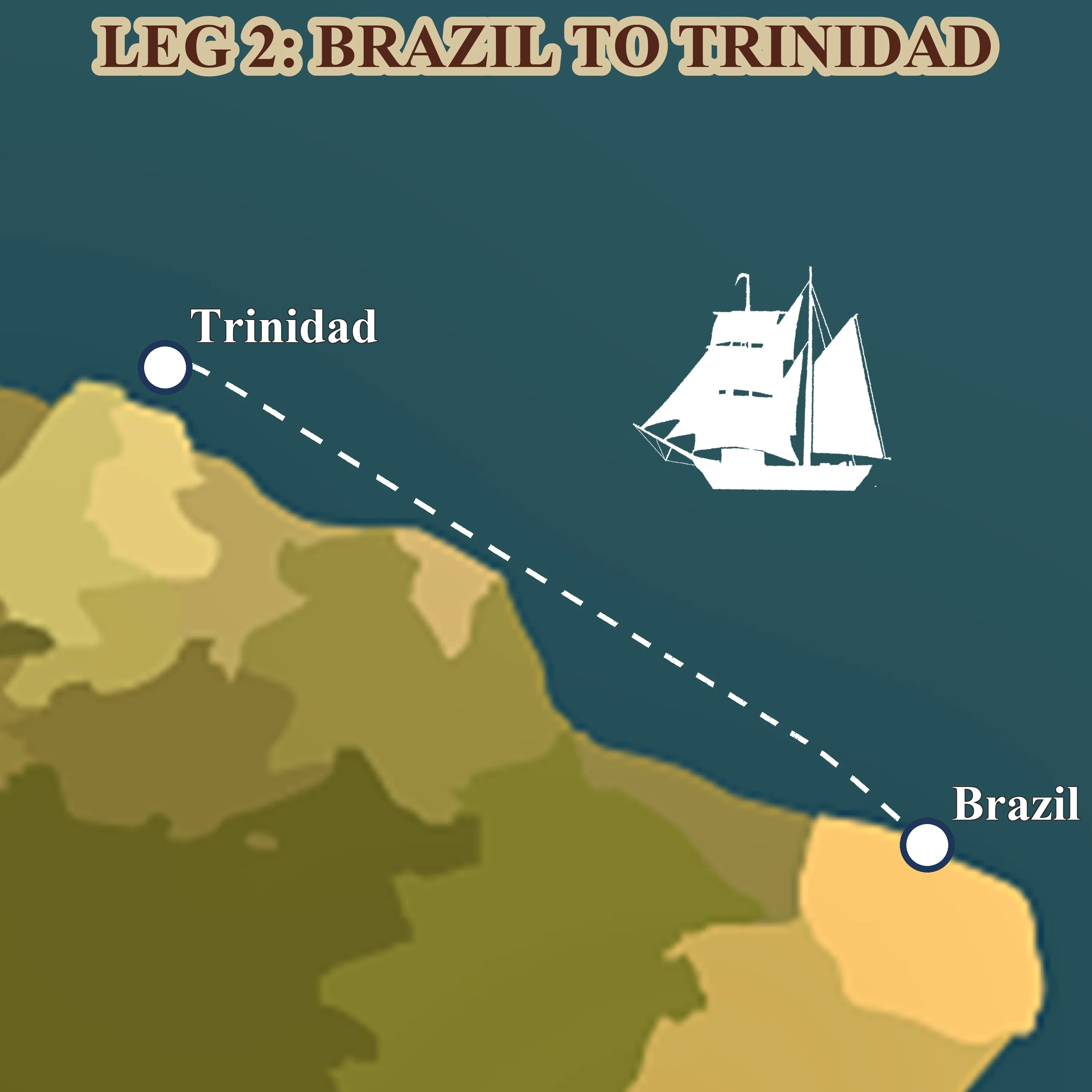
Leg 6: from Fortaleza to Trinidad along South America
Mar 2027 — Apr 2027 · Fortaleza, Brazil → Trinidad
A thousand miles of downwind trade running, the Amazon's brown water under the hull, the Guianas smudged on the horizon, and Trinidad's steelpan waiting at the end.
Read more about this leg → about Leg 6: from Fortaleza to Trinidad along South America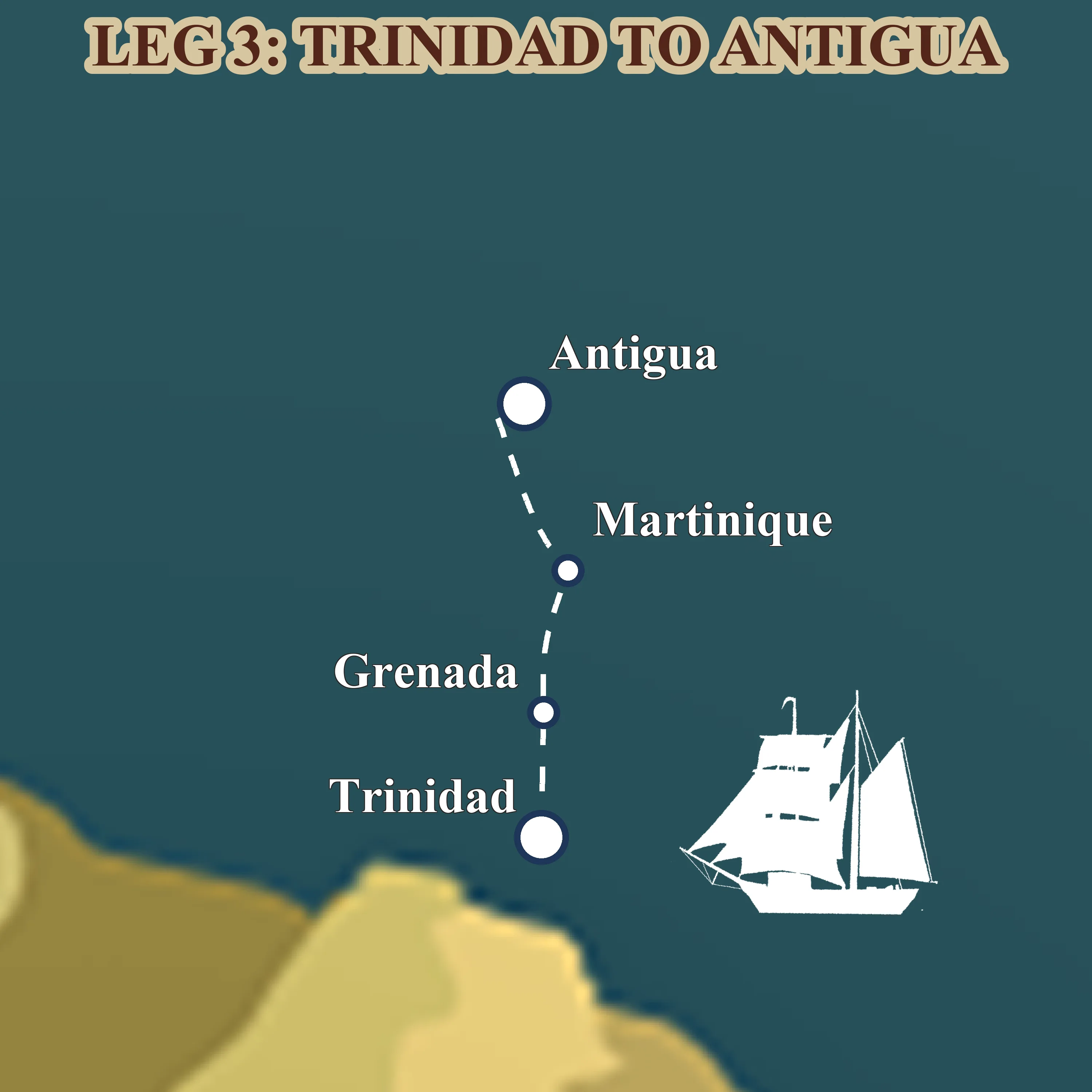
Leg 7: through the Windward Islands from Trinidad to Antigua
Apr 2027 — May 2027 · Trinidad → Antigua
Four weeks of short trade-wind daysails through the Lesser Antilles, turquoise anchorages, rum shops on the sand, French-Creole Martinique and the tall-ship scene in Antigua.
Read more about this leg → about Leg 7: through the Windward Islands from Trinidad to Antigua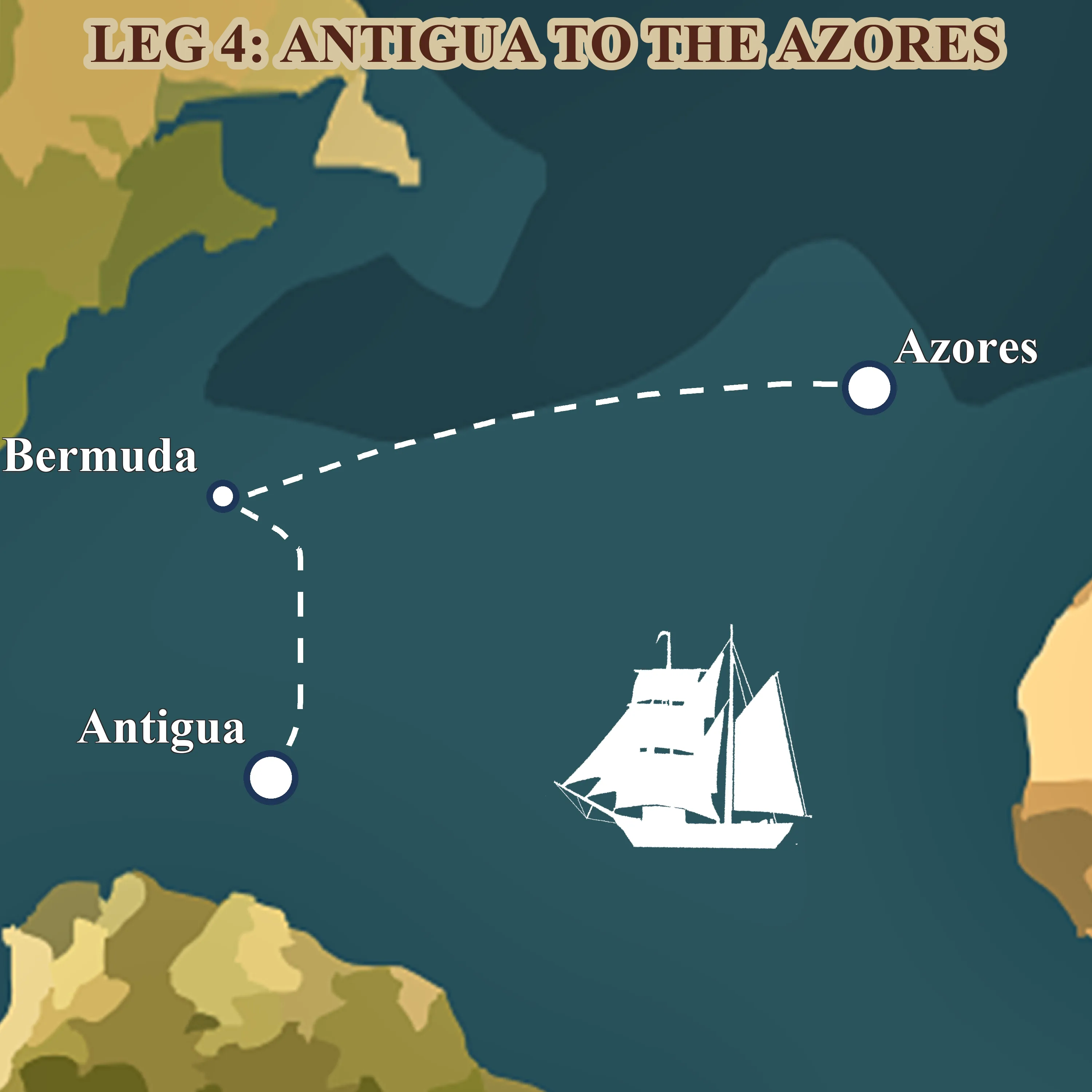
Leg 8: across the North Atlantic from Antigua to the Azores
May 2027 — Jul 2027 · Antigua → Ponta Delgada, Azores
Fifty-six days on the classic spring tall-ship route home, Antigua, a long reach to Bermuda's pink sand, then three weeks of open ocean to the volcanic Azores.
Read more about this leg → about Leg 8: across the North Atlantic from Antigua to the Azores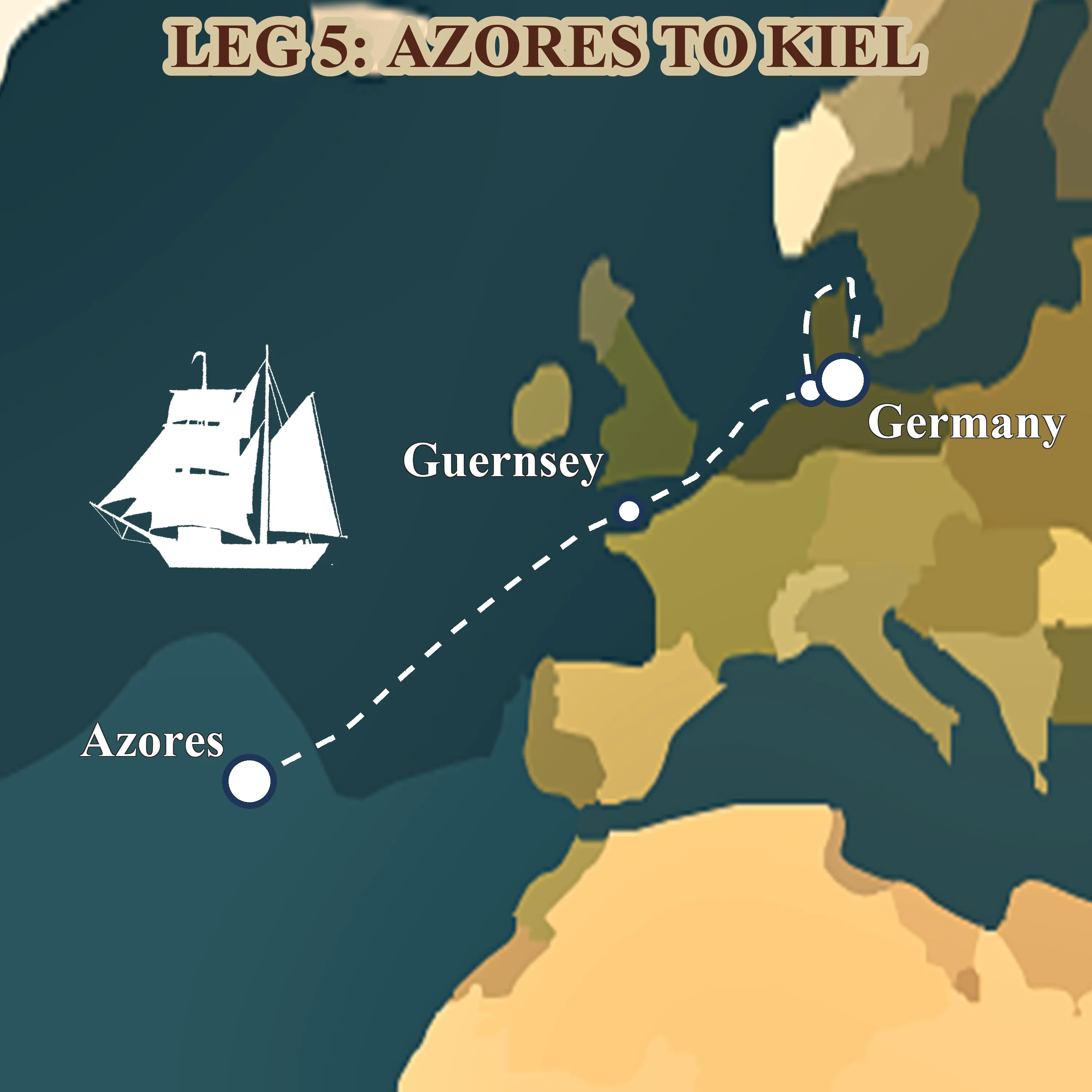
Leg 9: homecoming from the Azores to Kiel
Jul 2027 — Aug 2027 · Ponta Delgada, Azores → Kiel, Germany
The final 1,878 nm, from volcanic São Miguel to the Baltic, up the English Channel through the Dover TSS, past Helgoland's red cliffs and home to Kiel.
Read more about this leg → about Leg 9: homecoming from the Azores to KielThree threads that run through every ship on this list
Read all ten profiles in sequence and three patterns emerge that say something about how the tall-ship tradition has actually survived.
The first is reuse. Almost none of these ships were originally built for the role they hold today. Bark Europa was a German lightship for sixty-six years before she had a yard hoisted on her. Picton Castle was a fishing trawler for nearly seventy. NEPTUN was a Hamburg-financed fishing vessel before she was a brigantine. Even USCG Eagle and Statsraad Lehmkuhl, originally built for sail training, changed flags and ownership before settling into their current role. The pattern is closer to Theseus' ship than to a museum piece, every working tall ship is in some sense a second life.
The second is the money. Cadet ships (Vespucci, Eagle, Skoleskibet Danmark, Sørlandet historically) survive because a state navy or maritime authority writes a cheque every year. Trainee ships (Picton Castle, NEPTUN, Bark Europa) survive on a mix of crew-share contributions, voluntary labour, and donations, a thinner margin. NEPTUN specifically is a non-profit running on a shared-cost basis: crew pay covers the running costs of the voyage, not a margin. Replicas like Stad Amsterdam are underwritten by commercial sponsors. There is no model that supports a tall ship purely on what crew pay; every one of the ten has a backer who is paying for something other than the voyage itself.
The third is people. Every ship on this list runs on a chain of permanent crew who learned the work from people who learned it from people who learned it before them. The same lineage runs through the trainees who arrive knowing nothing and leave eight weeks later able to call a sail-handling team. If that chain ever breaks, the ships go cold. Reading about famous tall ships is one thing; stepping aboard one as a trainee is the only way the chain stays intact.
Become one more link in the chain
Every trainee on a tall ship is one more person who can teach the next. NEPTUN takes ten per leg, no experience needed.
FAQs
Common questions about famous tall ships still sailing today
How many tall ships are still sailing in 2026?
Estimates vary, but somewhere in the region of one thousand sailing vessels worldwide carry the "tall ship" label, of which perhaps a hundred and twenty regularly cross oceans. The ten in this guide are the ones that combine offshore work, public profile, and continuous service. Most active vessels are smaller schooners and ketches that sail coastal routes only.
What is the oldest tall ship still sailing?
The hull of bark Europa is the oldest in this list, launched in 1911, but she only became a sailing ship in 1994. The oldest ship that has been a tall ship continuously is Sørlandet, launched in 1927. By rig, she is also the oldest full-rigged ship still in active service.
Which famous tall ships can I actually sail on as a trainee?
Of the ten in this guide: Brigantine NEPTUN (10 trainees per leg, non-profit), Picton Castle (around 40 trainees per voyage), Bark Europa (Antarctic and trans-ocean voyages), Christian Radich (charter and trainee bookings), Statsraad Lehmkuhl (150 trainee berths) and Stad Amsterdam (limited offshore legs) all take paying trainees in some form. The naval ships, Vespucci, Eagle, Skoleskibet Danmark, and Sørlandet (which now carries A+ World Academy school students), do not. Sail with us covers what a NEPTUN trainee leg actually involves.
What is the difference between a barque, a brigantine and a full-rigged ship?
A full-rigged ship has square sails on every mast (Sørlandet, Vespucci, Skoleskibet Danmark, Christian Radich). A barque has square sails on the foremost masts and fore-and-aft sails only on the aftmost mast (Statsraad Lehmkuhl, Picton Castle, USCG Eagle, Bark Europa). A brigantine, like NEPTUN, has square sails only on the foremast and fore-and-aft sails on the main. The full breakdown is in what is a brigantine and brigantine vs schooner.
Are Bark Europa and Brigantine NEPTUN the same kind of programme?
Both take paying trainees on offshore voyages. The differences are scale, geography and structure. Bark Europa is larger, sails Antarctic and South-Atlantic routes, and operates as a Dutch private company. NEPTUN is smaller, runs a 482-day world voyage in 2026-2027, and operates as a Danish non-profit foundation. The trainee work, square-sail handling, watchkeeping, celestial sights, is broadly the same on either ship.
Why are so many famous tall ships German-built?
The German shipyards Blohm & Voss in Hamburg and C. Tecklenborg in Geestemünde built the last great commercial sailing fleet, the Flying P-Liners and the German naval training ships, between roughly 1900 and 1939. Three of the ten ships in this guide started life in those yards: Statsraad Lehmkuhl (1914), Bark Europa (1911) and USCG Eagle (1936). When wartime reparations re-distributed German tonnage in 1921 and 1946, those ships ended up under Norwegian, Dutch, American, Portuguese and Soviet flags, which is most of why the modern tall-ship fleet exists in its current form at all.
Has any of these ships been lost recently?
No total losses among the ten. Bark Europa fell over in dry dock at Cape Town in May 2023, with one minor injury and significant repair work; she returned to service. The wider tall-ship community lost STS Lord Nelson and SV Tenacious from active sailing when the Jubilee Sailing Trust closed in 2022, but neither vessel is wrecked, both are in shoreside hands. Heritage in this fleet is fragile; survival is not guaranteed.
The ten ships
The fleet, at a glance
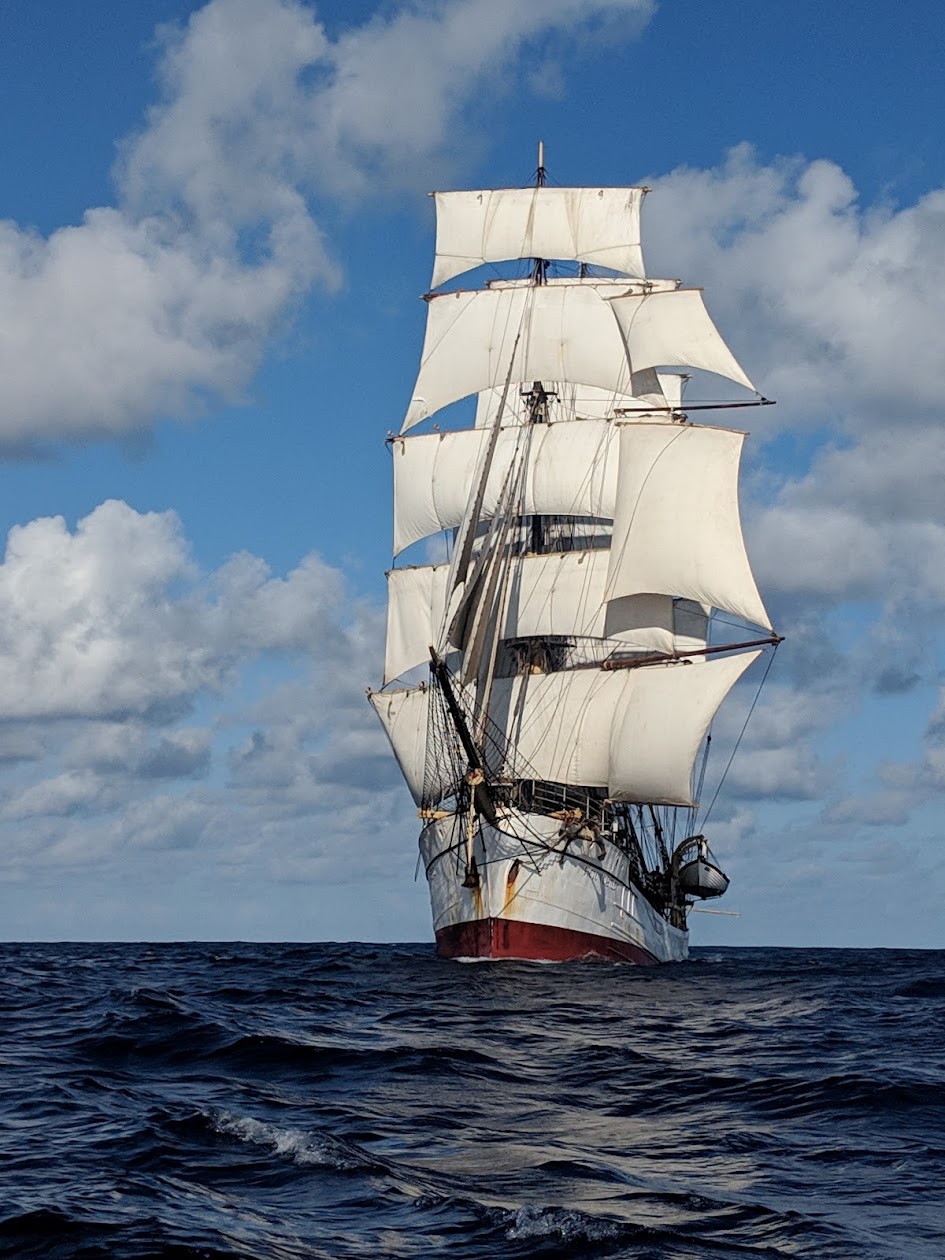
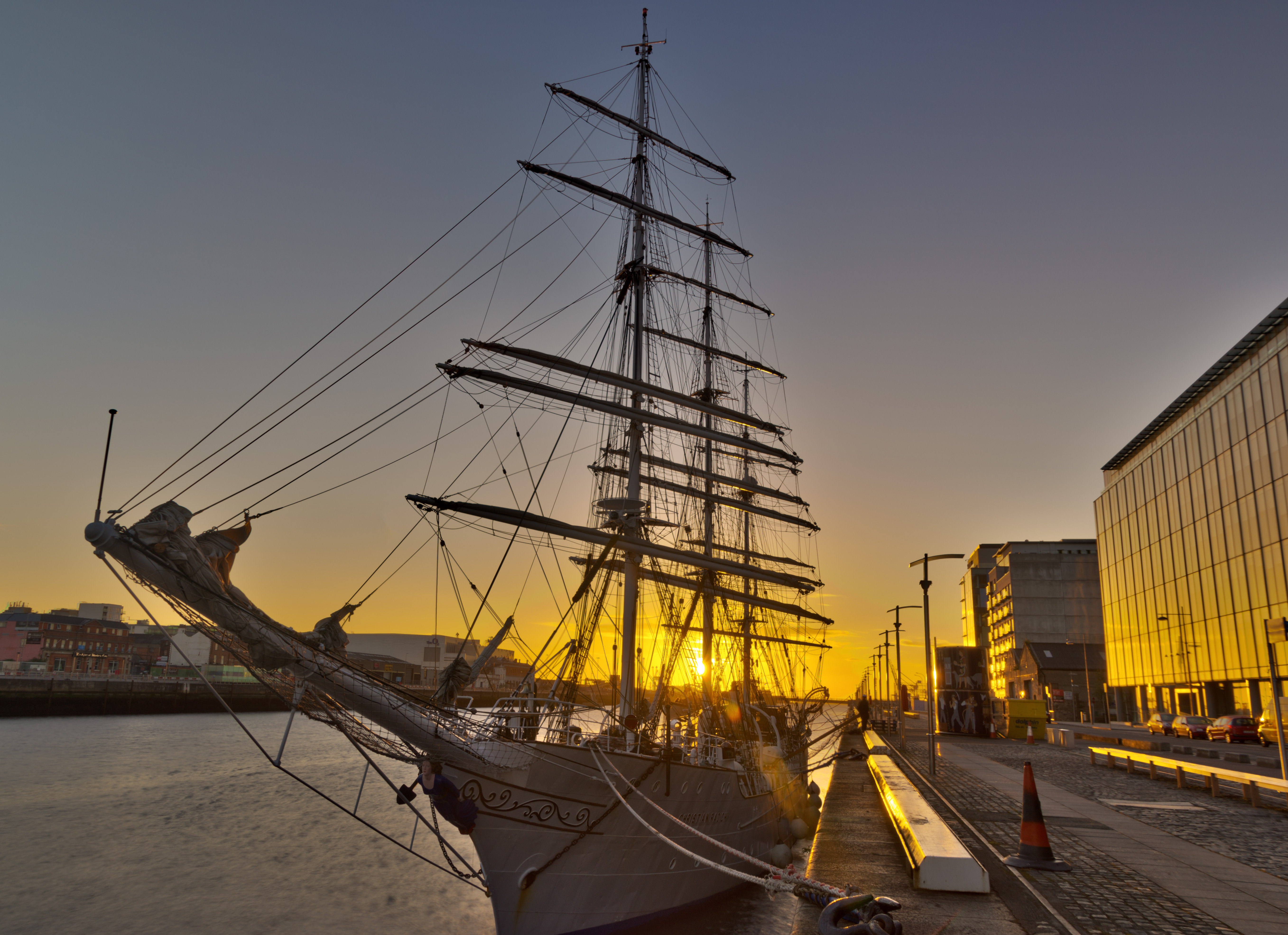
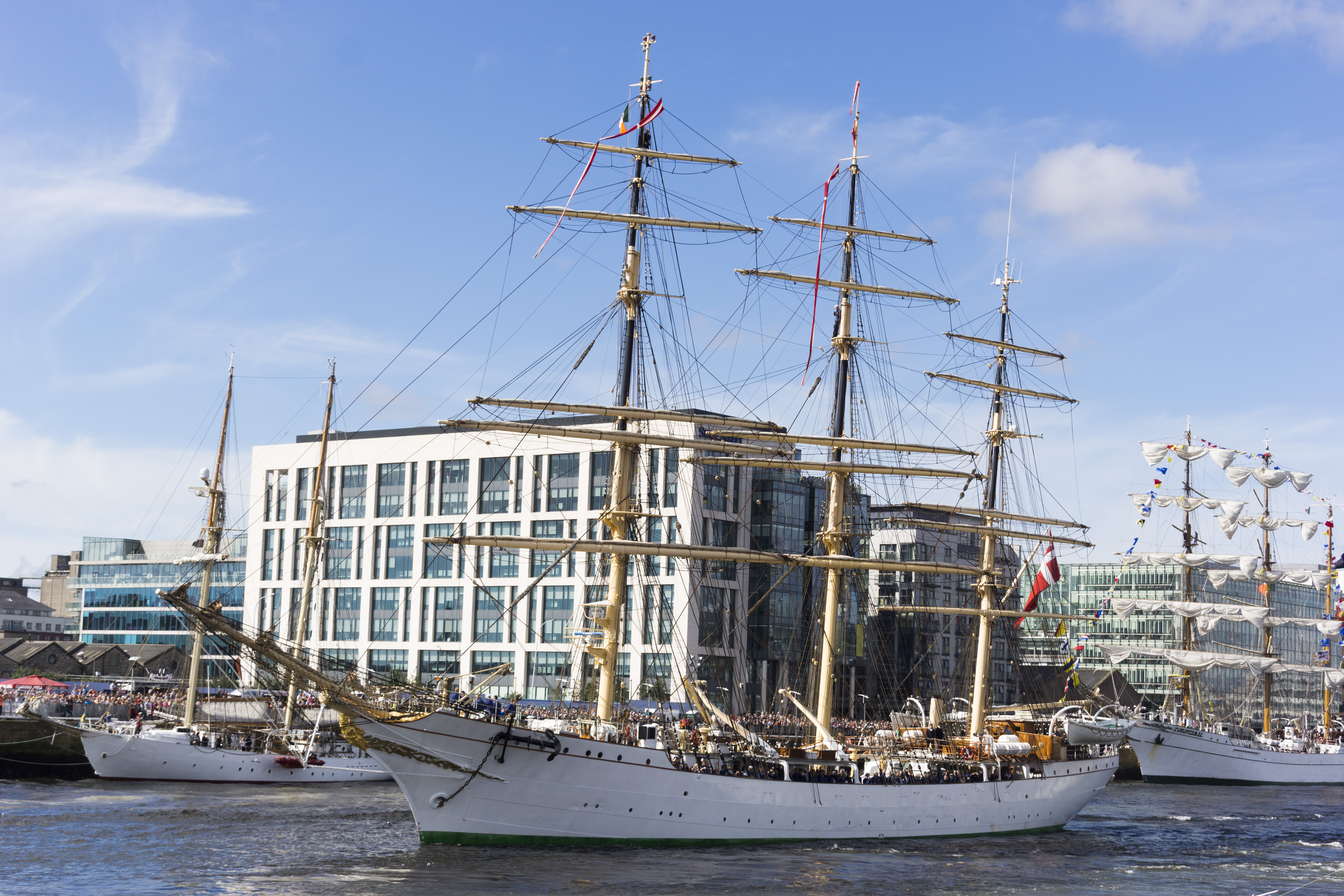
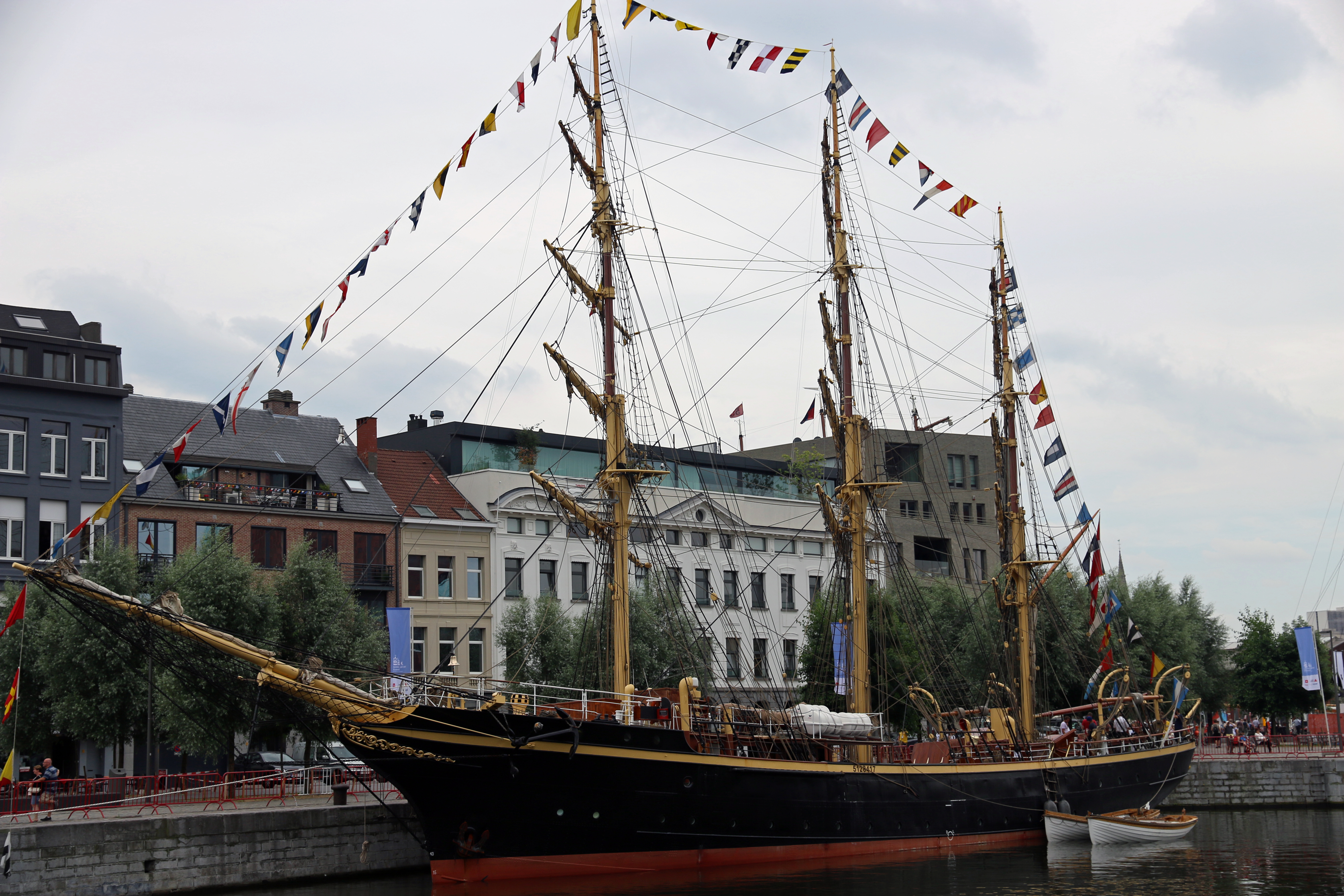
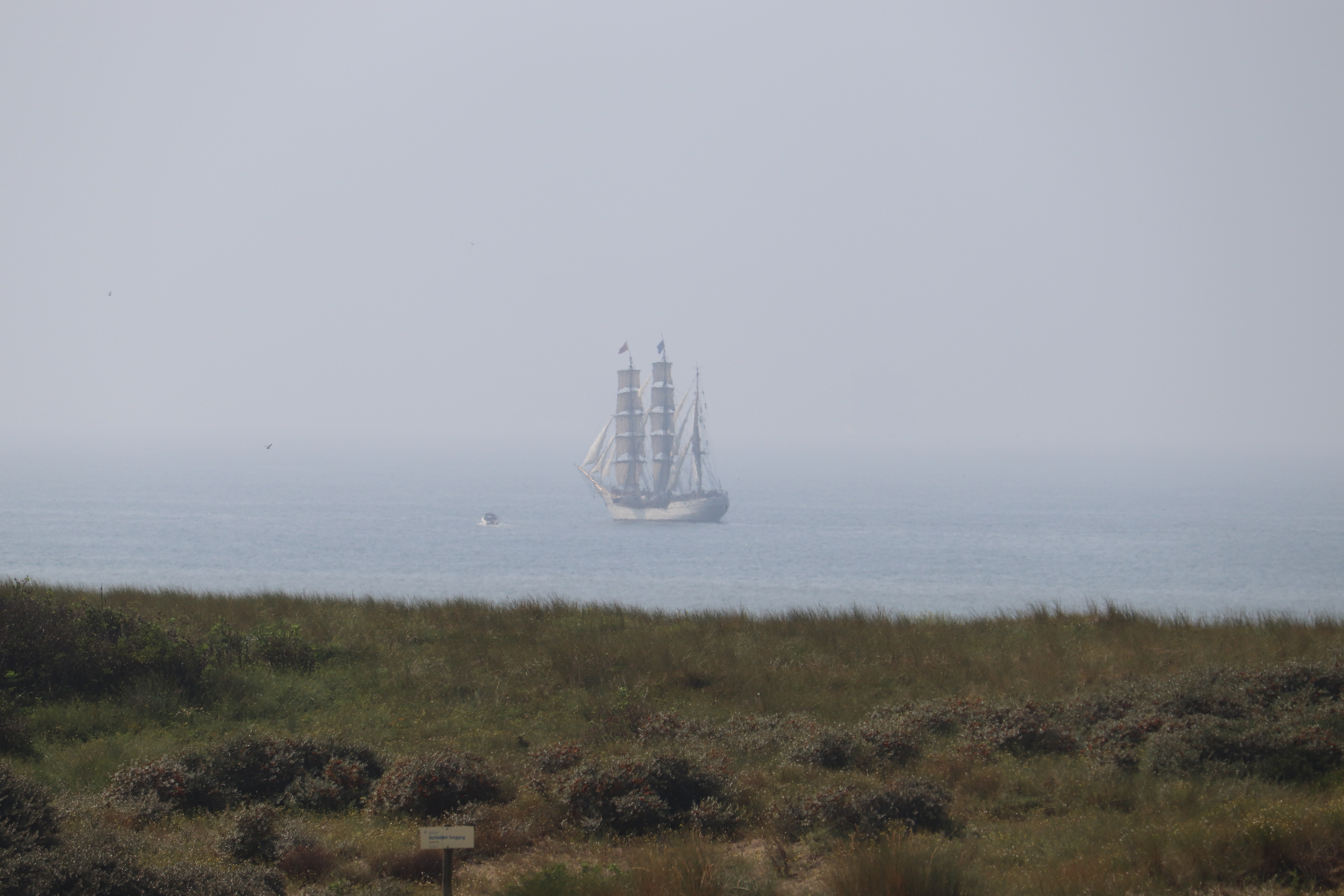
Photos sourced from Wikimedia Commons (CC-BY / CC0 / public domain) and NEPTUN's own crew archive. Captions credit each photographer and licence.
Read also
- Skoleskibet Danmark, Denmark's seagoing classroom since 1932, the WWII USCG-handover story in narrative
- Georg Stage, the foundation that has trained Danish sailors since 1882, the older Danish full-rigger
- Daniel Moreland and Picton Castle, how a fishing trawler became a circumnavigator, the captain who built the modern world-voyage trainee model
- Alan Villiers, the man who saved the windjammer story, the Australian writer-skipper who kept the genre alive in print
- Irving Johnson and the Yankee, seven world voyages with paying crew, the original blueprint for trainee circumnavigations
- Bill Kimberly and the rebuild of NEPTUN, how NEPTUN got her brigantine rig back
- What is a brigantine, the rig you will be working on if you sail with us
- Parts of a tall ship, the vocabulary, with diagrams
- Square sails explained, the canvas in detail
- Browse the 2026-2027 voyages, the nine legs you can apply for
- Apply for a berth, join NEPTUN as trainee crew
The 2026 season
Five legs from Atlantic to Pacific to Indian Ocean, pick the dates that fit yours.
Leg 1: from Bali to Réunion across the Indian Ocean
May 2026 — Aug 2026 · Bali, Indonesia → Réunion, France
The opening chapter of Neptun's 482-day world voyage, a 4,078-nm trade-wind passage from the temples of Bali to the volcanic cliffs of Réunion.
Read more about this leg → about Leg 1: from Bali to Réunion across the Indian OceanLeg 2: from Réunion to Zanzibar via Madagascar
Aug 2026 — Sept 2026 · Réunion, France → Zanzibar, Tanzania
Forty days across the western Indian Ocean, volcanic Réunion, lemur-haunted Nosy Be, the Mozambique Channel, and the spice-scented stone alleys of Zanzibar.
Read more about this leg → about Leg 2: from Réunion to Zanzibar via MadagascarLeg 3: from Zanzibar to Durban down the Mozambique Channel
Sept 2026 — Nov 2026 · Zanzibar, Tanzania → Durban, South Africa
Sixty-three days coasting the African shore, spice islands, mangrove anchorages, Portuguese praças and the long trade-wind run down the Mozambique Channel to Durban.
Read more about this leg → about Leg 3: from Zanzibar to Durban down the Mozambique ChannelLeg 4: from Durban around the Cape of Good Hope
Nov 2026 — Dec 2026 · Durban, South Africa → Cape Town, South Africa
Thirty-eight days of serious seamanship, the Agulhas current, the Cape of Good Hope and the Southern Ocean at the tip of Africa, finishing quietly in Cape Town for Christmas.
Read more about this leg → about Leg 4: from Durban around the Cape of Good HopeWant to sail with us? Brigantine NEPTUN is a non-profit training ship, every voyage takes 10 crew members through real ocean sailing, no experience needed. Apply for a berth or read about the voyages first.