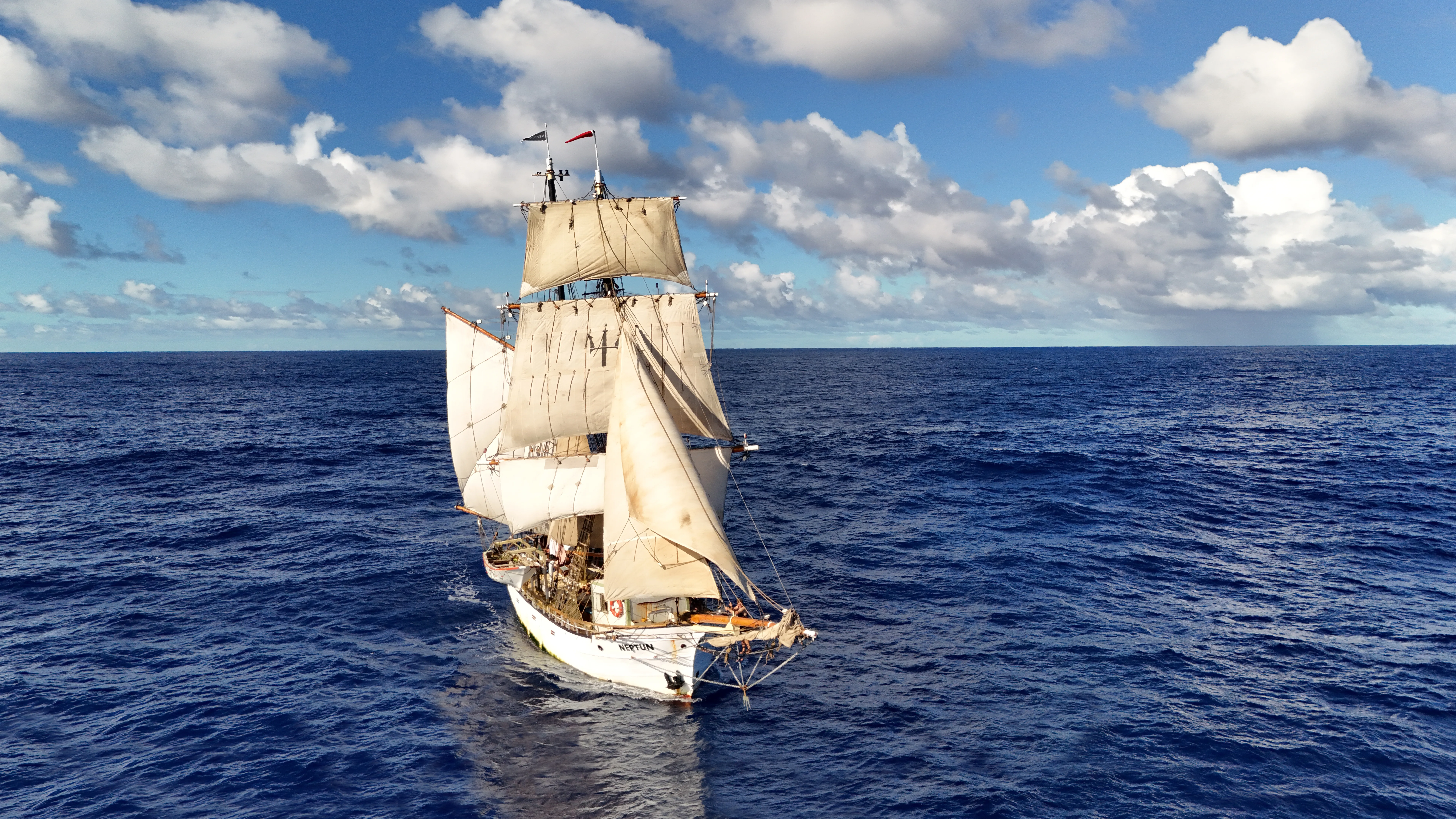
The working answer to an old question
Can you still sail trainees around the world under square rig in the 21st century? Dan Moreland and Picton Castle are the working answer. Since 1997, the Lunenburg-based barque has carried roughly 2,500 amateur crew across six full circumnavigations and logged on the order of 300,000 nautical miles, the longest unbroken run of trainee world voyages in modern square-rig sail training. Moreland himself learned the trade under the late Captain Arthur Kimberly aboard the brigantine Romance in the 1970s; what he learned there is the model Picton Castle has been running ever since.
This article covers who Moreland is, how the ship was found and converted, what the six world voyages actually did, why the pay-to-sail model works, and how the same lineage now feeds Brigantine NEPTUN's 2026-2027 world voyage.
Want to sail the same model, the next chapter? Apply for a berth on a NEPTUN leg or browse the nine legs of the 2026-2027 voyage first.
On this page
- The working answer to an old question
- Who Dan Moreland is
- The ship, from Welsh trawler to barque
- The 1997 first world voyage
- The Picton Castle model, pay-to-sail, no experience, real work
- The six world voyages
- Lunenburg and the Picton Castle ethos
- How Picton Castle shaped NEPTUN
- FAQ
- Read also
Who Dan Moreland is
Daniel Moreland's career reads like a deliberate apprenticeship in a trade most of the world had given up on. He sailed first on the West Indian schooner Maverick under Captain Jack Carstarphen in the early 1970s. From there he stepped to the brigantine Romance under Captain Arthur Kimberly, four years on a wooden square-rigger that the Kimberlys ran as a floating apprenticeship for whoever turned up willing to learn. Romance is the direct ancestor of every modern paid-trainee square-rigger, and Moreland is the most consequential graduate.
After Romance, Moreland served four years as bosun on the 800-ton Danish full-rigged ship Danmark, eight transatlantic passages, learning Danish to integrate with the Scandinavian crew, and what he later called "the Rolls-Royce of deepwater sail training." By the time he started looking for a ship of his own in the late 1980s, he had served as master or mate on topsail schooners, brigantines, brigs and barques across decades of working sail.
The credentials accumulated on the Picton Castle deck over the next quarter century: Sail Training International's Sail Trainer of the Year (2011) and a Tall Ships America Lifetime Achievement Award in Sail Training (2017). The career arc is the through-line: he learned from the last generation that ran square-riggers as a working trade, and he has spent thirty years passing that on, one watch at a time.
The lineage
Romance to Picton Castle to NEPTUN
Moreland sailed four years on Captain Kimberly's brigantine Romance, the ship that kept square-rig sail training alive when fibreglass had taken over everything else. What he learned there became the operating manual of Picton Castle. NEPTUN sits in the same line.
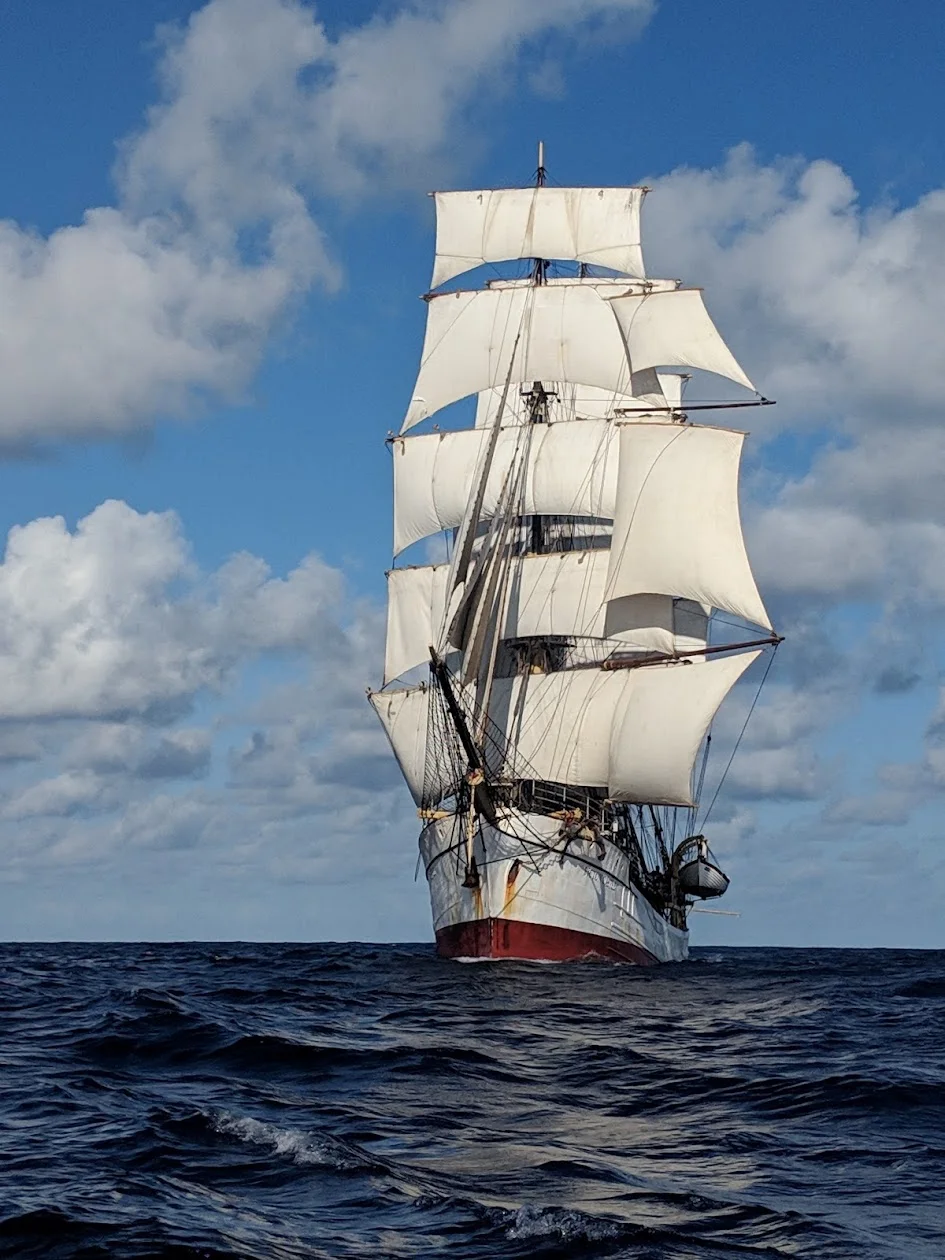
Photo: Anders Bischoff aboard Picton Castle, 2018.
The ship, from Welsh trawler to barque
The hull that became Picton Castle was launched in 1928 at Cochrane's yard in Selby, Yorkshire, as a steam-powered side trawler for Consolidated Fisheries of Swansea, Wales. She was named after Picton Castle in Pembrokeshire. For her first decade she fished the North Atlantic out of Milford Haven on the south Welsh coast.
In 1939 the Royal Navy requisitioned her and commissioned her as HMS Picton Castle, a minesweeper and convoy escort. She survived the war, returned to fishing for another decade or so, and in the post-war years was re-engined with a diesel and sold on as a coastal freighter, North Sea, Baltic, as far north as Russia and as far south as Portugal. By 1991 she was tied up in a Norwegian fjord near Kopervik and going nowhere in particular.
That was where Moreland found her. He had been searching listings and ports for years for "the right ship that could be properly converted into a real blue water square-rigger." The Picton Castle hull had what he wanted underneath the rust streaks, a sailing-ship's underbody, riveted steel construction, and the structural margin to carry a full square rig. Initial restoration work began at South Street Seaport Museum in New York; the multi-million-dollar refit ran in Lunenburg, Nova Scotia from 1996 to 1997, turning her into a three-masted barque with double topsails, twenty-three sails, and roughly 12,450 square feet of canvas.
Picton Castle by the numbers
The vessel as she sails today
| Field | Specification |
|---|---|
| Built | 1928, Cochrane's, Selby, Yorkshire |
| Original role | Steam side trawler, Consolidated Fisheries (Swansea) |
| Wartime role | HMS Picton Castle, RN minesweeper / convoy escort, 1939-45 |
| Conversion | Lunenburg, Nova Scotia, 1996-97 |
| Length overall | 179 ft (55 m) |
| Displacement | ~565 tons |
| Rig | Three-masted barque (square-rigged on fore and main; fore-and-aft on mizzen) |
| Sail area | 12,450 ft² (1,160 m²) |
| Number of sails | 23 |
| Engine | 690 hp Burmeister & Wain Alpha diesel |
| Professional crew | 12 |
| Trainee capacity | up to 40 |
| Flag | Cook Islands |
| Home port | Lunenburg, Nova Scotia (unofficial) |
Rig nomenclature matters here: Picton Castle is a barque, not a brigantine like NEPTUN. She carries square sails on two masts; NEPTUN carries them on one. The difference is meaningful for sail handling, but the underlying training model, climb the rig, set the canvas, stand the watch, is the same. See brigantine vs schooner vs barque and parts of a tall ship for the rig taxonomy.
Curious how the same model shows up on a brigantine? NEPTUN's 2026-2027 voyage opens nine legs to trainees with no prior experience, the Picton Castle pattern, in a different rig.
The 1997 first world voyage
The maiden world voyage departed Lunenburg in late 1997 and returned in 1999, roughly fourteen months at sea, the model voyage that every subsequent Picton Castle circumnavigation would refine. Westabout via Panama, Galapagos, the Marquesas, the Tuamotus, Tahiti, the Cook Islands, Tonga, Fiji, Vanuatu, the Torres Strait, the Indian Ocean, South Africa, the South Atlantic, the Caribbean, and home. Trade-wind routing, deliberate ports, working ship.
That first voyage proved two things that the sail-training world had been arguing about for thirty years. First, that a full barque could still be operated safely on a paid-trainee basis around the world by a small professional core supported by amateur watch-standers. Second, that there was real demand, that adults from outside the maritime trade would pay to spend a year crossing oceans the slow way and would do the actual work of running the ship.
The Tall Ship Chronicles television series picked up the second voyage (2001-2002), bringing Moreland's deck and the trainee experience onto Canadian television in monthly hour-long episodes. By that point the question was no longer whether the model worked, it was how many more circumnavigations she could do.
Follow the same model
Sail one of NEPTUN's nine legs
The Picton Castle template, pay-to-sail trainees, real ocean miles, no prior experience required, runs in 2026-2027 on Brigantine NEPTUN. Pick a leg.
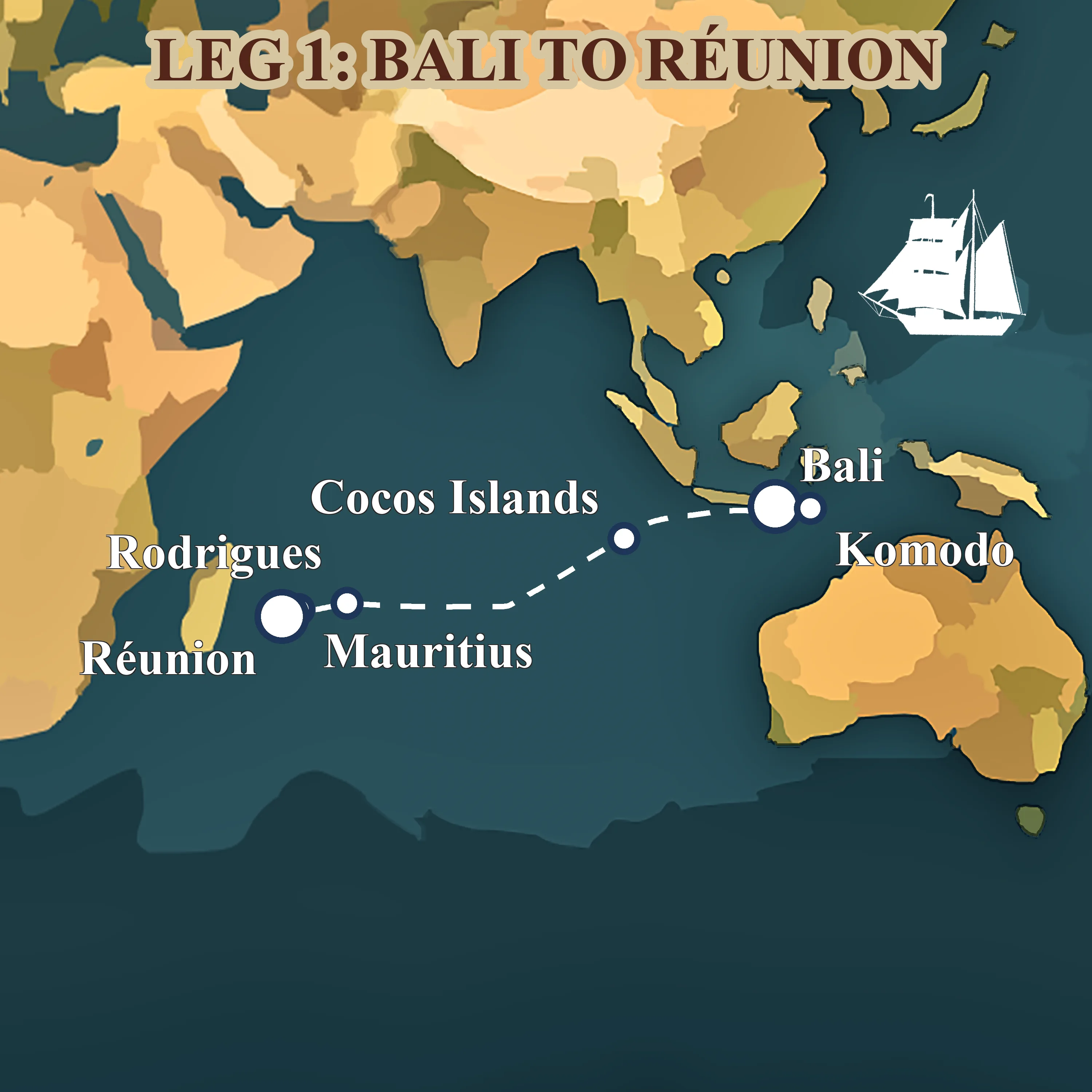
Leg 1: from Bali to Réunion across the Indian Ocean
May 2026 — Aug 2026 · Bali, Indonesia → Réunion, France
The opening chapter of Neptun's 482-day world voyage, a 4,078-nm trade-wind passage from the temples of Bali to the volcanic cliffs of Réunion.
Read more about this leg → about Leg 1: from Bali to Réunion across the Indian Ocean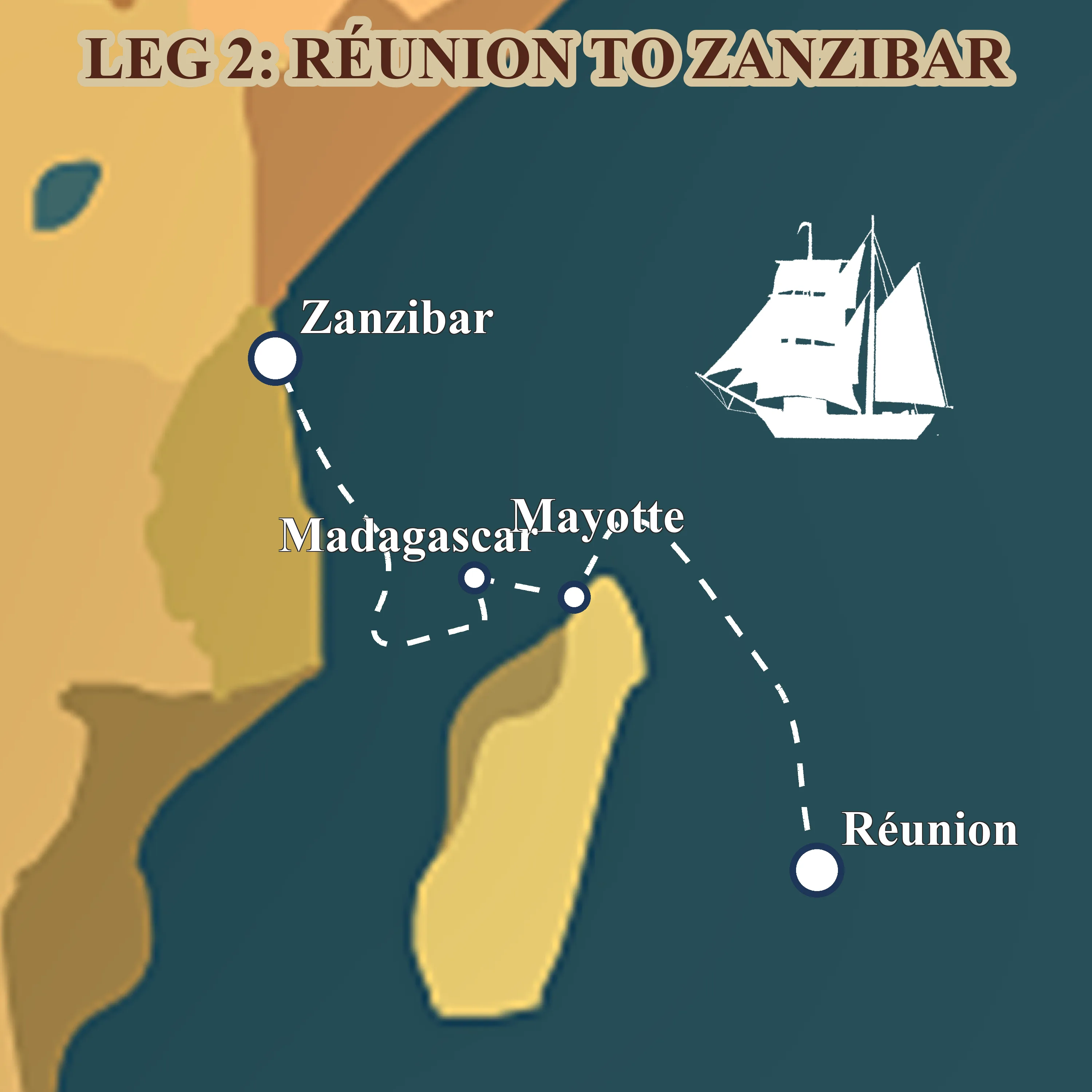
Leg 2: from Réunion to Zanzibar via Madagascar
Aug 2026 — Sept 2026 · Réunion, France → Zanzibar, Tanzania
Forty days across the western Indian Ocean, volcanic Réunion, lemur-haunted Nosy Be, the Mozambique Channel, and the spice-scented stone alleys of Zanzibar.
Read more about this leg → about Leg 2: from Réunion to Zanzibar via Madagascar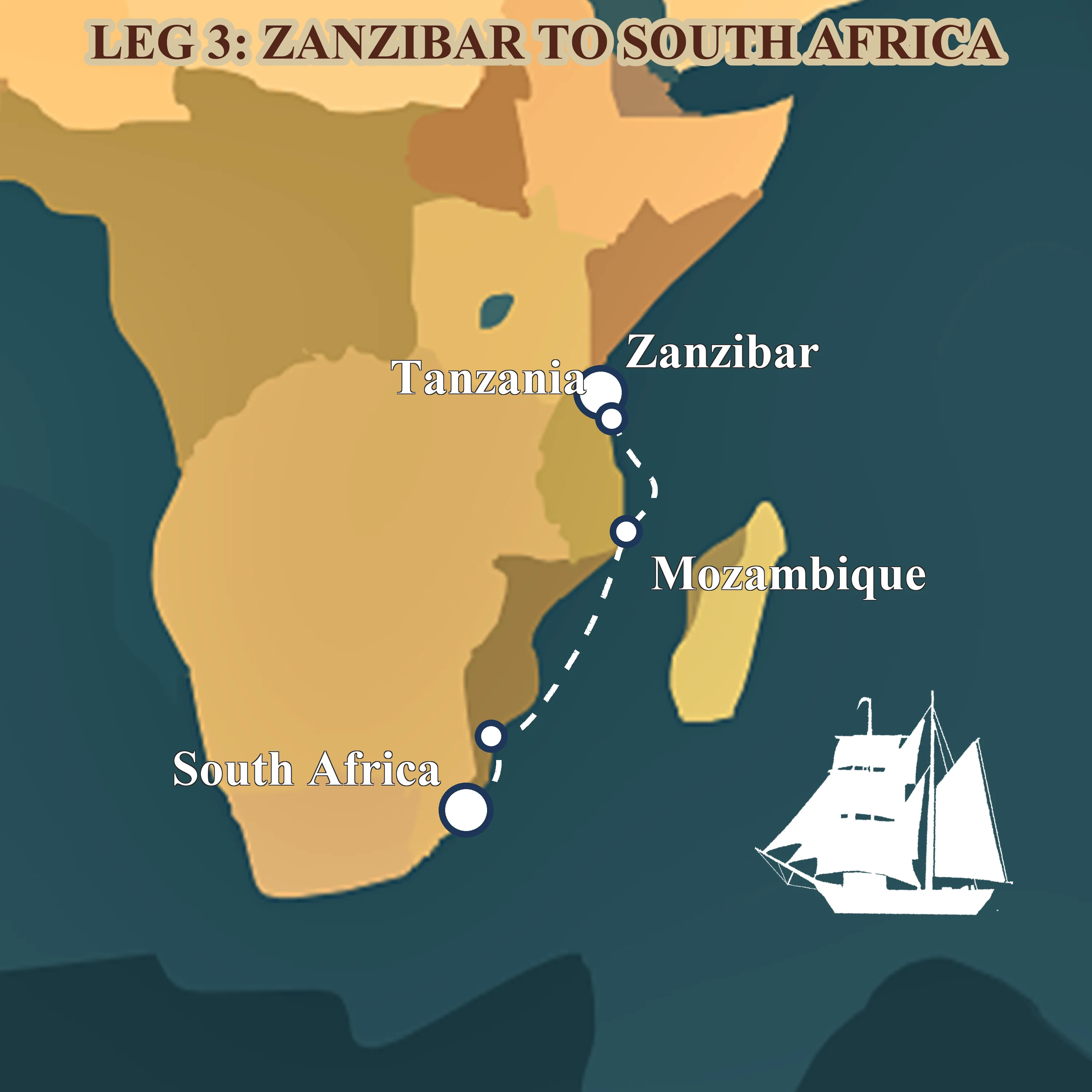
Leg 3: from Zanzibar to Durban down the Mozambique Channel
Sept 2026 — Nov 2026 · Zanzibar, Tanzania → Durban, South Africa
Sixty-three days coasting the African shore, spice islands, mangrove anchorages, Portuguese praças and the long trade-wind run down the Mozambique Channel to Durban.
Read more about this leg → about Leg 3: from Zanzibar to Durban down the Mozambique Channel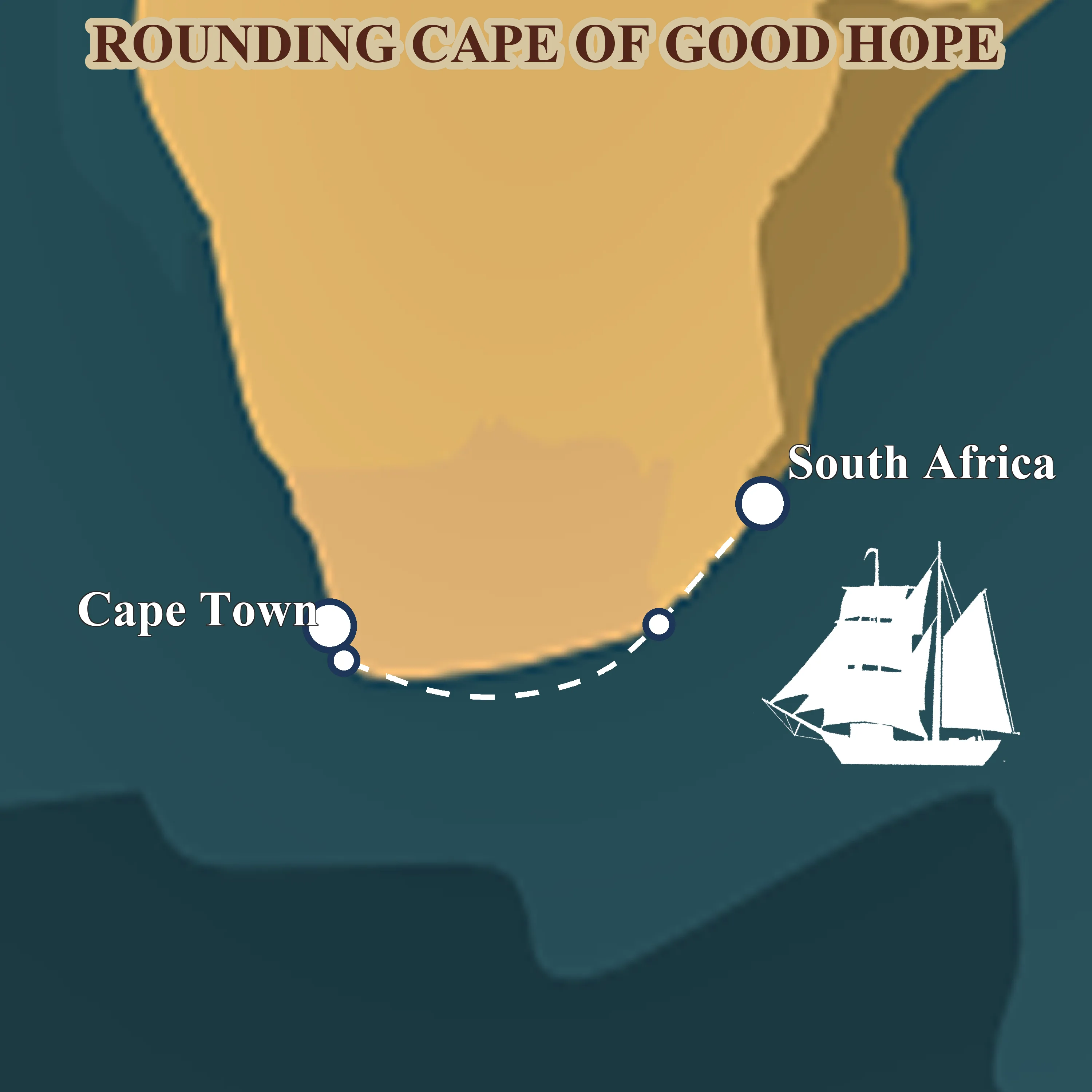
Leg 4: from Durban around the Cape of Good Hope
Nov 2026 — Dec 2026 · Durban, South Africa → Cape Town, South Africa
Thirty-eight days of serious seamanship, the Agulhas current, the Cape of Good Hope and the Southern Ocean at the tip of Africa, finishing quietly in Cape Town for Christmas.
Read more about this leg → about Leg 4: from Durban around the Cape of Good HopeThe Picton Castle model, pay-to-sail, no experience, real work
The Picton Castle operating model is what it always was: a small permanent crew, a much larger trainee complement, a fee that covers the voyage, and the explicit understanding that trainees are crew, not passengers. The deck has 205 named lines. Trainees learn them, stand watch, climb the rig in any weather, take the wheel on ocean passages, sew sails (all 23 are made aboard), caulk seams, paint, scrape, and stand fire and emergency stations alongside the professionals.
No prior experience required
The model was built for adults who have never set foot on a sailing vessel. Mentorship is structural, every watch pairs trainees with experienced crew. The voyage itself is the school.
Trainees are crew, not passengers
You handle lines, climb aloft, take the wheel, stand night watches. Pay-to-sail does not buy a hotel berth, it buys the right to be useful aboard a working ship.
Long ocean passages are the point
Multi-week ocean passages are not a side-effect of the route, they are what trainees come for. The transformation happens on day 18 of an open-ocean watch rotation, not in port.
Real seamanship, not simulation
Celestial navigation is taught alongside GPS. Sails are sewn aboard. Hull maintenance is done by the people who sail her. The standard is competence, not entertainment.
The mathematics of the model are simple. A core of twelve professional sailors plus up to forty trainees on a 179-foot barque is enough hands to run a three-watch system 24/7 across an ocean. Fees from trainees pay the running costs the way passenger revenue used to pay merchant shipping. Strip away the romance and the economics are blunt: this is the only way an organisation without a state navy or a wealthy patron can run a square-rigger across oceans for thirty years.
It is also the only model where a beginner can join. See how to join a tall ship crew without experience and what sail training actually costs for the practical detail. The fee structure is broadly comparable across the modern fleet, you can read the full economics in those two pieces.
The six world voyages
Picton Castle has completed six world voyages to date, plus a year-long Atlantic-basin voyage and an enormous list of shorter trade-wind, Caribbean, and Pacific runs. The chronological arc:
World Voyage 1, 1997-1999
The maiden circumnavigation. Roughly 14 months westabout via Panama, the South Pacific, the Indian Ocean, the Cape of Good Hope and the Atlantic back to Lunenburg. The proving ground for everything that followed.
World Voyage 2, 2001-2002
Documented in the Tall Ship Chronicles television series. 18 months. Ports included Cape Town, St Helena, Pitcairn, Palmerston, Puka Puka, Bali, Tonga, Vanuatu, Carriacou, the trainee experience brought to a national audience.
World Voyage 3, 2003-2004
A second-generation circumnavigation refining the now-established route. The model is no longer experimental.
World Voyage 4, 2005-2006
Continued the trade-wind westabout pattern. Each voyage adapts the route to local conditions, cyclone seasons, port closures, opportunities for remote-island delivery work.
World Voyage 5, 2010-2011
A return to circumnavigation after a stretch of Atlantic-basin and Caribbean voyaging. By this point the trainee community is generational, graduates of earlier voyages return as watch officers.
World Voyage 6, 2014-2016
A longer arc. By the mid-2010s, Picton Castle has been a working trainee square-rigger longer than most active careers in the trade. Moreland passes thirty years on his own deck.
A seventh circumnavigation was launched in 2018 and is referred to in some Picton Castle communications as the most recent / final under Moreland's command. Detailed dates of the most recent voyages vary across sources, pictoncastle.com is the authoritative list. The total miles logged across all six voyages and shorter runs is approximately 300,000 nautical miles, with around 2,500 amateur crew trained.
Long ocean legs
The legs that mirror Picton Castle's ocean passages
If what draws you to Picton Castle is the multi-week ocean leg, NEPTUN's longest 2026-2027 passages give you the same shape, minus the seven-figure ship.
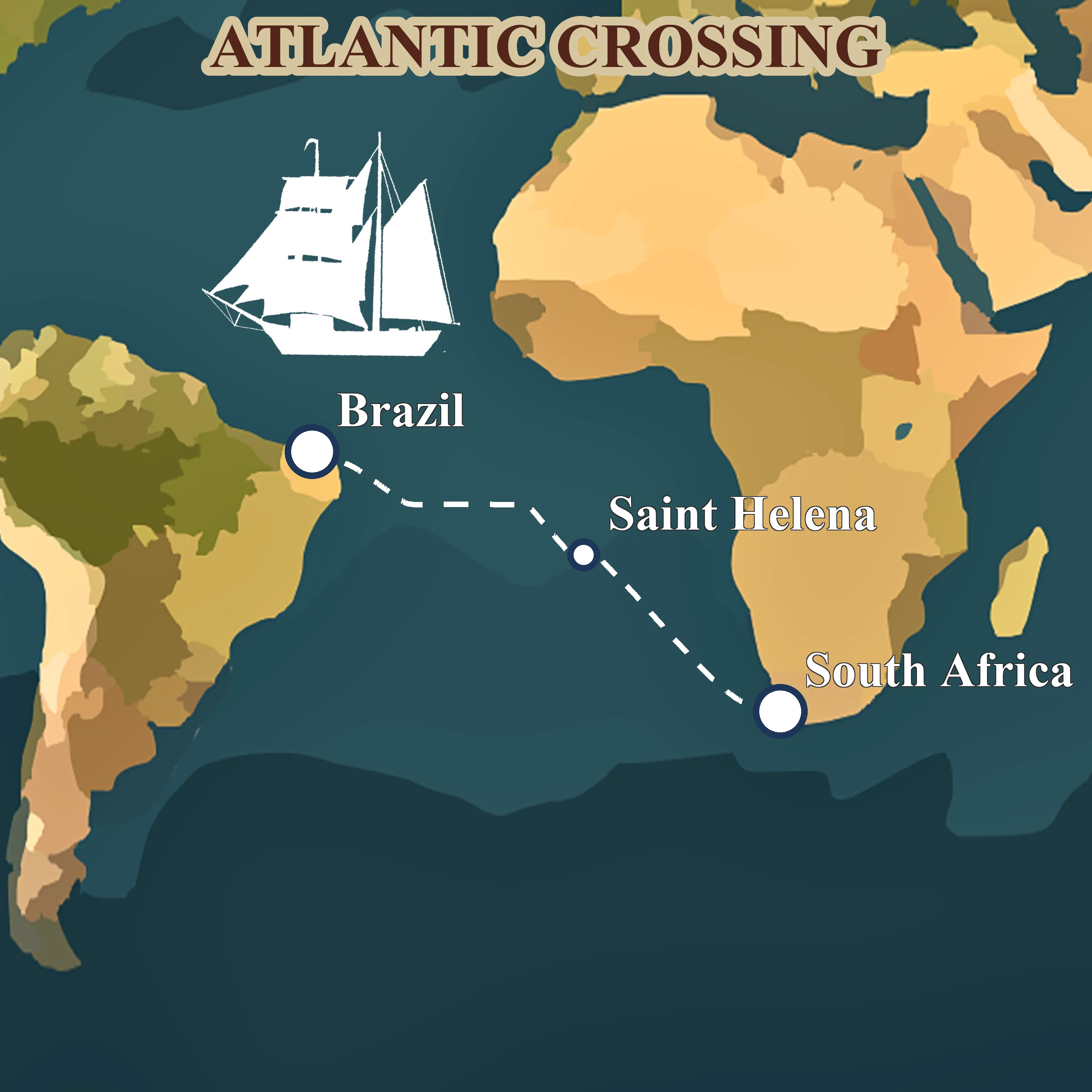
Leg 5: across the South Atlantic from Saldanha to Fortaleza
Jan 2027 — Mar 2027 · Saldanha Bay, South Africa → Fortaleza, Brazil
Forty-four days before the southeast trades, Napoleon's exile at St. Helena, the equator crossing, and landfall in tropical Brazil. The ocean chapter of the voyage.
Read more about this leg → about Leg 5: across the South Atlantic from Saldanha to Fortaleza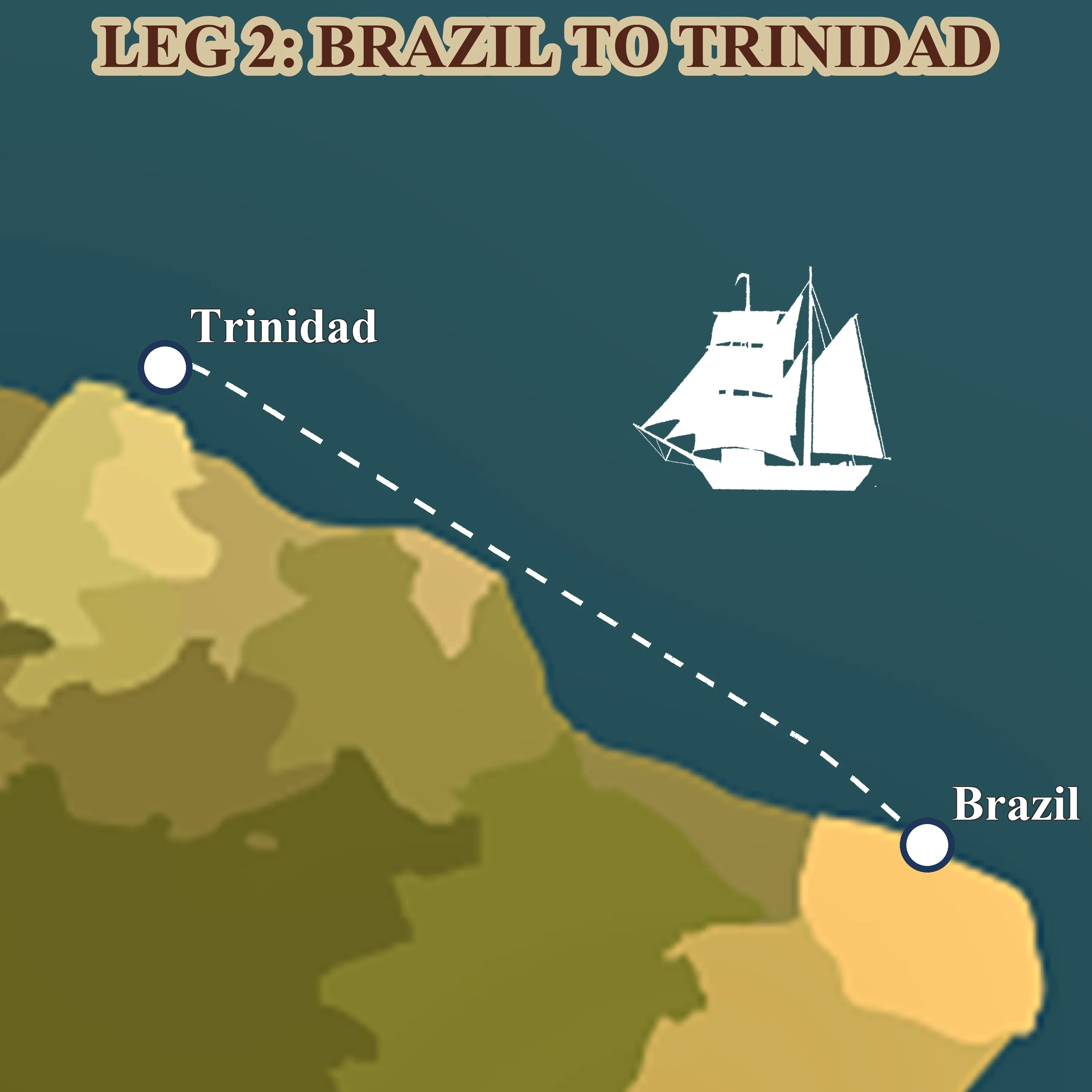
Leg 6: from Fortaleza to Trinidad along South America
Mar 2027 — Apr 2027 · Fortaleza, Brazil → Trinidad
A thousand miles of downwind trade running, the Amazon's brown water under the hull, the Guianas smudged on the horizon, and Trinidad's steelpan waiting at the end.
Read more about this leg → about Leg 6: from Fortaleza to Trinidad along South America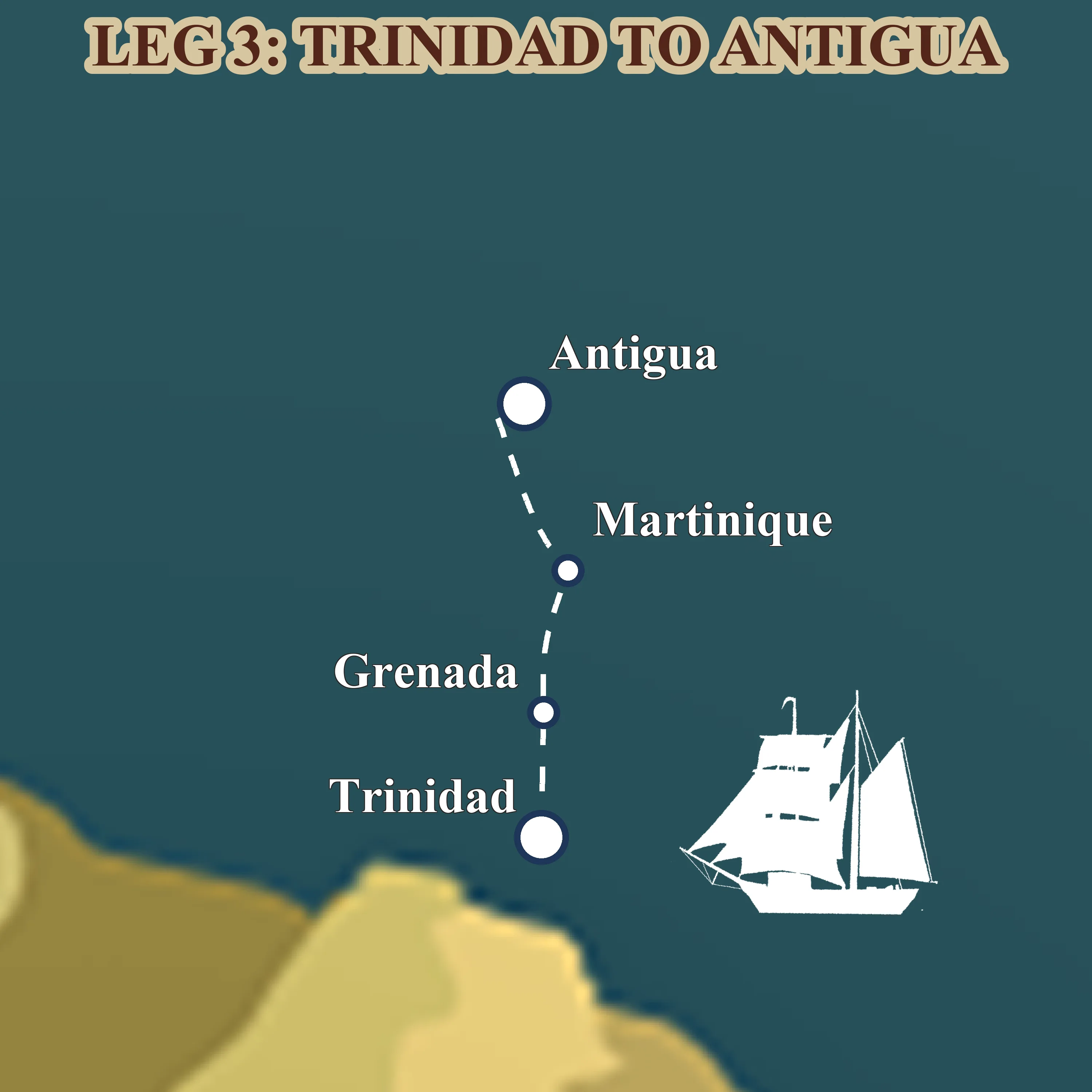
Leg 7: through the Windward Islands from Trinidad to Antigua
Apr 2027 — May 2027 · Trinidad → Antigua
Four weeks of short trade-wind daysails through the Lesser Antilles, turquoise anchorages, rum shops on the sand, French-Creole Martinique and the tall-ship scene in Antigua.
Read more about this leg → about Leg 7: through the Windward Islands from Trinidad to Antigua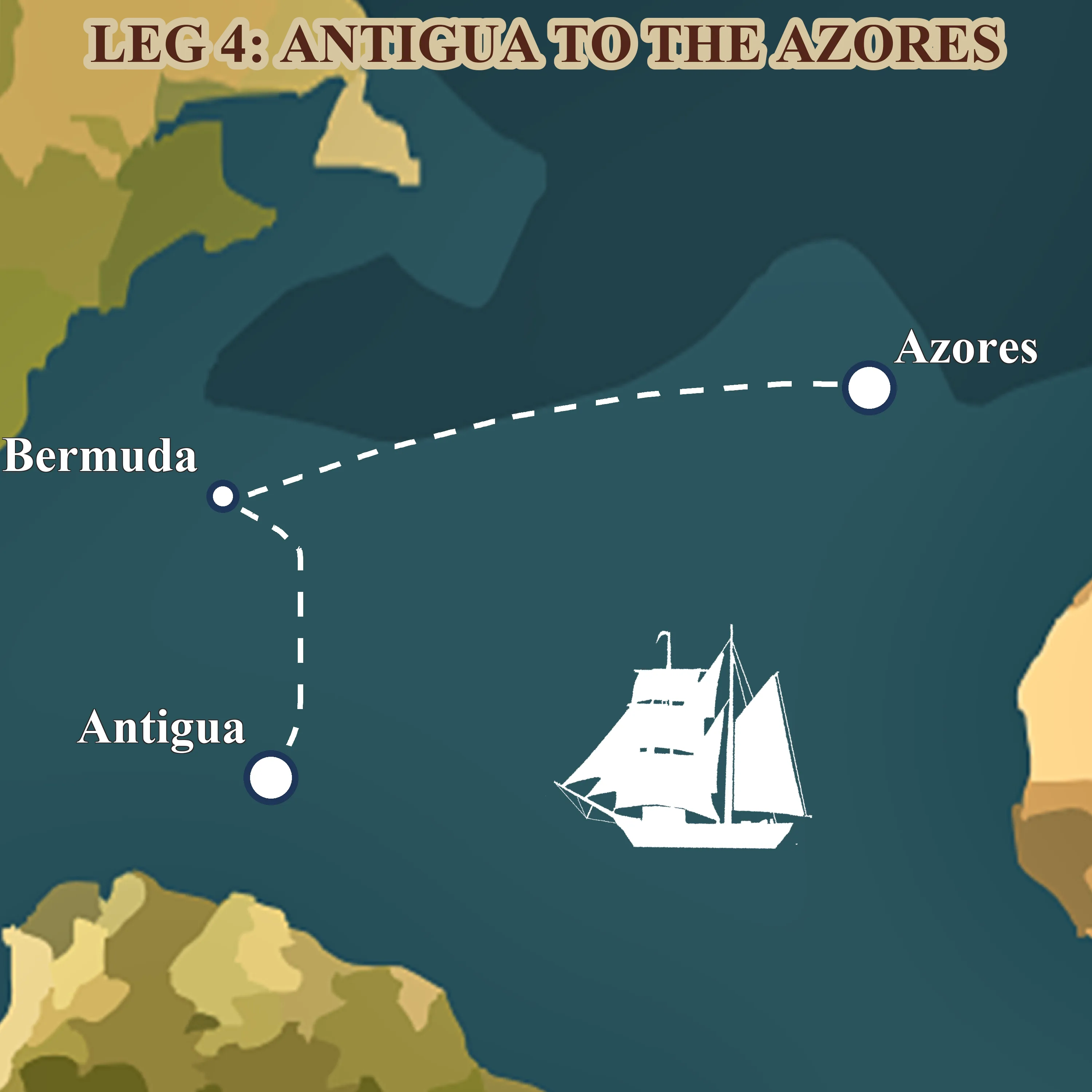
Leg 8: across the North Atlantic from Antigua to the Azores
May 2027 — Jul 2027 · Antigua → Ponta Delgada, Azores
Fifty-six days on the classic spring tall-ship route home, Antigua, a long reach to Bermuda's pink sand, then three weeks of open ocean to the volcanic Azores.
Read more about this leg → about Leg 8: across the North Atlantic from Antigua to the Azores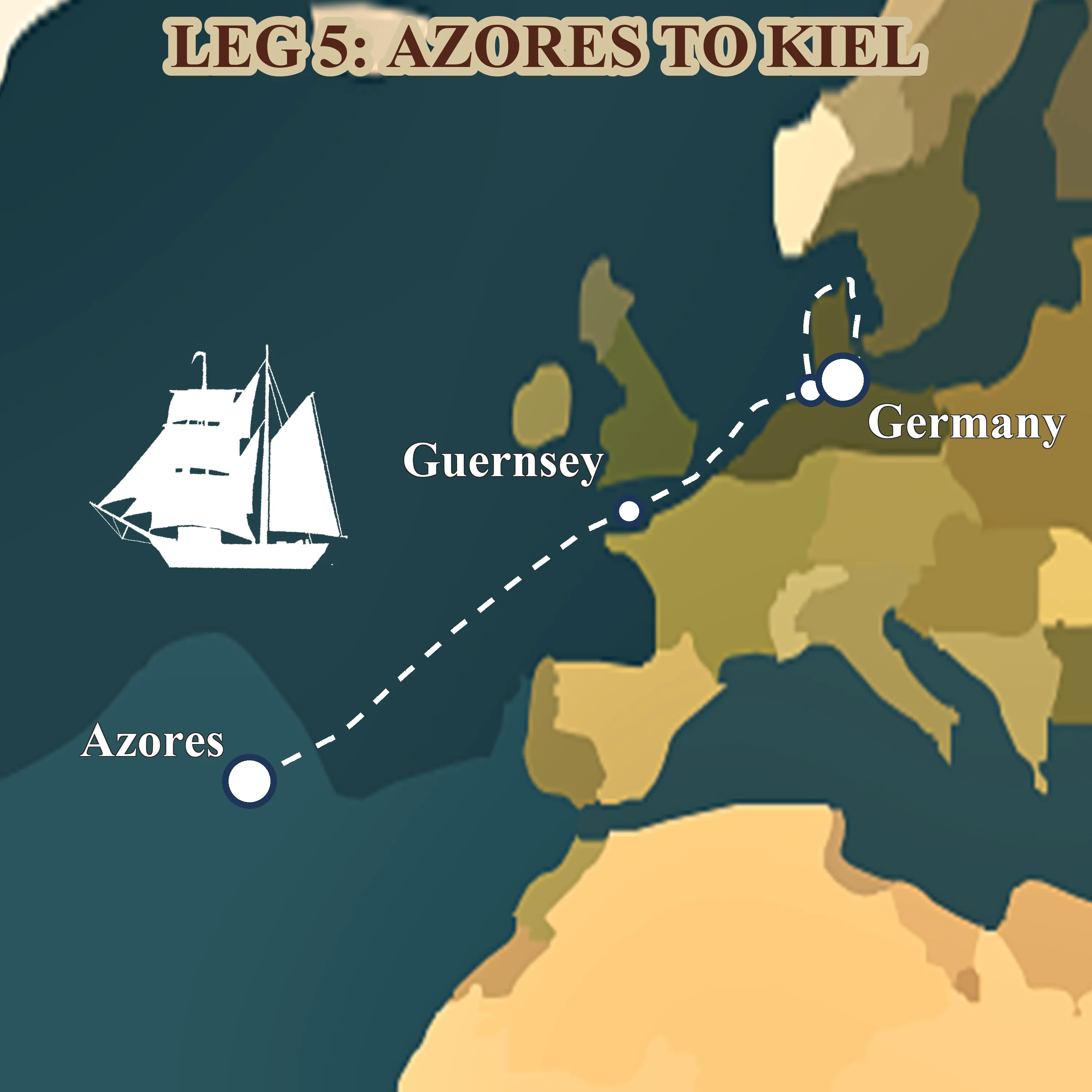
Leg 9: homecoming from the Azores to Kiel
Jul 2027 — Aug 2027 · Ponta Delgada, Azores → Kiel, Germany
The final 1,878 nm, from volcanic São Miguel to the Baltic, up the English Channel through the Dover TSS, past Helgoland's red cliffs and home to Kiel.
Read more about this leg → about Leg 9: homecoming from the Azores to KielLunenburg and the Picton Castle ethos
Lunenburg is not an accident. It is one of the very few towns in North America with an unbroken working tradition of wooden shipbuilding and offshore fishing, UNESCO listed for that reason, and Picton Castle is part of the harbour furniture there. The shipyard infrastructure, the riggers, the sailmakers, the chandlery, and the cultural memory of running working sail are all within walking distance of the dock.
That matters because Picton Castle is not a museum ship. She is a working square-rigger that comes home, refits, takes on stores, and sails again. Lunenburg makes that possible the way Mystic Seaport in Connecticut makes the same thing possible for North American sail training generally, see Mystic Seaport and the National Maritime Historical Society for the wider context. Without towns like these, the Picton Castle model would have nowhere to base.
The ethos that comes out of Lunenburg into Moreland's deck philosophy is the part that matters most. Quiet competence. The belief that "everyone's actions have consequences and competency matters." Old-school seamanship as the operating standard. No false drama. The ship is the teacher; the captain is the senior watchstander.
How Picton Castle shaped NEPTUN
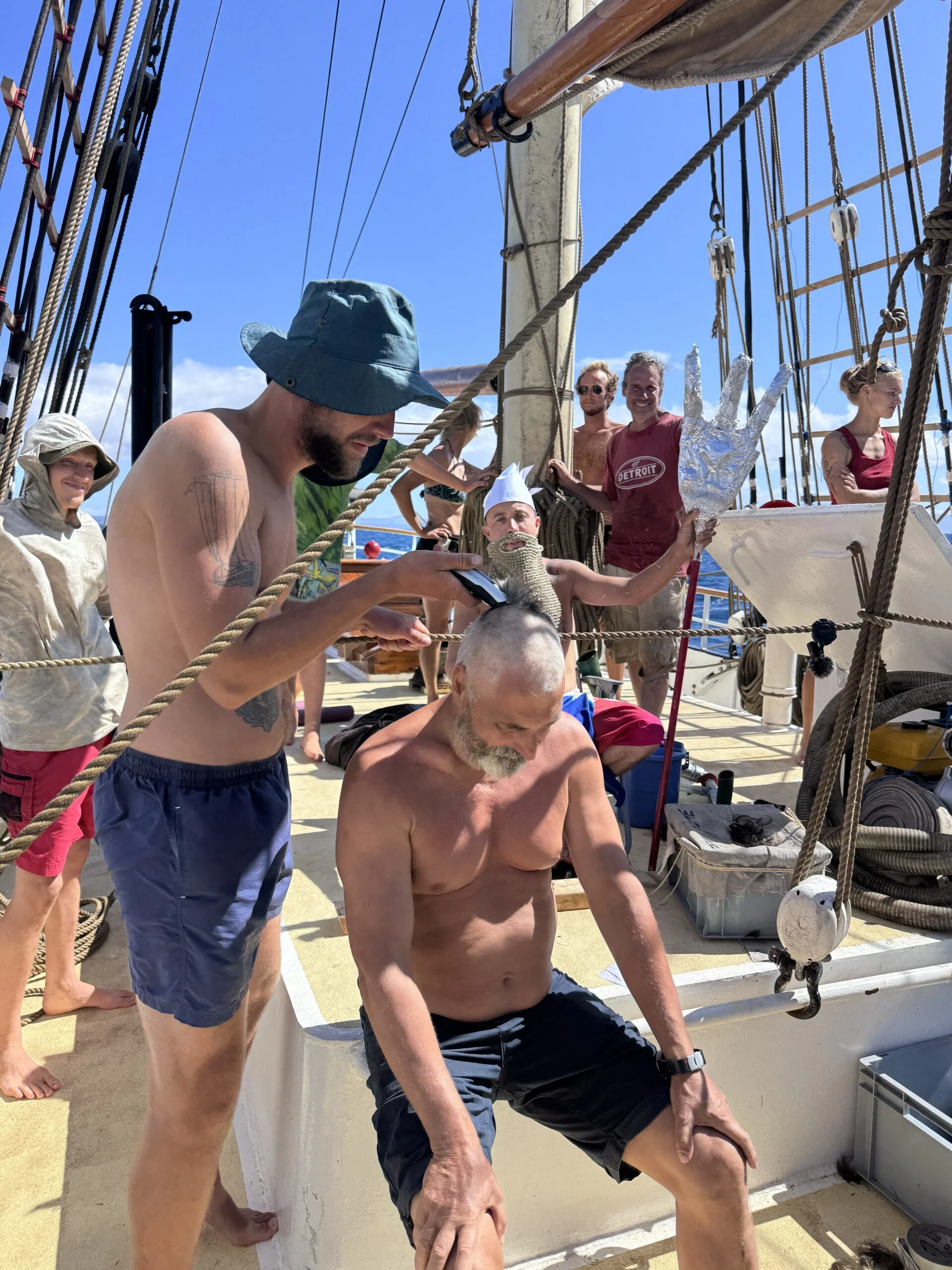
NEPTUN co-founder Anders Bischoff served two years' effective sea-time aboard Picton Castle, learning the square-rig training model that NEPTUN now extends. The lessons that travelled from one deck to the other are concrete and intentional, not ornamental.
Lessons that travelled
Two years on Picton Castle, fed into NEPTUN
The Picton Castle approach, trainees as real crew, long ocean legs as the heart of the voyage, mentorship structured into every watch, no prior experience required, is the same approach NEPTUN runs on the brigantine. Different rig, same operating model.
Three concrete inheritances:
Long ocean legs are the curriculum. NEPTUN's 2026-2027 voyage is not a series of port visits with sailing in between. The longest legs are 80+ days at sea, deliberately. That choice comes directly from the Picton Castle pattern, where the multi-week ocean passage is the part that does the actual work on a new sailor.
No prior experience is the rule, not the exception. Like Picton Castle, NEPTUN takes trainees who have never sailed before. Mentorship is structural. Every watch pairs new crew with experienced hands. See a day at sea on a tall ship for what that looks like in practice.
The trainee is crew, not passenger. This is not negotiable on Picton Castle and it is not negotiable on NEPTUN. You climb the rig, take the wheel, stand the night watch. The fee is for the voyage, not for a hotel berth.
NEPTUN is not Picton Castle. The rig is different (brigantine, not barque), the home port is different (Kiel, not Lunenburg), the route is different. What is the same is the operating philosophy. That continuity is the point.
The same lineage, the next chapter
Romance taught Picton Castle. Picton Castle taught NEPTUN. The 2026-2027 voyage is where the lineage writes its next chapter, and you can be aboard.
FAQs
Common questions about Dan Moreland and Picton Castle
How many world voyages has Picton Castle completed?
Six full circumnavigations between 1997 and the mid-2010s, plus a seventh that began in 2018 and is referred to in some Picton Castle communications as Moreland's last under his command. Total miles sailed across all voyages and shorter runs is approximately 300,000 nautical miles.
Who is Captain Dan Moreland?
Daniel Moreland is the founding captain of the barque Picton Castle. He sailed under Captain Arthur Kimberly aboard the brigantine Romance in the 1970s, served four years as bosun on the Danish full-rigged ship Danmark, and bought the Picton Castle hull in Norway in 1991. He has held command since the 1997 first world voyage.
When was Picton Castle built?
The hull was launched in 1928 at Cochrane's yard in Selby, Yorkshire, as a steam-powered side trawler for Consolidated Fisheries of Swansea, Wales. She served as HMS Picton Castle in the Royal Navy from 1939 to 1945, then returned to fishing and later coastal freight. Moreland converted her to a barque in Lunenburg, Nova Scotia, in 1996-97.
What rig does Picton Castle carry?
A three-masted barque, square-rigged on the fore and main masts, fore-and-aft rigged on the mizzen. She carries 23 sails totalling about 12,450 square feet (1,160 m²). For comparison, NEPTUN is a two-masted brigantine, square-rigged on the fore mast only.
Can a beginner sail with Picton Castle (or with NEPTUN)?
Yes. Both ships were built around the principle that trainees with no prior sailing experience can join. The voyage itself is the school. You learn lines, climb aloft, stand watches, and take the wheel under mentorship. The model has been running on Picton Castle since 1997 and on NEPTUN today. See how to join a tall ship crew for the practical steps.
How does the Picton Castle pay-to-sail model work?
A core professional crew of about twelve sails the ship; up to forty trainees pay a per-leg or per-voyage fee that covers running costs. Trainees are crew, not passengers, they handle lines, climb the rig, stand night watches. Fees vary by leg length but are broadly comparable across the modern trainee fleet. NEPTUN runs the same model on a smaller scale; see what sail training costs.
What is the connection between Romance, Picton Castle and NEPTUN?
It is a teaching lineage. Captain Kimberly's Romance was the floating apprenticeship that kept square-rig sail training alive in the 1970s. Dan Moreland sailed four years on Romance and built Picton Castle on what he learned. NEPTUN co-founder Anders Bischoff served two years aboard Picton Castle and brought that operating model to NEPTUN. Three ships, one continuous tradition.
Read also
- Captain Kimberly and brigantine Romance, the ship that taught Picton Castle
- Famous tall ships still sailing today
- Alan Villiers, the last full-rigged circumnavigation under sail
- Irving and Exy Johnson, seven world voyages on YANKEE
- How to join a tall ship crew without experience
- What a tall ship voyage actually costs
- The 2026-2027 world voyage, all nine legs
- Apply for a berth, the next chapter of the lineage
Want to sail with us? Brigantine NEPTUN is a non-profit training ship, every voyage takes 10 crew members through real ocean sailing, no experience needed. Apply for a berth or read about the voyages first.