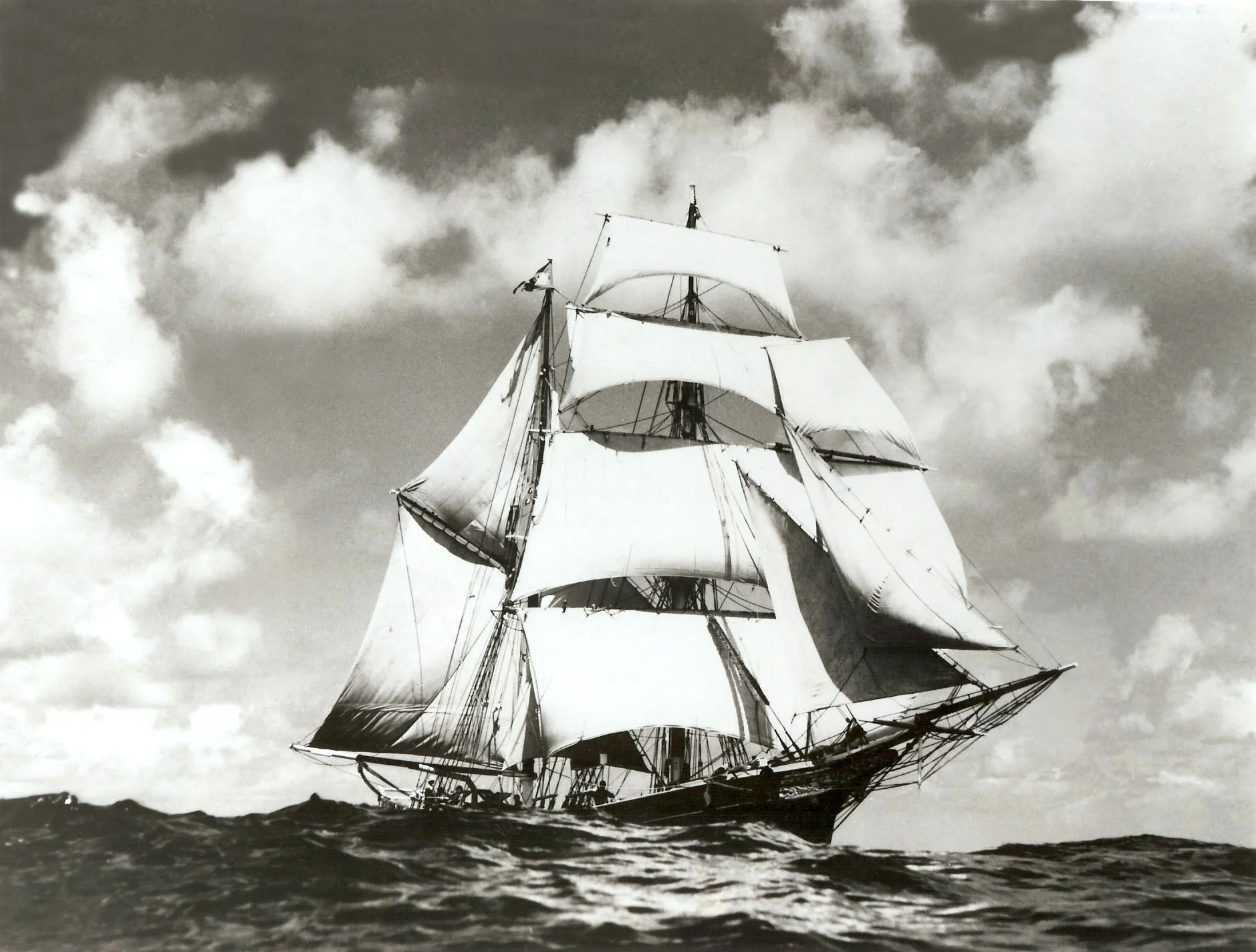
Arthur Kimberly and the brigantine Romance are the names every modern square-rig trainee should know before climbing a ratline. For twenty-three years, from 1966 to 1989, Captain Kimberly and his wife Gloria ran a 90-foot Danish-built brigantine as a working sail-training ship out of the Virgin Islands, twice taking her around the world. He was, by Dan Moreland's account, a man who "had poured more salt water out of his sea boots than most people see in a lifetime." That sentence is the lineage NEPTUN inherits: from Kimberly to Moreland to Picton Castle to every working square-rigger that still teaches the old way today.
This article tells that story properly, the man, the ship, the model, and the line of crew it produced. Verified facts only; where a date or detail is genuinely uncertain, the article says so.
Want to sail in the same tradition? Brigantine NEPTUN runs the Kimberly model, paying trainees, real ocean miles, no experience required. Apply for a berth or browse the nine legs of the 2026-2027 voyage first.
On this page
- Who Arthur Kimberly was
- The brigantine Romance, Grethe to film star to training ship
- The Kimberly model: paying trainees on a square-rigger
- The world voyages, twice round the planet
- The lineage, Dan Moreland and the captains Romance produced
- Karl Kortum Award and the recognition of legacy
- Why the Kimberly tradition is alive on NEPTUN today
- FAQ
- Read also
Who Arthur Kimberly was
Arthur M. Kimberly (1922–2011), known to everyone who sailed with him as "Skipper", was one of the last Americans to round Cape Horn under sail in commercial service. He went to sea young, sailed in working square-riggers when there were still working square-riggers, served in oil tankers in wartime convoys, and worked his way up through wooden cargo schooners and steel sailing ships until he held a master's ticket of his own. By the time he bought Romance in 1966 he had already lived several full sailing lives.
That biography matters for one reason: Kimberly was not a yachtsman who had read books about square-rig. He had crewed in it for decades when most of the world had moved to diesel and steel. When he and Gloria turned Romance into a sail-training ship, what they taught was not historical re-enactment. It was the same trade, learned the same way, by people who would still get blistered hands and seasick on the first morning.
Gloria Kimberly was the other half of the operation. She had sailed with Arthur on a small schooner out of the Bahamas before they met and married in Tahiti in 1961, and she ran the ship's affairs alongside him for the next three decades. Romance was always referred to in the Sea History articles and elsewhere as a Kimberly, singular surname, plural commitment. They were the ship.
Kimberly's seamanship
From Cape Horn to the Caribbean, a life on working ships
Captain Arthur Kimberly was one of the last Americans to round Cape Horn in commercial square-riggers. He sailed in steel sailing ships, wooden cargo schooners, and wartime oil tankers before he ever owned a vessel. When the Kimberlys bought Romance in 1966, what they put on board was not a heritage display, it was the same working seamanship Arthur had learned at sea, taught to anyone willing to climb the rigging.
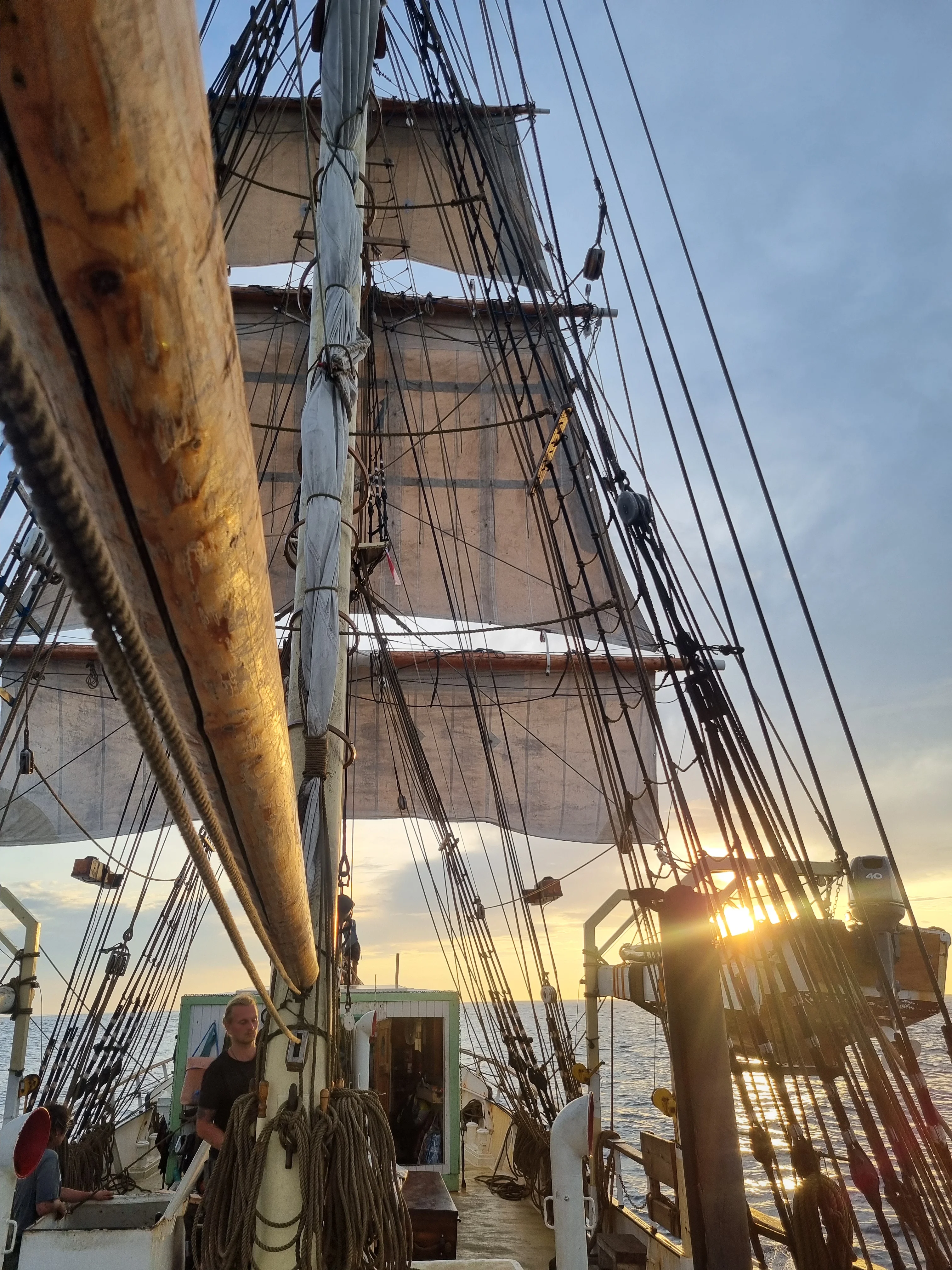
Apply for a berth on a 2026 leg and you walk into the same trade Kimberly came up in.
The brigantine Romance, Grethe to film star to training ship
Romance was originally built as Grethe, an auxiliary-powered Baltic galeas (trading vessel), at the J. Ring-Andersen shipyard in Svendborg, Denmark, in 1936. She was Danish-built of oak and beech, around 200 gross tons, intended for the Greenland trade, carrying cargo to and from the Danish North Atlantic settlements. She was, in other words, a real working merchant vessel, not a yacht.
Her transformation from trader to brigantine happened in 1964, when Captain Alan Villiers, the same Alan Villiers who in 1934-36 sailed the full-rigged ship Joseph Conrad round the world with a teenage crew, refitted her as an authentic-looking 1840-style brigantine for MGM's film of James Michener's Hawaii, where she would appear alongside Julie Andrews. Villiers' refit gave her two masts in brigantine rig, a fully square-rigged foremast, a fore-and-aft mainmast, and she became, in the contemporary phrase, "the loveliest of the smaller square-riggers." For more on what that rig actually means, see our reference article on what a brigantine is and brigantine vs schooner.
The Kimberlys learned of her in Hawaii after the film wrapped and bought her in 1966. She was 90 feet on deck, 110 feet overall, with royal yards aloft on the foremast, small for an ocean-crossing square-rigger, but big enough for serious offshore work and small enough that a paying-trainee crew could actually handle her.
Romance, by the numbers
Romance herself did not survive the Kimberly era by long. After the couple sold her in 1989 she changed hands and was eventually laid up in the West Indies; Hurricane Luis in 1995 caused extensive structural damage, and she was scuttled in 1996. The ship is gone. The lineage is not.
The Kimberly model: paying trainees on a working square-rigger
What the Kimberlys ran on Romance was, for the time, radical. Through the 1960s, 70s and 80s the world's working sailing ships had been retired to museums or scrapped. The few that still sailed under sail were either naval cadet ships funded by governments (the Danmark, Eagle, Sagres) or private yachts run for their owners' pleasure. There were almost no working ocean-going square-riggers crewed by amateurs paying their way and expected to learn the trade.
The Kimberlys built that gap into a programme. Romance ran two kinds of voyage:
- Eight-day Caribbean trips out of the Virgin Islands and the Lesser Antilles, short enough to fit a holiday, long enough to put trainees on watch, on the helm, and aloft for real sail handling.
- Long deep-water voyages including two world circumnavigations, multi-month passages through the South Pacific, and ocean crossings under royals.
What was taught on board, according to the Sea History profile by Captain Bert Rogers and Captain Daniel Moreland, was the full traditional curriculum: celestial navigation, meteorology, fancy work (decorative ropework, turk's heads, baggywrinkle, sennit), ship lore, and maintaining one's kit. Kimberly's phrase for the standard was "the Properly Way", meaning, do it the way a working ship has done it for two hundred years, not a shortcut. That phrase is repeated by half a dozen former crew in the published reminiscences.
What you actually learned aboard Romance
Celestial navigation
Sextant noon sights for latitude, morning and evening star sights, and the dead-reckoning plot that ties them together, the same fallback skills NEPTUN teaches today.
Square-rig sail handling
Setting, furling, reefing and bracing on a 90-foot brigantine. Royal yards aloft, foot-ropes, gaskets, the canvas drill any working square-rigger needs.
Meteorology
Reading the barometer, cloud, swell and the trades, the inputs a master used for centuries before satellite weather, and still uses when the GRIB file is days behind.
Fancy work
Decorative ropework, turk's heads, sennit, baggywrinkle. Not decoration: a way of training the hands and eyes until line work is automatic.
Ship lore
Vocabulary, traditions, the why behind every shipboard convention. The shared language that lets a ten-person crew act as a single instrument.
Personal kit
Maintaining your own gear, boots, oilskins, knife, palm and needle. A small thing that makes everything else work.
This is, almost line for line, the curriculum we run on NEPTUN today. The model was not an accident; it had been worked out by Kimberly over two decades.
Recognise the curriculum? Apply now and step onto the same ladder Kimberly's crew climbed. Apply for a berth on a 2026 leg.
Ocean crossings, the Kimberly tradition
Three NEPTUN legs that echo Romance's world voyage
Bali to Réunion across the Indian Ocean, Cape Town to Brazil across the South Atlantic, Antigua to the Azores up the North Atlantic, the same ocean passages Romance sailed in 1974-76.
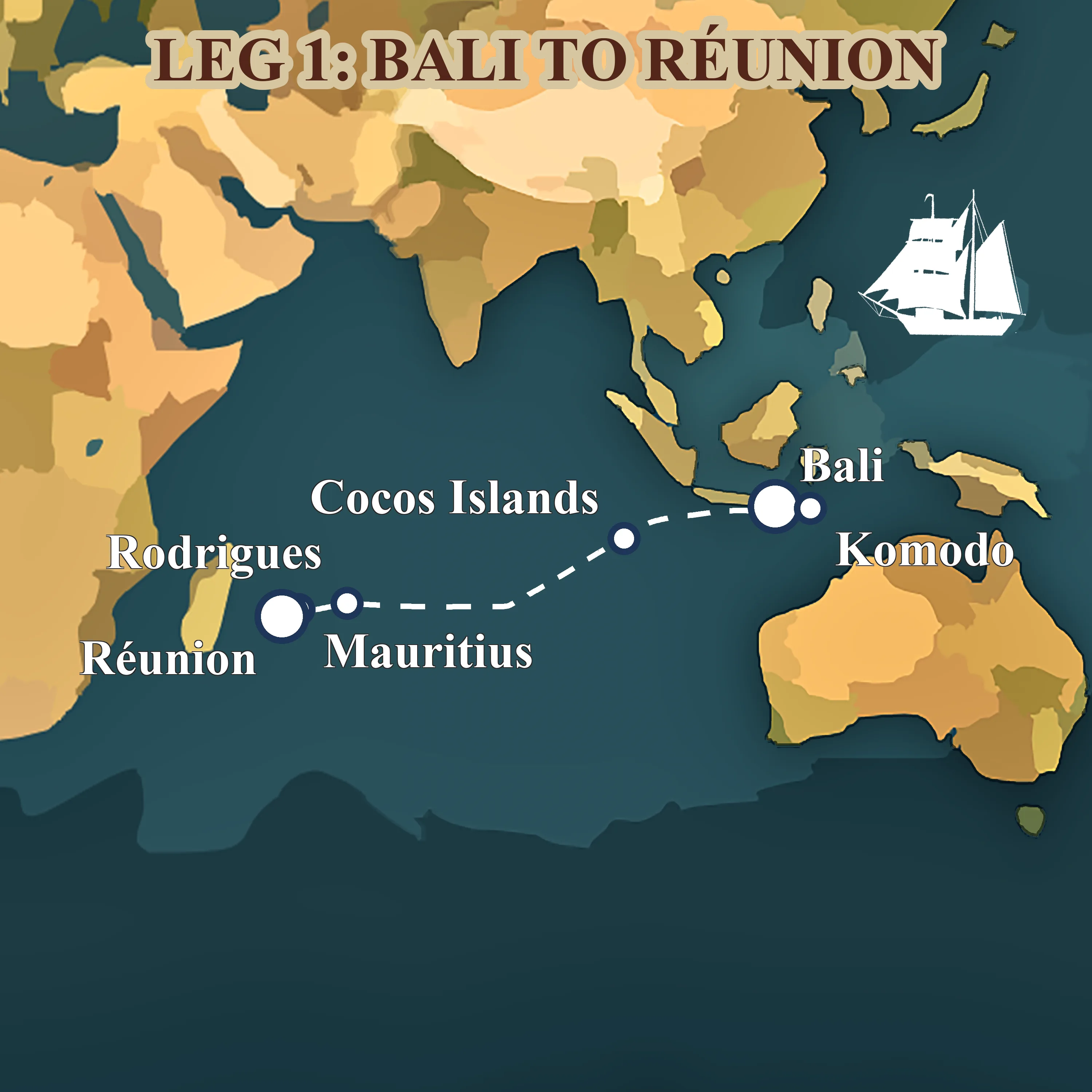
Leg 1: from Bali to Réunion across the Indian Ocean
May 2026 — Aug 2026 · Bali, Indonesia → Réunion, France
The opening chapter of Neptun's 482-day world voyage, a 4,078-nm trade-wind passage from the temples of Bali to the volcanic cliffs of Réunion.
Read more about this leg → about Leg 1: from Bali to Réunion across the Indian Ocean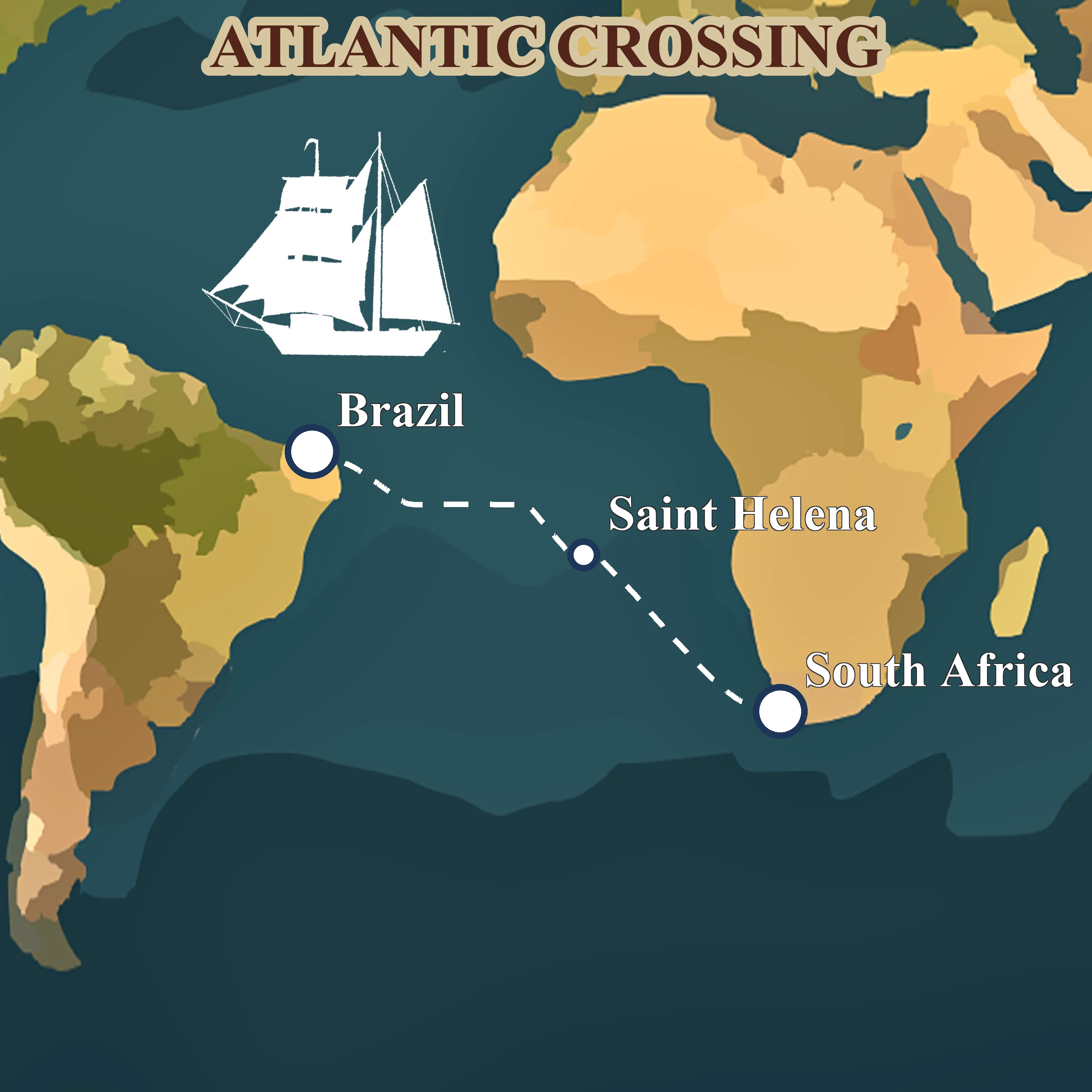
Leg 5: across the South Atlantic from Saldanha to Fortaleza
Jan 2027 — Mar 2027 · Saldanha Bay, South Africa → Fortaleza, Brazil
Forty-four days before the southeast trades, Napoleon's exile at St. Helena, the equator crossing, and landfall in tropical Brazil. The ocean chapter of the voyage.
Read more about this leg → about Leg 5: across the South Atlantic from Saldanha to Fortaleza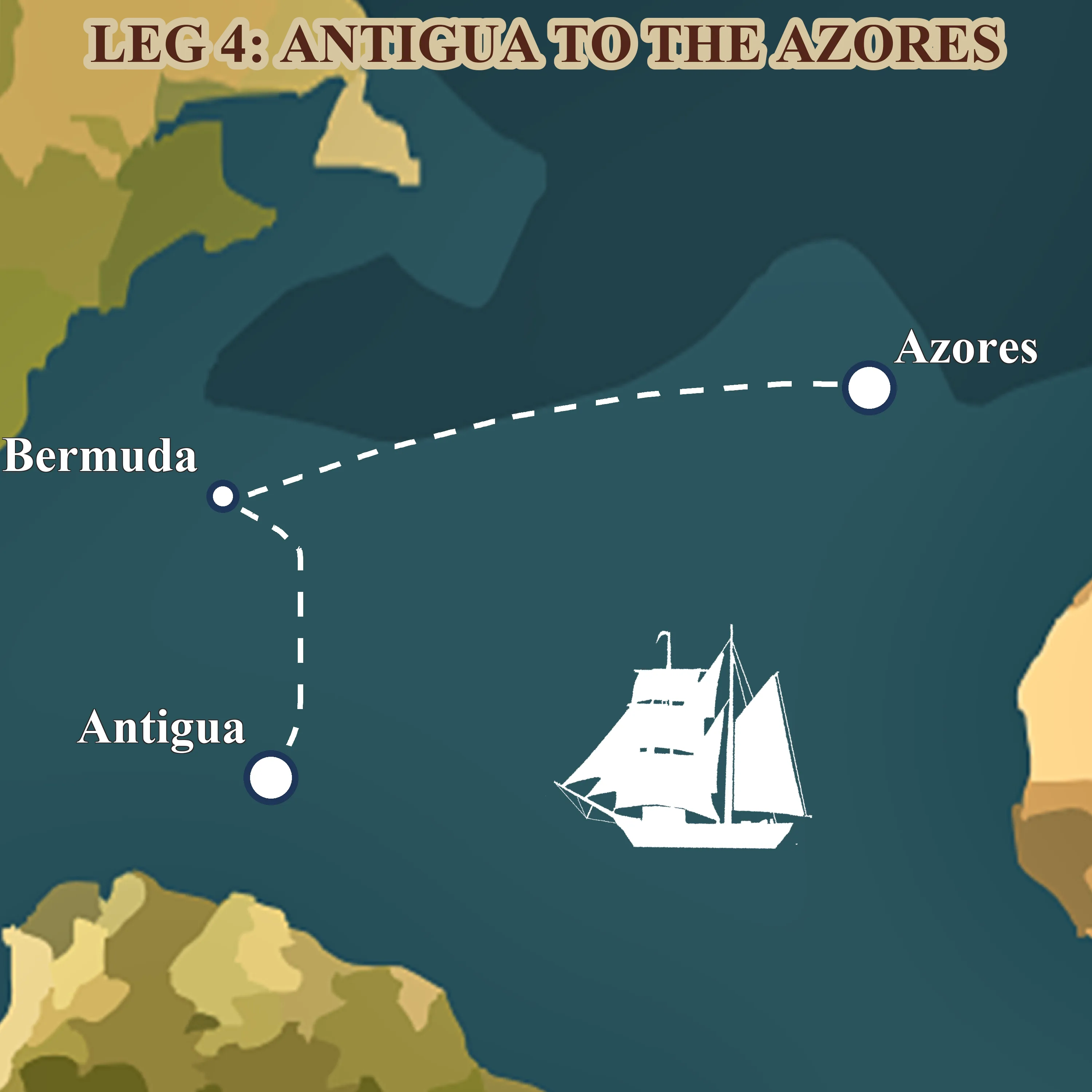
Leg 8: across the North Atlantic from Antigua to the Azores
May 2027 — Jul 2027 · Antigua → Ponta Delgada, Azores
Fifty-six days on the classic spring tall-ship route home, Antigua, a long reach to Bermuda's pink sand, then three weeks of open ocean to the volcanic Azores.
Read more about this leg → about Leg 8: across the North Atlantic from Antigua to the AzoresThe world voyages, twice round the planet
The two circumnavigations are the centrepiece of the Romance story. The first is the one most often cited: 1974-76, the voyage on which Dan Moreland sailed as mate. Multiple sources confirm the dates, Sea History magazine, the Soundings profile of Moreland, and the National Maritime Historical Society's award citation. A second circumnavigation followed later in the Kimberly era, though precise published dates for it are less consistent across sources; Sea History and the NMHS award page state plainly that the Kimberlys "took the Romance on voyages throughout the Caribbean and the South Pacific, and twice around the world." The second voyage's exact start and end dates are not one of the facts the published profiles agree on, so this article will not pin one down.
What the 1974-76 voyage looked like, in the broad shape: westabout from the Virgin Islands, across the Pacific via French Polynesia and Pitcairn, Dan Moreland recalls in Picton Castle's own writings that he first visited Pitcairn Island in the 1970s "sailing as Chief Mate for Captain Arthur Kimberly aboard the brigantine Romance", through the Indian Ocean, round the Cape of Good Hope, across the South Atlantic, and home through the Caribbean. The crew was a mix of permanent hands and paying trainees on rotating contracts; total time at sea ran to well over a year. One detail from the accounts, recorded in the squaresail.com archive, is that on the South Atlantic crossing in 1977 Romance carried studding sails for 26 consecutive days running before the trades, the kind of detail you only put in a logbook if you mean it.
For the rough geography of any westabout circumnavigation, see our milk run circumnavigation route and trade-wind sailing routes articles. NEPTUN's 2026-2027 voyage retraces large parts of the same arc.
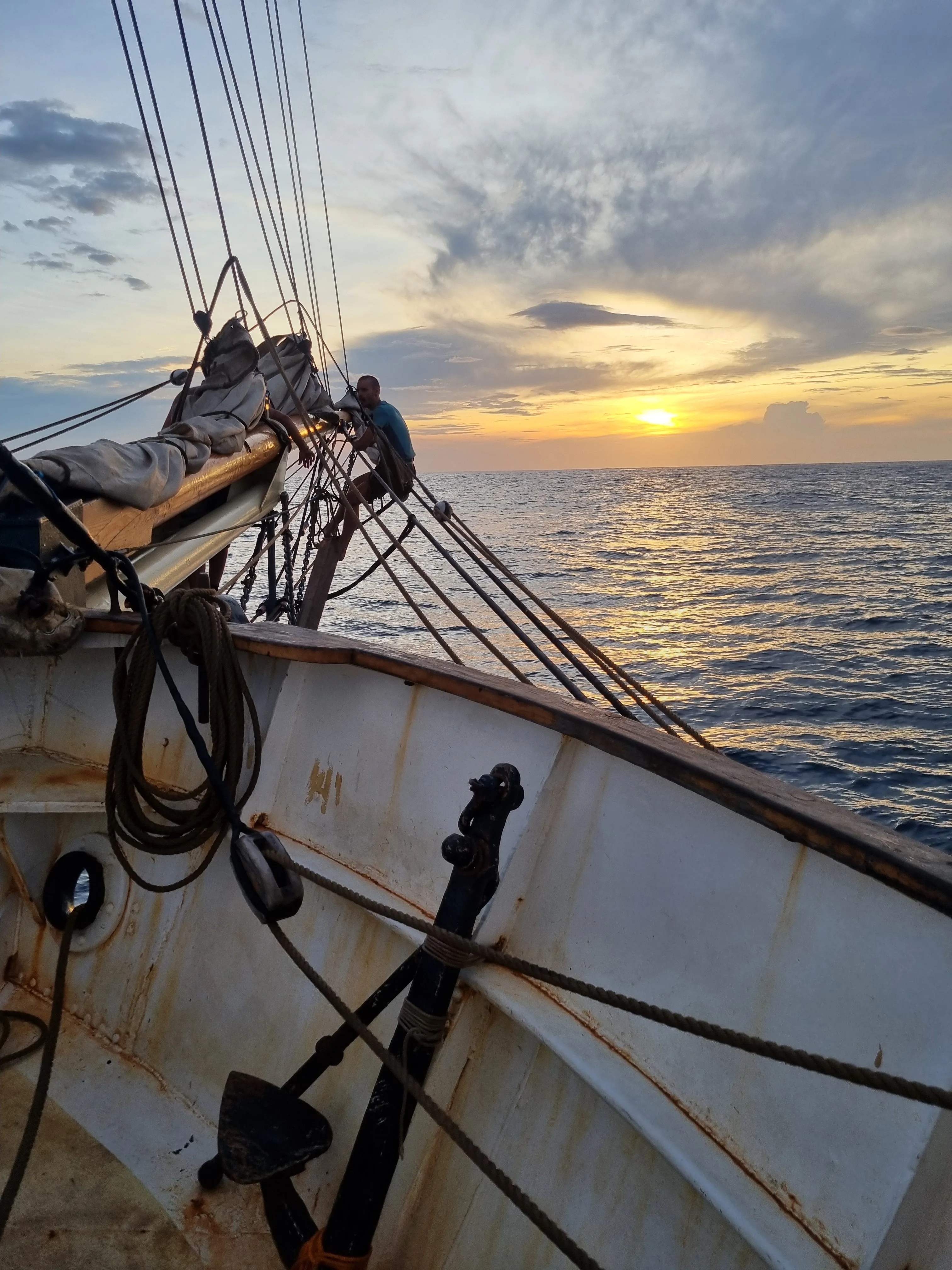
26 consecutive days under stuns'ls, Romance, South Atlantic, 1977
1936, Built as Grethe
J. Ring-Andersen shipyard, Svendborg, Denmark. An auxiliary-powered Baltic galeas built for the Greenland trade, Danish oak and beech, around 200 gross tons.
1964, Refitted as a brigantine
Captain Alan Villiers refits Grethe as an 1840-style brigantine for MGM's film of Michener's Hawaii. She is renamed Romance and gains the rig she will keep for the rest of her sailing life.
1966, The Kimberlys buy her
Arthur and Gloria Kimberly purchase Romance in Hawaii and sail her to the Virgin Islands, where she will operate for the next 23 years as a sail-training brigantine.
1974-76, First circumnavigation
Westabout from the Virgin Islands across the Pacific (including Pitcairn), the Indian Ocean, round the Cape of Good Hope, and home across the South Atlantic. Dan Moreland sails as mate.
1977, 26 days under studding sails
Romance carries stuns'ls for 26 consecutive days running before the trades on the South Atlantic crossing, the kind of passage detail only logged when it is real.
1989, End of the Kimberly era
After 23 years and two world voyages, the Kimberlys sell Romance and retire from active command. The training programme that ran continuously from 1966 closes.
1996, Romance is scuttled
Damaged by Hurricane Luis in the West Indies the previous year, Romance is scuttled. The ship is gone; the people she trained are still at sea.
2008, Karl Kortum American Ship Trust Award
The National Maritime Historical Society presents the award to Capt. Arthur M. Kimberly and the late Gloria Kimberly for the Romance years, explicit recognition of the lineage they built.
2011, Captain Kimberly dies
Arthur Kimberly dies on St. Thomas, US Virgin Islands. He is 89 years old.
The lineage, Dan Moreland and the captains Romance produced
If you only remember one thing from this article, remember this: Captain Daniel D. Moreland sailed as mate aboard Romance in the 1970s, including the 1974-76 world voyage, and went on to found and command the barque Picton Castle, which has now completed multiple circumnavigations of its own under sail. That is the direct lineage from Kimberly to the most prominent working sail-training square-rigger of our time.
Moreland is explicit about it in his own writing. In the Soundings profile, he describes Kimberly as a man who had sailed in "huge steel square-riggers, wooden cargo schooners and oil tankers in wartime convoys" and who "could do anything aboard ship." He cites three things he took from the four years aboard Romance: dedication to the trade, respect for the sea and its traditions, and what he calls "consummate old-school seamanship." After Romance, Moreland served four years as boatswain on the Danish full-rigged ship Danmark, then independent commands, and finally the founding of Picton Castle in 1996-97. The Kimberly model, paying trainees on a working square-rigger, taught by people who do the trade for a living, is the model Picton Castle runs to this day.
Moreland is the most visible Kimberly-trained captain, but he is not the only one. Captain Bert Rogers, longtime executive director of Tall Ships America (the renamed American Sail Training Association), co-authored the Sea History article on the Kimberlys with Moreland. Rogers also sailed with Romance during the Kimberly years. Between them, Rogers and Moreland represent the institutional memory of American sail training and one of its most active modern operators, both, by their own account, formed by Romance.
The lineage on deck
From Romance to Picton Castle, to NEPTUN
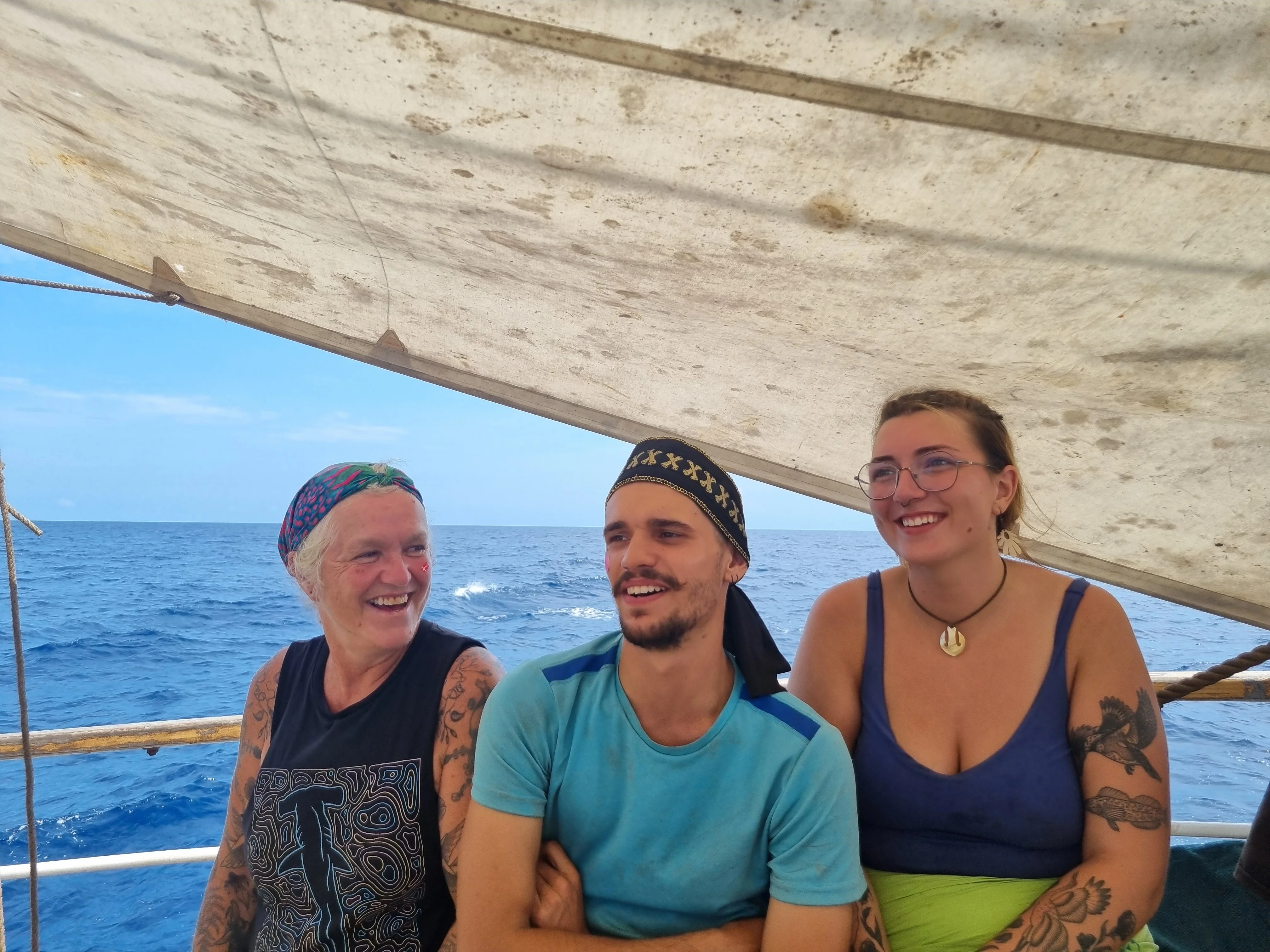
Dan Moreland sailed as mate on Romance in the 1970s, including the 1974-76 world voyage. He went on to found Picton Castle. Bert Rogers sailed with Romance and now runs Tall Ships America. Hundreds of other Romance trainees became masters, mates, and bosuns on tall ships across the world. NEPTUN inherits the same model: paying crew, real ocean miles, traditional seamanship taught on a working ship.
For NEPTUN's own take on Moreland's career, see our companion article, Dan Moreland and Picton Castle, and our broader survey of the modern fleet in famous tall ships still sailing.
Want to put yourself in that lineage? Apply for a berth on a 2026-2027 leg and start where every Romance trainee started, on deck, learning by doing.
The Karl Kortum Award and the recognition of legacy
In 2008, the National Maritime Historical Society awarded Captain Arthur M. Kimberly and the late Gloria Kimberly the Karl Kortum American Ship Trust Award for their work on Romance. The award is named after the founder of the San Francisco Maritime National Historical Park tradition, Kortum was the principal force behind the preservation of working sailing ships on the US west coast, and the award named for him explicitly recognises lifetime contributions to the same field. Earlier, in 1996, the American Sail Training Association (now Sail Training International's American partner, Tall Ships America) had given Kimberly its Lifetime Achievement Award.
The 2008 citation, published as part of NMHS's awards programme and reported in Sea History magazine, explicitly recognised what Romance had been: a working sail-training ship that, for 23 years, had taught the trade to anyone who came aboard, and had produced a generation of masters and mates who continued the work. The award was not for sentimentality. It was for results.
For the broader institutional context, Sea History magazine remains the single best published archive of the Kimberly era, two long-form profiles ran in issues 123 and 124 in 2008, written by Bert Rogers and Dan Moreland themselves. Anyone seriously researching this lineage starts there. Beyond that, Mystic Seaport and the National Maritime Historical Society hold parallel collections on American square-rig sail training that include Romance material.
Awards and recognition
American Sail Training Association Lifetime Achievement Award
Awarded to Captain Arthur Kimberly in 1996 for his contributions to sail training. ASTA later renamed itself Tall Ships America, and Bert Rogers, who sailed with Romance, runs it today.
Karl Kortum American Ship Trust Award
Awarded in 2008 by the National Maritime Historical Society to Captain Arthur M. Kimberly and the late Gloria Kimberly. The citation explicitly recognised the Romance years and the lineage they produced.
Why the Kimberly tradition is alive on NEPTUN today
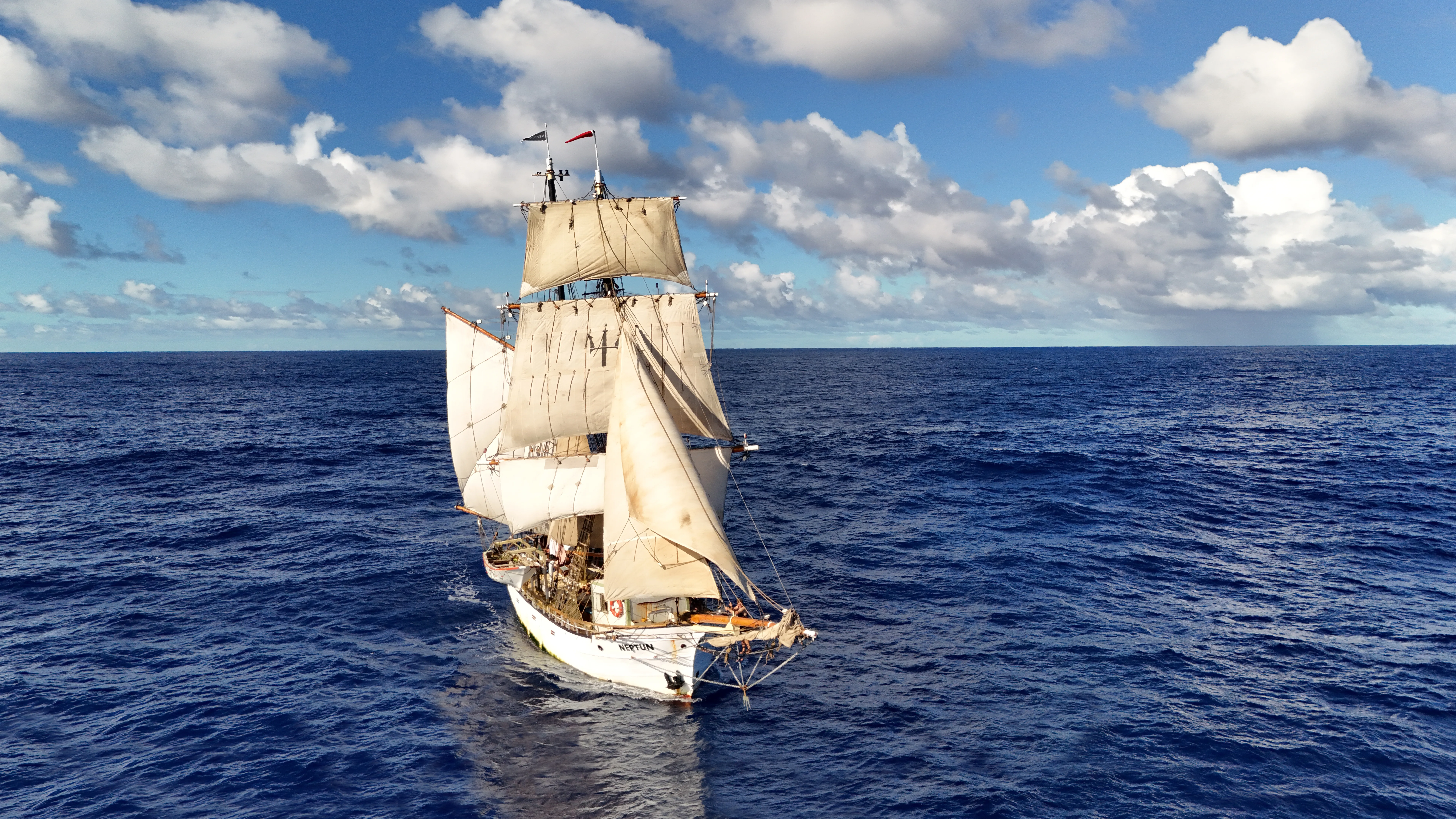
Brigantine NEPTUN is, intentionally, in the Kimberly line. The ship is a brigantine, the same rig Romance carried after the 1964 refit. The crew model is the same: a small permanent core, a rotating berth of paying trainees, real ocean voyaging rather than coastal day sails. The curriculum on board is the same: celestial navigation, square-rig sail handling, watchkeeping, ropework, weather, ship handling. The standard is the same: "the Properly Way" was Kimberly's phrase; "learn it on the ship, taught by people who do it for a living" is the same idea expressed differently. Read our voyages page and you will see the structure Kimberly would have recognised.
Three concrete continuities are worth naming:
- The voyage as the classroom. Romance taught seamanship over passages of weeks and months, not weekends. NEPTUN's 2026-2027 world voyage is a 482-day arc across nine legs precisely because that is how long it takes to learn the trade.
- No prior experience required. Kimberly's trainees were teachers, students, builders, and accountants who applied because they wanted to go. NEPTUN takes the same crew. See how to join a tall-ship crew and what sail training costs for what that pathway looks like in 2026.
- The lineage continues by training the next generation. Moreland trained Picton Castle's officers; Picton Castle's officers train others; some end up on NEPTUN. We hire from this pool because it is the only pool where the standard is intact.
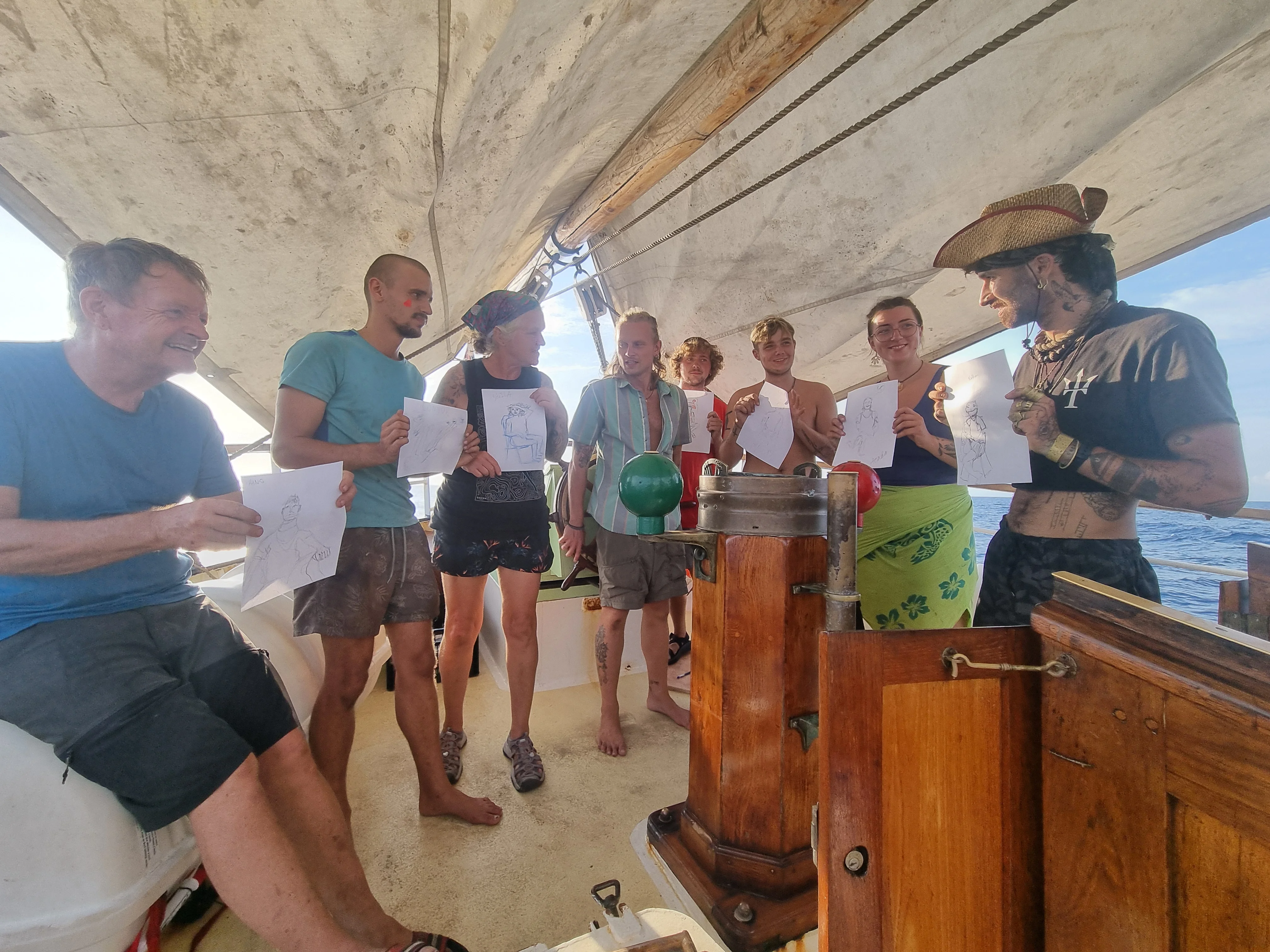
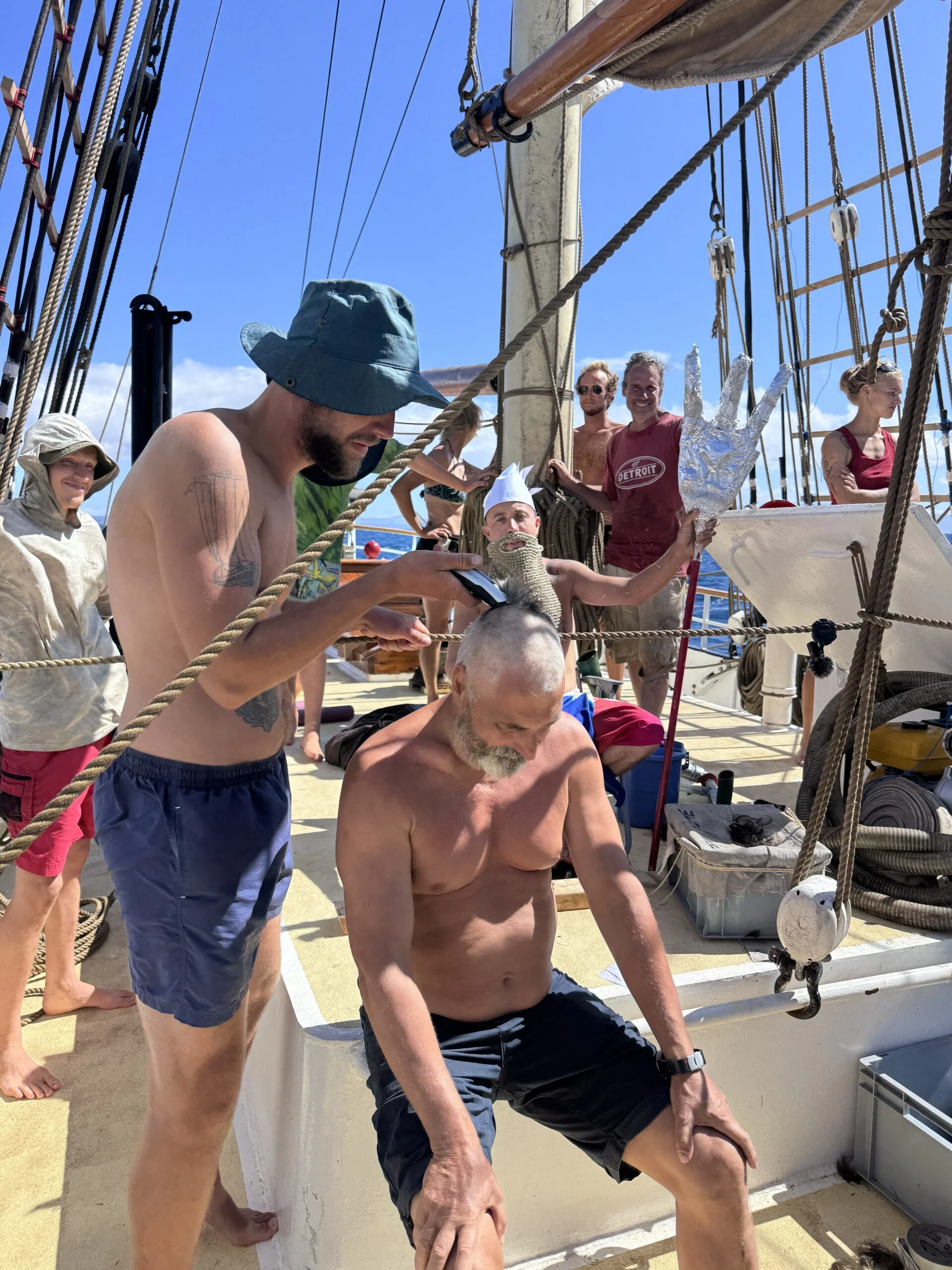
If you have read this far, the article has done its job. The case it makes is simple: there is a continuous line of working square-rig sail training that runs from the working ships Kimberly came up in, through the 23 years of Romance, through the captains Romance trained, through the ships those captains ran, to a brigantine called NEPTUN sitting in a Caribbean harbour today, with ten berths open on every leg of a world voyage. To stand a watch on NEPTUN is to be part of that line. That is the whole offer.
Ready to step onto the deck? Apply for a berth on a 2026 leg, no experience required, taught on board the way Kimberly's crew were taught.
The Kimberly line
Step onto the same deck, a 2026 leg
Brigantine NEPTUN runs the same model Captain Kimberly ran on Romance from 1966 to 1989: paying trainees, real ocean miles, traditional seamanship taught on a working ship. Ten berths open on every leg.
FAQ
Captain Kimberly and Romance, common questions
Who was Captain Arthur Kimberly?
Arthur M. Kimberly (1922–2011) was an American master mariner and one of the last Americans to round Cape Horn under sail in commercial service. He owned and commanded the brigantine Romance from 1966 to 1989, running her as a sail-training ship in the Caribbean and on two world voyages. He received the American Sail Training Association Lifetime Achievement Award in 1996 and the National Maritime Historical Society's Karl Kortum American Ship Trust Award in 2008.
What was the brigantine Romance?
Romance was a 90-foot two-masted brigantine, originally built in 1936 as the Danish trading galeas Grethe at the J. Ring-Andersen shipyard in Svendborg. Captain Alan Villiers refitted her as an 1840-style brigantine in 1964 for MGM's film of Michener's Hawaii. The Kimberlys bought her in 1966 and ran her as a working sail-training ship for 23 years.
Did Dan Moreland of Picton Castle really sail under Kimberly?
Yes. Captain Daniel D. Moreland sailed as mate aboard Romance in the 1970s, including the 1974-76 world voyage. He has written about it himself, and Picton Castle's own records describe him as "Chief Mate for Captain Arthur Kimberly aboard the brigantine Romance." After Romance he served on the Danish full-rigged ship Danmark and went on to found Picton Castle as a working sail-training square-rigger of his own.
When did Romance sail around the world?
Romance circumnavigated the world twice during the Kimberly era. The first voyage ran from 1974 to 1976, confirmed by multiple primary sources including Sea History magazine and Picton Castle's own writings. A second world voyage followed later in the Kimberly era; published sources agree it happened but disagree on precise start and end dates, so we do not pin them down here.
What happened to Romance after the Kimberlys sold her?
The Kimberlys sold Romance in 1989. After several years under different ownership she was laid up in the West Indies, sustained extensive structural damage in Hurricane Luis in 1995, and was scuttled in 1996. The ship herself is gone, but the lineage of crew she trained is very much alive, most visibly aboard Picton Castle.
What is the Karl Kortum Award?
The Karl Kortum American Ship Trust Award is presented by the National Maritime Historical Society for lifetime contributions to American sailing-ship preservation and tradition. It is named for the founder of the San Francisco maritime preservation movement. The Kimberlys received it in 2008, explicit recognition that Romance and the trainees she produced represented exactly the kind of living maritime tradition the award was created to honour.
How does NEPTUN relate to the Kimberly tradition?
NEPTUN is a working brigantine running paying trainees on real ocean voyages, the same model the Kimberlys ran on Romance. The curriculum on board (celestial navigation, square-rig sail handling, watchkeeping, traditional seamanship) is the curriculum Romance taught. We hire from the pool of officers trained by ships like Picton Castle, themselves Kimberly-line ships. Apply for a berth and you join the same lineage.
Read also
- Dan Moreland and the barque Picton Castle, Romance's most famous trainee, and the ship he built afterwards.
- Famous tall ships still sailing, the modern fleet, with the Kimberly-line ships in context.
- Learn traditional seamanship, the curriculum Romance taught, the curriculum NEPTUN runs.
- What is a brigantine?, the rig Romance carried, the rig NEPTUN carries.
- How to join a tall-ship crew, the practical pathway in 2026.
- Browse the 2026-2027 voyages, the nine-leg world voyage that runs in the Kimberly tradition.
- Apply for a berth, if the article did its job.
Want to sail with us? Brigantine NEPTUN is a non-profit training ship, every voyage takes 10 crew members through real ocean sailing, no experience needed. Apply for a berth or read about the voyages first.
2026-2027
The full world voyage, nine legs in the Kimberly tradition
482 days, over 30,000 nautical miles, four oceans, ten berths a leg. The same model Captain Kimberly ran on Romance, paying trainees, real ocean miles, taught on board.
Leg 1: from Bali to Réunion across the Indian Ocean
May 2026 — Aug 2026 · Bali, Indonesia → Réunion, France
The opening chapter of Neptun's 482-day world voyage, a 4,078-nm trade-wind passage from the temples of Bali to the volcanic cliffs of Réunion.
Read more about this leg → about Leg 1: from Bali to Réunion across the Indian Ocean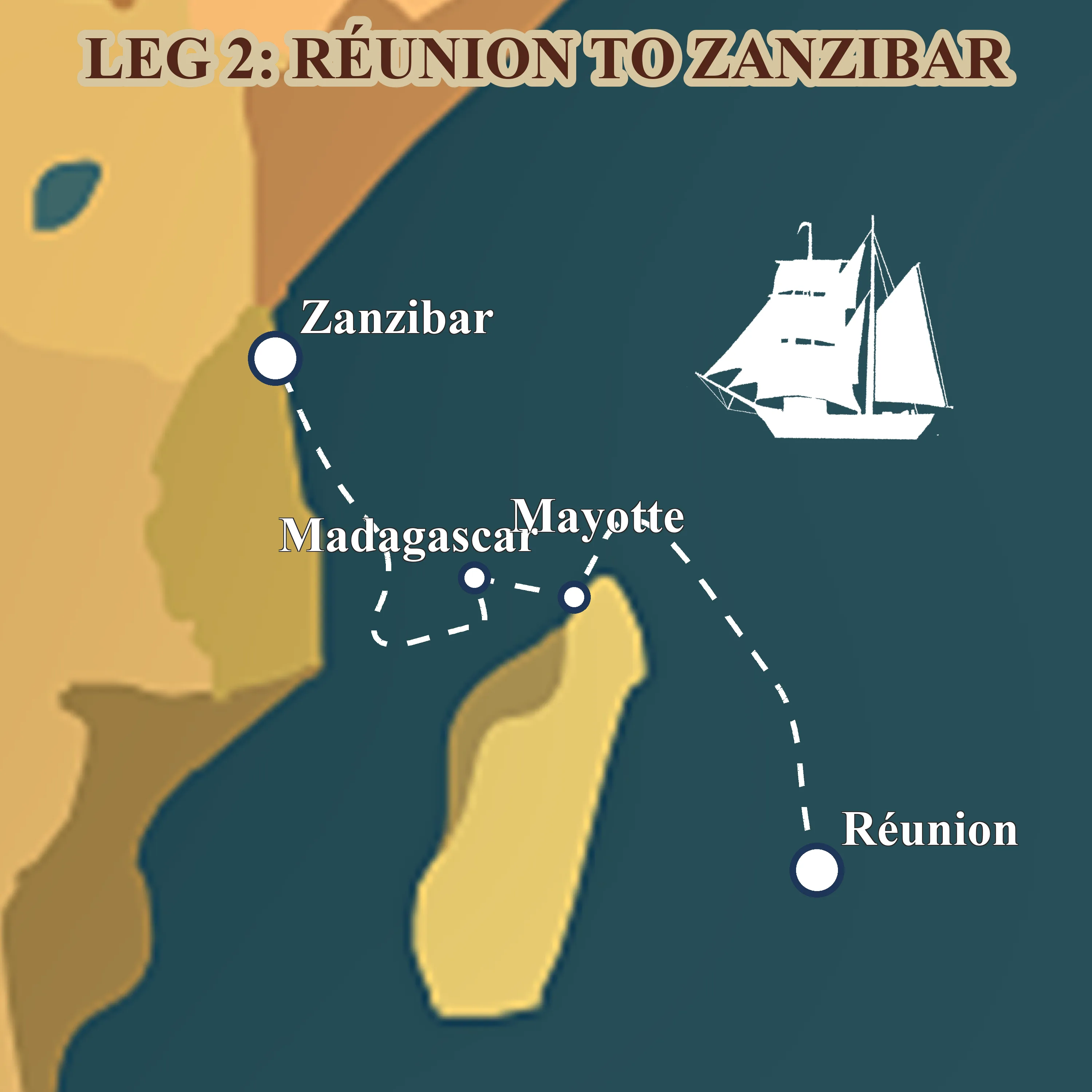
Leg 2: from Réunion to Zanzibar via Madagascar
Aug 2026 — Sept 2026 · Réunion, France → Zanzibar, Tanzania
Forty days across the western Indian Ocean, volcanic Réunion, lemur-haunted Nosy Be, the Mozambique Channel, and the spice-scented stone alleys of Zanzibar.
Read more about this leg → about Leg 2: from Réunion to Zanzibar via Madagascar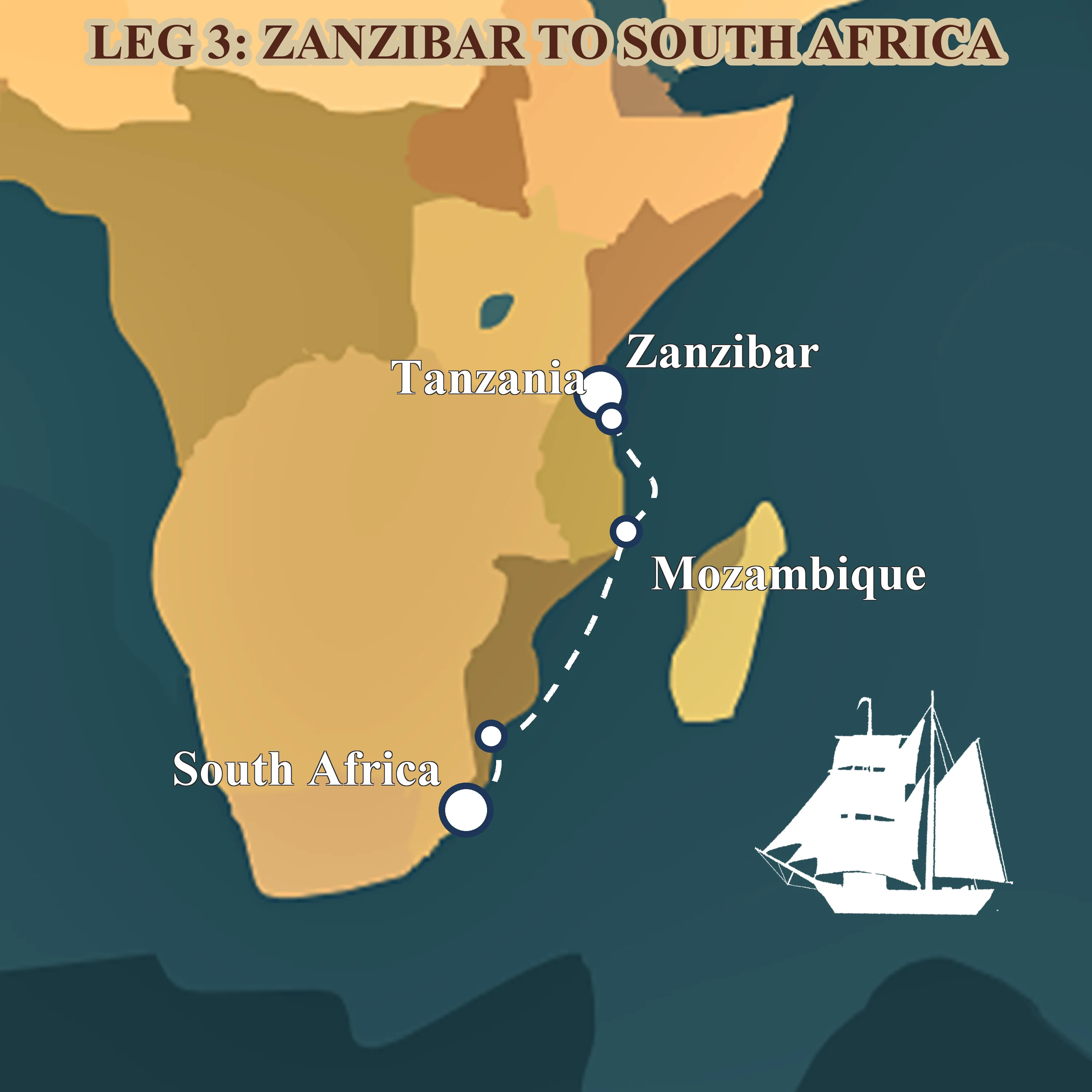
Leg 3: from Zanzibar to Durban down the Mozambique Channel
Sept 2026 — Nov 2026 · Zanzibar, Tanzania → Durban, South Africa
Sixty-three days coasting the African shore, spice islands, mangrove anchorages, Portuguese praças and the long trade-wind run down the Mozambique Channel to Durban.
Read more about this leg → about Leg 3: from Zanzibar to Durban down the Mozambique Channel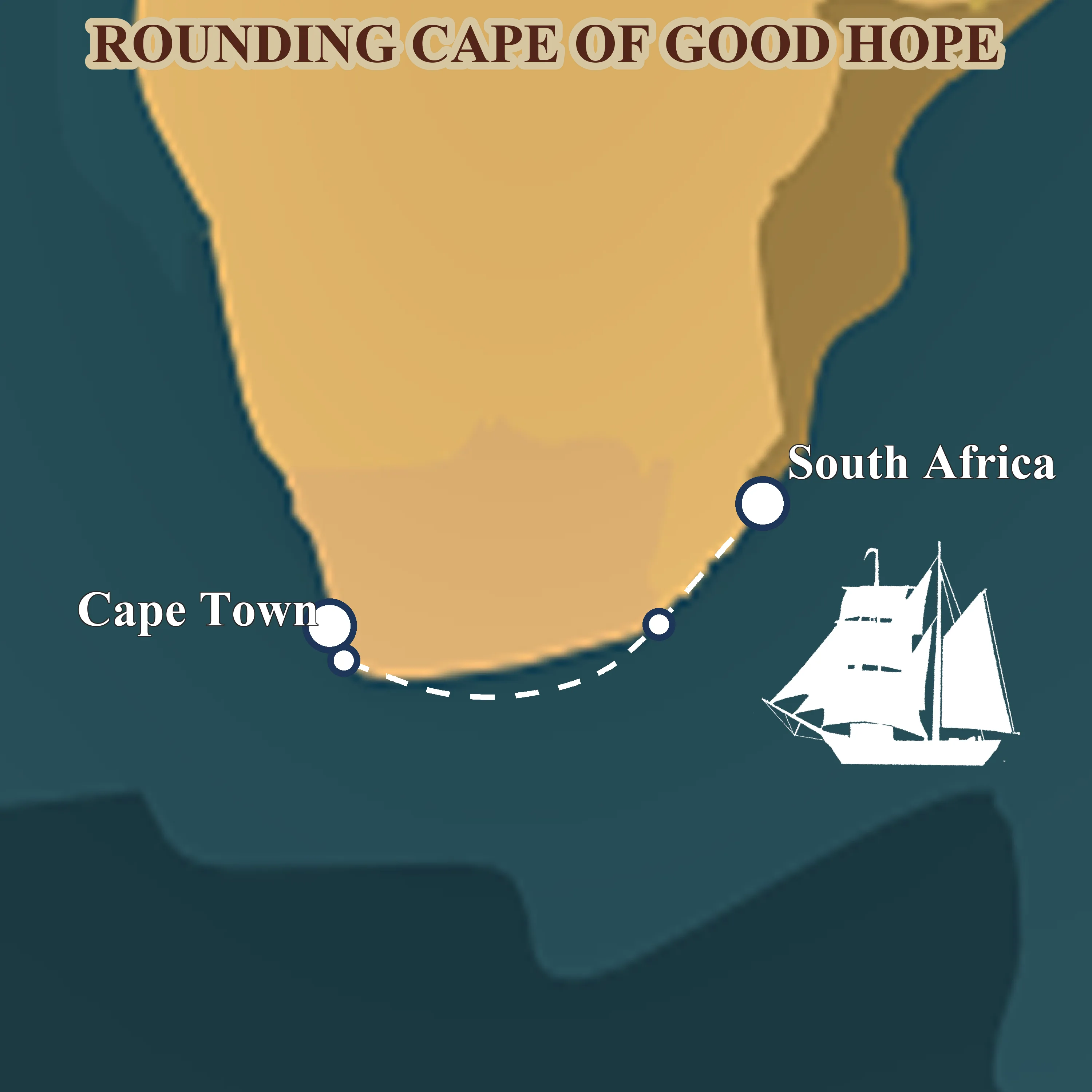
Leg 4: from Durban around the Cape of Good Hope
Nov 2026 — Dec 2026 · Durban, South Africa → Cape Town, South Africa
Thirty-eight days of serious seamanship, the Agulhas current, the Cape of Good Hope and the Southern Ocean at the tip of Africa, finishing quietly in Cape Town for Christmas.
Read more about this leg → about Leg 4: from Durban around the Cape of Good HopeLeg 5: across the South Atlantic from Saldanha to Fortaleza
Jan 2027 — Mar 2027 · Saldanha Bay, South Africa → Fortaleza, Brazil
Forty-four days before the southeast trades, Napoleon's exile at St. Helena, the equator crossing, and landfall in tropical Brazil. The ocean chapter of the voyage.
Read more about this leg → about Leg 5: across the South Atlantic from Saldanha to Fortaleza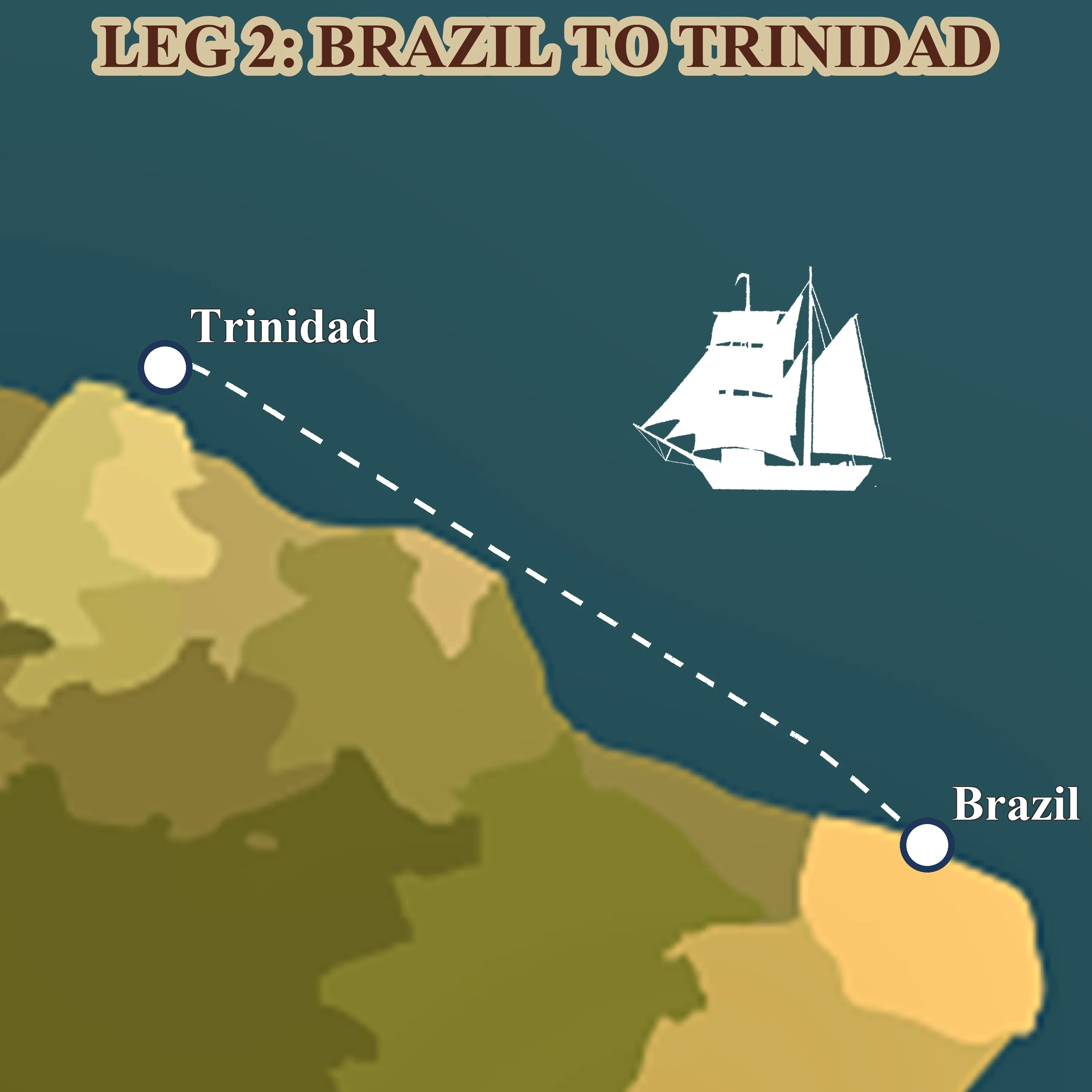
Leg 6: from Fortaleza to Trinidad along South America
Mar 2027 — Apr 2027 · Fortaleza, Brazil → Trinidad
A thousand miles of downwind trade running, the Amazon's brown water under the hull, the Guianas smudged on the horizon, and Trinidad's steelpan waiting at the end.
Read more about this leg → about Leg 6: from Fortaleza to Trinidad along South America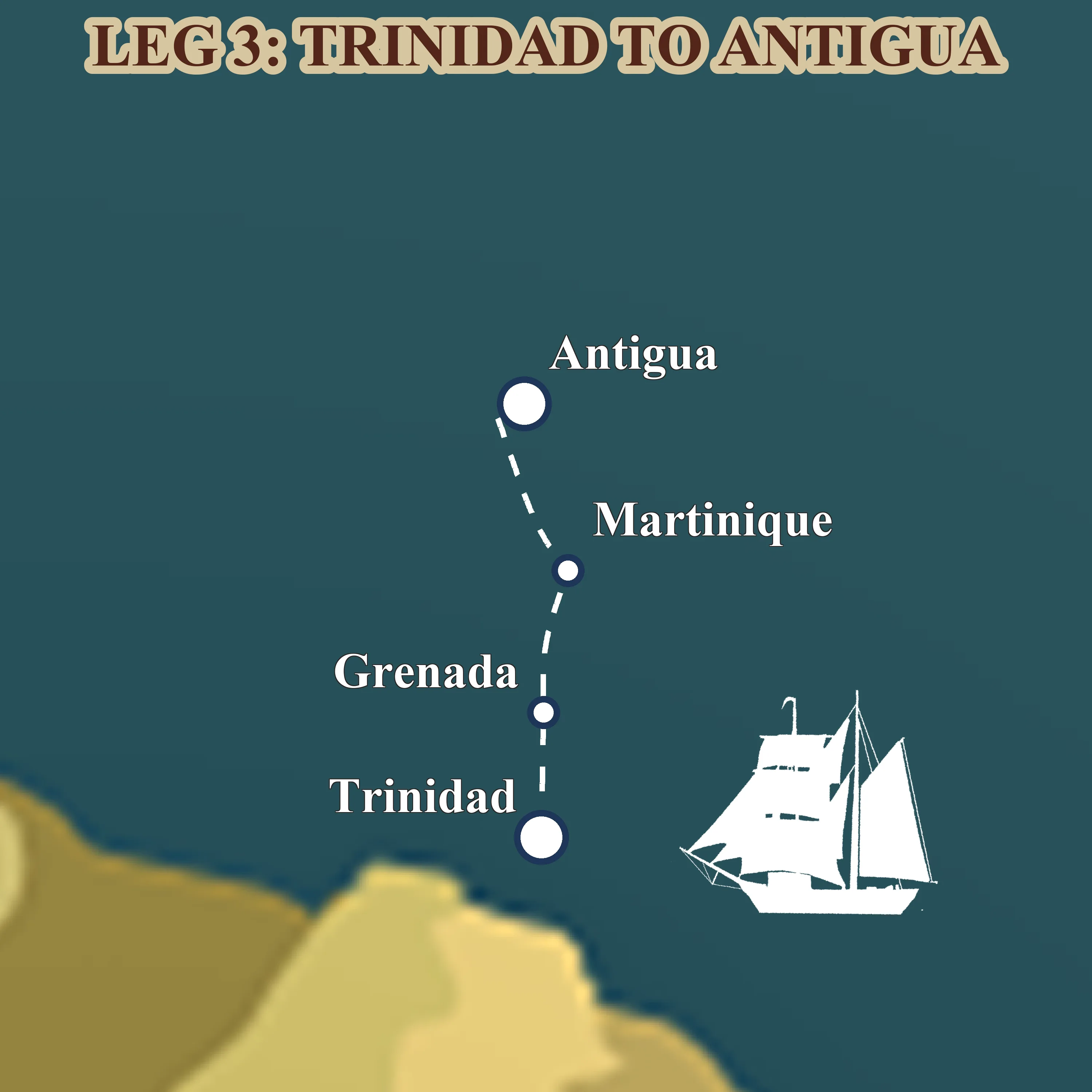
Leg 7: through the Windward Islands from Trinidad to Antigua
Apr 2027 — May 2027 · Trinidad → Antigua
Four weeks of short trade-wind daysails through the Lesser Antilles, turquoise anchorages, rum shops on the sand, French-Creole Martinique and the tall-ship scene in Antigua.
Read more about this leg → about Leg 7: through the Windward Islands from Trinidad to AntiguaLeg 8: across the North Atlantic from Antigua to the Azores
May 2027 — Jul 2027 · Antigua → Ponta Delgada, Azores
Fifty-six days on the classic spring tall-ship route home, Antigua, a long reach to Bermuda's pink sand, then three weeks of open ocean to the volcanic Azores.
Read more about this leg → about Leg 8: across the North Atlantic from Antigua to the Azores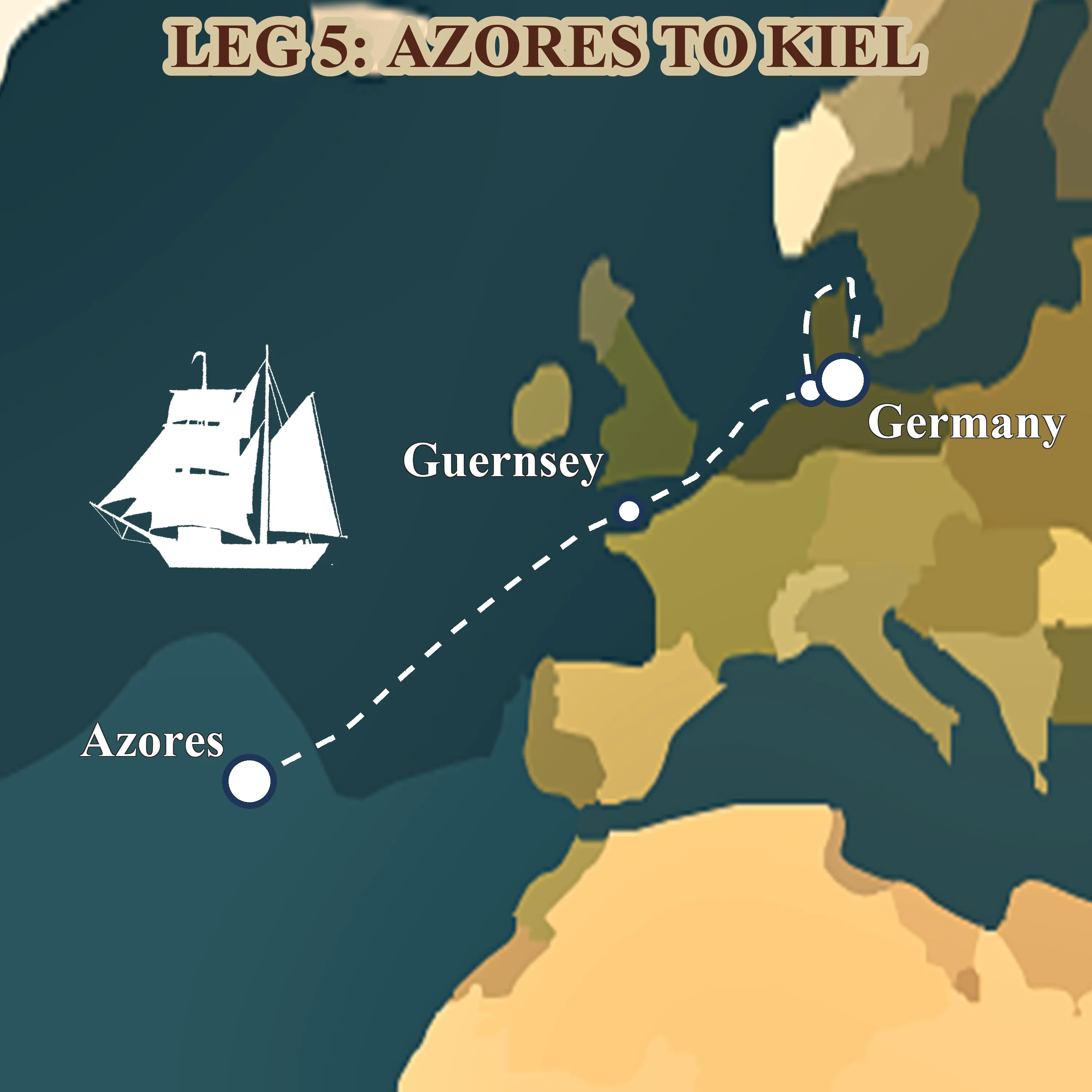
Leg 9: homecoming from the Azores to Kiel
Jul 2027 — Aug 2027 · Ponta Delgada, Azores → Kiel, Germany
The final 1,878 nm, from volcanic São Miguel to the Baltic, up the English Channel through the Dover TSS, past Helgoland's red cliffs and home to Kiel.
Read more about this leg → about Leg 9: homecoming from the Azores to Kiel