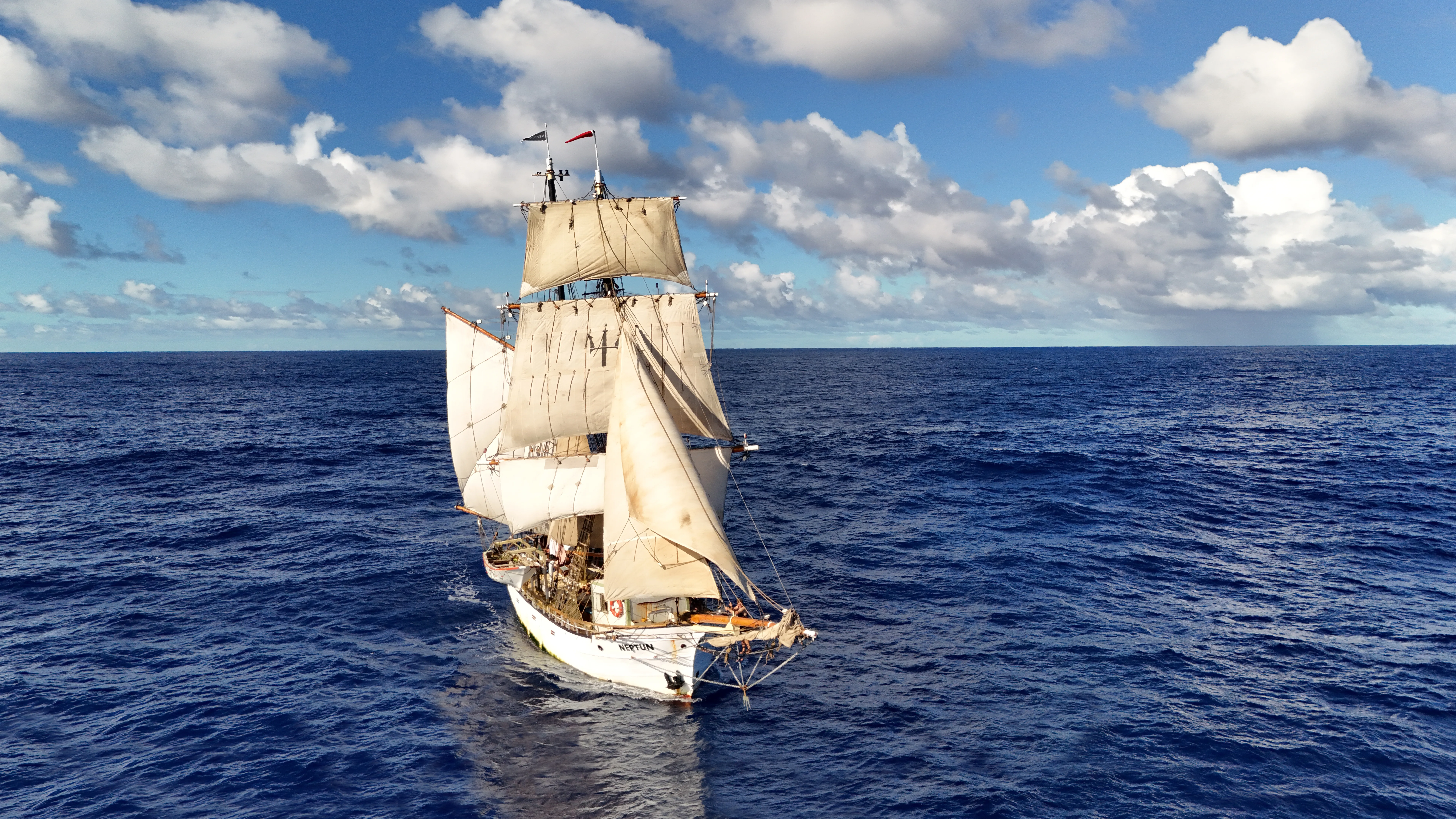
The milk run circumnavigation is the single most travelled ocean-crossing route in cruising, and the one Brigantine NEPTUN deliberately chose not to sail in 2026. This article covers what the route is, where it stops, what the seasons demand, what it costs, and why our 2026-2027 voyage picks up where the milk run drops off. The World ARC 2026-27 rally left Saint Lucia in January 2026 to circle the world in 15 months and 26,000 nautical miles, its 10,000-nm Pacific leg the pacific milk run at its most organised. For the mainstream of modern circumnavigation, start here; for the alternative, browse our nine-leg 2026-2027 voyage first.
Want the short version? Brigantine NEPTUN sails the other half of a westabout circumnavigation, Indian Ocean, Cape of Good Hope, Atlantic, not the Pacific milk run. Browse the nine-leg alternative route.
On this page
- What is the milk run?
- The route, stop by stop
- Seasonality and cyclone windows
- What it costs, three ways
- Why sailors choose the milk run over the alternatives
- Why NEPTUN's 2026-2027 voyage deliberately doesn't take it
- FAQ
- Read also
What is the milk run?
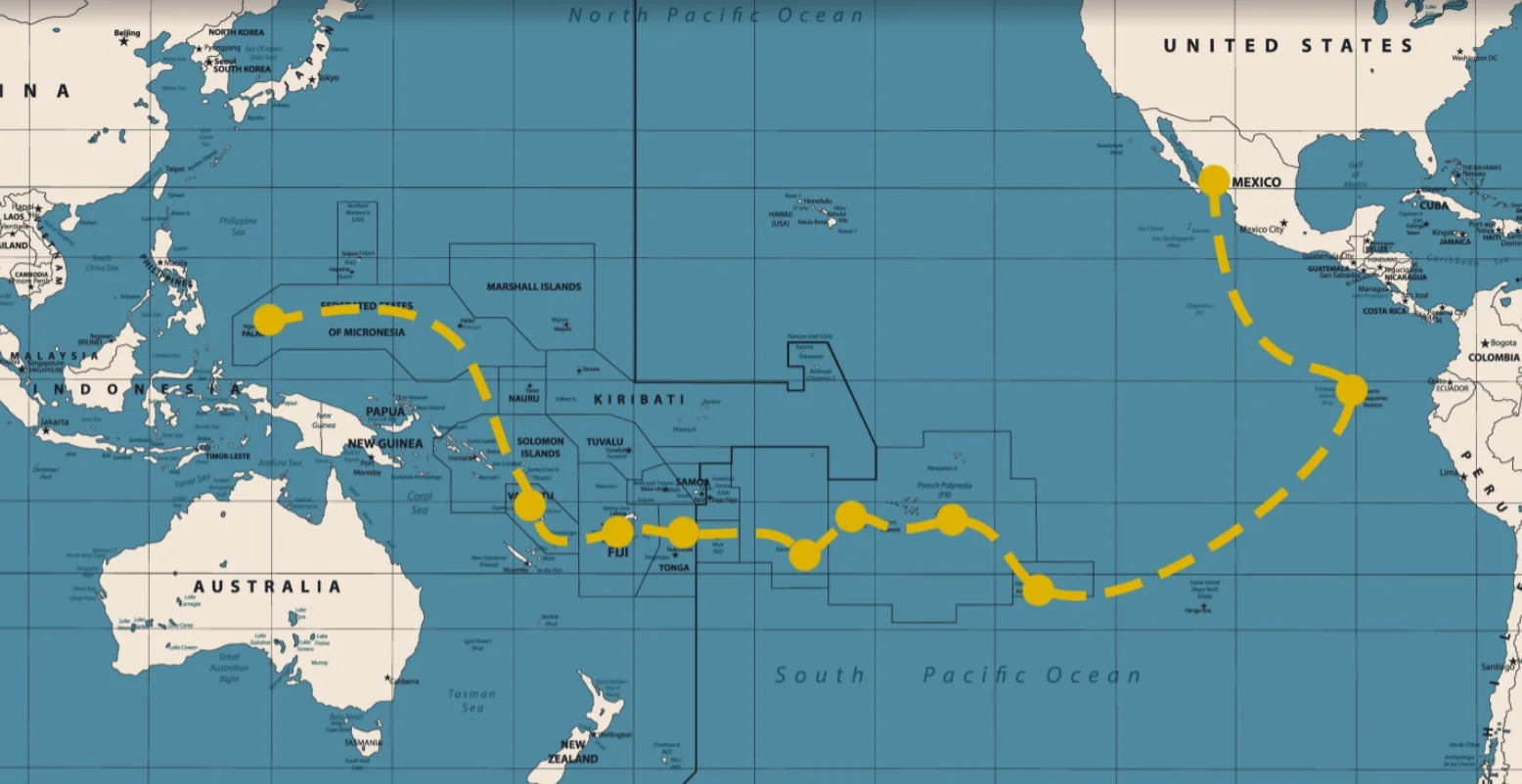
The milk run is the classic westabout tropical sailing route across the Pacific, running from Panama through the Galápagos, Marquesas, Tuamotus, Society Islands, Tonga and Fiji to New Zealand or Australia. It is the world's most-travelled circumnavigation route because its trade winds, weather windows, and island stops are reliably kind to small sailing vessels. The name comes from the idea that the passage is as predictable as a milkman's daily round.
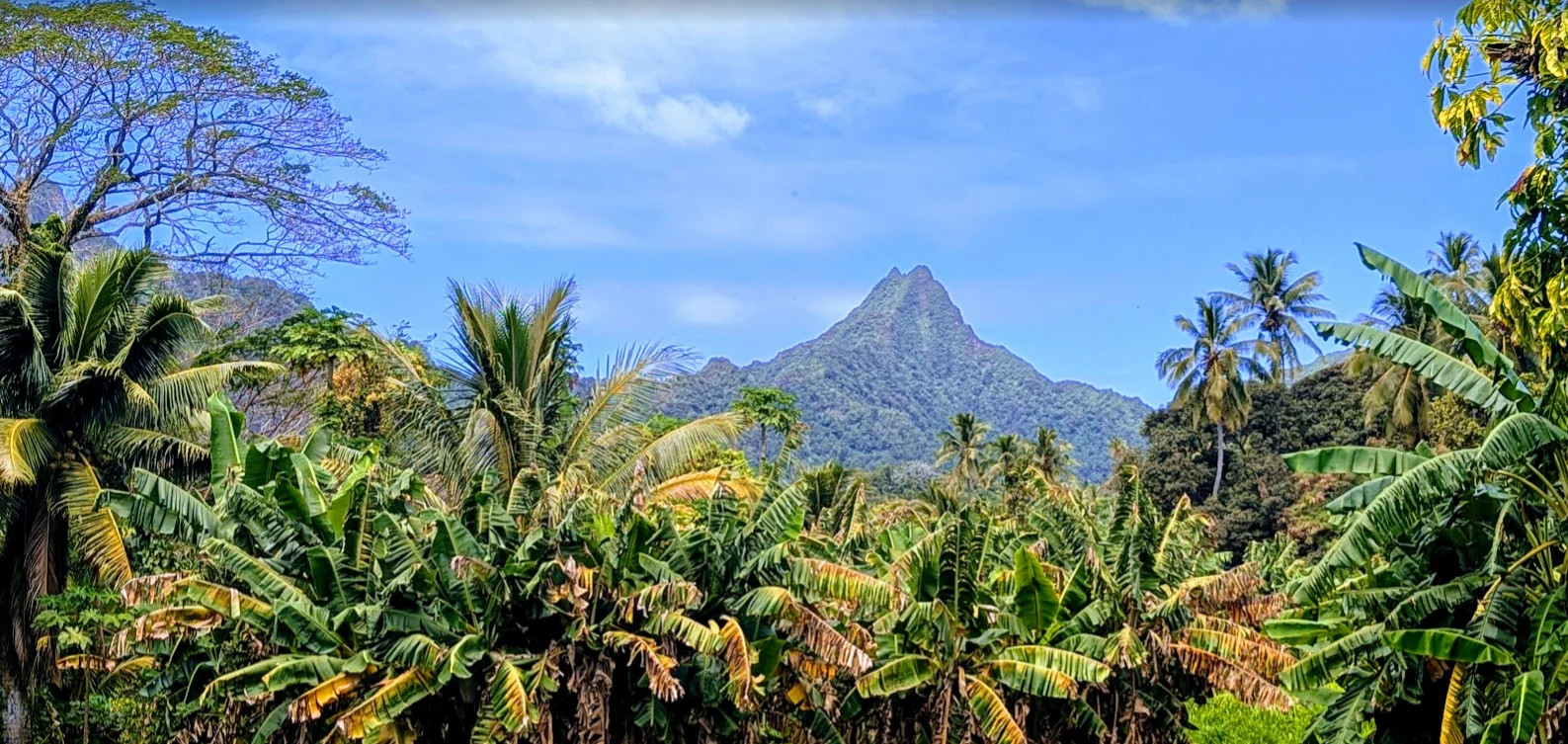
Where the name came from
English sailors in the mid-twentieth century coined "milk run" for the Panama-to-NZ migration, the same winds, anchorages, and landfalls every year. American cruisers later renamed their section the coconut milk run (coconuts at every Polynesian stop; the passage felt that easy). The Panama-to-Marquesas leg picked up a third name in the 1990s, the Pacific Puddle Jump, still used by the rally that crosses it every spring. Three names, one route. Jimmy Cornell's World Cruising Routes is the canonical reference.
Milk run, coconut milk run, puddle jump, same route, three names
Milk run
The full westabout Pacific migration, Panama to NZ or Australia via French Polynesia, Tonga, Fiji. ~10,000 nm over 6–10 months.
Coconut milk run
American cruisers' term for the same route. Same stops, same timing, same trade winds, just the Pacific side of the fleet's nickname.
Pacific Puddle Jump
The 3,000-nm leg from the Americas to the Marquesas. A subset of the milk run, but the most talked-about one, a 20-day open-ocean passage.
Why this became the "default" circumnavigation
Most of the world is ocean and most tropical wind blows from the east. A vessel leaving Panama has a free ride to Australia, no beating to windward for thousands of miles, no high-latitude weather, an anchorage every few hundred miles. Compared with east-about through the Great Capes or high-latitude routes through the Northwest Passage, the milk run is warm, downwind, forgiving. Roughly 95% of cruising circumnavigations follow it, and rallies like the World ARC package it as a 15-month turnkey event. For the full time budget, see how long it really takes to sail around the world.
The route, stop by stop
The canonical milk run has eleven main stops and roughly 10,000 nautical miles of Pacific between Panama and New Zealand. Sequence and spacing are fixed by the trade winds and the cyclone calendar; cruisers rarely deviate except to skip a stop for time. Below is the sequence as it is actually sailed, with approximate distances to the next landfall.
11 stops · ~10,000 nautical miles · 8–10 months
The canonical milk run, Panama to the South Pacific
1 · Panama (Colón → Balboa)
Canal transit from Caribbean to Pacific. Boats gather here Jan–Feb to wait out Puddle-Jump weather.
2 · Las Perlas Islands (~25 nm)
Short shakedown sail south of Panama. Final check before 3,000 nm of open ocean.
3 · Galápagos, San Cristóbal / Santa Cruz (~860 nm)
Strict Ecuadorian biosecurity, unique wildlife stop. Last landfall before the Puddle Jump.
4 · Marquesas, Hiva Oa / Nuku Hiva (~3,000 nm)
The Pacific Puddle Jump. 18–22 days of downwind trade sailing. Steep green islands rising from the empty Pacific, the emotional peak of most cruisers' circumnavigation.
5 · Tuamotus (~500 nm)
Seventy-eight low coral atolls. Passes must be timed to slack water, 6 knots of current otherwise. The milk run's one technical section.
6 · Society Islands, Tahiti / Bora Bora (~250 nm)
Papeete for refits, Moorea and Bora Bora for the postcard anchorages. Boats spend 6–12 weeks here May–August.
7 · Niue (~1,200 nm)
Single upraised coral island, no anchorage, mooring buoys only. Clean-water stop en route to Tonga.
8 · Tonga, Vava'u / Nuku'alofa (~400 nm)
Protected cruising ground; humpbacks breed here Jul–Oct. Social hub of the middle milk run.
9 · Fiji (~450 nm)
Savusavu and Vuda Marina for check-in; Yasawa and Mamanuca for cruising. Vuda offers cyclone pits.
10 · Vanuatu (Tanna / Port Vila) (~500 nm)
Active volcanoes at Tanna, traditional villages offshore. Last tropical stop before the fleet splits for NZ/AU in late October.
11 · New Zealand (Opua) or Australia (~1,000–1,200 nm)
Final passage out of the tropics before 1 November. Arrival closes the Pacific leg at ~10,000 miles since Panama.
Cruisers Wiki, noonsite, and Jimmy Cornell agree on this ordering with minor variations (Cook Islands between Societies and Niue; New Caledonia between Vanuatu and Australia). Past NZ/AU the milk run sailing route continues through the Indian Ocean, around the Cape of Good Hope or Suez, and home across the Atlantic, the full lap about 26,000 nm. The Pacific is just under half, but it is the half that defines the route.
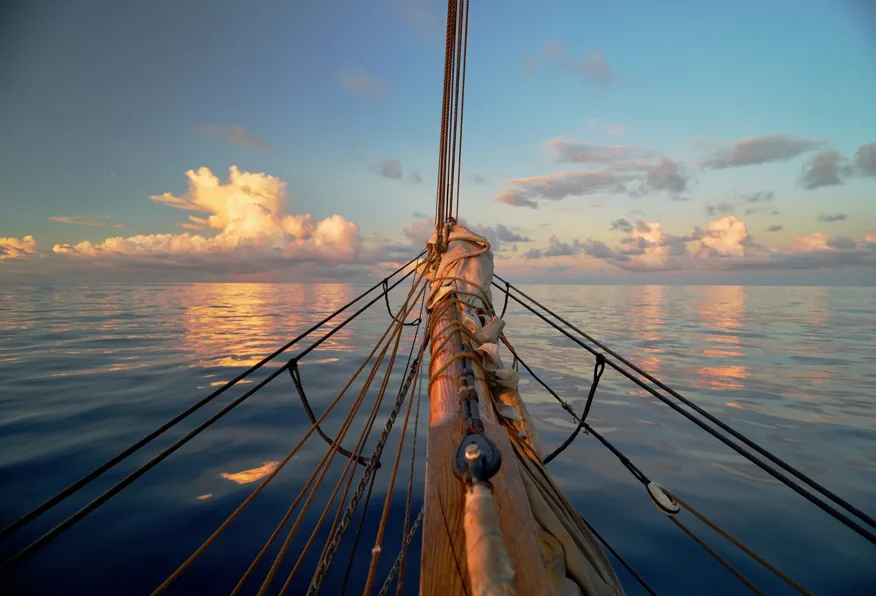
What an ocean crossing actually teaches you.
Read, Day at sea on a tall shipSeasonality and cyclone windows
The milk run is not a "sail whenever you like" route. It is a fixed annual migration because the South Pacific cyclone season forces the fleet out of the tropics between 1 November and 30 April. Miss the window and you are either wintering in the tropics in the path of storms, or racing a late-autumn low south to New Zealand. Neither is a good option.
The cyclone calendar that shapes the route
Puddle Jump departures run late January through April. May–August the fleet works west through French Polynesia; August–September to Tonga and Fiji. October is the last safe month to make NZ or AU, almost everyone is in Opua or Bundaberg by Halloween.
Where boats hide from 1 November to 30 April
Most cross to New Zealand or Queensland. A smaller group stays in Fiji and books a cyclone pit at Vuda Marina, excavated in-ground berths for survival-grade shelter. A few dozen remain in Tahiti. Nobody stays unprotected. Our guide to trade winds and classic sailing routes covers the global pattern.
Why almost nobody sails the reverse direction
East-about against the southeast trades is possible on paper, miserable in practice, a 10,000-nm beat into 20-knot headwinds with adverse current. The reverse milk run exists as a concept; as a practice it is vanishingly rare.
What it costs, three ways
There is no single milk-run price tag. How you sail it determines the number. The three real models are: own your own yacht, crew for someone else, or join a tall ship.
Own a cruising yacht
US$18,000–$47,000/yr running cost for a 40-footer, once insurance, moorings, maintenance, fuel and food are in. Buy-in another $60,000–$250,000. Slowest to start, most freedom underway.
Crew for someone else
Free berth on a boat that needs watch-standers, or €30–€80/day to cover food and fuel. Crew-finder networks fill up before Puddle Jump departures. Limited control over route and timing.
Join a tall ship
Flat per-day rate covering berth, meals, and full sail-training. NEPTUN at €79/day; comparable tall ships €70–€150. Published schedule, professional crew, real training programme.
The yacht-owner math
Published cruising budgets for a couple on a 40-foot yacht settle around US$2,000–$4,000 per month, with one-off refits bumping individual years higher. A five-year lap on your own boat typically runs US$150,000–$300,000 including the boat and mid-voyage refits.
Crewing as a cheaper way in
Crewing ranges from a free berth (work watches, earn your passage) to €30–€80 per day. Owners want competent watch-standers who do not cause drama over three thousand miles. Cheapest way onto the milk run; hardest to plan.
What you're really paying for
Three cost centres on any model: the boat's fixed costs (insurance, moorings, survey), the time (a full westabout is two to three years done properly), and shore spending.
Thinking about the tall-ship model? See what sail training actually costs per leg on NEPTUN, flat €79/day, everything included, no surprise surcharges.
Why sailors choose the milk run over the alternatives
There are three realistic ways to sail around the world. Each has a character, a constituency, and a failure mode, the milk run is the forgiving middle one.
Westabout tropical (the milk run)
Panama → Pacific → Indian Ocean → Cape of Good Hope or Suez → Atlantic. Trade winds, warm water, an anchorage every few hundred miles. ~95% of cruising circumnavigations.
East-about via the Great Capes
Round the three Great Capes (Good Hope, Leeuwin, Horn) against Southern Ocean westerlies. The racer's route. Brutal but fast, Vendée Globe, Jules Verne Trophy.
High-latitude (Northwest Passage)
Through the Arctic via the Northwest Passage, or via Cape Horn both ways. Fewer than 300 vessels have ever completed it. Ice-class or expedition-grade prep mandatory.
The milk run wins on forgiveness. The Great Capes win on time. High-latitude variants win on novelty. For every first-time circumnavigator, forgiveness is the right trade.
Planning your own ocean voyage? Our sibling reference on trade winds and the classic sailing routes covers the global wind pattern that makes each of these routes work.
Why NEPTUN's 2026-2027 voyage deliberately doesn't take it
The NEPTUN alternative
Why we went the other way around
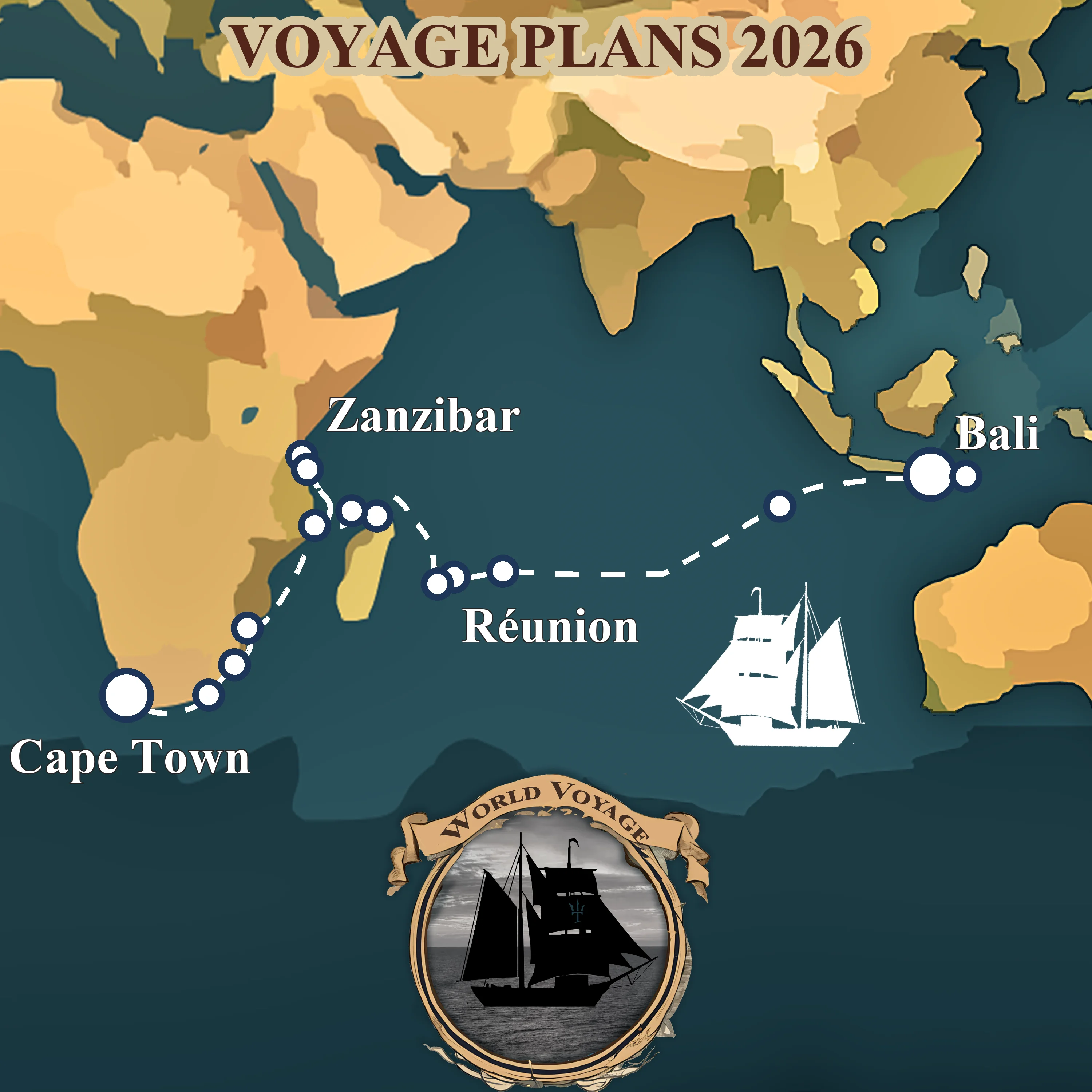
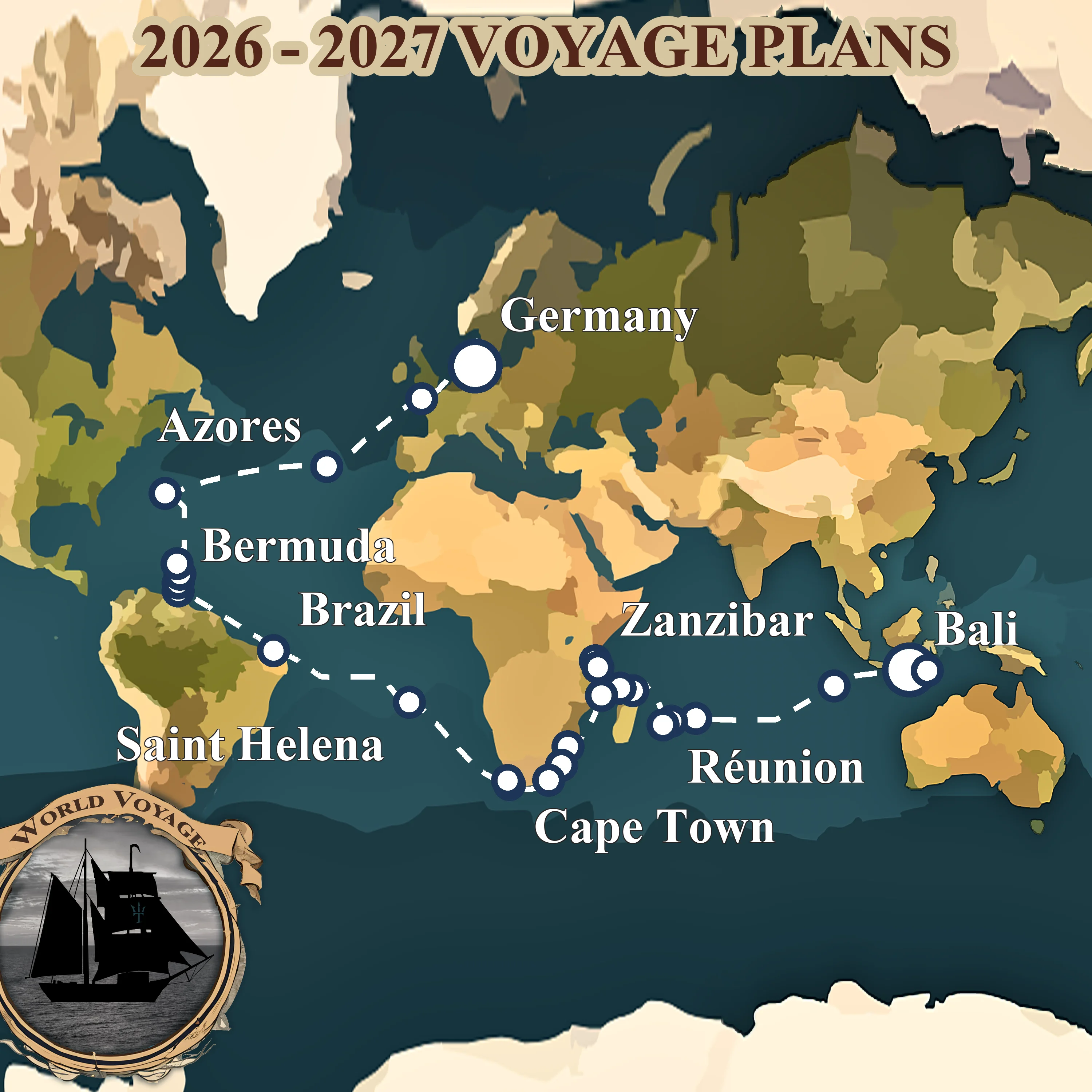
Our 2026-2027 voyage is also westabout and also rides the trades, but instead of crossing the Pacific we complete the remaining half of a circumnavigation: Indian Ocean, Cape of Good Hope, South Atlantic, Caribbean, North Atlantic, North Sea. Nine legs, 19,000 nautical miles, 482 days. A deliberate choice, not a compromise.
We already did the milk run in 2025
NEPTUN sailed the Pacific in 2024-2025, Tonga, Fiji, Vanuatu are in her recent logbook. The 2026 voyage picks up from Bali, the natural westabout continuation from where the South Pacific milk run deposits its fleet. Instead of repeating the Pacific we are completing the back half: Leg 1, Bali to Réunion crosses the Indian Ocean, passing Cocos Keeling (itself a milk-run continuation waypoint) before Réunion.
The Cape route is a better teaching voyage
Nine distinct legs with genuine destinations, Réunion, Zanzibar, Durban, Cape Town, Saint Helena, Fortaleza, Trinidad, Antigua, Azores, Kiel, make a richer syllabus than one long Pacific glide. An 18-day Atlantic crossing in weather teaches more seamanship than an 18-day downwind run in the tradewind belt. Rounding the Cape of Good Hope on Leg 4 and the South Atlantic crossing to Fortaleza give trainees conditions the milk run does not.
Milk run vs NEPTUN's 2026-2027 voyage
Same westabout philosophy, different half of the world, different purpose.
The NEPTUN alternative, our east-via-Cape route
Four oceanic contrasts to the milk run, a square-rig Indian Ocean crossing, the Cape of Good Hope under sail, the South Atlantic to Brazil, and the North Atlantic home.
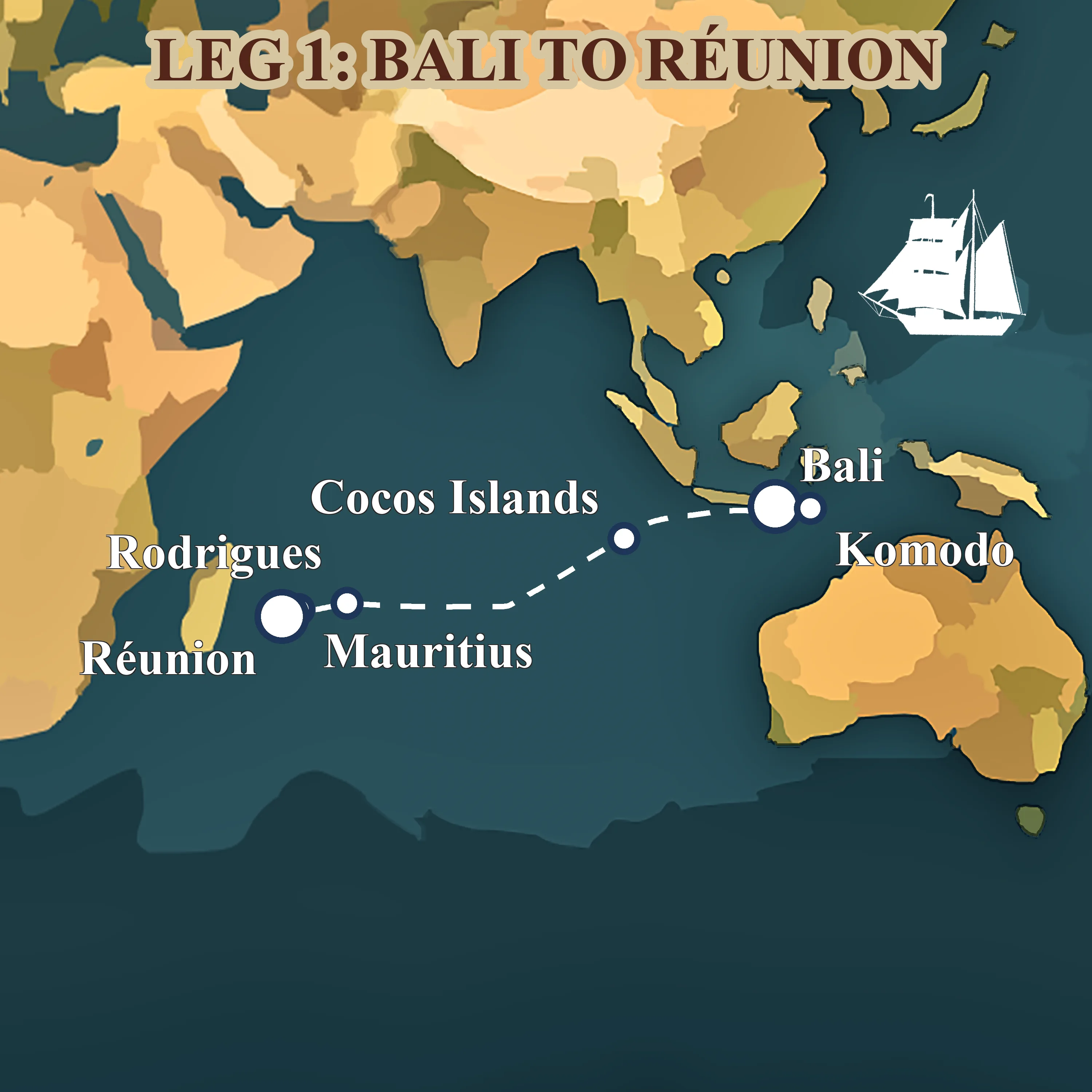
Leg 1: from Bali to Réunion across the Indian Ocean
May 2026 — Aug 2026 · Bali, Indonesia → Réunion, France
The opening chapter of Neptun's 482-day world voyage, a 4,078-nm trade-wind passage from the temples of Bali to the volcanic cliffs of Réunion.
Read more about this leg → about Leg 1: from Bali to Réunion across the Indian Ocean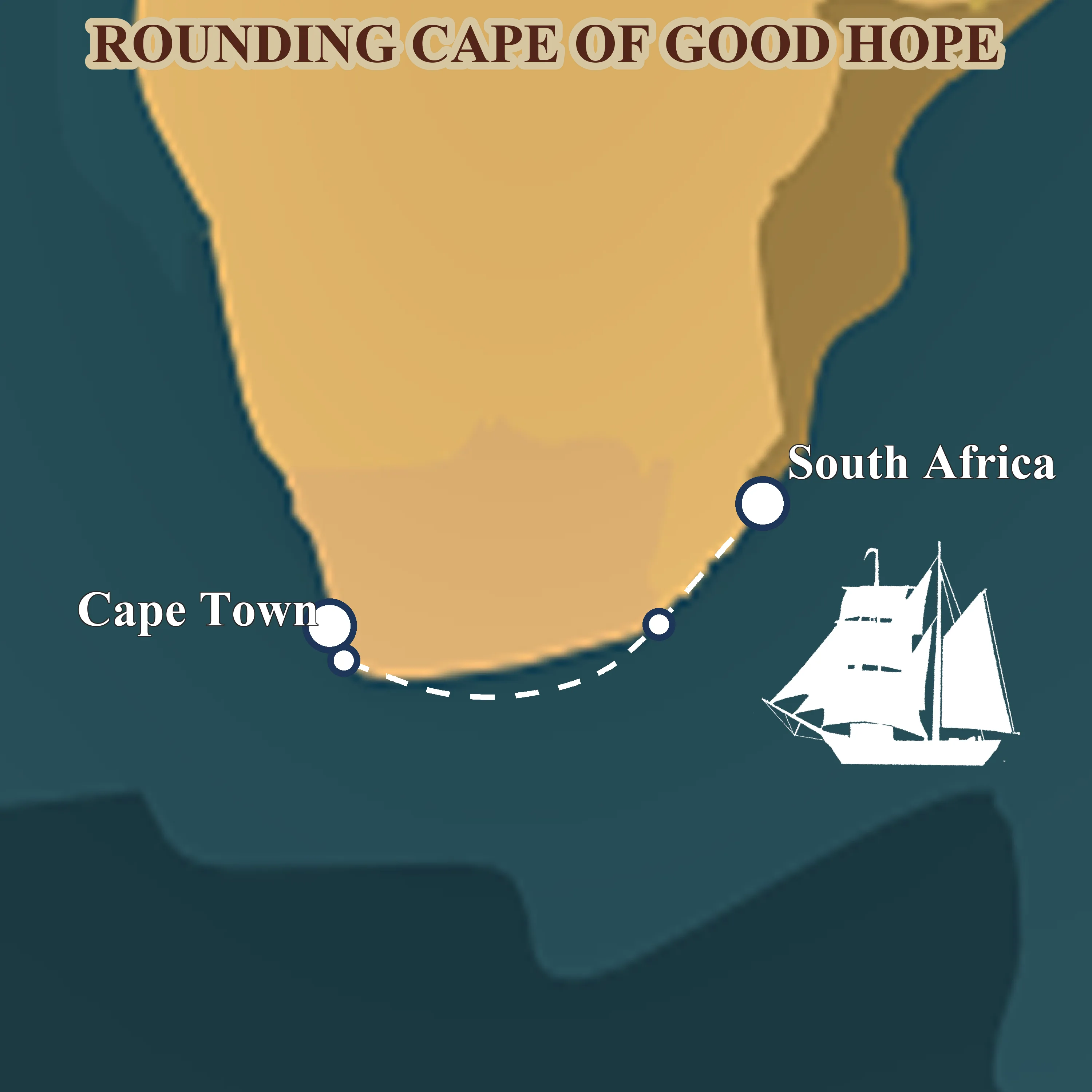
Leg 4: from Durban around the Cape of Good Hope
Nov 2026 — Dec 2026 · Durban, South Africa → Cape Town, South Africa
Thirty-eight days of serious seamanship, the Agulhas current, the Cape of Good Hope and the Southern Ocean at the tip of Africa, finishing quietly in Cape Town for Christmas.
Read more about this leg → about Leg 4: from Durban around the Cape of Good Hope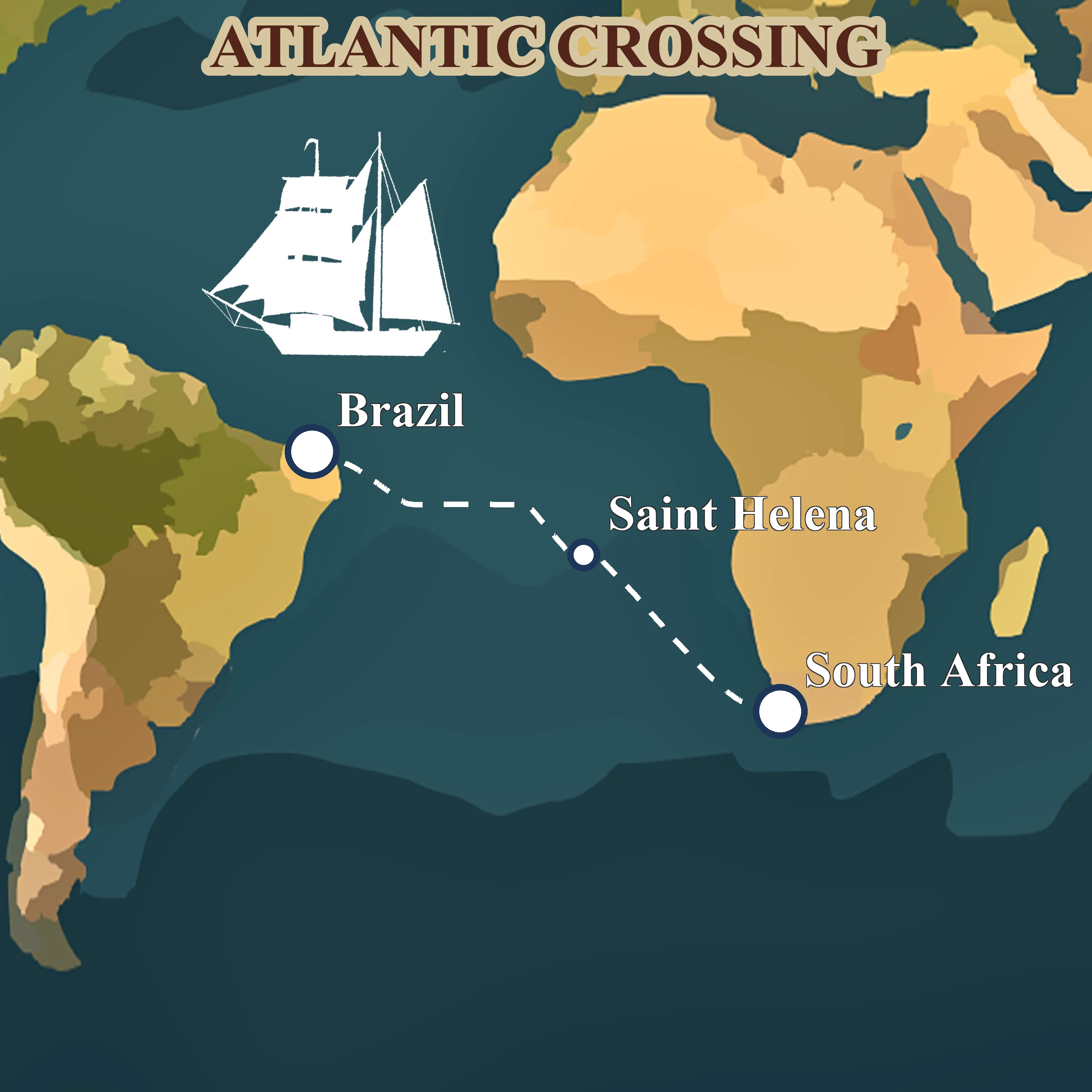
Leg 5: across the South Atlantic from Saldanha to Fortaleza
Jan 2027 — Mar 2027 · Saldanha Bay, South Africa → Fortaleza, Brazil
Forty-four days before the southeast trades, Napoleon's exile at St. Helena, the equator crossing, and landfall in tropical Brazil. The ocean chapter of the voyage.
Read more about this leg → about Leg 5: across the South Atlantic from Saldanha to Fortaleza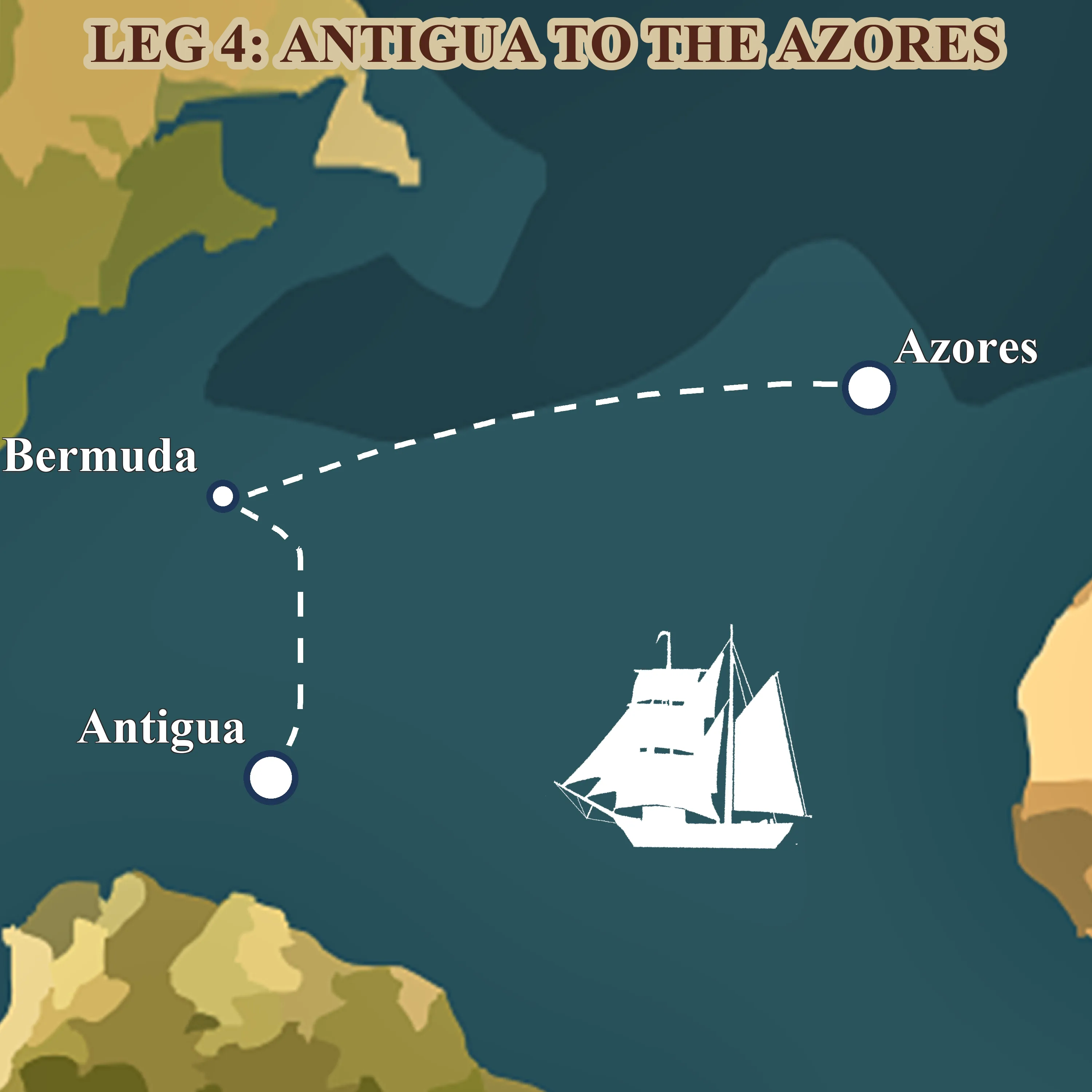
Leg 8: across the North Atlantic from Antigua to the Azores
May 2027 — Jul 2027 · Antigua → Ponta Delgada, Azores
Fifty-six days on the classic spring tall-ship route home, Antigua, a long reach to Bermuda's pink sand, then three weeks of open ocean to the volcanic Azores.
Read more about this leg → about Leg 8: across the North Atlantic from Antigua to the AzoresThe Red Sea in 2026, why there's no shortcut
The traditional alternative to the Cape is Suez, historically how westabout cruisers return from the Indian Ocean. In 2026 that route is closed to leisure sailors. After the October 2025 ceasefire and February-March 2026 Houthi re-escalation, cruising yachts and sail-training vessels are still routing south via the Cape. It is the only practical westabout return to Europe this year.
What our nine legs share with the milk run (and what they don't)
Same westabout philosophy. Same reliance on trade winds, the southeast trades push us across the Indian Ocean; southeast then northeast carry us across both Atlantics. Same seasonal discipline (Cape rounded in November before the Southern Ocean depressions intensify). What differs is the teaching model: the milk run is set up for crews already sailing their own boats. NEPTUN takes beginners, beginners can sail with us because teaching is embedded in the watch system.
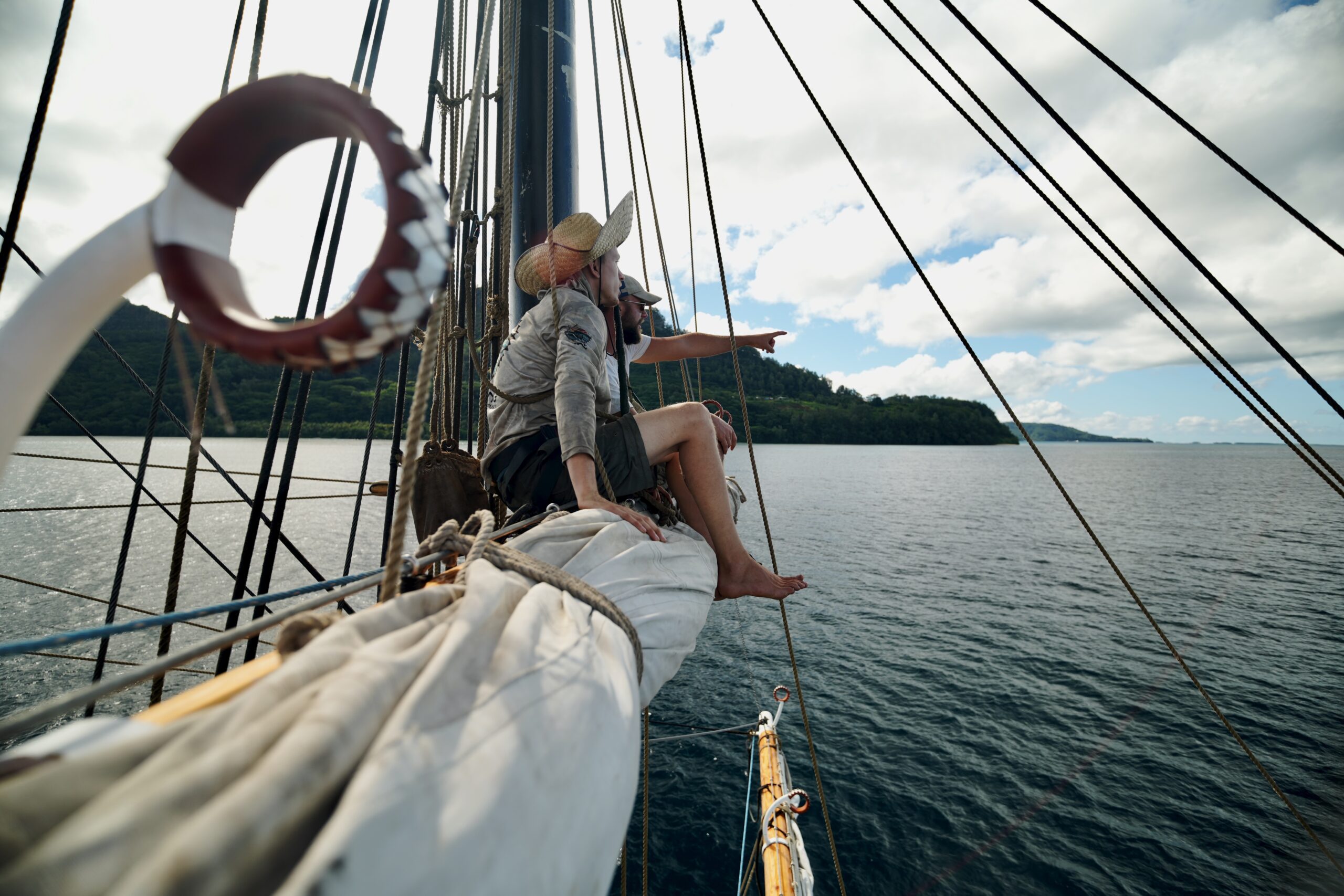
Ready to commit? Apply for a berth on the 2026-2027 voyage. Applications are reviewed weekly; berths on the South Atlantic and North Atlantic homeward legs fill first.
All nine legs below. Each available individually or stacked; most trainees sail two to three consecutive legs.
All nine legs, the full 2026-2027 voyage
Bali to Kiel, 482 days, 19,000 nm. Every leg available individually.
Leg 1: from Bali to Réunion across the Indian Ocean
May 2026 — Aug 2026 · Bali, Indonesia → Réunion, France
The opening chapter of Neptun's 482-day world voyage, a 4,078-nm trade-wind passage from the temples of Bali to the volcanic cliffs of Réunion.
Read more about this leg → about Leg 1: from Bali to Réunion across the Indian Ocean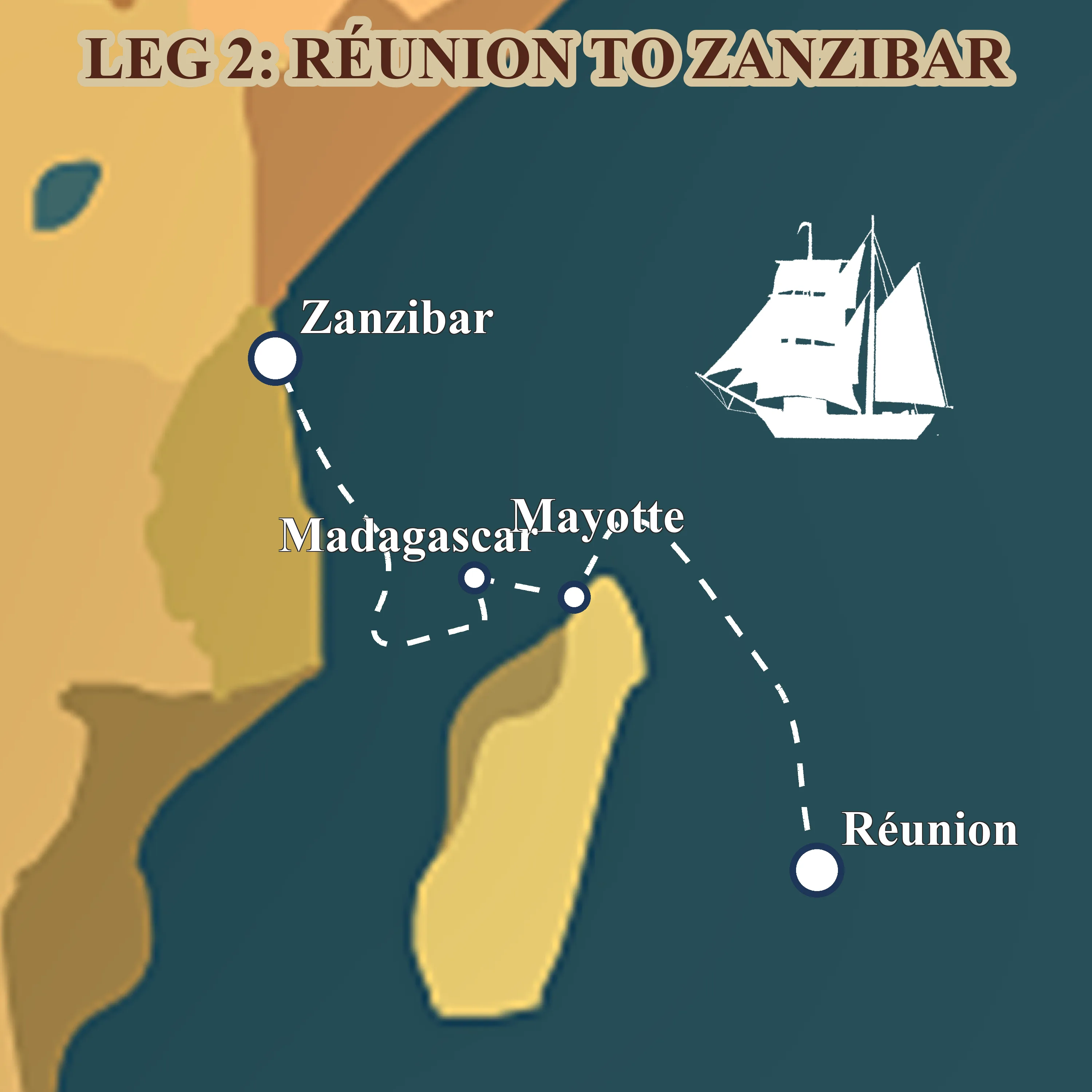
Leg 2: from Réunion to Zanzibar via Madagascar
Aug 2026 — Sept 2026 · Réunion, France → Zanzibar, Tanzania
Forty days across the western Indian Ocean, volcanic Réunion, lemur-haunted Nosy Be, the Mozambique Channel, and the spice-scented stone alleys of Zanzibar.
Read more about this leg → about Leg 2: from Réunion to Zanzibar via Madagascar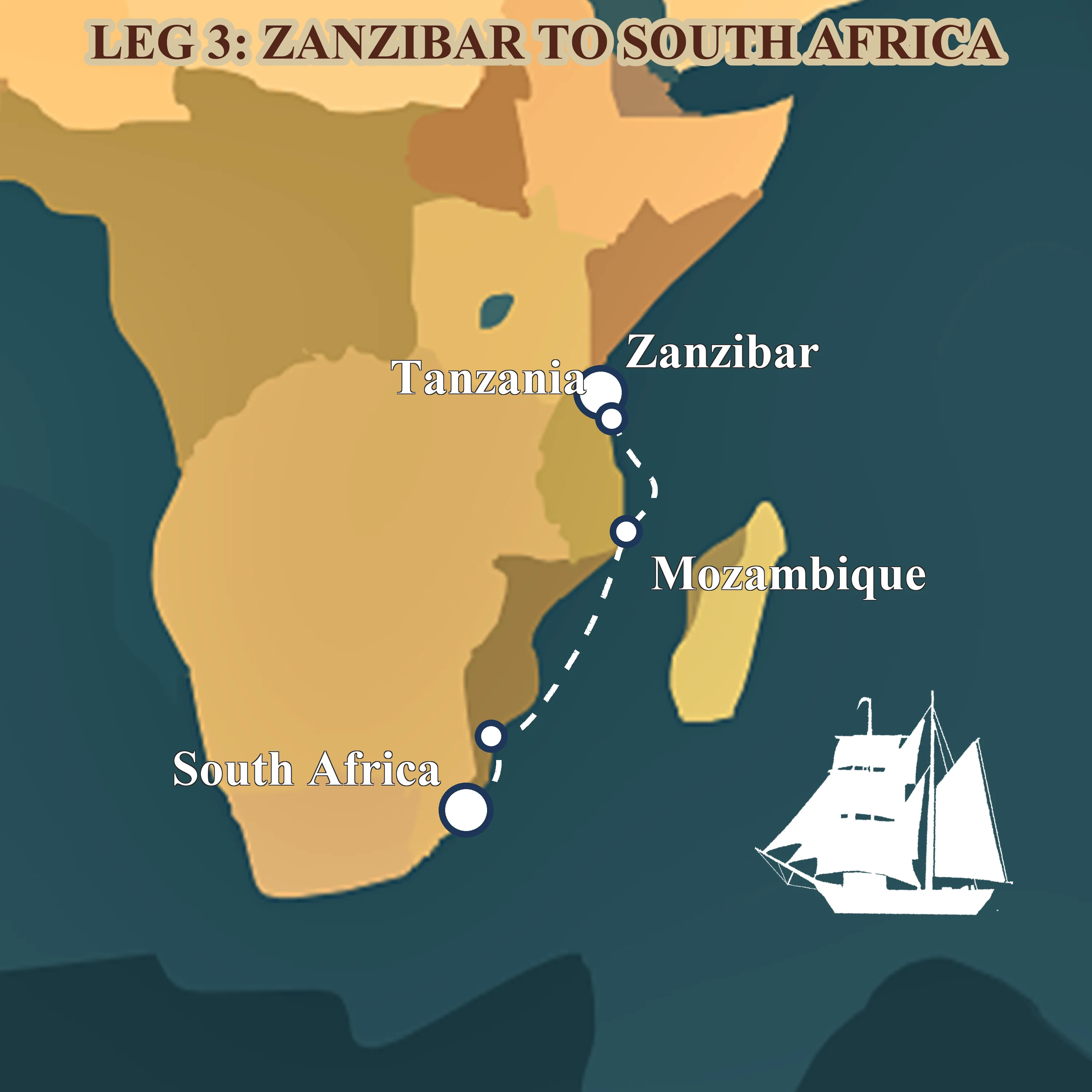
Leg 3: from Zanzibar to Durban down the Mozambique Channel
Sept 2026 — Nov 2026 · Zanzibar, Tanzania → Durban, South Africa
Sixty-three days coasting the African shore, spice islands, mangrove anchorages, Portuguese praças and the long trade-wind run down the Mozambique Channel to Durban.
Read more about this leg → about Leg 3: from Zanzibar to Durban down the Mozambique ChannelLeg 4: from Durban around the Cape of Good Hope
Nov 2026 — Dec 2026 · Durban, South Africa → Cape Town, South Africa
Thirty-eight days of serious seamanship, the Agulhas current, the Cape of Good Hope and the Southern Ocean at the tip of Africa, finishing quietly in Cape Town for Christmas.
Read more about this leg → about Leg 4: from Durban around the Cape of Good HopeLeg 5: across the South Atlantic from Saldanha to Fortaleza
Jan 2027 — Mar 2027 · Saldanha Bay, South Africa → Fortaleza, Brazil
Forty-four days before the southeast trades, Napoleon's exile at St. Helena, the equator crossing, and landfall in tropical Brazil. The ocean chapter of the voyage.
Read more about this leg → about Leg 5: across the South Atlantic from Saldanha to Fortaleza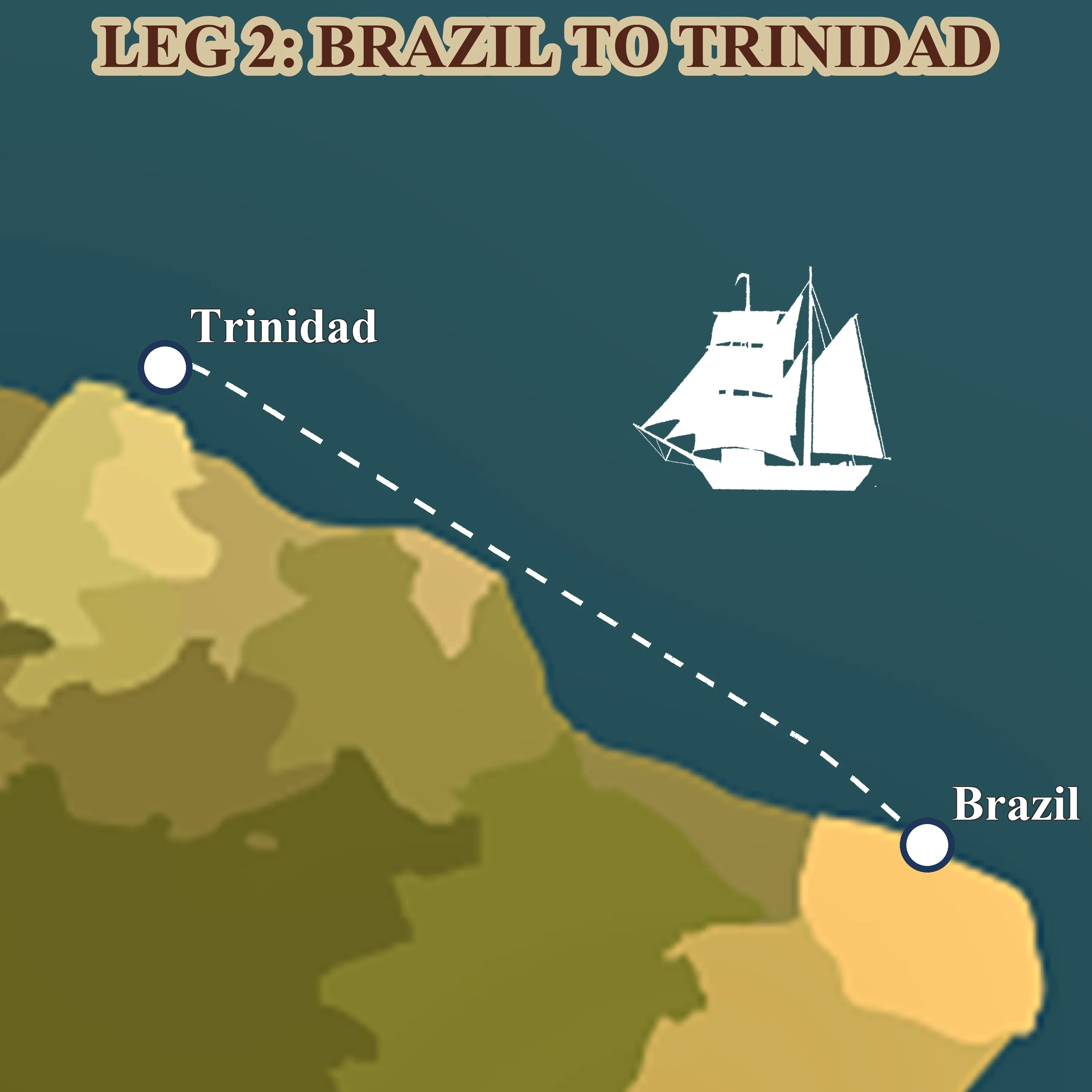
Leg 6: from Fortaleza to Trinidad along South America
Mar 2027 — Apr 2027 · Fortaleza, Brazil → Trinidad
A thousand miles of downwind trade running, the Amazon's brown water under the hull, the Guianas smudged on the horizon, and Trinidad's steelpan waiting at the end.
Read more about this leg → about Leg 6: from Fortaleza to Trinidad along South America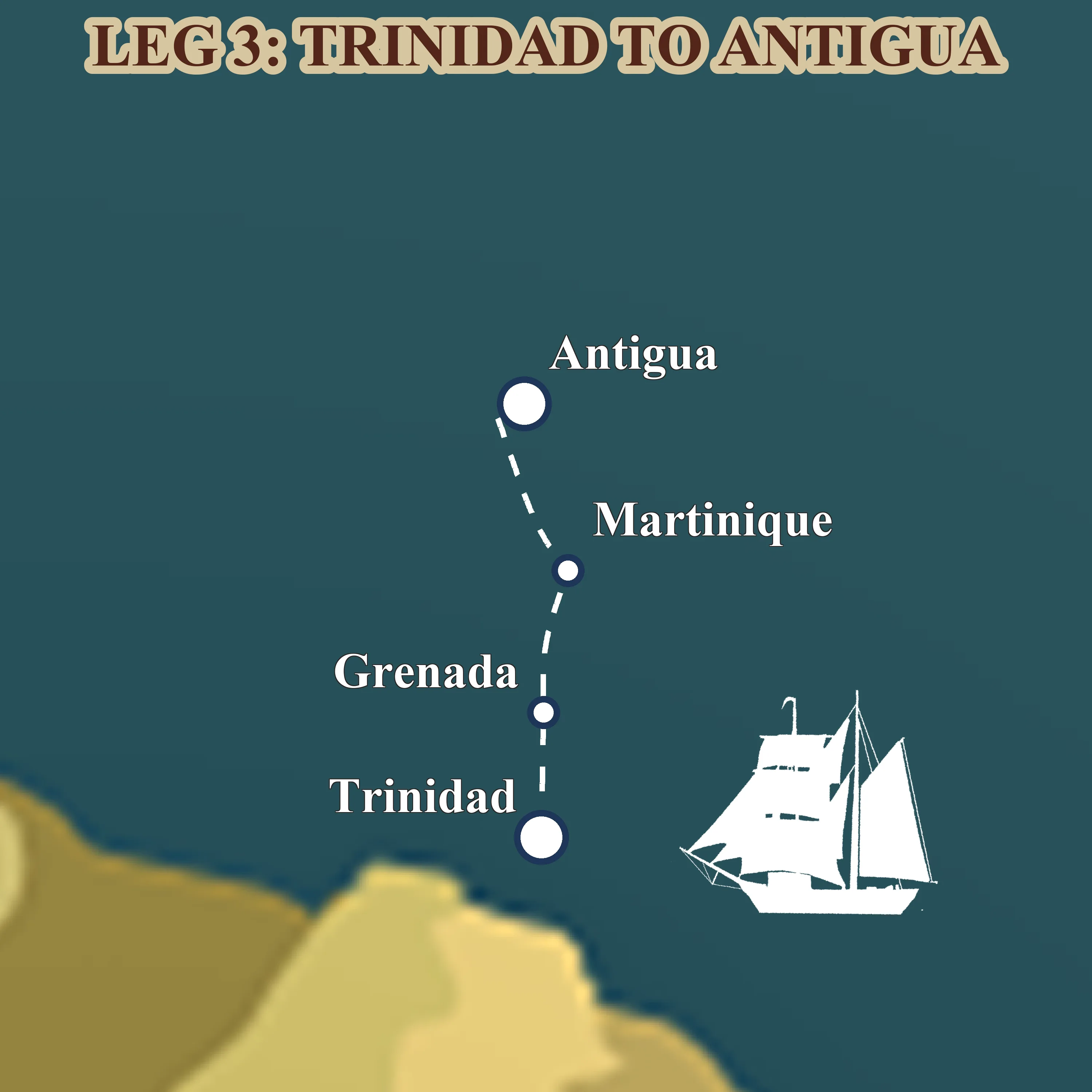
Leg 7: through the Windward Islands from Trinidad to Antigua
Apr 2027 — May 2027 · Trinidad → Antigua
Four weeks of short trade-wind daysails through the Lesser Antilles, turquoise anchorages, rum shops on the sand, French-Creole Martinique and the tall-ship scene in Antigua.
Read more about this leg → about Leg 7: through the Windward Islands from Trinidad to AntiguaLeg 8: across the North Atlantic from Antigua to the Azores
May 2027 — Jul 2027 · Antigua → Ponta Delgada, Azores
Fifty-six days on the classic spring tall-ship route home, Antigua, a long reach to Bermuda's pink sand, then three weeks of open ocean to the volcanic Azores.
Read more about this leg → about Leg 8: across the North Atlantic from Antigua to the Azores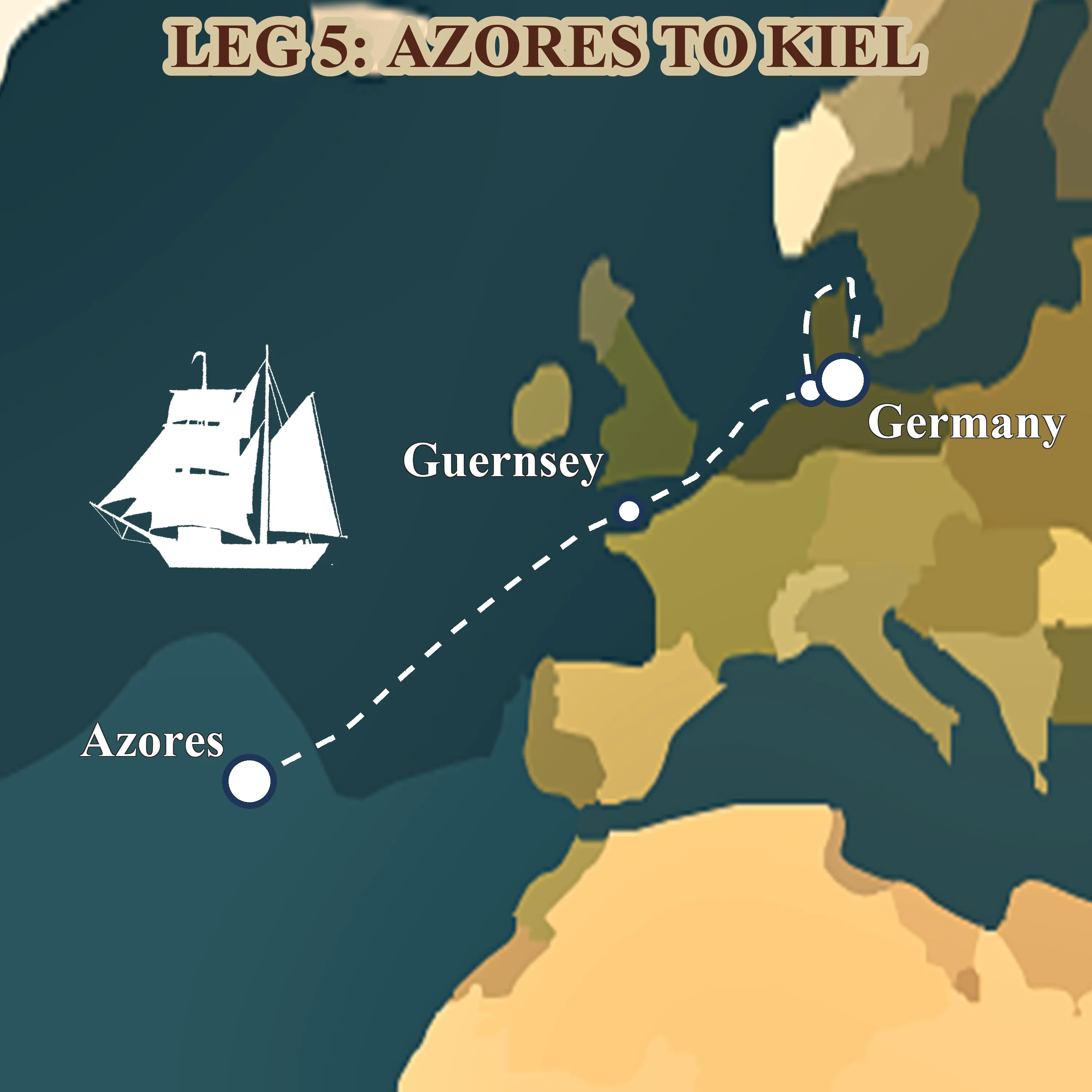
Leg 9: homecoming from the Azores to Kiel
Jul 2027 — Aug 2027 · Ponta Delgada, Azores → Kiel, Germany
The final 1,878 nm, from volcanic São Miguel to the Baltic, up the English Channel through the Dover TSS, past Helgoland's red cliffs and home to Kiel.
Read more about this leg → about Leg 9: homecoming from the Azores to KielThe first half is mapped in the 2026 season overview; the homeward run in the 2027 homecoming year. Our sail training programme is what turns a berth into a learning experience, what makes a tall ship voyage different from a milk-run charter.
FAQ
What is the milk run sailing?
The milk run is the classic westabout tropical sailing route across the Pacific, running from Panama through the Galápagos, Marquesas, Tuamotus, Society Islands, Tonga and Fiji to New Zealand or Australia. It is the world's most-travelled circumnavigation route because its trade winds, weather windows, and island stops are reliably kind to small sailing vessels.
What is the best time to do the Pacific milk run?
Leave Panama or Galápagos between late January and April for the Puddle-Jump window. Cruise French Polynesia May–August, Tonga and Fiji August–October, arrive NZ or AU by end October, always before the 1 November start of the South Pacific cyclone season.
How long does the milk run take?
Roughly 8–10 months from Panama to NZ/AU at cruising pace, the World ARC formalises it at 15 months back to Saint Lucia. A full westabout circumnavigation via the Indian Ocean and Cape (or Suez) typically takes 18–24 months, depending on how long you linger in French Polynesia.
Is the Pacific milk run dangerous?
Statistically safer than the east-about Great Capes route, the trade winds are predictable and stops reliably spaced. Real risks are reef navigation in the Tuamotus (passes must be timed to slack water) and cyclone timing if boats leave too late for NZ/AU. Managed properly, it is the forgiving route, not a dangerous one.
Why is it called the coconut milk run?
American cruisers coined the "coconut" variant because coconuts appear at every Polynesian stop, and because the passage itself is so easy and predictable it was compared, like the original English "milk run", to a milkman's daily round.
Can beginners sail the milk run?
On a private yacht, usually not, a two-person crew on a 3,000-nm Puddle Jump is demanding even for experienced sailors. On a tall ship with professional crew and a training syllabus, yes, that is the whole point of how beginners can sail with us on NEPTUN.
Why does NEPTUN not sail the milk run?
We already did the Pacific in 2024-2025. The 2026 voyage picks up from Bali and completes the westabout circumnavigation via the Indian Ocean, Cape of Good Hope, and both Atlantics, three oceans and nine distinct legs against the milk run's one long Pacific transit. With the Red Sea closed to leisure sailors in 2026, it is also the only practical westabout return to Europe.
Read also
- Trade winds and the classic sailing routes, the global wind engine behind the milk run and our own crossings.
- How long does it take to sail around the world?, time-budgets for every circumnavigation model.
- Day at sea on a tall ship, what the milk-run alternative feels like on deck.
- Rounding the Cape of Good Hope under sail, where NEPTUN diverges from the milk-run model.
- The 2026-2027 voyage, full nine-leg catalogue, product page, live dates, live pricing.
Want to sail with us? Brigantine NEPTUN is a non-profit training ship, every voyage takes trainee crew through real ocean sailing, no experience needed. Apply for a berth or read about the voyages first.