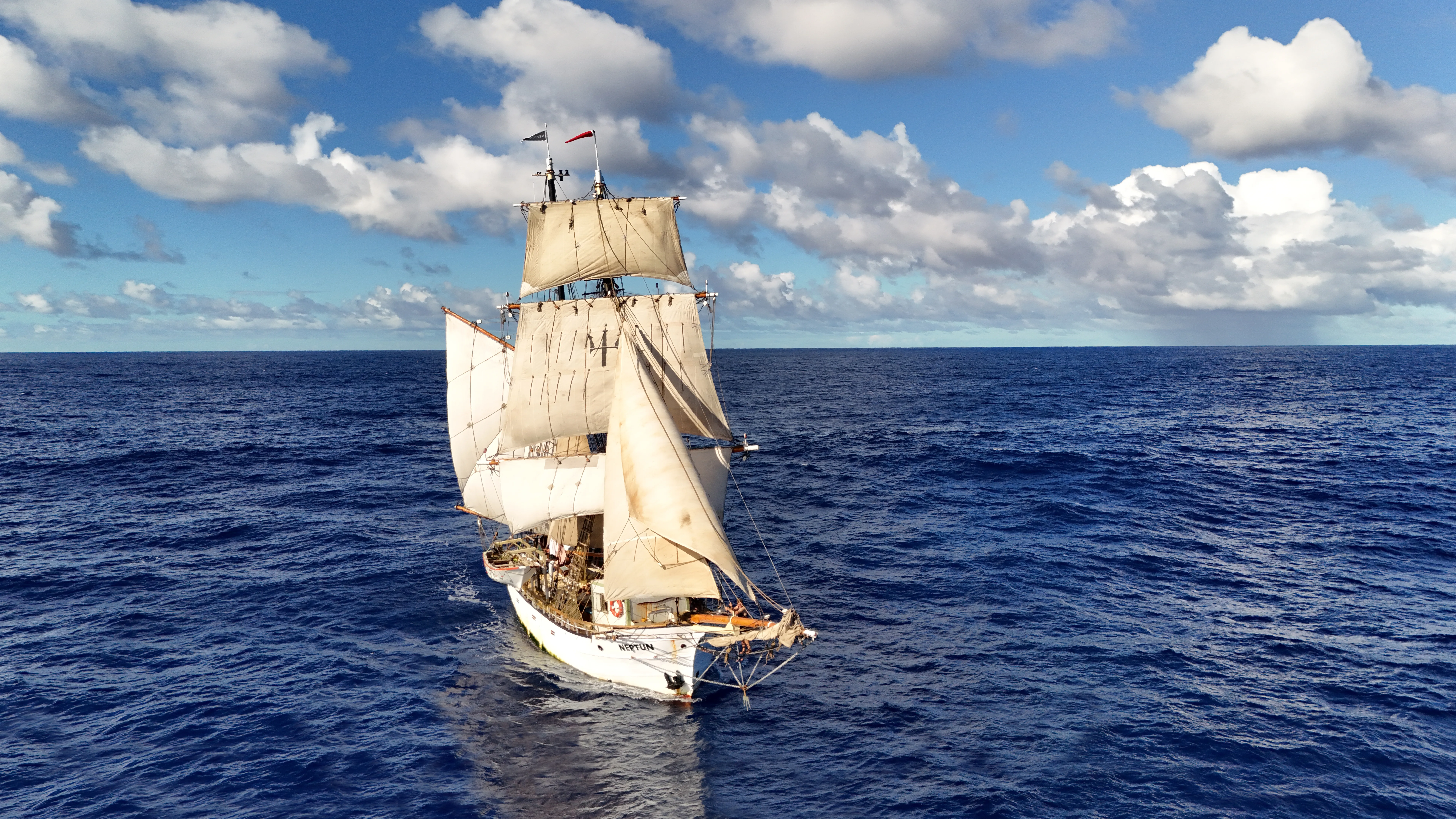
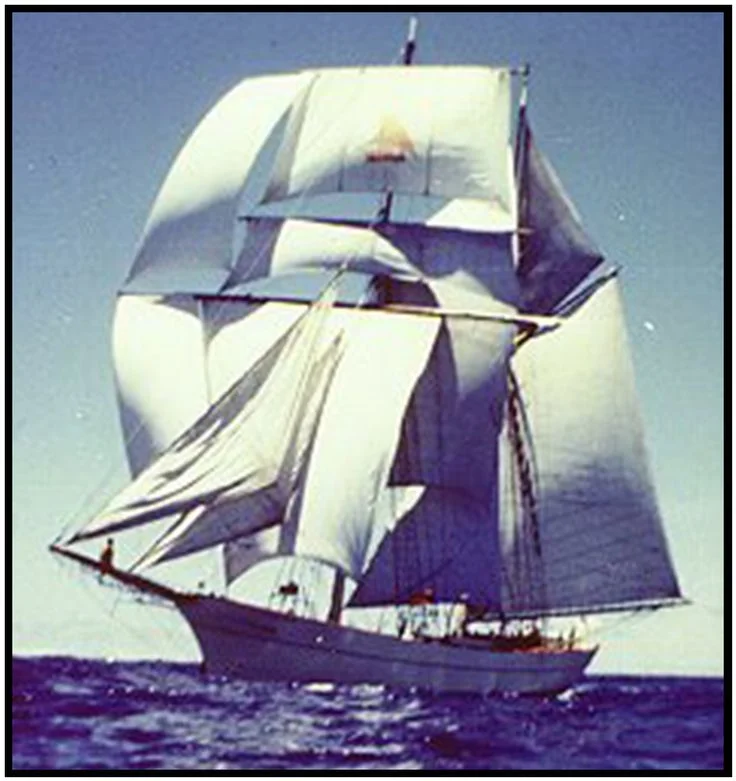
The story of Irving Johnson and Yankee is the story of the model Brigantine NEPTUN runs on. Between 1933 and 1958, Irving and Electa "Exy" Johnson sailed seven complete circumnavigations on two different ships both named Yankee, each voyage roughly eighteen months long, each one crewed not by professional sailors but by paying amateurs, young women, young men, doctors, students, teachers, anyone willing and broadly fit. They proved, decade after decade, that a long ocean voyage on a square-rigged ship could be taught and survived by ordinary people. NEPTUN's apply page works today because the Johnsons proved the model works. This article walks through who they were, the two Yankees, the seven voyages, and what the Johnson legacy means for a trainee climbing NEPTUN's rigging in 2026.
Want to live the modern version? The 2026-2027 voyage is the closest thing to a Yankee circumnavigation sailing today, browse the nine legs and pick your own.
On this page
- Who Irving and Exy Johnson were
- Cape Horn on Peking, 1929, the formative voyage
- The two Yankees
- The seven circumnavigations
- The amateur-crew innovation
- Cultural impact: National Geographic, books, films
- The Johnson legacy, what NEPTUN inherits
- FAQ
- Read also
Who Irving and Exy Johnson were
Irving McClure Johnson was born on 4 July 1905 in Hadley, Massachusetts, on a farm. He was not a professional sailor by birth or training. He worked his way to the sea as a teenager, yacht hand, merchant marine, and eventually deck-hand on the German nitrate barque Peking on a 1929 voyage from Hamburg round Cape Horn to Chile. He died on 2 January 1991, aged 85.
Electa "Exy" Search was born in 1909 and met Irving in 1931 aboard the schooner Wanderbird on a North Atlantic crossing. They married, sources differ on whether the wedding was 1932 or early 1933, and started planning a circumnavigation almost immediately. Exy was not a passenger. She co-captained, kept the logs, ran the galley and the bookkeeping, took photographs, wrote books with Irving, and ran the shore correspondence that filled each new crew berth. The Mystic Seaport collection holds twenty-four boxes and fifty-six volumes of their voyage records, a substantial portion in Exy's hand. Older accounts often called the voyages "Captain Johnson's"; the Mystic archive makes clear they were a partnership.
The pattern they invented, two captains who were also a married couple, eighteen-month voyages, a fresh crew of twenty-something amateurs each time, was unprecedented when they started in 1933 and remained largely theirs until the modern sail-training movement caught up forty years later. Irving served as a trustee of Mystic Seaport and the Sea Education Association until his death. Exy outlived him by thirteen years.
The partnership
Irving and Exy Johnson
They met aboard the schooner Wanderbird in 1931, married in 1932, and bought their first ship the following year. For the next twenty-five years they ran a floating apprenticeship, seven circumnavigations, two ships, hundreds of trainees. Older books call them Captain and Mrs Johnson. Mystic's archive shows what was always true: two captains, one ship, one logbook split between them.
Cape Horn on Peking, 1929, the formative voyage
The voyage that made Irving Johnson into Irving Johnson was on a ship that was not his and on a route he never sailed again. In 1929, aged 23, he signed on the four-masted barque Peking, a Flying-P-Liner of the Hamburg nitrate trade, as a deck hand for the run from Hamburg to Talcahuano, Chile, around Cape Horn westabout. He took an amateur 16mm cine camera up the rigging with him.
The film he shot in a Cape Horn gale, the camera lashed to the foot of the mainmast and to the lower yards while the ship lay on her beam-ends in 60-foot seas, became, fifty-six years later, the documentary Around Cape Horn (released 1985). Johnson narrated it himself in his late seventies. It is the closest thing the world has to a moving record of what working a tall ship in a Cape Horn winter actually looked like under sail. For the rest of his life he showed the film aboard Peking herself when she lay at South Street Seaport in New York between 1974 and 2016, narrating each screening live.
Two things came out of the Peking voyage. First, the conviction that the era of working square-riggers was ending and someone had to capture it before it was gone. Second, the conviction that the people who needed to see it most were not professional sailors, they were the amateurs, the curious, the ones who would otherwise never go. Both convictions shaped everything he did for the next sixty years.
Want the modern equivalent? A Cape rounding under sail is not a thing of the past, Leg 4 of the 2026 voyage rounds the Cape of Good Hope. Apply for a berth if you want to be on it.
The two Yankees
The seven Yankee circumnavigations were sailed on two completely different ships. Sources occasionally conflate them; the distinction matters because the Johnsons' approach changed between the schooner era (voyages 1-3) and the brigantine era (voyages 4-7).
The first Yankee was a Dutch North Sea pilot schooner, originally Loodschooner 4, built around 1897 for the Dutch government to ferry pilots out to North Sea shipping. By the time the Johnsons bought her in 1933 she had been renamed Texel under one private owner. They re-rigged her as a topsail schooner, named her Yankee, and sailed her on three world voyages, 1933, 1936, 1939, before selling her in 1941 to the Admiral Billard Naval Academy in New London, Connecticut, on the eve of America's entry into the war.
The second Yankee was bigger, German-built, and steel-hulled. Constructed in 1911 by Nordseewerke in Emden as the Emden, sometimes called the last sailing schooner the German yards built before steam took over, she served the Hamburg pilots on the Elbe under the name Duhnen until the Royal Air Force captured her in May 1945. The Johnsons acquired her in 1946 with help (and reputed financial assistance) from the actor Sterling Hayden, refitted her at Brixham in Devon, and re-rigged her as a brigantine carrying around 7,775 square feet of canvas. Hull dimensions: 96 feet overall, 81 feet on the waterline, 21.5-foot beam, 11-foot draft. She made the four post-war circumnavigations.
A third "Yankee" existed but does not belong to this story: a 50-foot steel auxiliary ketch designed by Irving Johnson with the American naval architect Olin Stephens, built in Holland in 1959, used by the Johnsons for European canal cruising in retirement. No world voyages.
The two voyaging Yankees
The brigantine Yankee's post-Johnson story is its own small tragedy. Sold to Reed Whitney in 1958, then to Mike Burke of Windjammer Cruises in Miami Beach for the Bahamas charter trade, she ran aground on a reef at Avarua, Rarotonga, on 23-24 July 1964 and was abandoned. The wreck was finally dismantled in 1995. The schooner Yankee, the Dutch pilot boat, survives in fragmentary form in private hands; full provenance is not documented in open sources.
The seven circumnavigations
Each voyage took roughly eighteen months and followed broadly the same westabout track: Gloucester, Massachusetts, south through the Atlantic, Panama Canal, west across the Pacific, Indian Ocean, around the Cape of Good Hope, home up the Atlantic. Pacific island work, the Tuamotus, the Marquesas, Tahiti, the Solomons, Bali, was the heart of every Yankee voyage. Over twenty-five years the Johnsons returned to many of the same anchorages with new crews, watching island life change between visits.
The Johnson schedule
Seven world voyages, 1933-1958
Voyage 1, 1933-1935 (Schooner Yankee)
Departed November 1933. The first eighteen-month circumnavigation, westabout via Panama, the Pacific islands, the Indian Ocean, and the Cape of Good Hope. Proof of concept that an amateur crew could do it.
Voyage 2, 1936-1938 (Schooner Yankee)
Departed November 1936, returned May 1938. Second pass round the world. By now the model, fresh crew, eighteen months, westabout, was the established Johnson formula.
Voyage 3, 1939-1941 (Schooner Yankee)
Departed October 1939 weeks after war broke out in Europe; returned April 1941. The last pre-war voyage. The schooner was sold to a naval academy on return.
Voyage 4, 1947-1949 (Brigantine Yankee)
Departed 2 November 1947, returned 1 May 1949. The first post-war voyage on the new brigantine. Larger ship, larger crew, same eighteen-month rhythm.
Voyage 5, 1950-1952 (Brigantine Yankee)
Departed October 1950, returned January 1952. Pacific island stops featured in National Geographic dispatches read in living rooms across America.
Voyage 6, 1953-1955 (Brigantine Yankee)
Departed November 1953, returned May 1955. The voyage that defined the post-war Pacific island sequence, Galápagos, Marquesas, Society Islands, Solomons, Bali.
Voyage 7, 1956-1958 (Brigantine Yankee)
Departed November 1956, returned February 1958. The final Johnson circumnavigation. Filmed for what became a 1966 CBS / National Geographic television special. Brigantine sold the same year.
The total adds up to roughly 25 years of voyaging, three on the schooner, eleven on the brigantine, and well over half a million ocean miles between the two ships. Each voyage carried a different crew of around twenty paying trainees, so by 1958 a hundred and fifty or more Americans (and a smaller number of others) had sailed an entire circumnavigation under the Johnsons.
What a Yankee voyage looks like in 2026
The modern equivalent
Nine legs, 482 days, around the world. Pick the leg that fits your dates, or string several together.
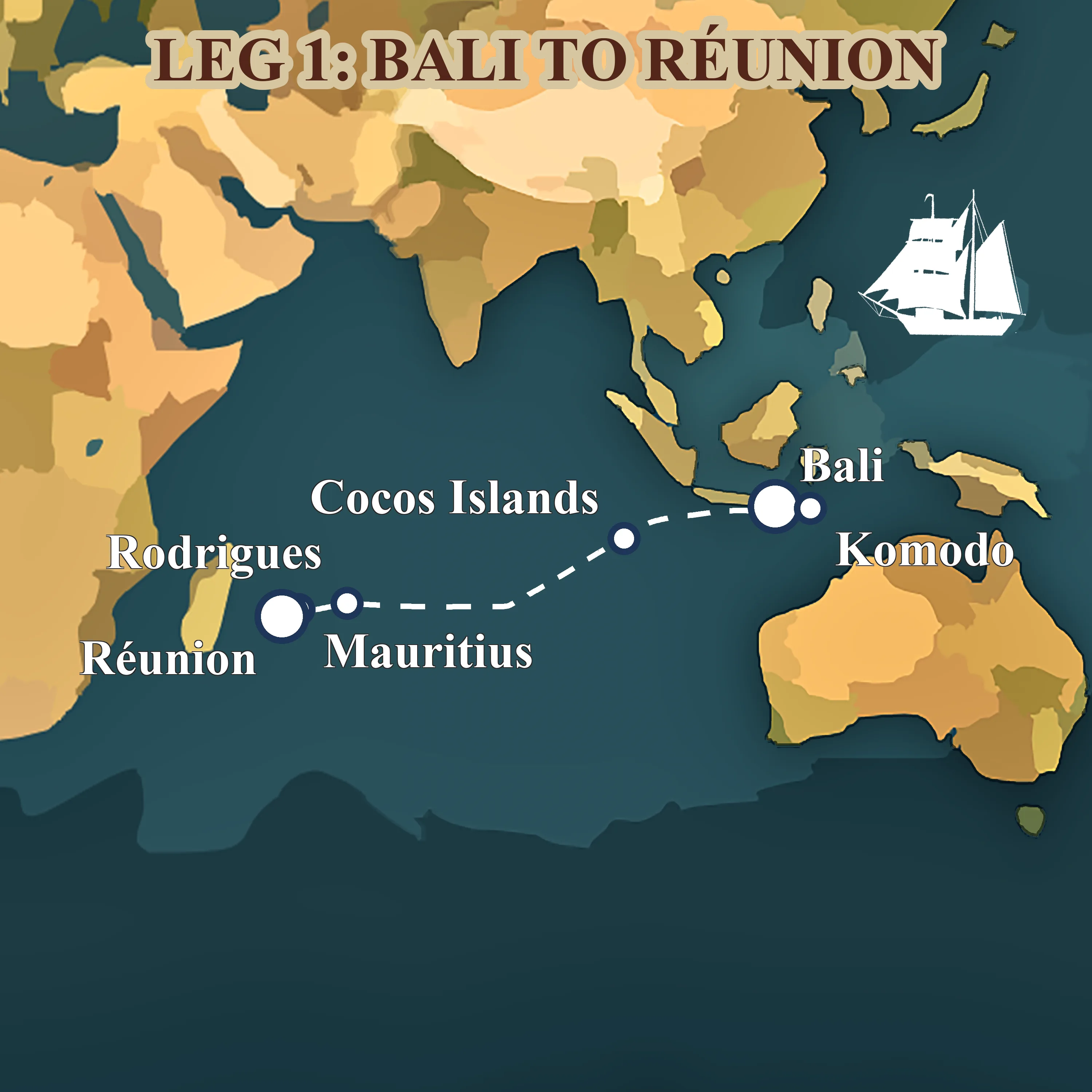
Leg 1: from Bali to Réunion across the Indian Ocean
May 2026 — Aug 2026 · Bali, Indonesia → Réunion, France
The opening chapter of Neptun's 482-day world voyage, a 4,078-nm trade-wind passage from the temples of Bali to the volcanic cliffs of Réunion.
Read more about this leg → about Leg 1: from Bali to Réunion across the Indian Ocean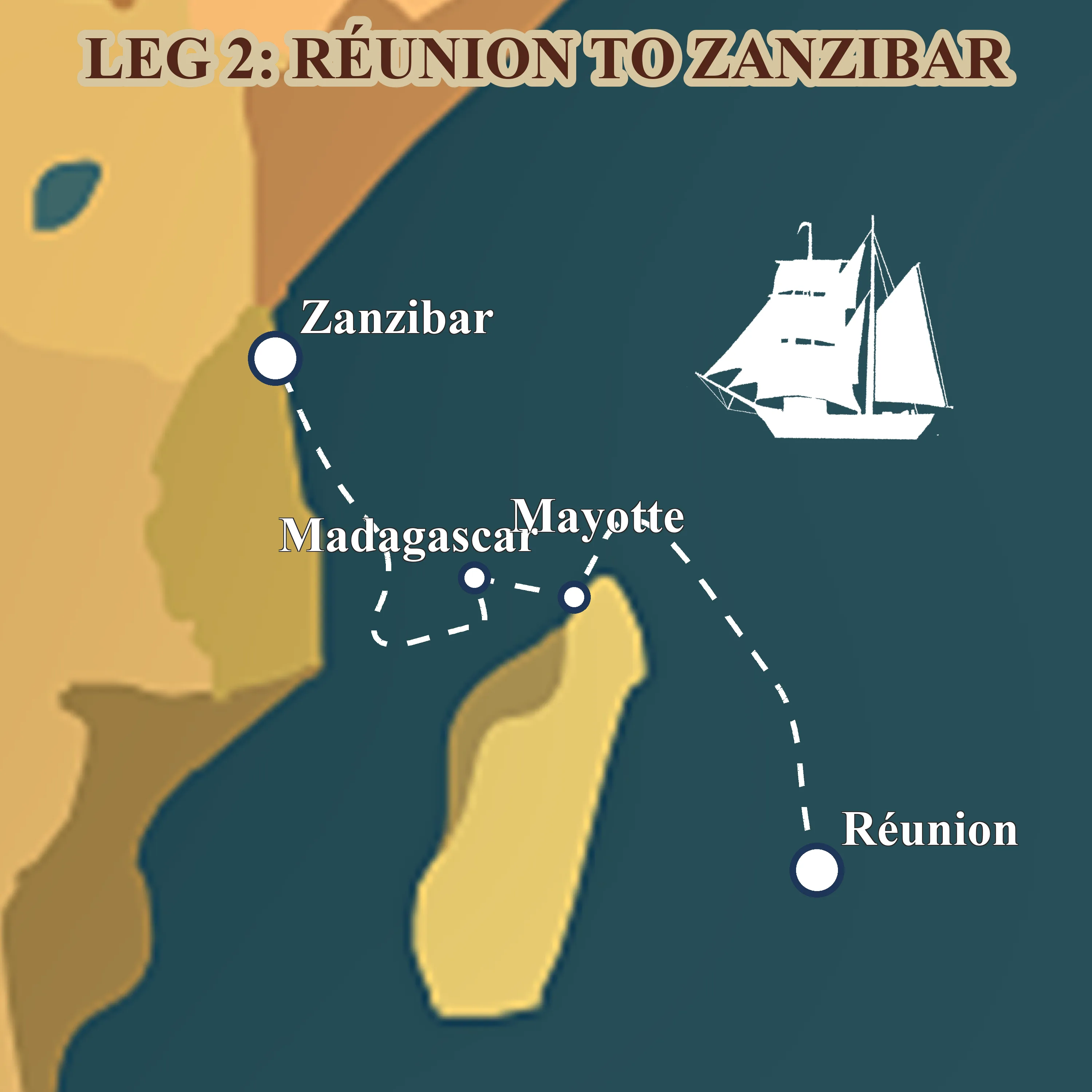
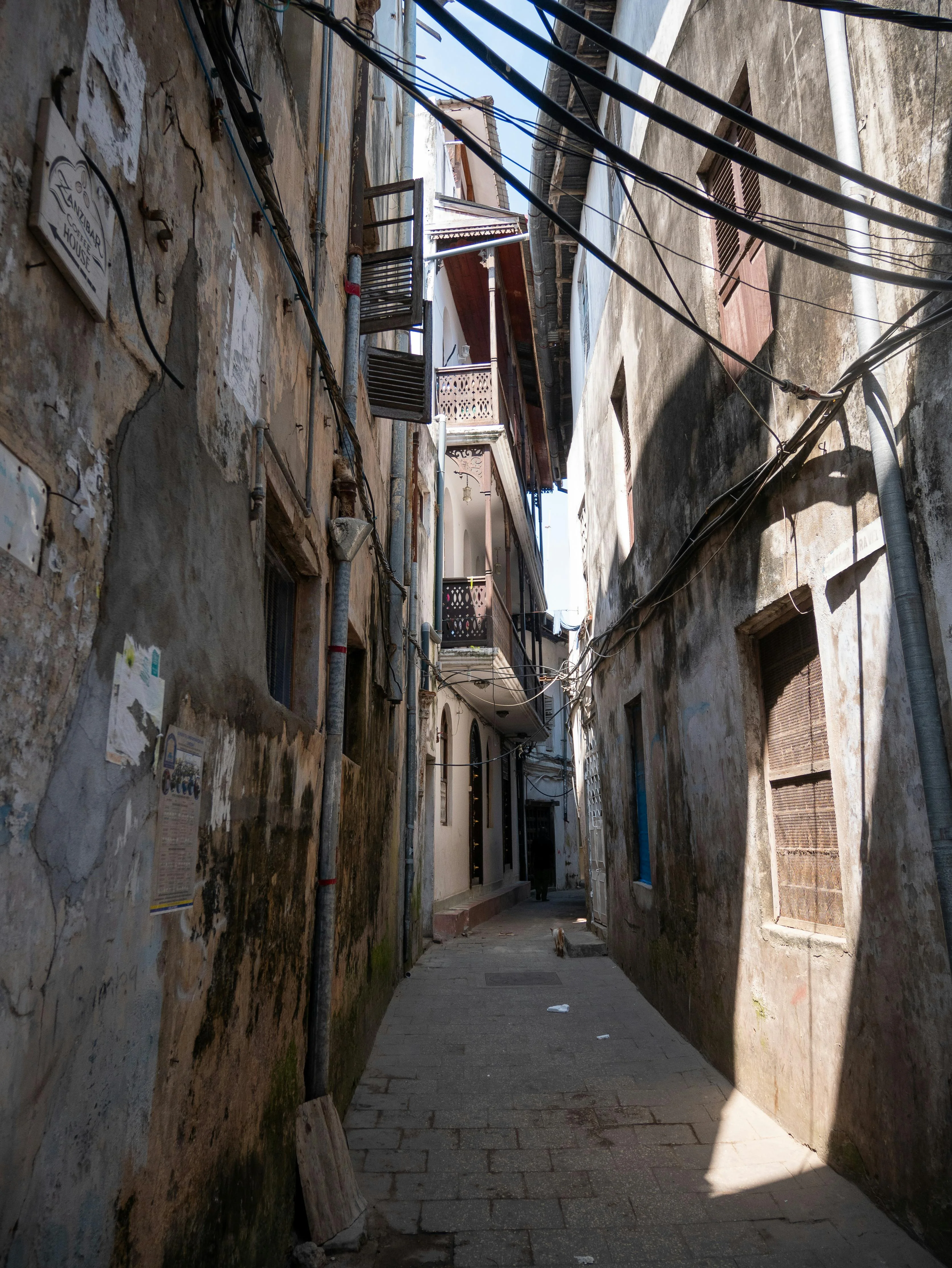
Leg 2: from Réunion to Zanzibar via Madagascar
Aug 2026 — Sept 2026 · Réunion, France → Zanzibar, Tanzania
Forty days across the western Indian Ocean, volcanic Réunion, lemur-haunted Nosy Be, the Mozambique Channel, and the spice-scented stone alleys of Zanzibar.
Read more about this leg → about Leg 2: from Réunion to Zanzibar via Madagascar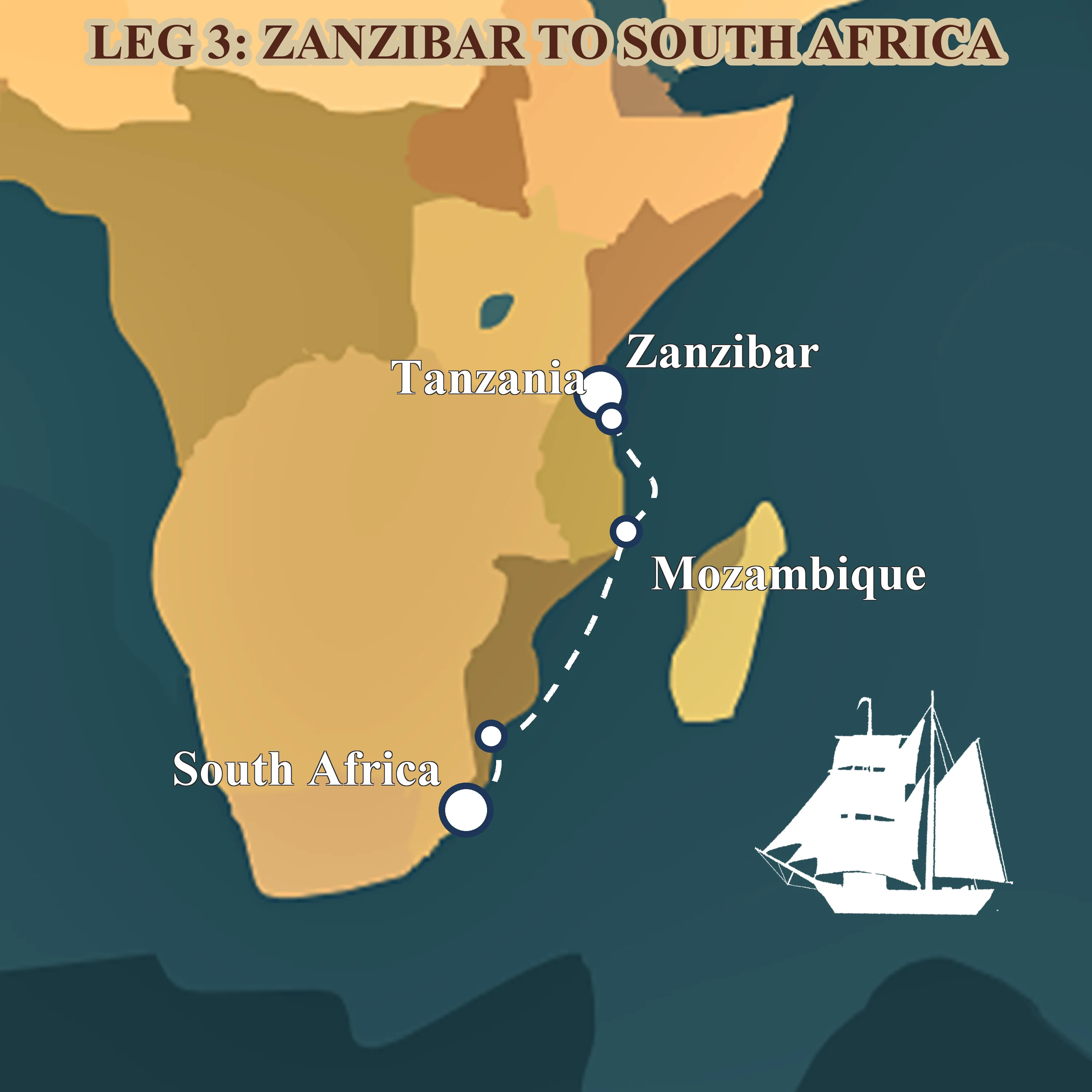
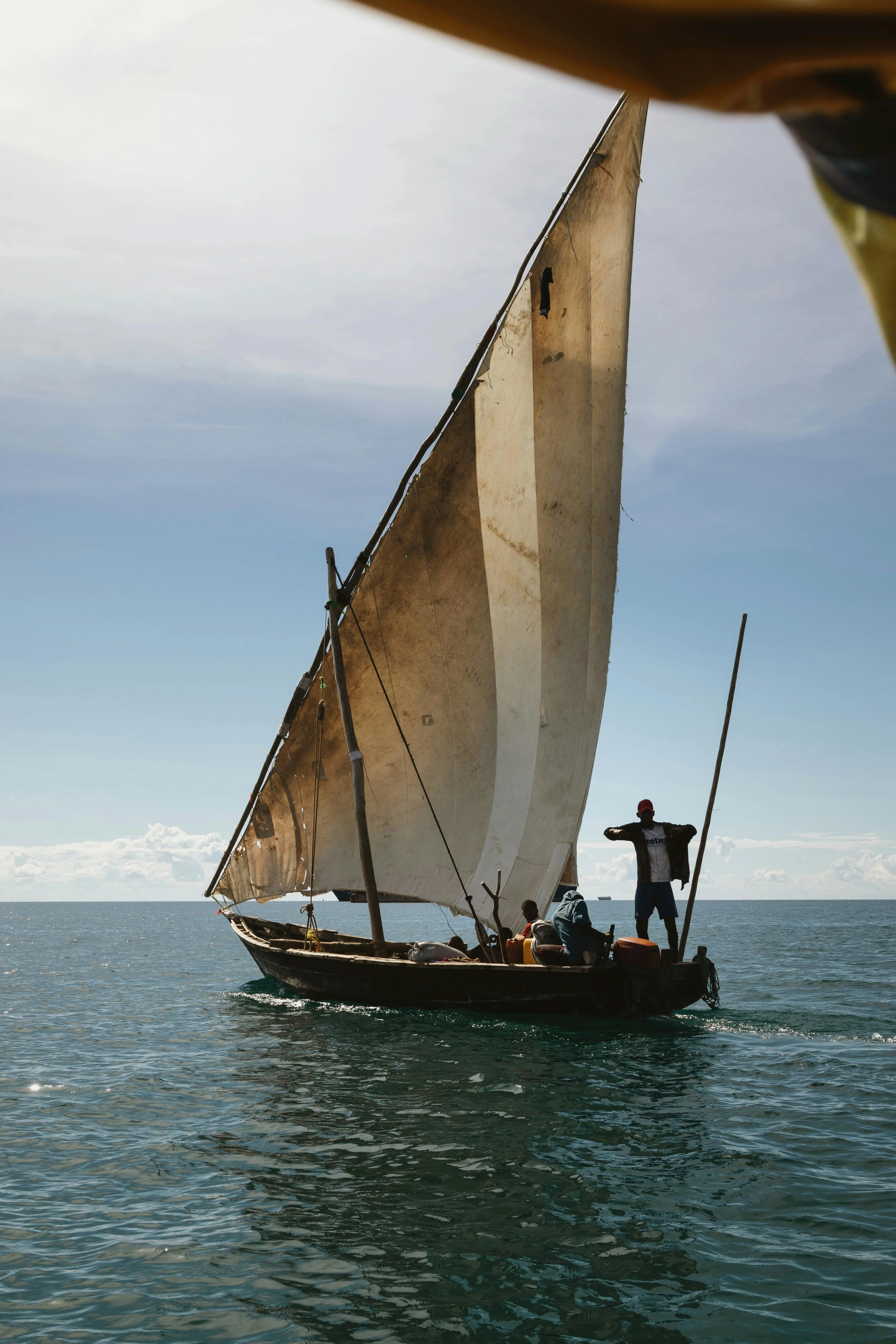
Leg 3: from Zanzibar to Durban down the Mozambique Channel
Sept 2026 — Nov 2026 · Zanzibar, Tanzania → Durban, South Africa
Sixty-three days coasting the African shore, spice islands, mangrove anchorages, Portuguese praças and the long trade-wind run down the Mozambique Channel to Durban.
Read more about this leg → about Leg 3: from Zanzibar to Durban down the Mozambique Channel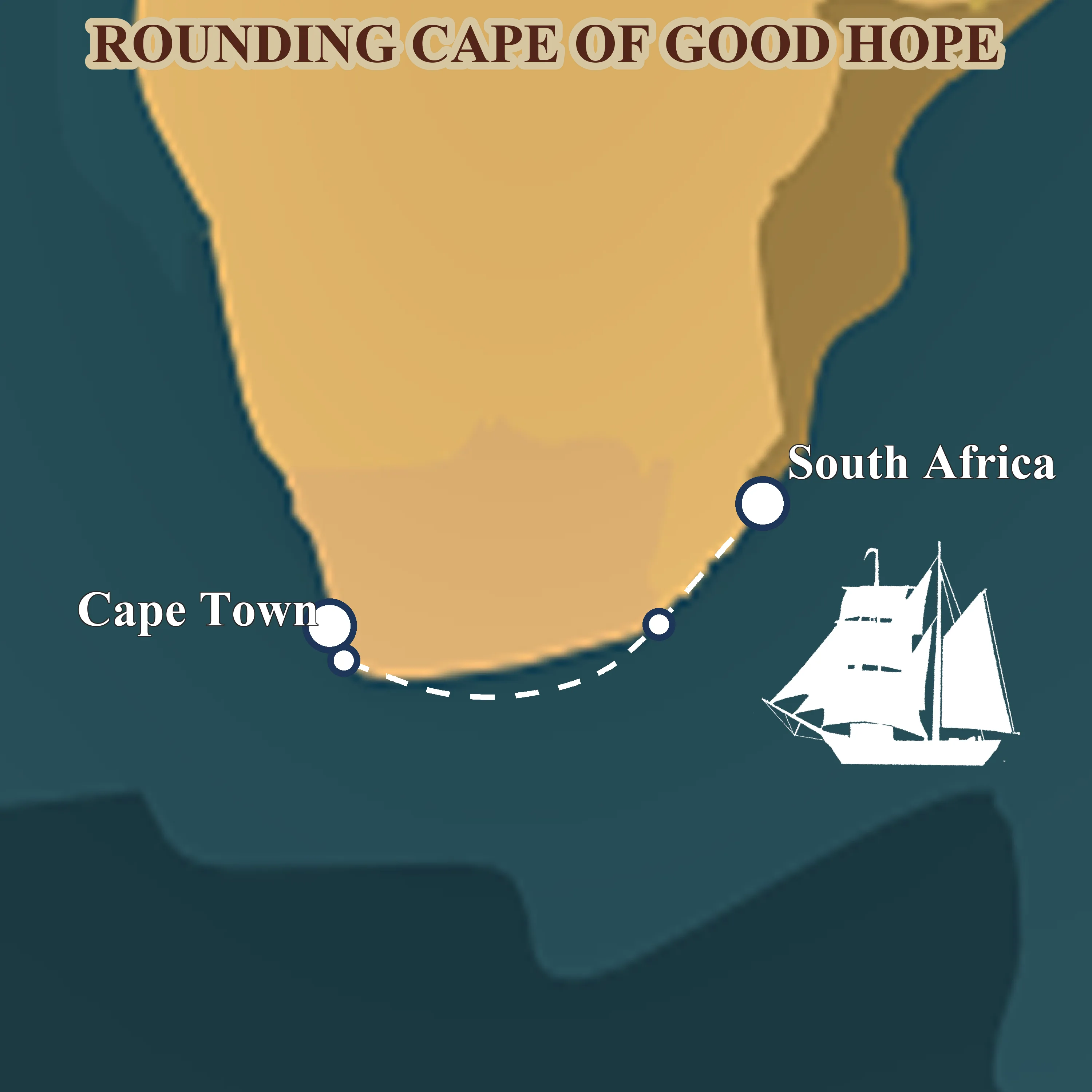
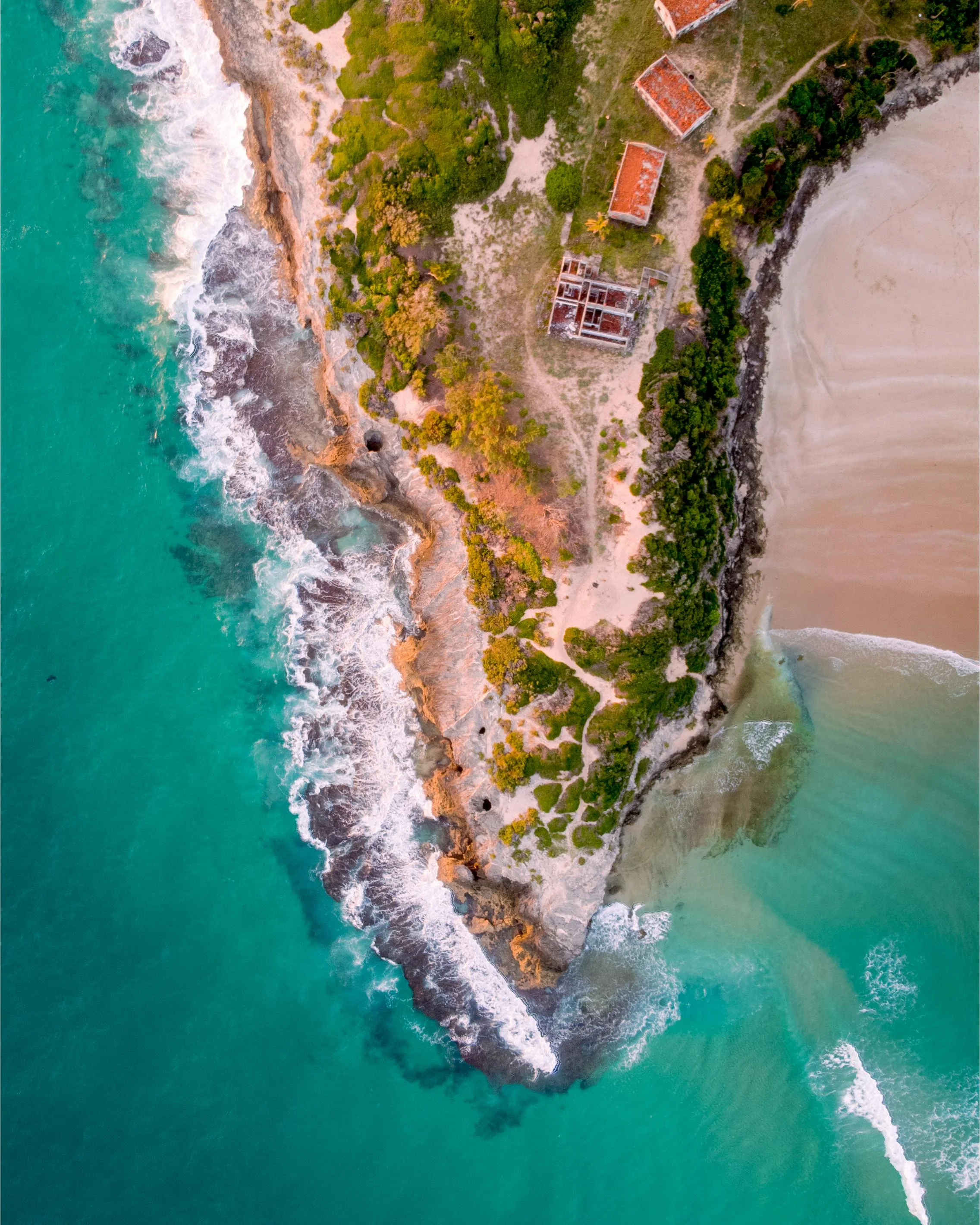
Leg 4: from Durban around the Cape of Good Hope
Nov 2026 — Dec 2026 · Durban, South Africa → Cape Town, South Africa
Thirty-eight days of serious seamanship, the Agulhas current, the Cape of Good Hope and the Southern Ocean at the tip of Africa, finishing quietly in Cape Town for Christmas.
Read more about this leg → about Leg 4: from Durban around the Cape of Good Hope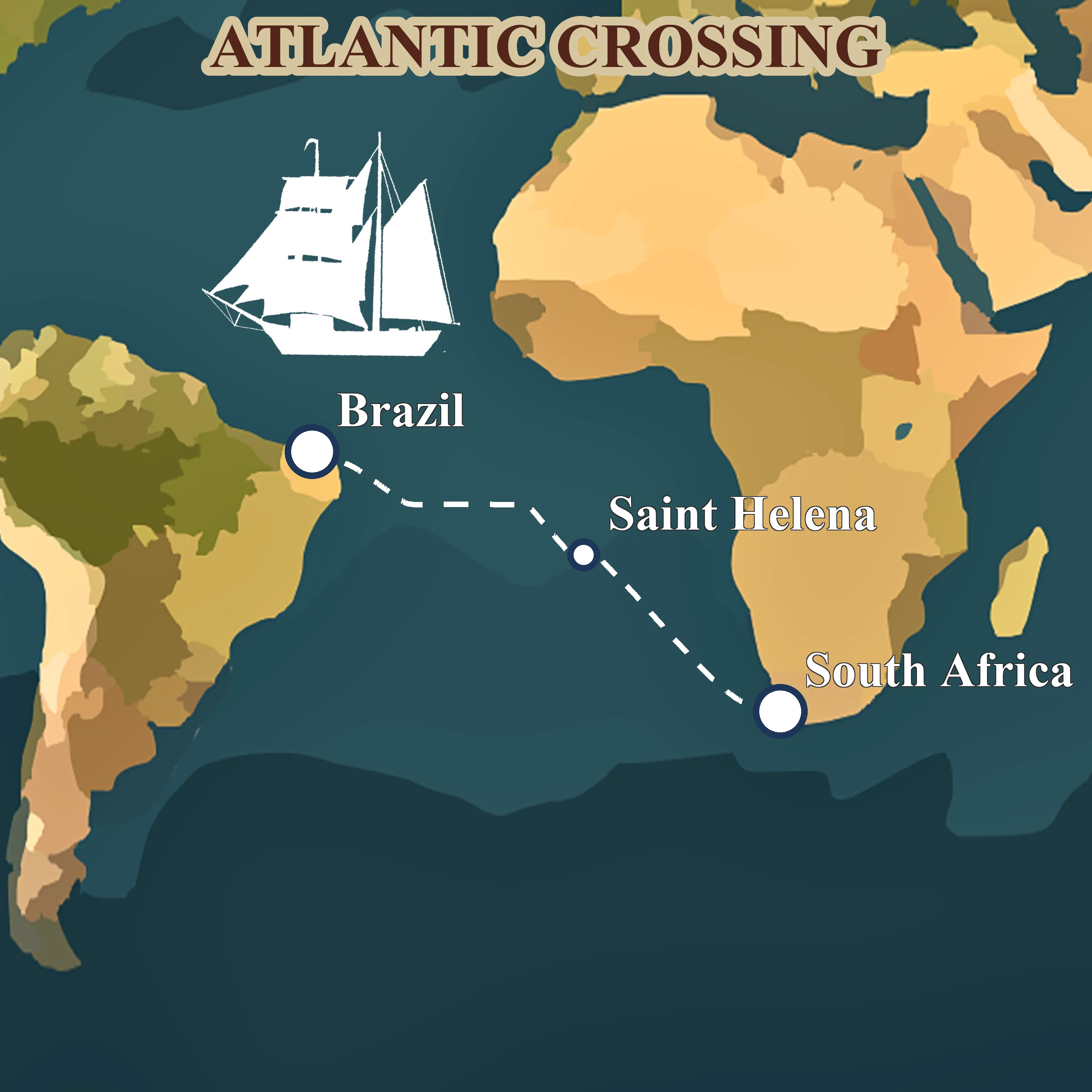
Leg 5: across the South Atlantic from Saldanha to Fortaleza
Jan 2027 — Mar 2027 · Saldanha Bay, South Africa → Fortaleza, Brazil
Forty-four days before the southeast trades, Napoleon's exile at St. Helena, the equator crossing, and landfall in tropical Brazil. The ocean chapter of the voyage.
Read more about this leg → about Leg 5: across the South Atlantic from Saldanha to Fortaleza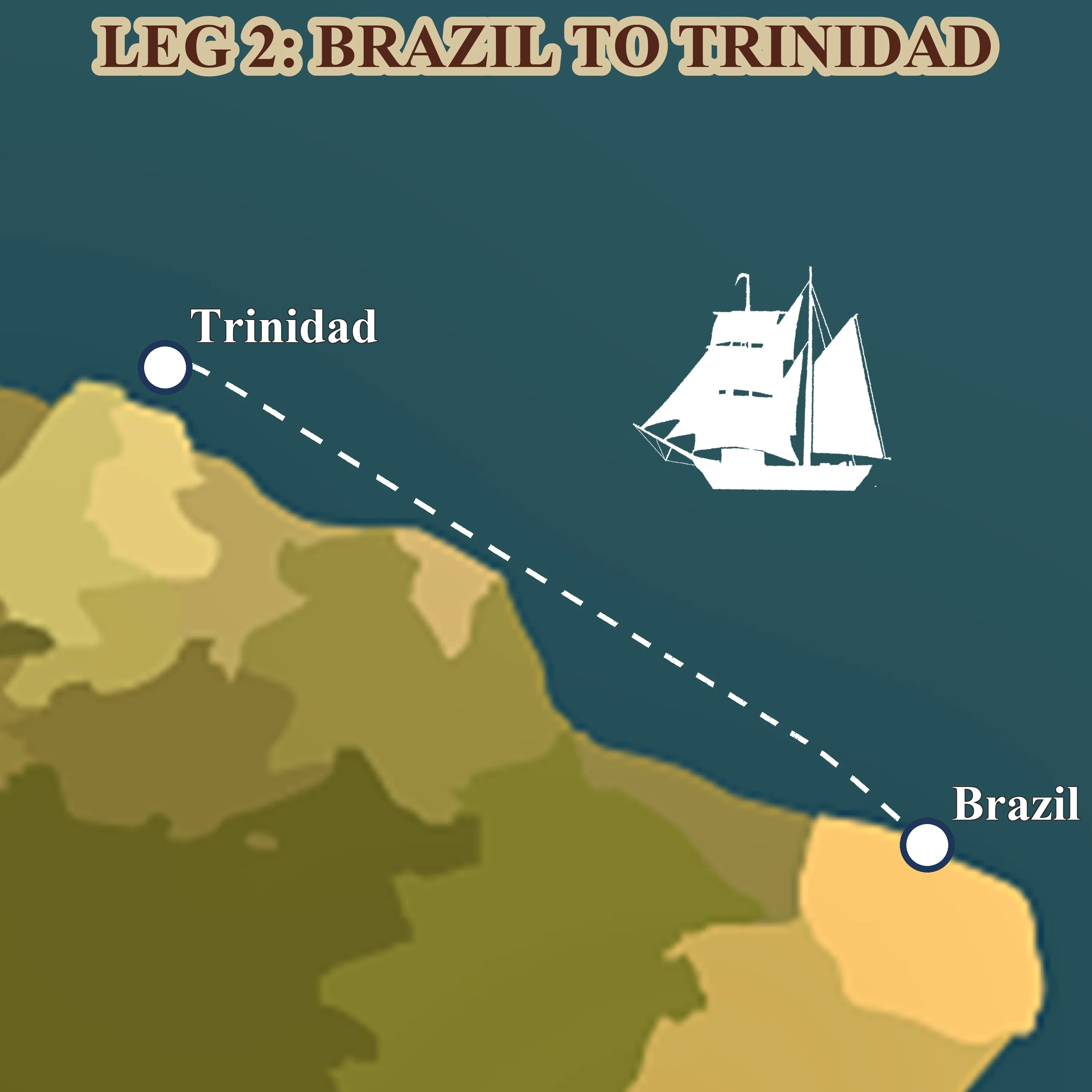
Leg 6: from Fortaleza to Trinidad along South America
Mar 2027 — Apr 2027 · Fortaleza, Brazil → Trinidad
A thousand miles of downwind trade running, the Amazon's brown water under the hull, the Guianas smudged on the horizon, and Trinidad's steelpan waiting at the end.
Read more about this leg → about Leg 6: from Fortaleza to Trinidad along South America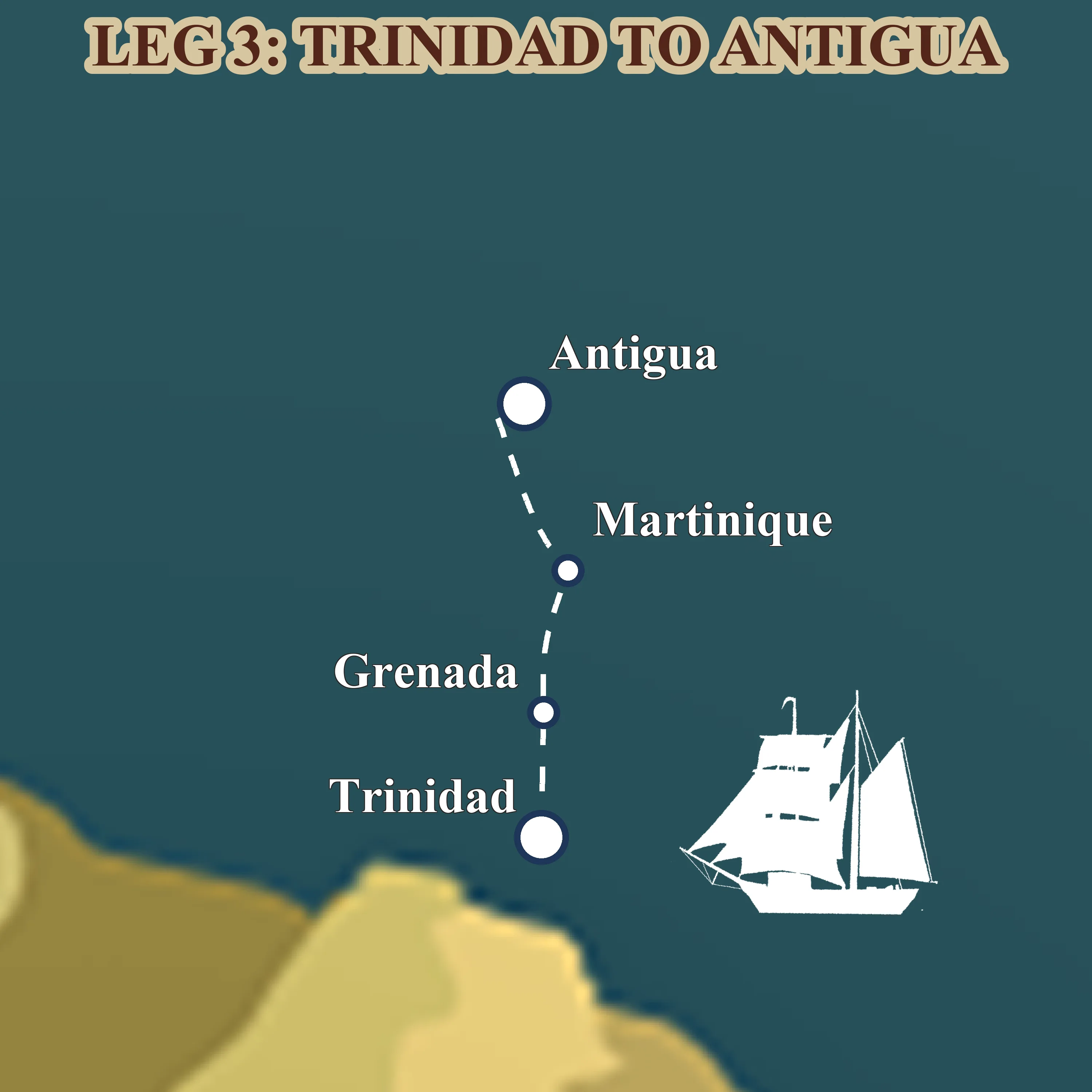
Leg 7: through the Windward Islands from Trinidad to Antigua
Apr 2027 — May 2027 · Trinidad → Antigua
Four weeks of short trade-wind daysails through the Lesser Antilles, turquoise anchorages, rum shops on the sand, French-Creole Martinique and the tall-ship scene in Antigua.
Read more about this leg → about Leg 7: through the Windward Islands from Trinidad to Antigua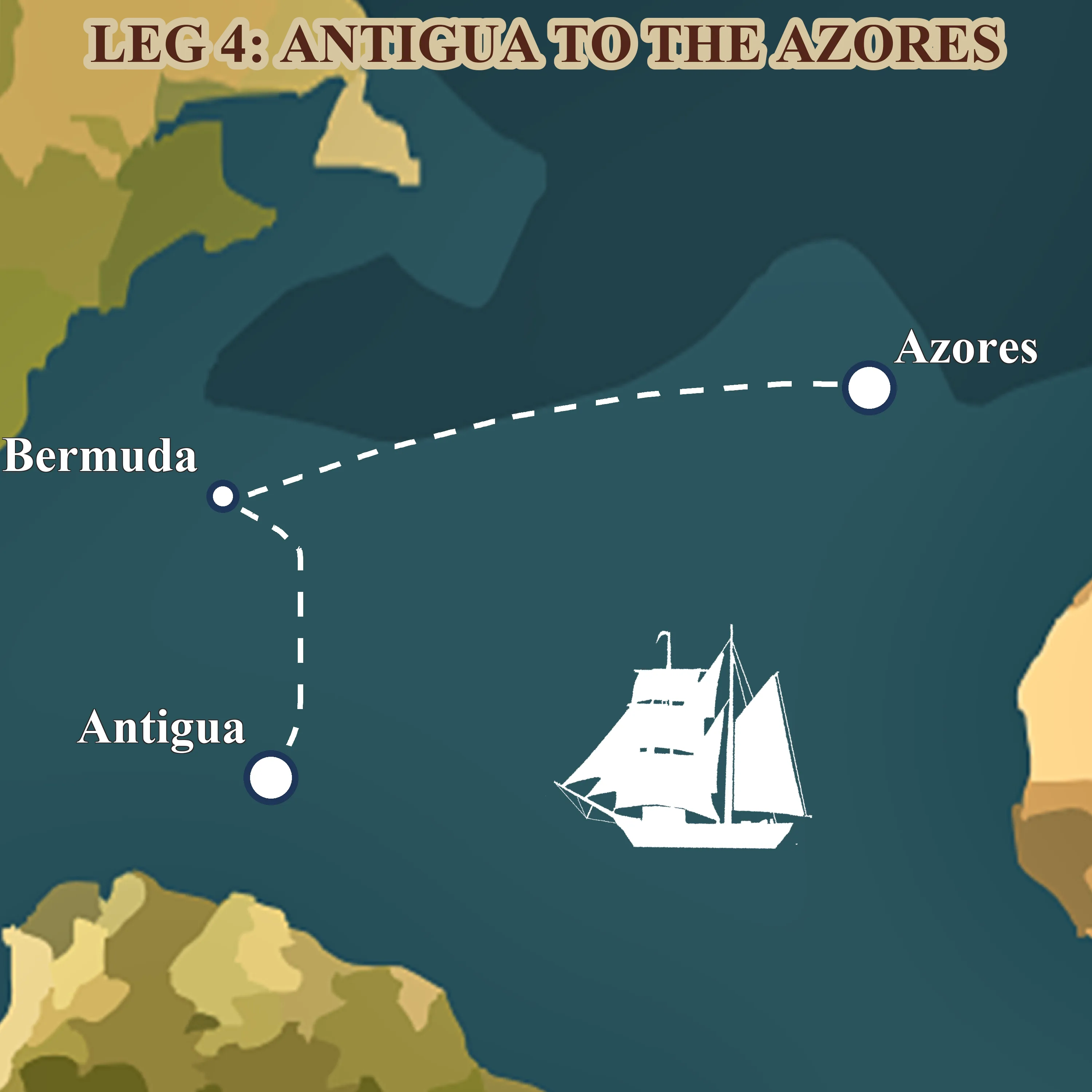
Leg 8: across the North Atlantic from Antigua to the Azores
May 2027 — Jul 2027 · Antigua → Ponta Delgada, Azores
Fifty-six days on the classic spring tall-ship route home, Antigua, a long reach to Bermuda's pink sand, then three weeks of open ocean to the volcanic Azores.
Read more about this leg → about Leg 8: across the North Atlantic from Antigua to the Azores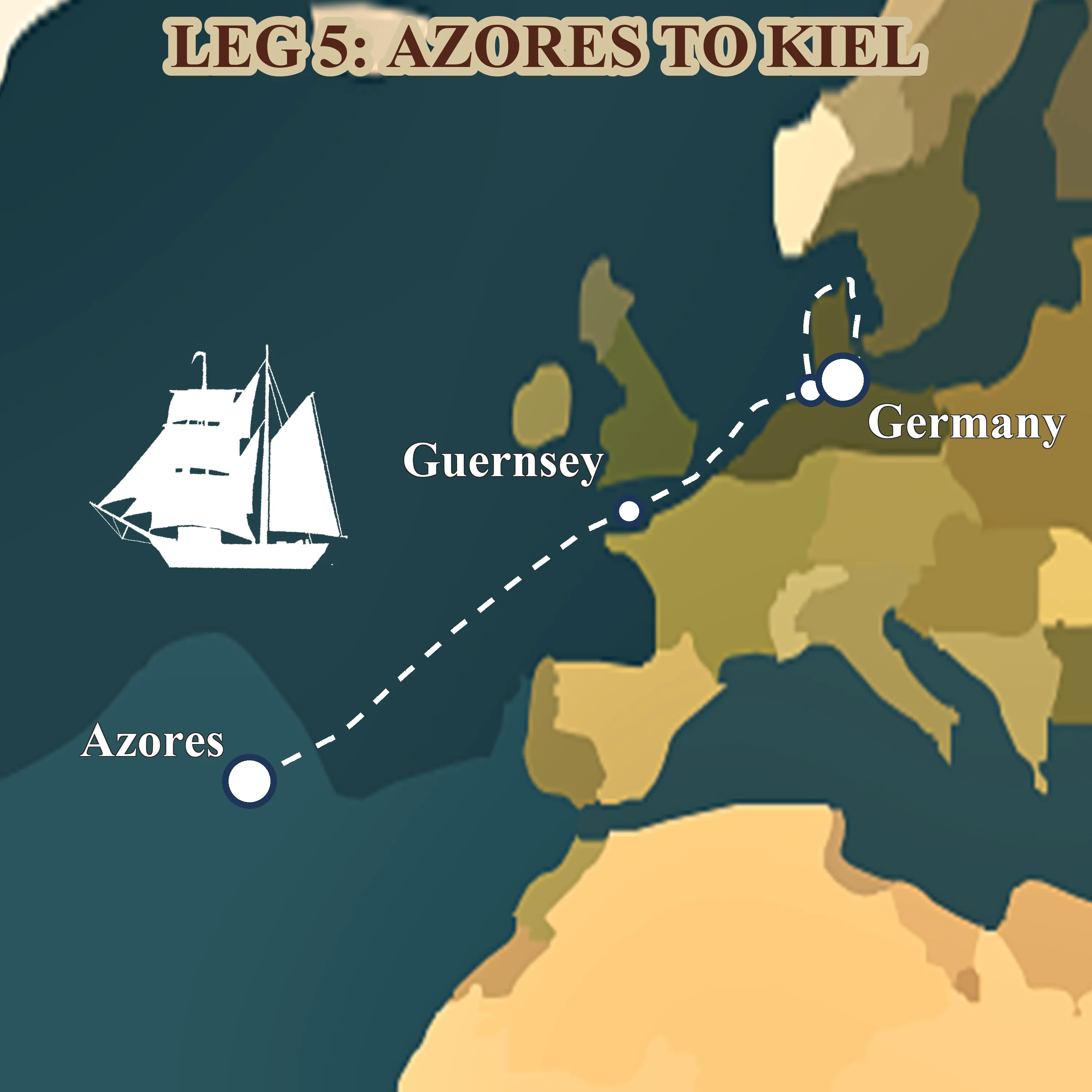
Leg 9: homecoming from the Azores to Kiel
Jul 2027 — Aug 2027 · Ponta Delgada, Azores → Kiel, Germany
The final 1,878 nm, from volcanic São Miguel to the Baltic, up the English Channel through the Dover TSS, past Helgoland's red cliffs and home to Kiel.
Read more about this leg → about Leg 9: homecoming from the Azores to KielThe amateur-crew innovation: how it worked
In 1933 every other working square-rigger sailed with professional crews, career deep-water seamen, often boys apprenticed by their families. Sail-training as a deliberate practice for non-sailors barely existed. The Johnsons' idea was to invert it: charge the crew, teach them the ship, and use the fees to keep her at sea. The first voyage proved the financial model would work. The next six proved it would scale.
The composition was deliberate. A typical Yankee crew was around twenty people: usually four young women, sixteen young men, a doctor, and a mate. Most were in their late teens or early twenties. The crew was hand-picked from a flood of applicants, Mystic's archive holds Exy Johnson's correspondence with thousands of would-be trainees. Selection criteria leaned toward fitness, attitude, and the ability to live in close quarters for eighteen months, not on prior sailing experience. Most had never been to sea.
For 1933 the inclusion of women crew was significant on its own. Working square-riggers had been an entirely male environment for centuries. The Johnsons' insistence on a mixed crew was practical, Exy needed the same accommodation either way, and the work didn't care about the sex of the person doing it, but it was also a quiet refusal of the convention that women didn't go to sea on commercial sailing ships. Most pre-war and post-war contemporaries took years to follow.
What the amateur-crew model looked like
About 20 per voyage
Roughly four young women, sixteen young men, plus a doctor and a mate. Hand-picked from thousands of applicants. Eighteen months on board.
Paying trainees, not staff
Each crew member paid their share of the voyage. The fees ran the ship. Same mechanism Brigantine NEPTUN uses today.
Taught on board
No prior sailing experience required. Knots, sail handling, navigation, watch-keeping, galley duty, all learned underway, taught by the captains and the mate.
The result is the model NEPTUN runs on. Read it in the how to join a tall ship crew guide and you are reading a near-direct descendant: ten trainees instead of twenty, no prior experience required, taught on board, the fees keep the ship at sea. The wording has changed; the structure has not.
Want to step into the model? Apply for a berth on Brigantine NEPTUN, same shape as a Yankee voyage, modern ship, your own start date.
Cultural impact: National Geographic, books, films
A Yankee voyage was not a private adventure. The Johnsons made every voyage public, on the page, on the screen, and on the lecture circuit, and that is half of why the model survived to be inherited.
Their National Geographic articles ran almost continuously between the 1930s and the 1970s; eight or more major features by Irving (sometimes co-bylined with Exy) appeared during the voyaging years, plus shorter dispatches. National Geographic published voyage maps that put Yankee's track into millions of American homes. Their books, Westward Bound in the Schooner Yankee, Sailing to See, Yankee's People and Places, Yankee Sails Across Europe, Yankee Sails the Nile, and others, sold steadily through the post-war decades and stayed in print as classics of voyage literature.
The films were the wider reach. Between Around Cape Horn (the 1929 Peking footage, finally released as a documentary in 1985 with Irving's own narration) and the 1966 CBS / National Geographic special on the seventh voyage and the 1984 Irving Johnson, High Seas Adventurer National Geographic broadcast, a generation of American teenagers grew up seeing what a working square-rigger looked like in the post-war Pacific. Many later applied to crew on the next-generation sail-training ships, Picton Castle, Europa, Sørlandet, eventually NEPTUN, because Yankee planted the seed.
A small detail captures the public reach. When the brigantine Yankee was sold to Mike Burke for the Bahamas charter trade in 1959, she was already a celebrity ship, clients booked the charter explicitly because they had read about her in Geographic or seen her on CBS. The wreck on the reef at Rarotonga in 1964 was front-page news in the maritime press. The vessel had become a cultural object as much as a ship.
The Johnson legacy, what NEPTUN inherits
The direct lineage from the Johnsons to the modern sail-training fleet runs through three intermediate links: Captain Arthur Kimberly and the brigantine Romance, who started his own twenty-three-year run of trainee voyages in 1966 explicitly modelled on the Yankees; Captain Daniel Moreland of the Picton Castle, who sailed under Kimberly before launching his own world voyages in 1997; and the wider sail-training movement organised under Sail Training International and the Tall Ships America awards. Brigantine NEPTUN sits in this lineage, a modern, non-profit, paying-trainee, non-experience-required ocean voyaging ship, and inherits four specific things from the Johnsons.
First, the financial model: the trainees pay the running costs, and that is what keeps the ship at sea. Second, the eighteen-month voyage as the canonical unit (NEPTUN's 482-day 2026-2027 world voyage runs almost exactly that length). Third, the principle that no prior experience is required, the ship teaches what is needed. Fourth, the mixed crew as a non-negotiable: women have been ordinary square-rigger crew since 1933, on Yankee, before they were welcome anywhere else under sail.
What we don't inherit is harder won. The Johnsons sailed without GPS, without weather routing, without satellite phones, without modern life rafts, and with medical kit a generation behind today's standard. We inherit the model, and bring 90 years of safety improvements with us.
Yankee voyaging in numbers
Ready to sail the modern Yankee voyage? The 2026-2027 NEPTUN circumnavigation runs 482 days across nine legs. Pick one. Apply for a berth.
Four legs, the first half of the world voyage
The 2026 season
The 2026 calendar: Indonesia to Mauritius, Cape of Good Hope, South Atlantic crossing, Brazil. The Pacific ocean stretches the Yankees would have known.
Leg 1: from Bali to Réunion across the Indian Ocean
May 2026 — Aug 2026 · Bali, Indonesia → Réunion, France
The opening chapter of Neptun's 482-day world voyage, a 4,078-nm trade-wind passage from the temples of Bali to the volcanic cliffs of Réunion.
Apply for the leg → about Leg 1: from Bali to Réunion across the Indian OceanLeg 2: from Réunion to Zanzibar via Madagascar
Aug 2026 — Sept 2026 · Réunion, France → Zanzibar, Tanzania
Forty days across the western Indian Ocean, volcanic Réunion, lemur-haunted Nosy Be, the Mozambique Channel, and the spice-scented stone alleys of Zanzibar.
Apply for the leg → about Leg 2: from Réunion to Zanzibar via MadagascarLeg 3: from Zanzibar to Durban down the Mozambique Channel
Sept 2026 — Nov 2026 · Zanzibar, Tanzania → Durban, South Africa
Sixty-three days coasting the African shore, spice islands, mangrove anchorages, Portuguese praças and the long trade-wind run down the Mozambique Channel to Durban.
Apply for the leg → about Leg 3: from Zanzibar to Durban down the Mozambique ChannelLeg 4: from Durban around the Cape of Good Hope
Nov 2026 — Dec 2026 · Durban, South Africa → Cape Town, South Africa
Thirty-eight days of serious seamanship, the Agulhas current, the Cape of Good Hope and the Southern Ocean at the tip of Africa, finishing quietly in Cape Town for Christmas.
Apply for the leg → about Leg 4: from Durban around the Cape of Good HopeFAQ
Irving Johnson and Yankee, common questions
How many times did Irving and Exy Johnson sail around the world?
Seven complete circumnavigations between 1933 and 1958. Three on the Dutch-built topsail schooner Yankee (1933, 1936, 1939) and four on the German-built brigantine Yankee (1947, 1950, 1953, 1956). Each voyage took roughly 18 months and carried a fresh crew of around 20 paying amateur trainees. They are by some margin the most-circumnavigated couple in the history of sail.
Were the two Yankees the same ship?
No, two completely different ships, two different countries of origin, two different rigs. The first Yankee was a Dutch North Sea pilot schooner, originally Loodschooner 4, built around 1897 and acquired by the Johnsons in 1933. The second was a German-built North Sea pilot vessel, originally the Emden, built in 1911, captured by the RAF in 1945, refitted at Brixham, and re-rigged as a brigantine for the Johnsons in 1946. The schooner sailed voyages 1-3, the brigantine voyages 4-7.
What was the Peking voyage that made Irving Johnson famous?
In 1929, aged 23, Johnson signed on as a deck hand for a single Cape Horn passage on the German nitrate barque Peking, from Hamburg to Chile. He took an amateur film camera up the rigging and shot some of the only surviving moving footage of a working square-rigger in a Cape Horn winter gale. The film was finally released as the documentary Around Cape Horn in 1985 with Johnson narrating it himself in his late seventies.
Did women sail on the Yankee voyages?
Yes, every voyage. A typical Yankee crew of around 20 included roughly four young women alongside the men. This was unusual in 1933 and remained unusual on commercial sailing ships for decades after. Exy Johnson herself co-captained every voyage. The mixed crew is one of the principles modern tall-ship sail-training inherits directly from the Johnsons.
Did the trainees pay to sail with the Johnsons?
Yes. The Yankee voyages ran on trainee fees, each crew member paid their share of the running costs of an eighteen-month circumnavigation. This is the financial model Brigantine NEPTUN uses today, and the model the Picton Castle and other modern training ships use. The Johnsons did not invent the idea of paying crew, but they were the first to scale it across decades and prove it could keep a square-rigger at sea continuously.
What happened to the brigantine Yankee?
The Johnsons sold her in 1958 after the seventh voyage. She passed through Reed Whitney to Mike Burke and the Windjammer Cruises charter fleet in the Bahamas. On 23-24 July 1964, in heavy weather, she ran aground on a reef at Avarua, Rarotonga, in the Cook Islands, and was abandoned. The wreck was finally dismantled in 1995, sixty-six years after she was launched, sixteen years after she completed her final Johnson circumnavigation.
How is Brigantine NEPTUN connected to the Johnsons?
Through lineage, not direct line. The Johnsons established the model, paying amateur crew, no prior experience required, eighteen-month voyages, mixed crew, between 1933 and 1958. Captain Arthur Kimberly inherited it on the brigantine Romance (1966-1989). Captain Daniel Moreland inherited it from Kimberly on the Picton Castle (1997-present). NEPTUN inherits it from the broader sail-training movement that grew out of those ships, and runs the same shape of voyage today: a 482-day circumnavigation with paying trainees and no experience required.
Read also
- Captain Kimberly and the brigantine Romance, the man who inherited the Johnson model and ran it for 23 years.
- Dan Moreland and the Picton Castle, the modern reference voyage, by a captain who sailed under Kimberly.
- Alan Villiers and Joseph Conrad, 1934-1936, the Johnsons' contemporary, full-rigged ship, teenage crew.
- Famous tall ships still sailing, the living fleet that carries the Yankee model forward.
- How long does it take to sail around the world, why eighteen months is still the canonical voyage length.
- Apply for a berth on NEPTUN, the modern entry point.
Want to sail with us? Brigantine NEPTUN is a non-profit training ship, every voyage takes 10 crew members through real ocean sailing, no experience needed. Apply for a berth or read about the voyages first.
The model the Johnsons proved
Sail the modern Yankee voyage
Eighteen months around the world, paying trainees, no experience required, mixed crew, taught on board. The Johnsons proved it works in 1933. NEPTUN runs it now, pick a leg, or sail the whole 482-day arc.