Thirty-one shipmates, one old ship, and an ocean each way
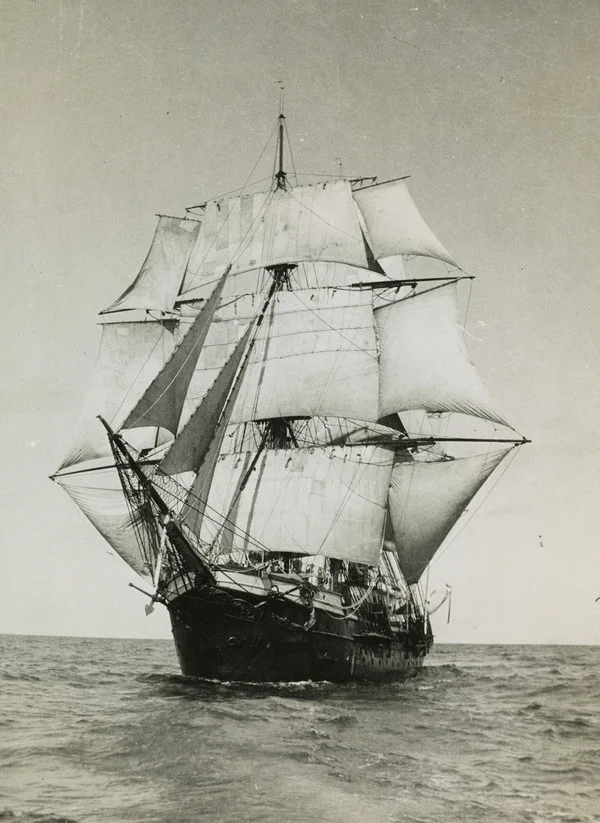
In October 1934 a 31-year-old Australian journalist named Alan Villiers sailed a 52-year-old full-rigged ship out of Ipswich, England, with a crew of roughly thirty, half of them teenage cadets, most paying a modest fee for the privilege of going round the Horn. The ship was the Joseph Conrad, formerly the Danish training ship Georg Stage, 212 tons and 111 feet on deck. Two years and 58,000 nautical miles later she dropped her anchor in New York harbour. She was the last full-rigged ship to circle the planet under sail with a mostly-amateur crew, and the voyage Villiers wrote up as Cruise of the Conrad (1937) is the closest thing tall-ship sail training has to a founding document.
This is the story of alan villiers joseph conrad, the man, the ship, the route, and why a small Danish training ship built in 1882 still defines what a tall-ship voyage is supposed to feel like.
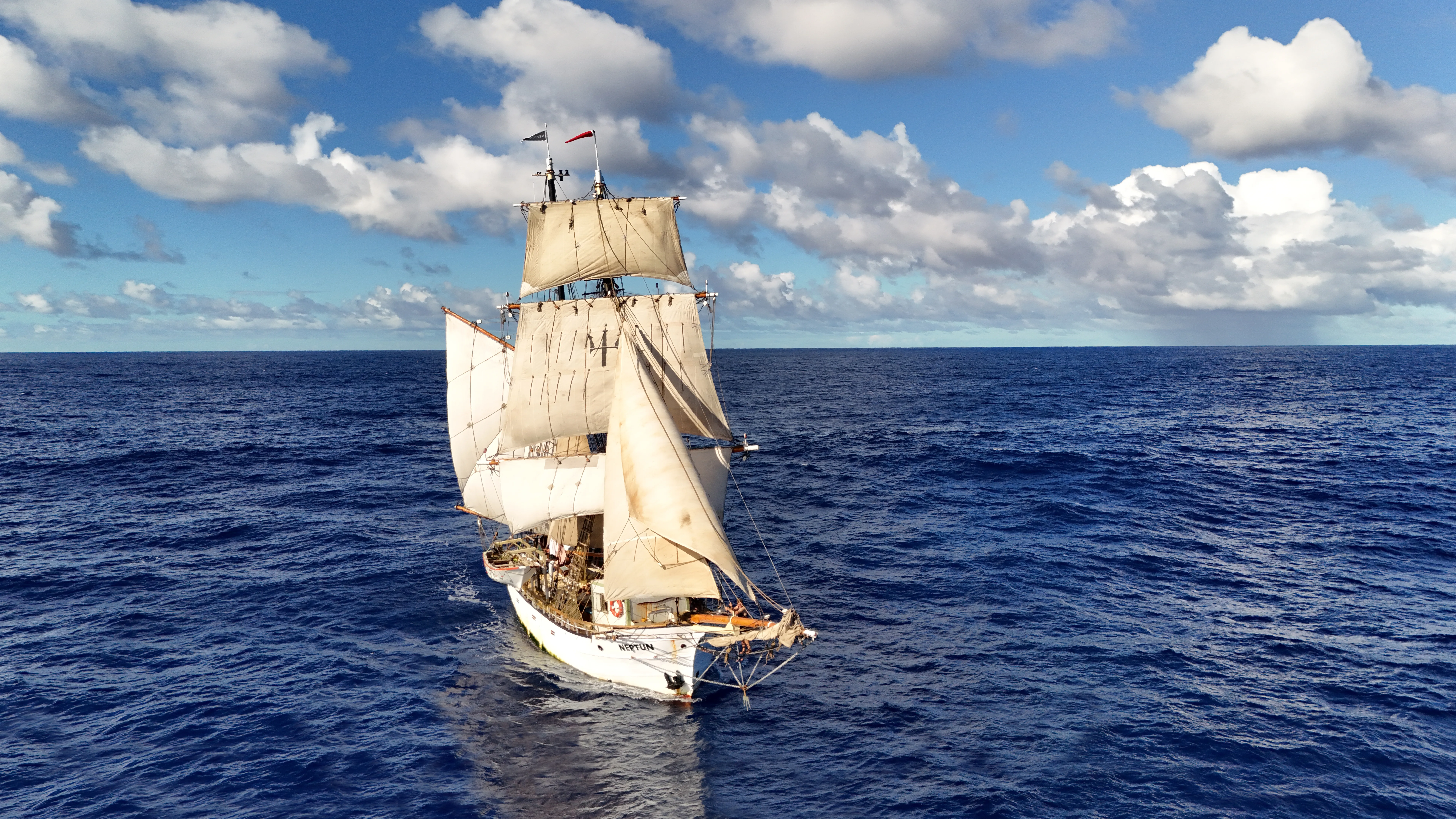
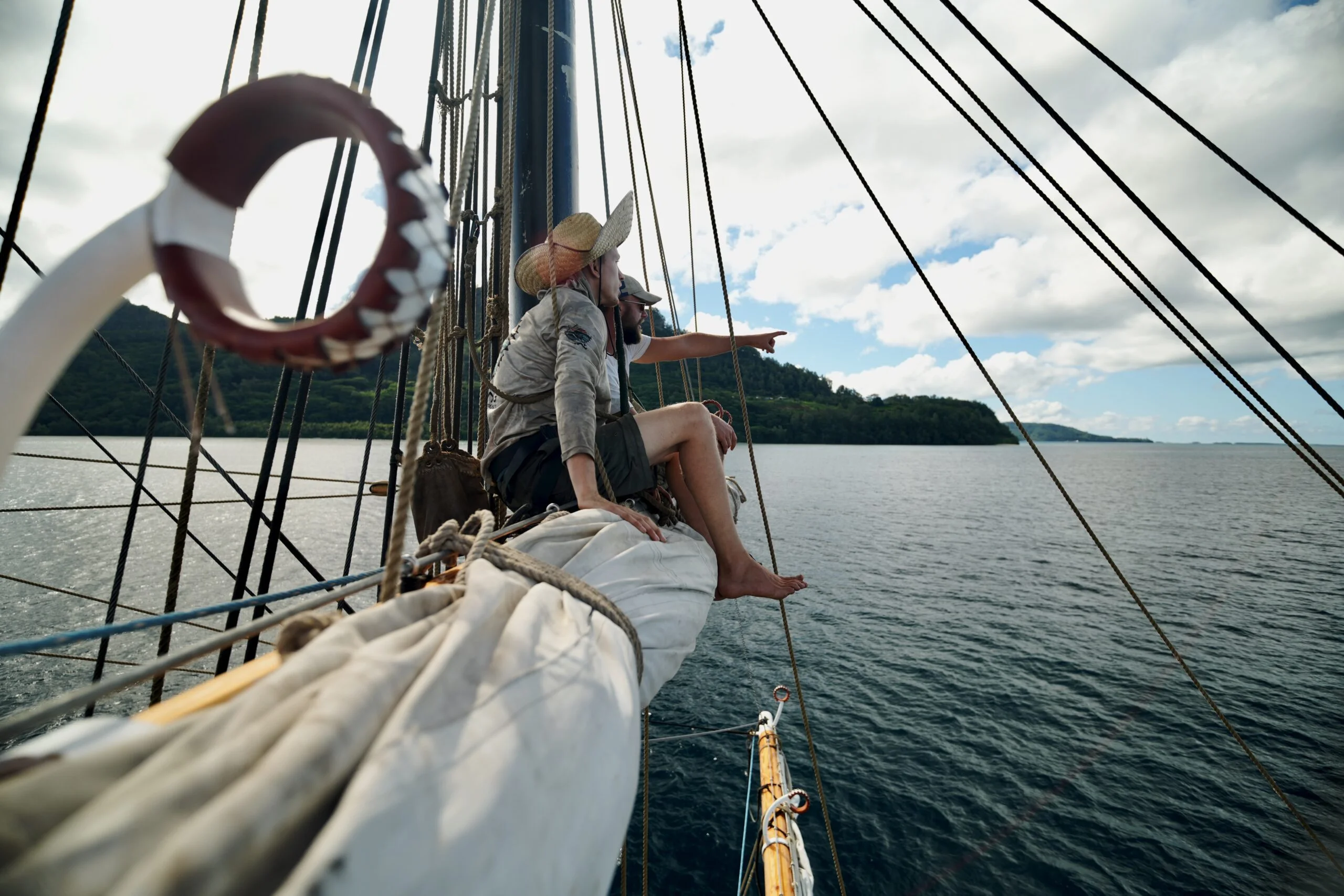
The same idea, ninety years later. Brigantine NEPTUN sails the same model: ten trainees per leg, no experience required, real ocean. Apply for a berth or browse the nine legs of the 2026–2027 voyage first.
On this page
- Thirty-one shipmates, one old ship, and an ocean each way
- Who Alan Villiers was
- The ship, built as Georg Stage in 1882
- Why this voyage was different
- The 1934–36 route
- Lessons Villiers brought home
- What happened after 1936
- The link to NEPTUN
- FAQ
- Read also
Who Alan Villiers was
Alan John Villiers was born in Melbourne on 23 September 1903 and died in Oxford on 3 March 1982. By the time he bought the Joseph Conrad at the age of 30 he had already lived more sea-time than most professional captains: apprenticed at 15 in the Tasman Sea trader Rothesay Bay, injured aboard the four-mast barque Lawhill in 1922, signed on for an Antarctic whaling expedition in the Sir James Clark Ross at the end of 1923, and rounded Cape Horn six times in the great grain ships of the late square-rig era, Herzogin Cecilie, Grace Harwar, Parma. He sailed the Parma as a part-owner from 1931 to 1933, racing wheat from South Australia to Falmouth in the last commercial sailing fleet on Earth.
He was, in other words, a working square-rig sailor who happened also to be one of the best sea-writers in English. Villiers wrote 44 books, including By Way of Cape Horn (1930), Cruise of the Conrad (1937), Sons of Sindbad (1940), his account of sailing in an Arab dhow from Oman to the Rufiji Delta, and The Way of a Ship (1953). He commanded Mayflower II on her maiden Atlantic crossing in 1957, fifty-four days faster than the original Mayflower's sixty-seven, and he chaired the Society for Nautical Research from 1960 to 1970.
What made him the right man to attempt the 1934 voyage was a single conviction. Villiers believed, and is one of the first people on record to argue it, that the discipline of working a square-rigger at sea was a form of education in itself, valuable to a teenager who would never go to sea again as it was to one who would.
Alan Villiers, 1903–1982
A working square-rig sailor who happened also to write
Born in Melbourne, apprenticed at 15, six Cape Horn roundings before he turned 30, part-owner of the grain-racer Parma 1931–33, captain of Mayflower II in 1957. Wrote 44 books. The Joseph Conrad voyage was his manifesto for sail training, the idea that a few months on the yards changes a young person whether or not the sea is their life's work.
The ship, built as Georg Stage in 1882
The vessel Villiers bought was already a story when he found her. She was launched in 1882 by Burmeister & Wain in Copenhagen as the Georg Stage, a memorial training ship endowed by the Danish ship-owner Frederik Stage in memory of his son, who had died at the age of 22. For more than fifty years she trained Danish boys for the merchant fleet. On 26 June 1905 she was rammed by the British steamer Ancona off Copenhagen and sank in minutes; 22 cadets aged 14 to 17 were lost, a tragedy that still shapes how Danish sail-training ships are surveyed and rigged. She was raised, refitted, and returned to service.
By the early 1930s the Danish Naval Foundation had built a replacement (the modern Georg Stage that still trains young Danish seafarers from Copenhagen today), and the original was for sale. Villiers bought her in 1934, renamed her Joseph Conrad after the Polish-born novelist who had himself been a master mariner, and rigged her for an Atlantic offing.
Her dimensions are why she mattered: at 111 feet on deck and 212 register tons, she was one of the smallest full-rigged ships ever built in modern times. Three masts. Square sails on every one. Royals, t'gallants, upper and lower topsails, courses, the full square rig, in miniature. A boy who learned his sea-time on the Conrad learned every line a deep-water square-rig sailor would ever need.
The fact that she had been designed as a sail-training ship, not converted from a merchant career, was crucial. Her layout, her stability, her sail plan, everything about her was built to teach. Villiers did not need to invent a sail-training ship. He had to buy one and run her.
Going to school in a square-rigger. Curious how a fully rigged tall ship actually works? See our how-square-sails-actually-work explainer, or read about the parts of a tall ship before you climb the rig for the first time.
Why this voyage was different
By 1934 commercial sail was over. The last grain races between South Australia and Britain still ran (Villiers had been part of them) but they were the dying tail of an extinct industry. The world's deep-water square-riggers had been scrapped, hulked, or laid up. The few tall ships still working were either training ships for navies and merchant fleets, Sørlandet, Christian Radich, Dänemark, or yachts for the very rich.
Villiers' voyage was different in three concrete ways.
Amateur teenage crew, by design
Villiers shipped about thirty all told, of whom roughly half were paying cadets, schoolboys and young men aged in their mid-teens, with no professional career in front of them at sea. The other half were experienced able seamen Villiers had recruited from the surviving sail fleet. The mix was deliberate: the professionals taught the cadets, and the cadets paid the bills. Most modern paid-trainee tall-ship voyages, including Brigantine NEPTUN, Picton Castle, Bark Europa, still run on this exact division.
A real square-rigger, not a schooner
Square rig is not nostalgia. It is a different sailing discipline, climbing the rigging, working out on the yards, handing canvas in heavy weather, standing wheel-and-lookout watches with no engine in earshot. Villiers refused to do the voyage in any easier rig. He wanted his cadets to come home as deep-water sailors, not yachtsmen. In that he sided with his own teachers from the grain-fleet generation, and he founded a tradition that runs through the Picton Castle of today.
Real oceans and a real circumnavigation
The route was not a coastal trip with deep-water flavour. The Conrad crossed the North Atlantic, then the South Atlantic, the Indian Ocean, the Pacific, and rounded Cape Horn for the homeward passage to New York. Two years at sea. Roughly 58,000 nautical miles. By the time Villiers came home, no full-rigged ship under sail had attempted the same thing, and none has done it since with an amateur crew.
The voyage in numbers
The 1934–36 route
The Joseph Conrad sailed from Ipswich on 22 October 1934 and dropped anchor in New York on 16 October 1936, almost two years to the day. The route, as Villiers describes it in Cruise of the Conrad and as it appears in the ship's own logs in archive, ran "by way of Good Hope, the South Seas, the East Indies, and Cape Horn". The order of the principal landfalls was Atlantic-first, eastward through the Cape, the East Indies, the Pacific, and home around the Horn, the reverse of the modern westabout cruising route.
22 October 1934, Departure from Ipswich
The Joseph Conrad casts off with roughly thirty aboard, Villiers as master, half a dozen experienced able seamen, and the cadets. Ipswich is chosen because she had been refitting in the Orwell. First task: shake the rust out of the rigging in the North Sea before the Atlantic.
Late 1934, North Atlantic to New York
A westabout Atlantic crossing in the autumn gales, the worst possible season for it. The Conrad arrives in New York having tested the ship and the cadets in conditions Villiers later said were the hardest of the voyage.
1935, South Atlantic via Rio and Cape Town
New York southbound to Rio de Janeiro, then a long South Atlantic passage to Cape Town. Trade-wind sailing in its purest form: weeks on the same tack, royals set, watch-and-watch. This is where the cadets earn their sea-time.
1935, Indian Ocean and the East Indies
East from the Cape on the southern trade winds, into the Indian Ocean and on to the East Indies, Bali among the landfalls. The ship is nearly lost on Wari Reef in the Coral Sea, an episode that takes up some of the most-quoted pages in Cruise of the Conrad.
1935–36, Sydney, New Zealand, the South Pacific
Across the Coral Sea to Sydney, on to New Zealand, then north into the South Pacific atolls and Tahiti. Villiers calls this the part of the voyage the cadets remembered most, the part that turned them into shipmates rather than passengers.
Early 1936, Cape Horn eastabout
The Conrad rounds Cape Horn from the Pacific into the South Atlantic. The most demanding ocean passage on the planet for a sailing ship, and a passage Villiers had already made six times in the grain fleet.
16 October 1936, Arrival in New York
The Joseph Conrad drops her anchor in New York harbour after two years and roughly 58,000 nautical miles. The cadets disperse. Villiers begins writing the book that will frame sail training for the next century.
The voyage was not without its bruises. The Conrad was nearly wrecked on the Brooklyn Rocks in a blizzard, ran aground on Wari Reef in the Coral Sea, and Villiers was forced to take aboard a paying passenger to keep the books afloat. None of the public sources, Wikipedia, the Naval Marine Archive, The Spectator's 1937 review, or Villiers' own published journal, record any deaths or serious injuries during the two-year voyage.
Pick your ocean
NEPTUN's ocean-crossing legs
The same square-rig discipline Villiers used in 1934, the four open-ocean passages of the 2026–2027 voyage.
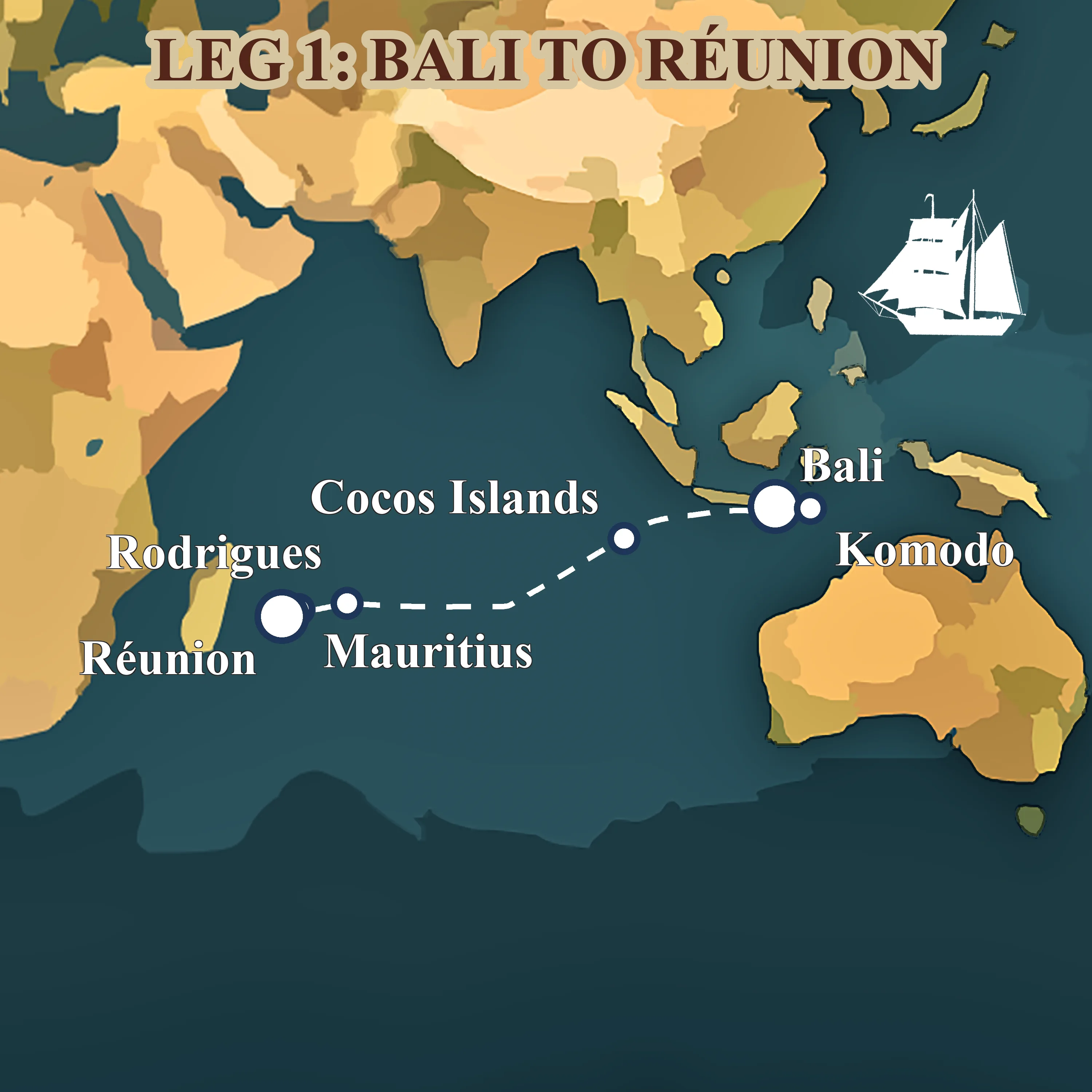
Leg 1: from Bali to Réunion across the Indian Ocean
May 2026 — Aug 2026 · Bali, Indonesia → Réunion, France
The opening chapter of Neptun's 482-day world voyage, a 4,078-nm trade-wind passage from the temples of Bali to the volcanic cliffs of Réunion.
Read more about this leg → about Leg 1: from Bali to Réunion across the Indian Ocean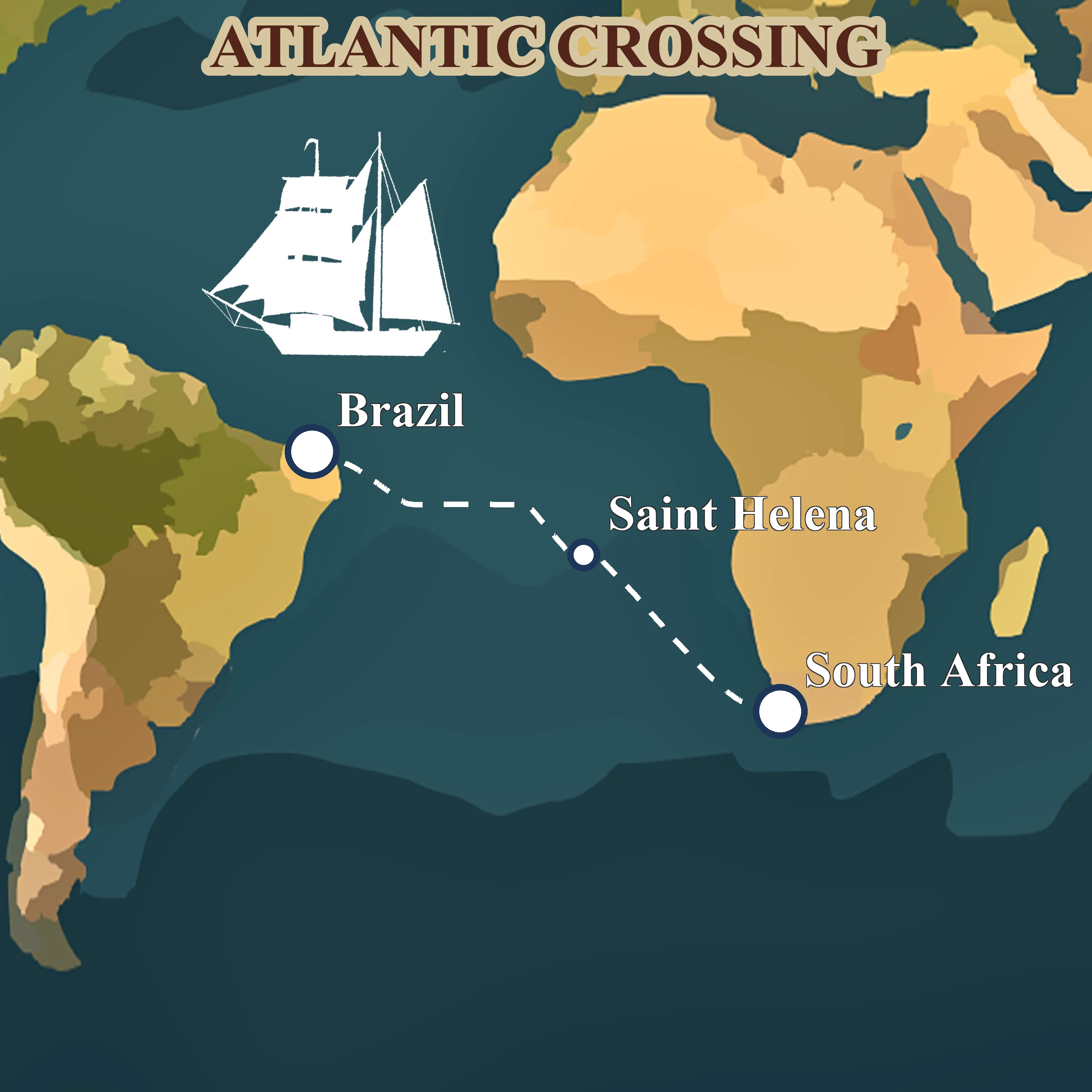
Leg 5: across the South Atlantic from Saldanha to Fortaleza
Jan 2027 — Mar 2027 · Saldanha Bay, South Africa → Fortaleza, Brazil
Forty-four days before the southeast trades, Napoleon's exile at St. Helena, the equator crossing, and landfall in tropical Brazil. The ocean chapter of the voyage.
Read more about this leg → about Leg 5: across the South Atlantic from Saldanha to Fortaleza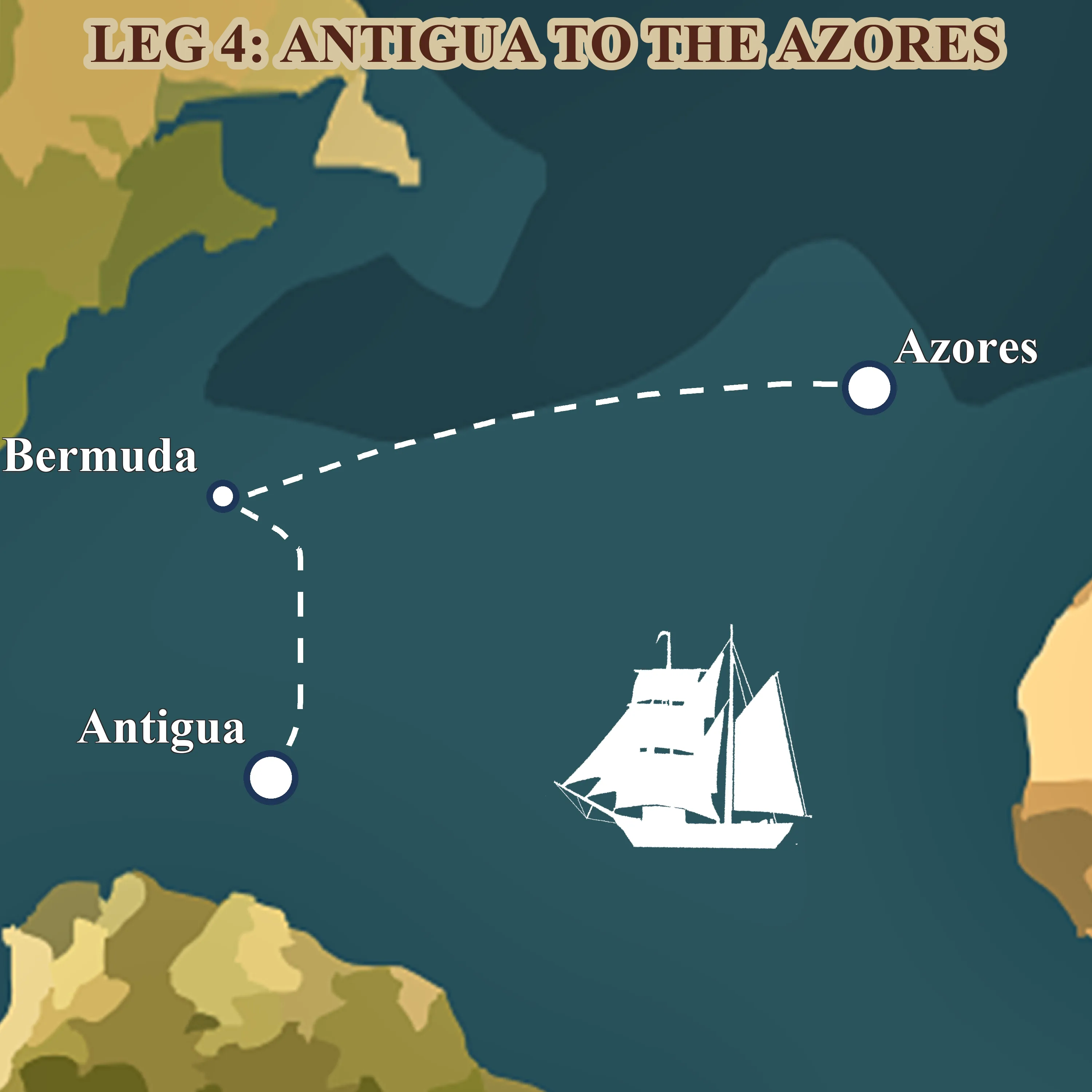
Leg 8: across the North Atlantic from Antigua to the Azores
May 2027 — Jul 2027 · Antigua → Ponta Delgada, Azores
Fifty-six days on the classic spring tall-ship route home, Antigua, a long reach to Bermuda's pink sand, then three weeks of open ocean to the volcanic Azores.
Read more about this leg → about Leg 8: across the North Atlantic from Antigua to the Azores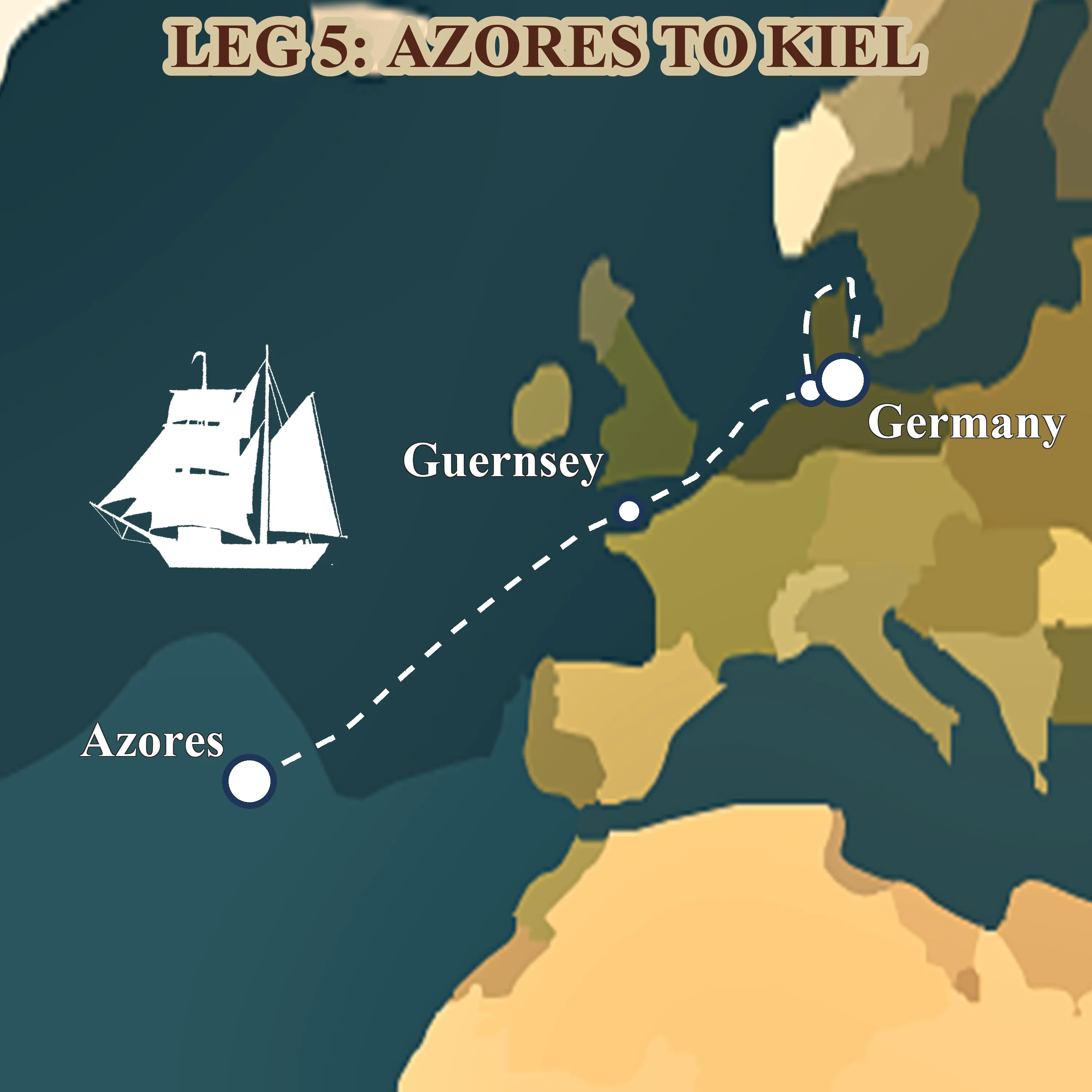
Leg 9: homecoming from the Azores to Kiel
Jul 2027 — Aug 2027 · Ponta Delgada, Azores → Kiel, Germany
The final 1,878 nm, from volcanic São Miguel to the Baltic, up the English Channel through the Dover TSS, past Helgoland's red cliffs and home to Kiel.
Read more about this leg → about Leg 9: homecoming from the Azores to KielLessons Villiers brought home
The voyage produced two books and one philosophy. Cruise of the Conrad (1937) and Stormalong, written for younger readers, told the story; the philosophy is what survived. Three planks of it shape modern sail training and are visible on every modern training ship.
1. Real rope, real consequences
Villiers refused to give cadets simulated tasks. If a sail had to be furled, a cadet went up with the watch and furled it. If the ship needed warping into a berth, a cadet was on the line. The principle was that a young person learns by being trusted with a task that has consequences, and that the consequences themselves are the teacher. Modern STCW-compliant training ships still run on the same logic: there is no fake rope on a square-rigger.
2. The mixed crew is the teaching system
The pairing of paid amateur cadets with experienced professionals was not a financial expedient. Villiers wrote that the professionals were essential as teachers, and the cadets as questions. A captain alone could not teach thirty teenagers to be sailors. A bosun and four AB's, with thirty cadets to mentor on watch-and-watch, could. NEPTUN, Picton Castle, and every reputable modern paid-trainee ship use the same crew architecture.
3. Going to sea is education in itself
Villiers was not training the cadets for a career at sea. He was training them, full stop. He believed the experience of running a watch in heavy weather, of sleeping in a hammock for two weeks of trade-wind sailing, of furling a t'gallant in the dark, of being hungry, cold, and competent at the same time, formed a person in ways no school could match. This was the radical claim. It survived him because it turned out to be true.
The same claim, ninety years on. No prior sailing experience required. The voyage teaches you. Read about life onboard NEPTUN or the day-at-sea routine on a tall ship.
What happened after 1936
When the Conrad tied up in New York the voyage was over and Villiers' money was gone. The ship needed an expensive refit. He sold her to George Huntington Hartford, the A&P grocery heir, who fitted an auxiliary engine and used her as a private yacht. In 1939 Hartford donated the Joseph Conrad to the U.S. Coast Guard for merchant-marine officer training in Jacksonville, Florida, closing the loop on what Villiers had wanted her to be in the first place. After the Second World War she was laid up briefly, and in 1947 Congress transferred her by act of legislation to Mystic Seaport in Connecticut. She has lived there ever since.
She is still a full-rigged ship. The Mystic Mariner Program and the Joseph Conrad Sailing Camp use her as a static training vessel for young people every summer; she is open to the public the rest of the year. The 144-year-old hull built in Copenhagen as a memorial to a 22-year-old has now trained more young sailors than almost any vessel afloat.
Villiers, for his part, went on. He sailed an Arab dhow from Kuwait round Arabia in 1938–39, the journey that became Sons of Sindbad, the only first-hand account in English of pre-modern Arab dhow sailing. He served in the Royal Naval Volunteer Reserve through the Second World War with a Distinguished Service Cross. He commanded the cod-fishing schooner Argus on the Grand Banks for The Quest of the Schooner Argus (1951). He delivered Mayflower II across the Atlantic in 1957. He was a trustee of the National Maritime Museum in Greenwich and chair of the Cutty Sark Preservation Society. The voyages stopped only when his body did, in 1982.
The link to NEPTUN
There is a direct line from the Joseph Conrad to Brigantine NEPTUN. It is not a sentimental line. It is the same set of decisions, made the same way, ninety years apart.
Villiers ran a real square-rigger on real ocean with a mixed crew of paid amateur trainees and a small core of professionals. NEPTUN does the same. Villiers refused to use the rig as theatre, every line was a working line. NEPTUN refuses to do anything different. Villiers believed a teenager who stood watches across an ocean would come home a different person whether or not they ever went to sea again. Every NEPTUN trainee who has rounded the Cape of Good Hope or crossed the line at the equator has confirmed it in writing.
The historical link runs through Villiers' own ship. The Joseph Conrad began life as the Georg Stage, named for a 22-year-old Dane in 1882, sailing out of Copenhagen, the same harbour NEPTUN's present-day Danish training-ship neighbour still calls home. The lineage of square-rigged sail training as practised in northern Europe runs Copenhagen → Villiers → Mystic → and onward through every ship still doing it.
NEPTUN's 2026–2027 voyage is 482 days, nine legs, and over 30,000 nautical miles. It is a different shape from Villiers' two-year arc, but the trainee who joins her one leg at a time is doing exactly what a Conrad cadet did between Ipswich and New York. Climb the rigging. Stand the watch. Hand the sail. Come home different.
The same model, ninety years on.
A real square-rigger. A mixed crew of trainees and professionals. Real ocean. No prior experience required. Pick a leg of the 2026–2027 voyage and apply for a berth.
FAQ
Common questions about Alan Villiers and the Joseph Conrad
Was the Joseph Conrad really the last full-rigged circumnavigation under sail?
With an amateur crew, yes, that is the claim every reliable source supports. Naval and commercial training ships continued (and continue) to circumnavigate under square rig, but the Conrad was the last full-rigged ship to sail around the world with a crew that was largely paying amateur cadets, and she is the last to have done so without engine assistance for the principal passages.
How many cadets were aboard?
About 32 all told, according to Villiers' own book. Roughly half were paying amateur cadets, schoolboys and young men, mostly in their mid-teens. The other half were experienced able seamen Villiers recruited from the surviving sailing fleet. The professionals taught; the cadets paid the bills and learned the trade. The same model NEPTUN runs on today.
Did anyone die on the voyage?
No deaths or serious injuries are recorded in any of the public sources. The ship was nearly wrecked twice, on the Brooklyn Rocks in a blizzard and on Wari Reef in the Coral Sea, but Villiers brought every shipmate home. By square-rig standards of the era, that alone was a remarkable result.
What happened to the Joseph Conrad after the voyage?
Villiers sold her in 1936 to American businessman George Huntington Hartford, who used her as a yacht. Hartford donated her in 1939 to the U.S. Coast Guard for merchant-marine training. In 1947 Congress transferred her to Mystic Seaport in Connecticut, where she has been a museum and static training ship ever since.
What was the ship's original name?
She was launched in 1882 in Copenhagen by Burmeister & Wain as the Georg Stage, a memorial training ship for the Danish merchant fleet. She trained Danish boys for fifty years before Villiers bought her in 1934 and renamed her after the novelist Joseph Conrad. The Danish foundation that endowed her built a replacement, the modern Georg Stage, which still trains young Danish seafarers from Copenhagen.
Why is Villiers' voyage important to modern sail training?
Because he wrote down the philosophy. Cruise of the Conrad (1937) is the founding text for the idea that a teenager who works a square-rigger across an ocean comes home a different person, and that the work itself is the teacher. Every modern paid-trainee tall-ship programme, from Picton Castle to Brigantine NEPTUN, runs on the same logic.
Where can I see the Joseph Conrad today?
At Mystic Seaport Museum in Mystic, Connecticut. She is moored there year-round, open to visitors as an exhibit, and used in summer as a static training ship for young sailors in the Mystic Mariner Program. She is one of only two surviving sail-training full-rigged ships in the United States.
Read also
- Captain Arthur Kimberly and the brigantine Romance, the man who kept square-rig sail training alive after Villiers
- Irving Johnson and the seven Yankee world voyages, the American cousin of the Villiers method, 1933–58
- Famous tall ships still sailing today, the living square-rig fleet
- Georg Stage, the Danish training ship Villiers bought, the ship the Joseph Conrad originally was, and the one that succeeded her in Copenhagen
- How to join a tall ship crew without experience, the modern version of what Villiers' cadets did in 1934
- What sail training actually costs, paid trainee berths, then and now
- Apply now, join a leg of the 2026–2027 voyage
The full 2026–2027 voyage, all nine legs
482 days, over 30,000 nautical miles, four oceans, the same square-rig discipline Villiers wrote down in 1937.
Leg 1: from Bali to Réunion across the Indian Ocean
May 2026 — Aug 2026 · Bali, Indonesia → Réunion, France
The opening chapter of Neptun's 482-day world voyage, a 4,078-nm trade-wind passage from the temples of Bali to the volcanic cliffs of Réunion.
Read more about this leg → about Leg 1: from Bali to Réunion across the Indian Ocean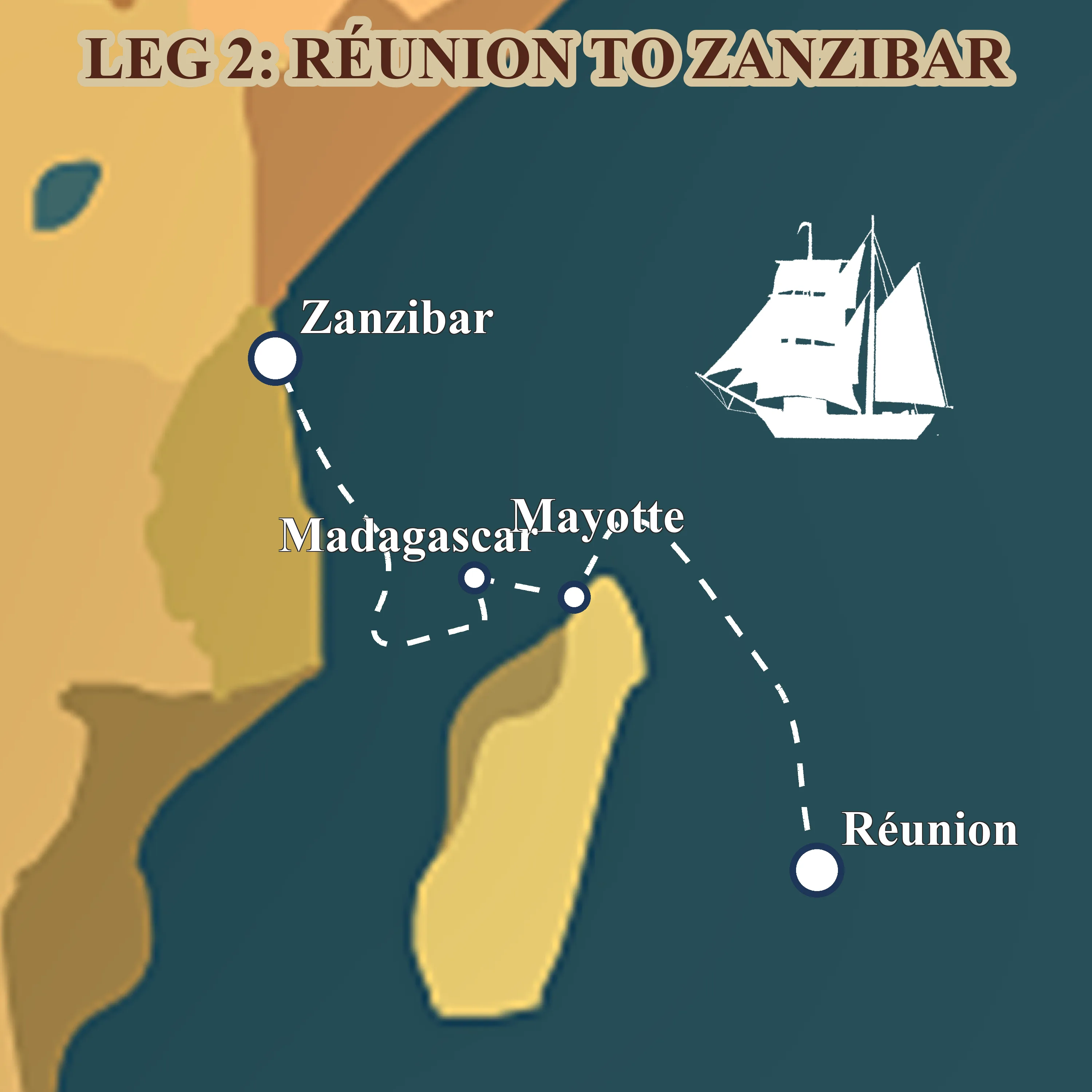
Leg 2: from Réunion to Zanzibar via Madagascar
Aug 2026 — Sept 2026 · Réunion, France → Zanzibar, Tanzania
Forty days across the western Indian Ocean, volcanic Réunion, lemur-haunted Nosy Be, the Mozambique Channel, and the spice-scented stone alleys of Zanzibar.
Read more about this leg → about Leg 2: from Réunion to Zanzibar via Madagascar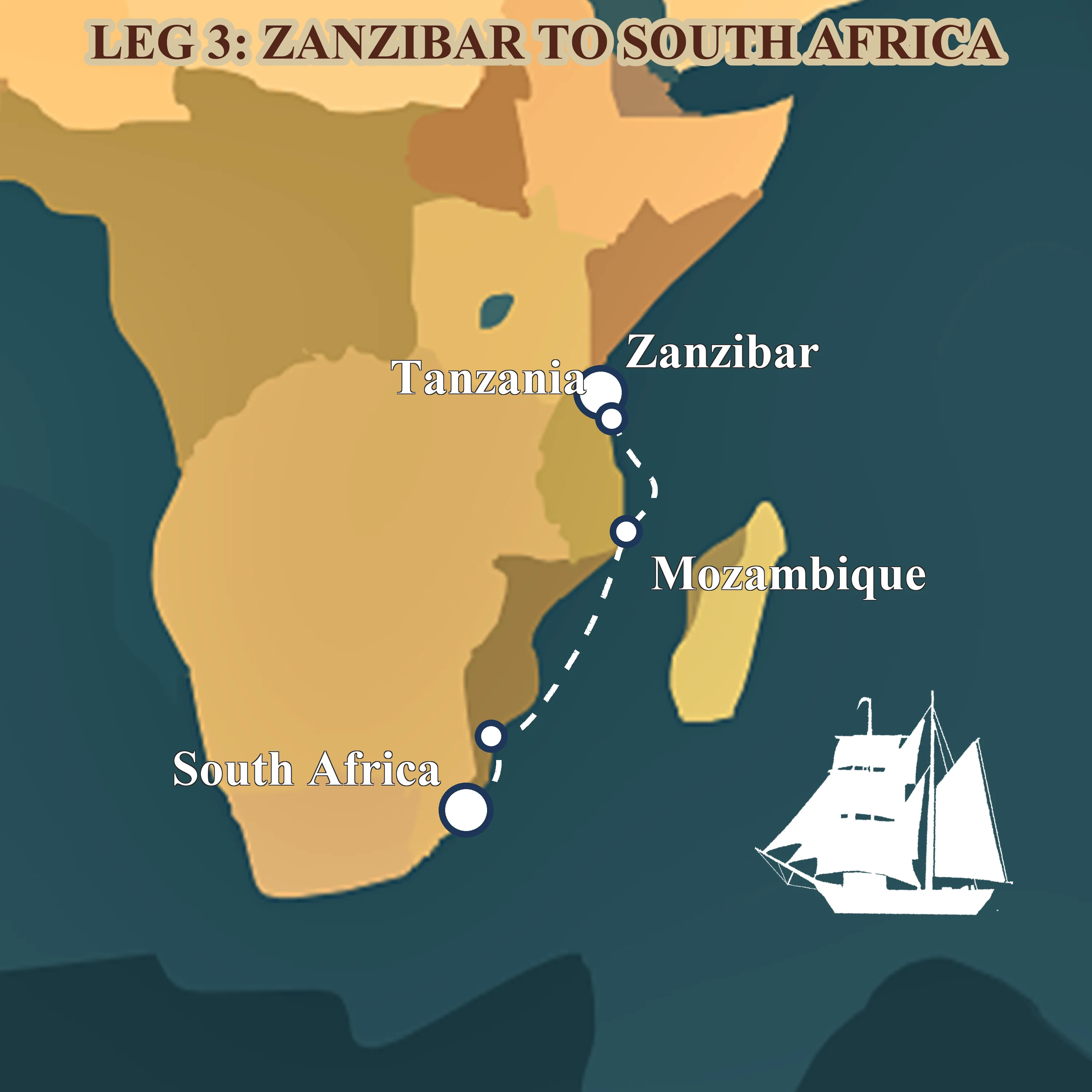
Leg 3: from Zanzibar to Durban down the Mozambique Channel
Sept 2026 — Nov 2026 · Zanzibar, Tanzania → Durban, South Africa
Sixty-three days coasting the African shore, spice islands, mangrove anchorages, Portuguese praças and the long trade-wind run down the Mozambique Channel to Durban.
Read more about this leg → about Leg 3: from Zanzibar to Durban down the Mozambique Channel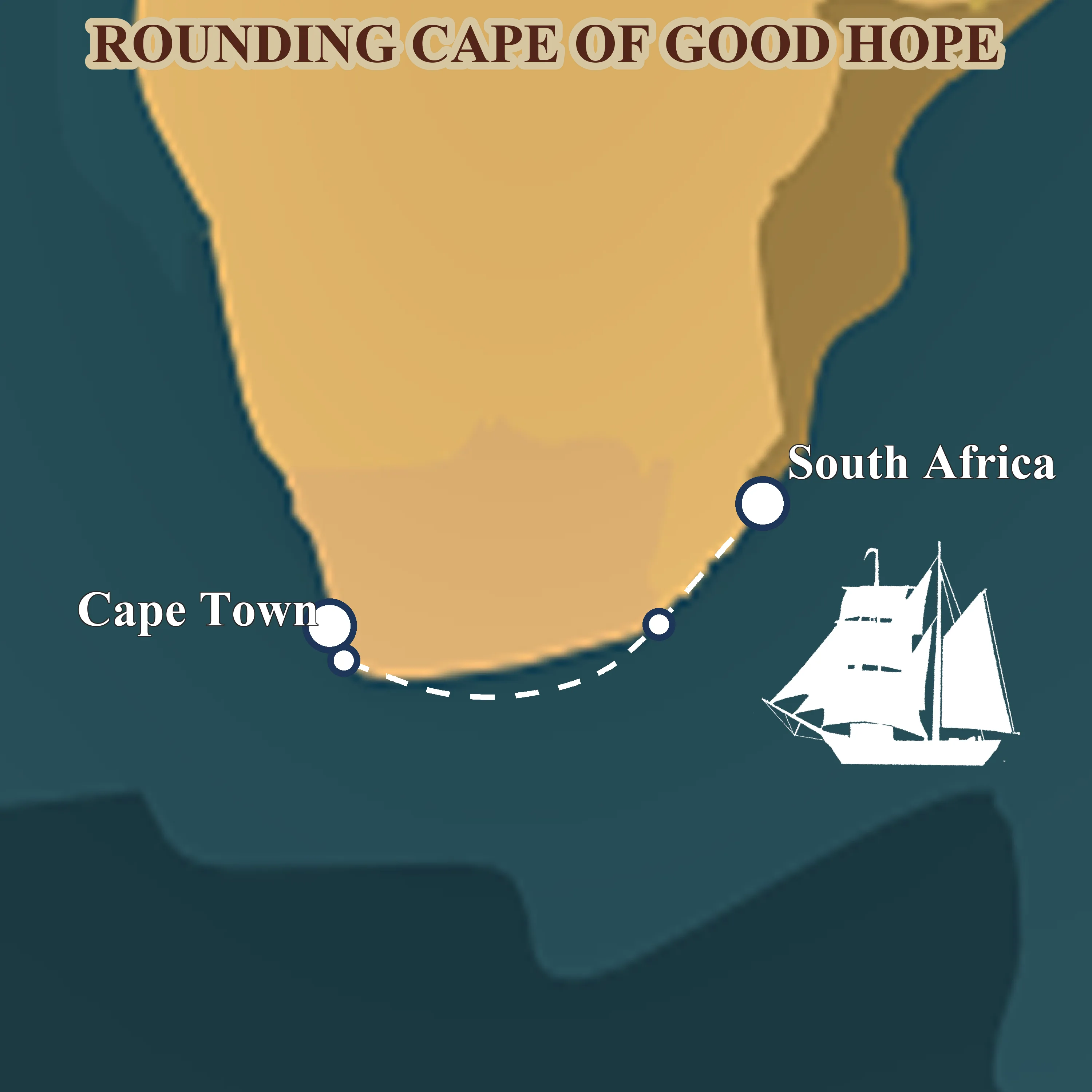
Leg 4: from Durban around the Cape of Good Hope
Nov 2026 — Dec 2026 · Durban, South Africa → Cape Town, South Africa
Thirty-eight days of serious seamanship, the Agulhas current, the Cape of Good Hope and the Southern Ocean at the tip of Africa, finishing quietly in Cape Town for Christmas.
Read more about this leg → about Leg 4: from Durban around the Cape of Good HopeLeg 5: across the South Atlantic from Saldanha to Fortaleza
Jan 2027 — Mar 2027 · Saldanha Bay, South Africa → Fortaleza, Brazil
Forty-four days before the southeast trades, Napoleon's exile at St. Helena, the equator crossing, and landfall in tropical Brazil. The ocean chapter of the voyage.
Read more about this leg → about Leg 5: across the South Atlantic from Saldanha to Fortaleza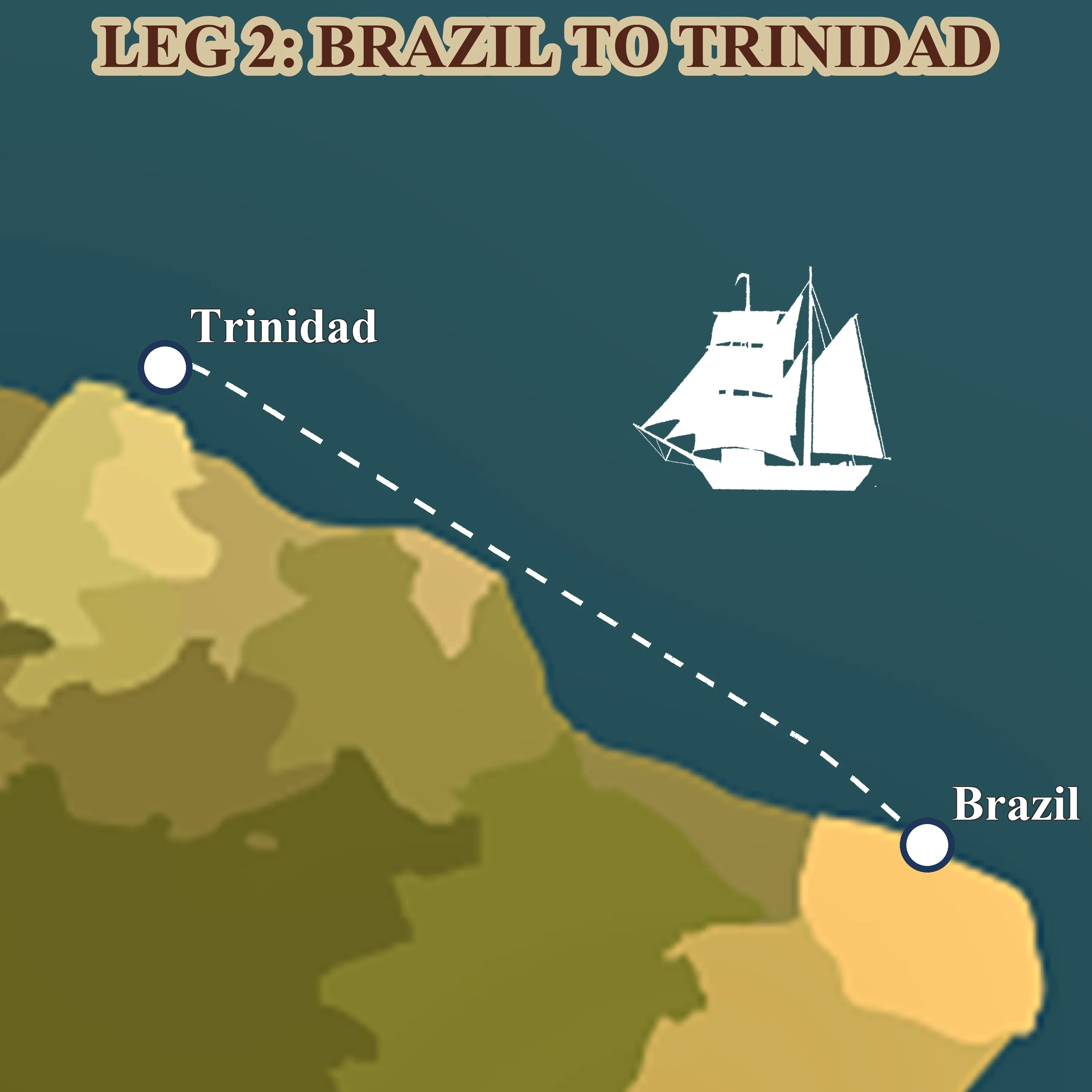
Leg 6: from Fortaleza to Trinidad along South America
Mar 2027 — Apr 2027 · Fortaleza, Brazil → Trinidad
A thousand miles of downwind trade running, the Amazon's brown water under the hull, the Guianas smudged on the horizon, and Trinidad's steelpan waiting at the end.
Read more about this leg → about Leg 6: from Fortaleza to Trinidad along South America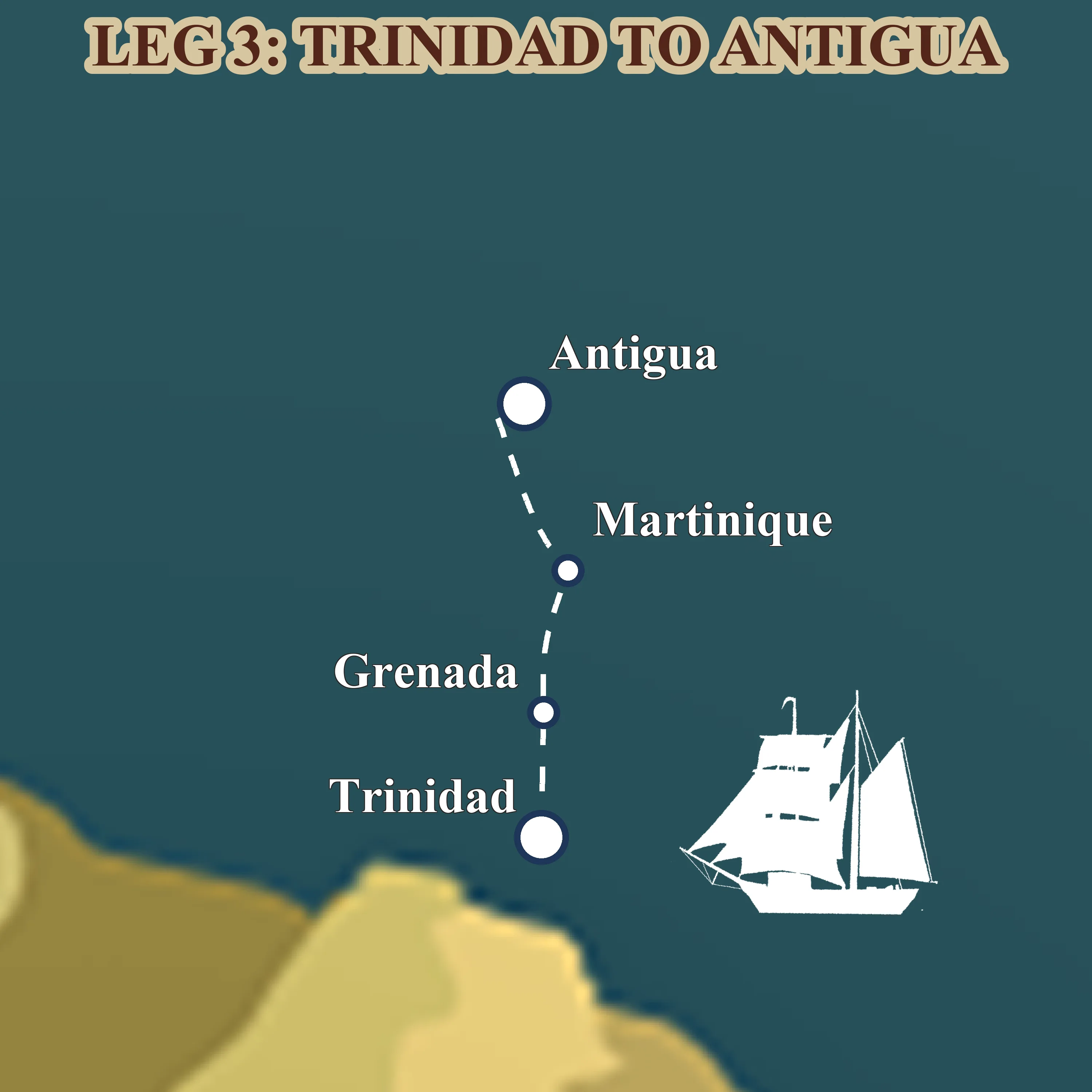
Leg 7: through the Windward Islands from Trinidad to Antigua
Apr 2027 — May 2027 · Trinidad → Antigua
Four weeks of short trade-wind daysails through the Lesser Antilles, turquoise anchorages, rum shops on the sand, French-Creole Martinique and the tall-ship scene in Antigua.
Read more about this leg → about Leg 7: through the Windward Islands from Trinidad to AntiguaLeg 8: across the North Atlantic from Antigua to the Azores
May 2027 — Jul 2027 · Antigua → Ponta Delgada, Azores
Fifty-six days on the classic spring tall-ship route home, Antigua, a long reach to Bermuda's pink sand, then three weeks of open ocean to the volcanic Azores.
Read more about this leg → about Leg 8: across the North Atlantic from Antigua to the AzoresLeg 9: homecoming from the Azores to Kiel
Jul 2027 — Aug 2027 · Ponta Delgada, Azores → Kiel, Germany
The final 1,878 nm, from volcanic São Miguel to the Baltic, up the English Channel through the Dover TSS, past Helgoland's red cliffs and home to Kiel.
Read more about this leg → about Leg 9: homecoming from the Azores to KielWant to do what Villiers' cadets did? Brigantine NEPTUN is a non-profit training ship, every voyage takes 10 trainees through real ocean sailing under square rig, no experience required. Apply for a berth or read about the 2026–2027 voyages first.