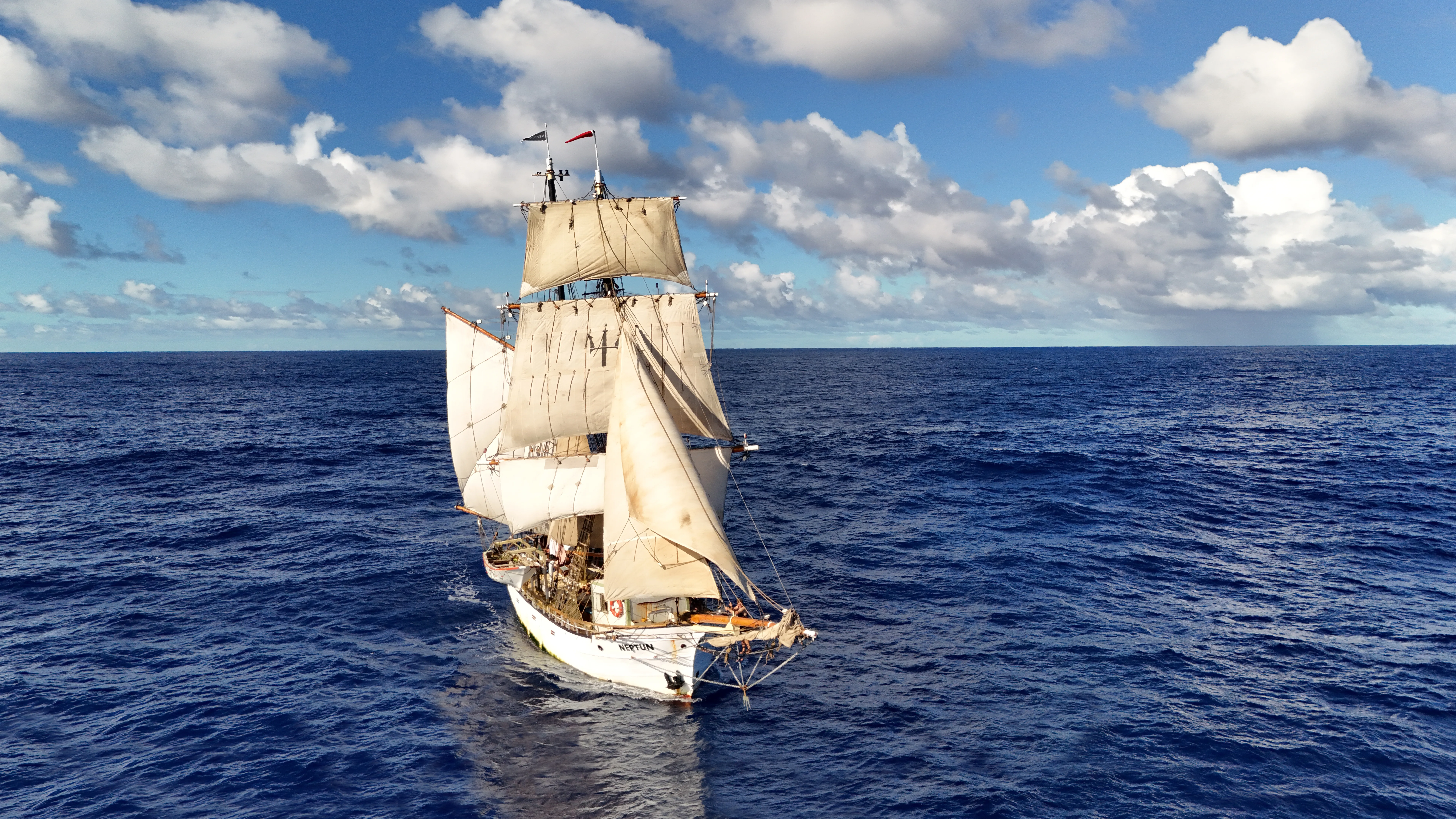
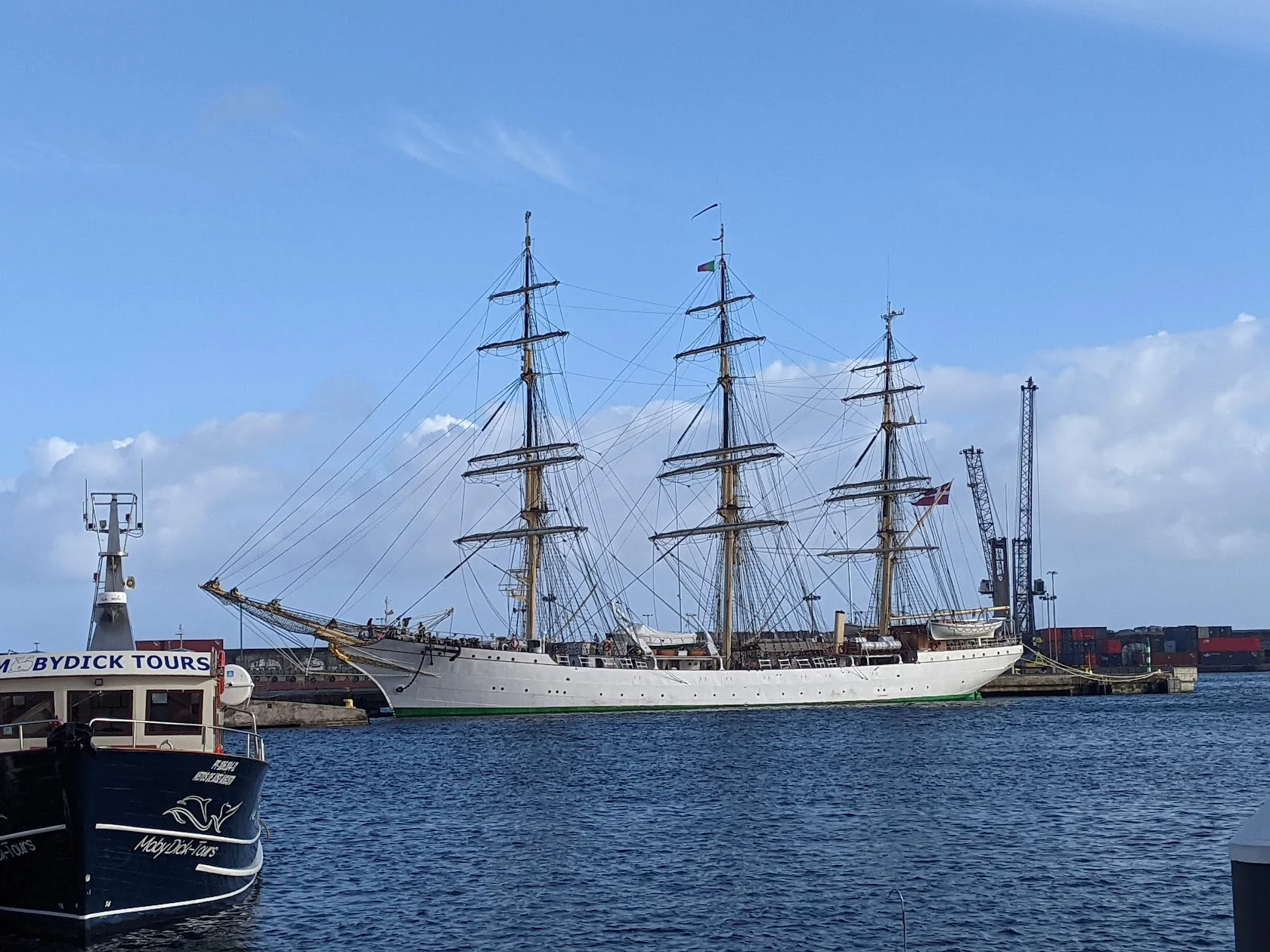
Skoleskibet Danmark is the full-rigged Danish training ship that has been turning teenagers into seafarers since 1932, a 77-metre, three-masted square-rigger owned by the Danish Maritime Authority and operated out of Frederikshavn on the northern tip of Jutland. She is one of the last state-run full-rigged training ships still putting cadets to sea under canvas, and she is still doing it the way she was designed to: 80 young people, three months at a time, eight months a year, no shortcuts.
This article walks through what she is, how she was built, the WWII odyssey that left her stranded in the United States training Coast Guard officers, and what a voyage on her looks like today. There is also a note on the lineage NEPTUN shares with her: our co-founder, Anders Bischoff, served two years' effective sea-time aboard Skoleskibet Danmark before NEPTUN existed.
Want to sail in the Danish tradition? NEPTUN is a non-profit brigantine running the same teach-by-doing model on a smaller scale, apply for a 2026 leg or browse the nine voyages first.
On this page
- The ship: a 1932 full-rigger, still working
- Why she was built, the København story
- The 1939 New York odyssey and the US Coast Guard years
- Coming home: post-war Danish training
- A typical voyage today
- An old crew connection, NEPTUN's lineage to her
- Where you can see her
- FAQ
- Read also
The ship: a 1932 full-rigger, still working
Skoleskibet Danmark is a steel-hulled, three-masted full-rigged ship, the rig with square sails on all three masts, the most demanding configuration a sail-training ship can carry. She was launched in 1932 at the Nakskov Skibsværft on Lolland and fitted out the following year. By the standards of working sail she is not the largest tall ship afloat, but she is one of the most intensely sailed.
The headline numbers, as recorded in her Wikipedia entry and her own entry on the Danish Maritime Authority's site:
- Length overall: 252 ft / 77 m
- Beam: 32 ft / 9.8 m
- Draft: 17 ft / 5.2 m
- Gross tonnage: 790 GT
- Sails: 26 in a full set
- Rig: full-rigged ship (square sails on all three masts)
- Auxiliary engine: 486 hp diesel, 9 knots under power
- Crew complement: 15 permanent crew + 80 cadets
The figure to hold in your head is 26 sails on three masts handled by 80 cadets aged 17-23. That is the entire pedagogical premise. There are not enough permanent crew to sail her without the trainees; the trainees are the crew. From the day they step aboard, every operation, setting topsails, bracing yards, going aloft to furl, standing helm and lookout, is theirs to do. There is nowhere to hide.
She is a working square-rigger, not a floating museum. For what each part of her does, see parts of a tall ship and square sails explained.
Steel hull, full square rig, eighty cadets
The ship Denmark built to keep her seafarers
Skoleskibet Danmark was designed for one job: to put eighty young Danes through three months of real ocean sailing on a full-rigged ship and turn them into people the merchant marine could employ. Ninety years on, the design is still doing that job.
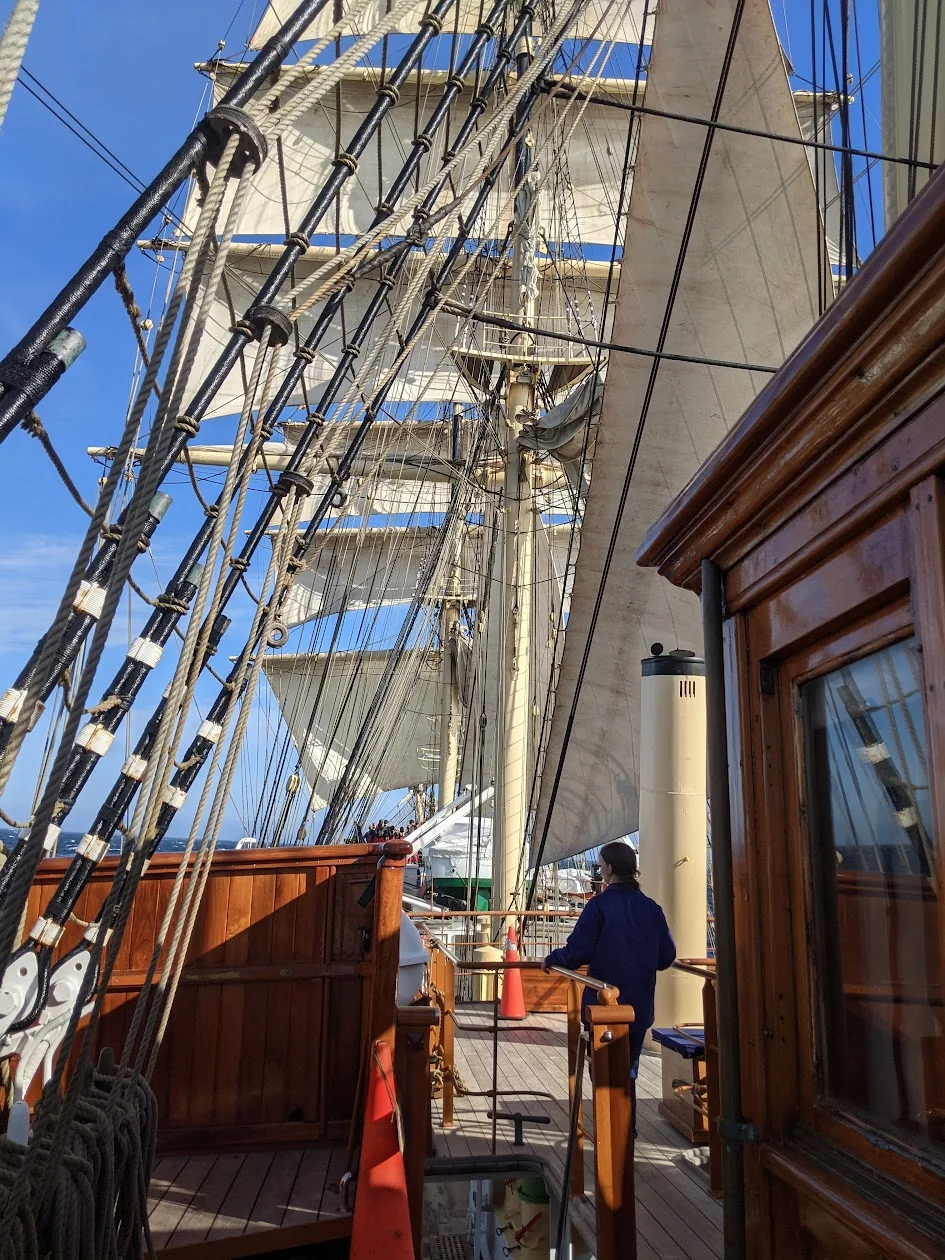
Photo: Anders Bischoff aboard Skoleskibet Danmark, 2021.
Skoleskibet Danmark in numbers
Why she was built, the København story
Skoleskibet Danmark exists because the ship before her did not come back.
Her predecessor as Denmark's principal training vessel was the København, a five-masted barque, the largest sailing ship Denmark had ever owned and one of the largest sail-training ships of any nation. In December 1928, on a voyage from Buenos Aires to Australia with a complement of cadets and crew, she vanished. No wreck was ever found. All hands were lost. To this day she is one of the great mysteries of twentieth-century sail.
Denmark's response was not to abandon sail training but to commission a smaller, more conservative successor. Where København had been a sprawling five-master, the new ship would be a three-masted full-rigger, a more compact, less ambitious vessel that could still teach the full square-rig curriculum. The keel was laid at Nakskov in 1931. She was launched in 1932 and put into service in 1933 as the new home of Danish merchant-marine cadet training.
The pedagogical purpose has not changed since: prepare young Danes to become officers in the merchant marine, by working a full-rigged sailing ship for a season at a time. As Denmark's commercial fleet shifted to motor vessels through the 20th century, the role broadened, today she trains cadets bound for everything from offshore service vessels to ferry crews, but the method is unchanged.
Curious about the bigger story of sail training? This article is one of a planned cluster on famous training ships still sailing, see also our notes on Georg Stage, Denmark's other training ship, and the wider canon at famous tall ships still sailing.
The 1939 New York odyssey and the US Coast Guard years
The most famous chapter in Skoleskibet Danmark's story is the one nobody planned.
In 1939, after a routine training cruise across the Atlantic, she sailed into New York to take part in the 1939 World's Fair. She was tied up there as Denmark's flagship maritime exhibit when, in April 1940, German forces occupied Denmark. Her captain, Knud Langvad Hansen, was given an impossible choice: try to run home through a North Atlantic now controlled by the Kriegsmarine, or stay where she was. He stayed.
She spent the early war years laid up, first in New York, then in Jacksonville, Florida, a 77-metre full-rigged ship with no country and no orders. Then, after Pearl Harbor brought the United States into the war, Hansen made the move that put Skoleskibet Danmark into American naval history: he offered her to the US government as a sail-training ship for the duration.
The US Coast Guard accepted. From 1942 until the end of the war she sailed under American command as USCGC Danmark (WIX-283), retaining her Danish captain and turning out US Coast Guard cadets at a pace no American ship could match. By the time she was returned to Denmark in 1945, she had trained roughly five thousand US Coast Guard cadets, many of whom went on to officer the Coast Guard's own square-rigger, the USCGC Eagle, once the Eagle was acquired as a war reparation in 1946.
The arc is striking. A Danish ship that could not go home spent the war years founding what would become the modern American sail-training establishment. Then she sailed back to Denmark and resumed her original job.
Timeline of Skoleskibet Danmark, the 90-year arc
1928, København lost at sea
Denmark's previous training ship, the five-masted barque København, disappears with all hands on a voyage from Buenos Aires to Australia. Denmark commissions a successor.
1932, Launched at Nakskov
Skoleskibet Danmark is launched at Nakskov Skibsværft on Lolland, a three-masted, steel-hulled full-rigged ship designed for 80 cadets at a time.
1939, New York World's Fair
She crosses the Atlantic to represent Denmark at the 1939 World's Fair in New York City. She is still in US waters when Germany occupies Denmark in April 1940.
1942, USCGC Danmark (WIX-283)
After Pearl Harbor, her Danish captain offers her to the US government. She serves as a US Coast Guard training ship for the rest of the war, training roughly 5,000 American cadets.
1945-46, Returned to Denmark
At the end of the war she is returned to Denmark and resumes her original Danish merchant-marine training duty the following year.
1959, Refit
A major refit reduces her cadet complement from 120 to 80, the figure she still carries today, and modernises crew accommodation and training spaces.
1964, Lead ship at New York World's Fair
Twenty-five years after her first World's Fair appearance, she leads the parade of ships at the 1964 New York World's Fair, a quiet bookending of her wartime exile.
1971-1980, The Onedin Line
She is one of seven sailing ships used in the BBC television drama The Onedin Line, for a decade she carries Victorian merchant-marine storytelling on screen.
Present, Active service
Operated by the Danish Maritime Authority out of Frederikshavn. Eighty cadets per voyage, three months at sea, eight months a year. Still teaching the same curriculum.
Coming home: post-war Danish training
Skoleskibet Danmark was returned to Denmark at the end of 1945 and resumed cadet training in 1946. She has been at it ever since, interrupted only by refits.
The most significant of these was in 1959, when her cadet complement was reduced from her original 120 to the present-day 80. Crew accommodation was modernised, training spaces were rebuilt, and the working areas of the ship were made fit for a generation of cadets who would no longer be living to nineteenth-century shipboard standards. The reduction in numbers was the right call: 80 trainees on a 77-metre ship is intense; 120 was crowding.
For most of the post-war period she has been operated by the Danish Maritime Authority (Søfartsstyrelsen) and based at the Maritime Training and Education Centre in Frederikshavn. She runs roughly two voyages a year, each three months long, taking cadets aged 17-23 through what is for many of them the first long absence from home. Most go on to careers in the Danish merchant marine; some end up in the navy, in offshore wind, in pilotage, in the deep-sea cruise sector. A small number find their way to other tall ships.
She has appeared at the 1964 New York World's Fair (where she led the parade of ships), in seven seasons of the BBC drama The Onedin Line between 1971 and 1980, and at countless port visits and Tall Ships gatherings since. The headlines come and go; the cadets do not stop turning up.

Ninety years on, the same job: turning teenagers into seafarers.
A typical voyage today
A modern Skoleskibet Danmark voyage runs about three months and covers a few thousand nautical miles. Routes vary year to year, a typical year might take her from Frederikshavn south through the North Sea, into the Atlantic, around the Bay of Biscay, into the Mediterranean and back, or out to the Caribbean and back via the Azores. The route is decided by training value, not by tourism. Some passages are weeks of open ocean; some are a series of short coastal hops with port calls.
What stays constant is the routine. Cadets are split into watches running the standard four-on, eight-off rotation, the same watch system every working ship has used for centuries. Lookout, helm, log entries, sail handling, going aloft to furl in any weather. They eat together, sleep in slung hammocks, scrub down the deck at change of watch, and sit through the same celestial-navigation and meteorology classes their grandfathers' shipmates would have recognised.
For a sense of what that watch rhythm feels like in practice, see watch systems on a tall ship and a day at sea on a tall ship. The fundamentals on Skoleskibet Danmark are identical to the ones we run on NEPTUN, the scale is just larger.
The cadets do not pay to be there. Skoleskibet Danmark is a state programme; the cost is borne by the Danish Maritime Authority and partner shipowners. That makes her place in Danish maritime culture distinct from a commercial sail-training operation: she is the institution that produces the next generation of Danish officers, and she has been doing it long enough that "I sailed Danmark" is a recognisable line in any shipowner's office in Copenhagen, Esbjerg or Aarhus.
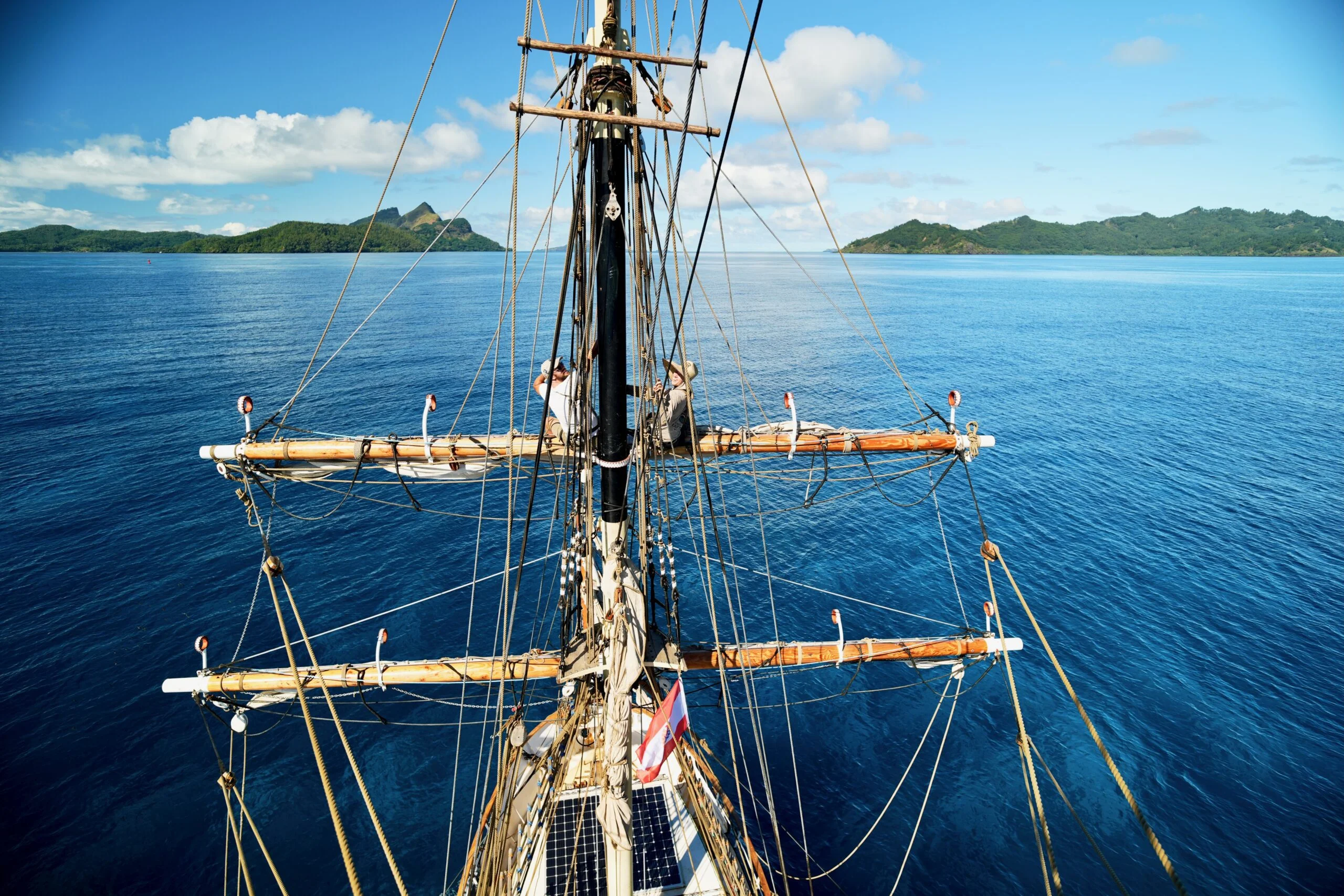
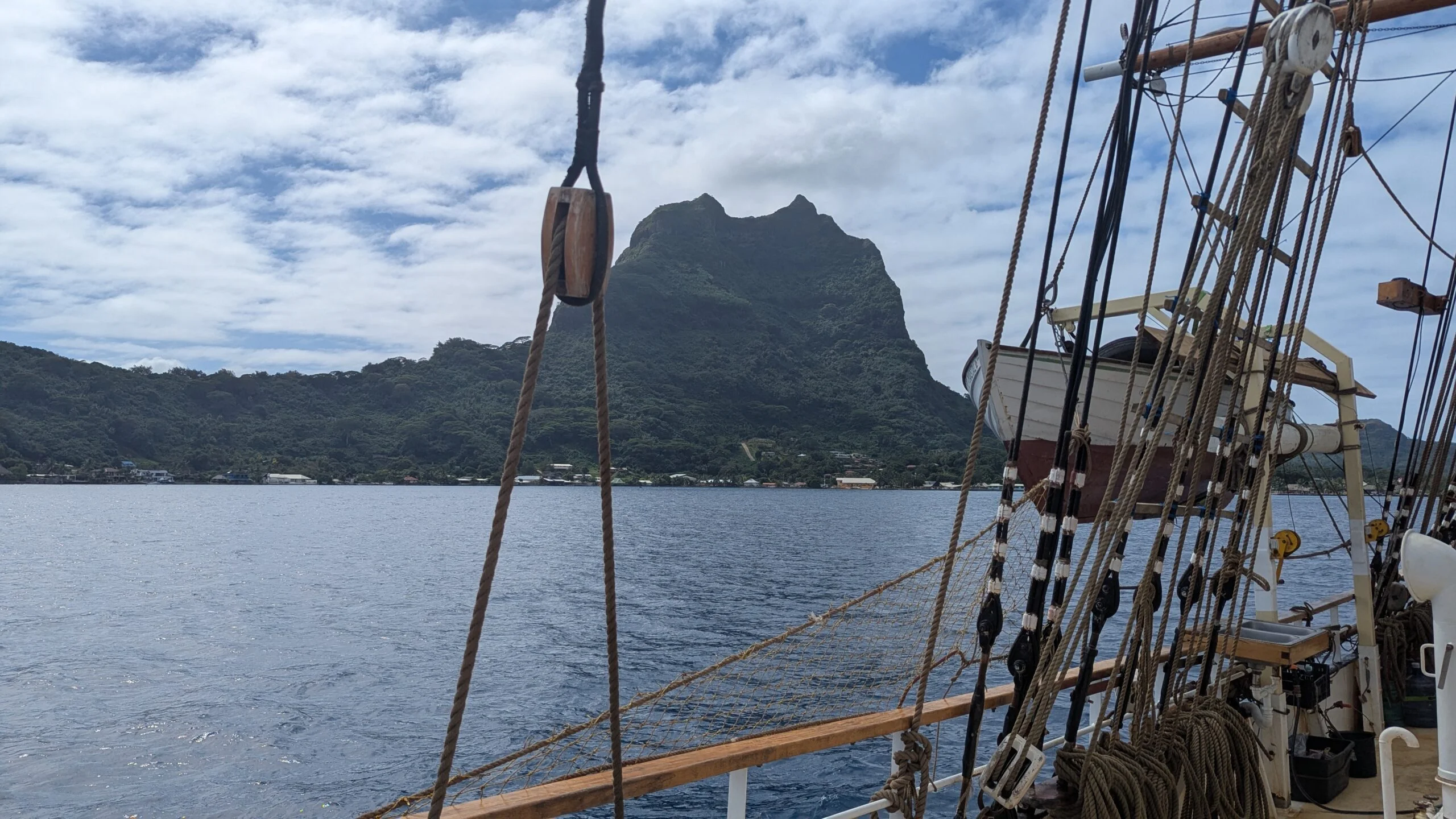
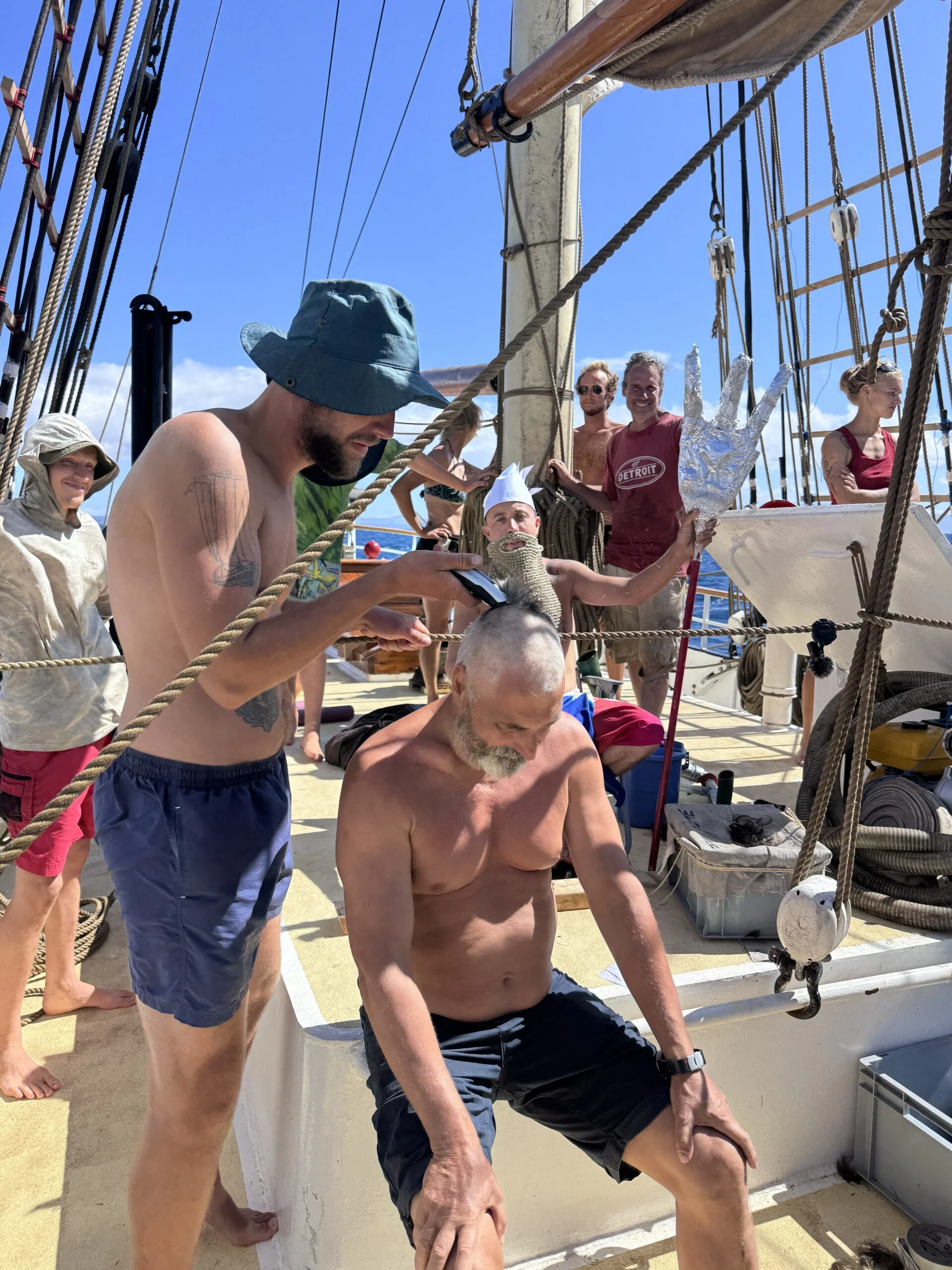
The same Danish maritime tradition, on NEPTUN scale
Sail one of NEPTUN's nine legs in 2026-2027
Skoleskibet Danmark trains Danish cadets on a state programme. NEPTUN runs the same teach-by-doing tradition as a non-profit, open to anyone, every leg takes 10 trainee crew members through real ocean sailing, no experience needed.
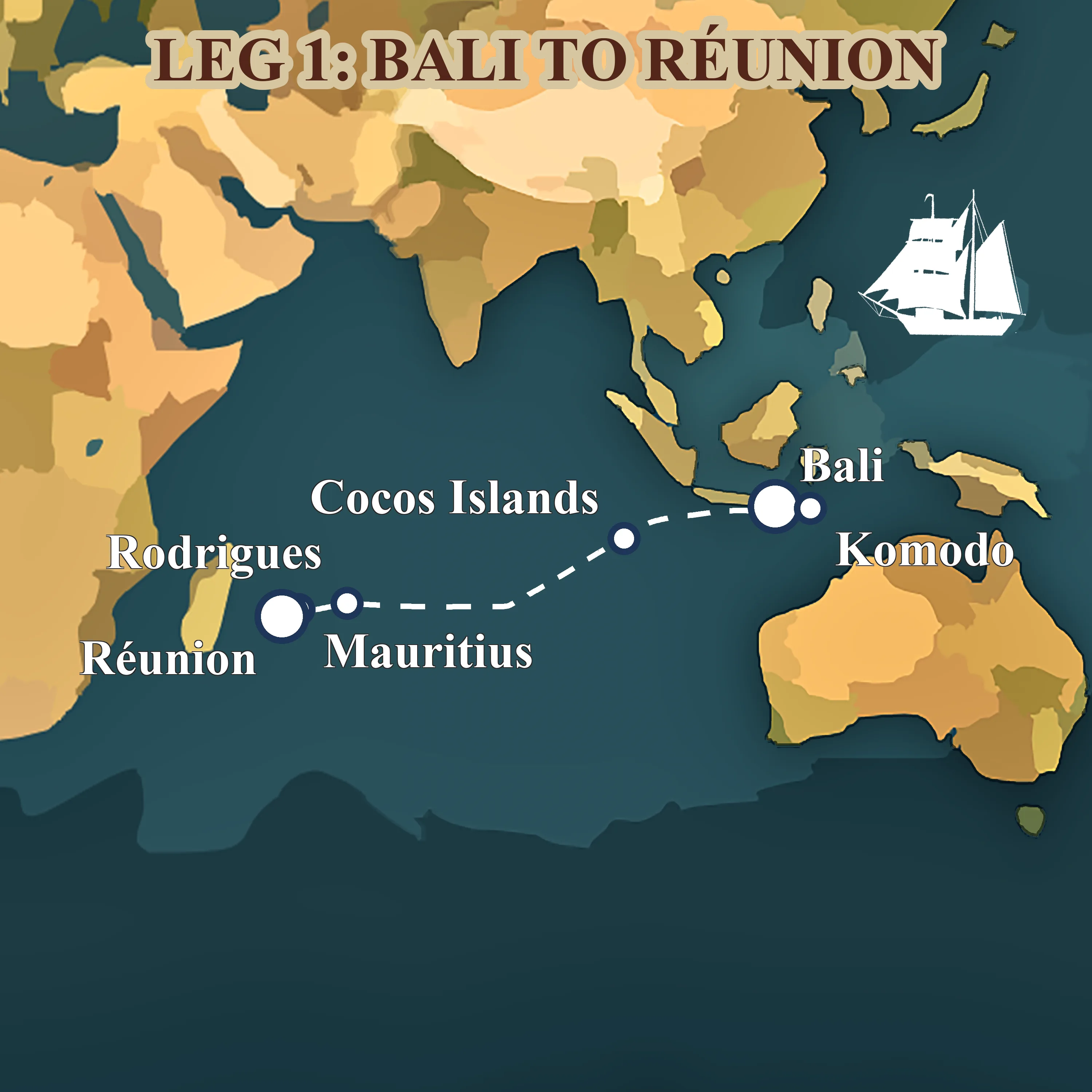
Leg 1: from Bali to Réunion across the Indian Ocean
May 2026 — Aug 2026 · Bali, Indonesia → Réunion, France
The opening chapter of Neptun's 482-day world voyage, a 4,078-nm trade-wind passage from the temples of Bali to the volcanic cliffs of Réunion.
Read more about this leg → about Leg 1: from Bali to Réunion across the Indian Ocean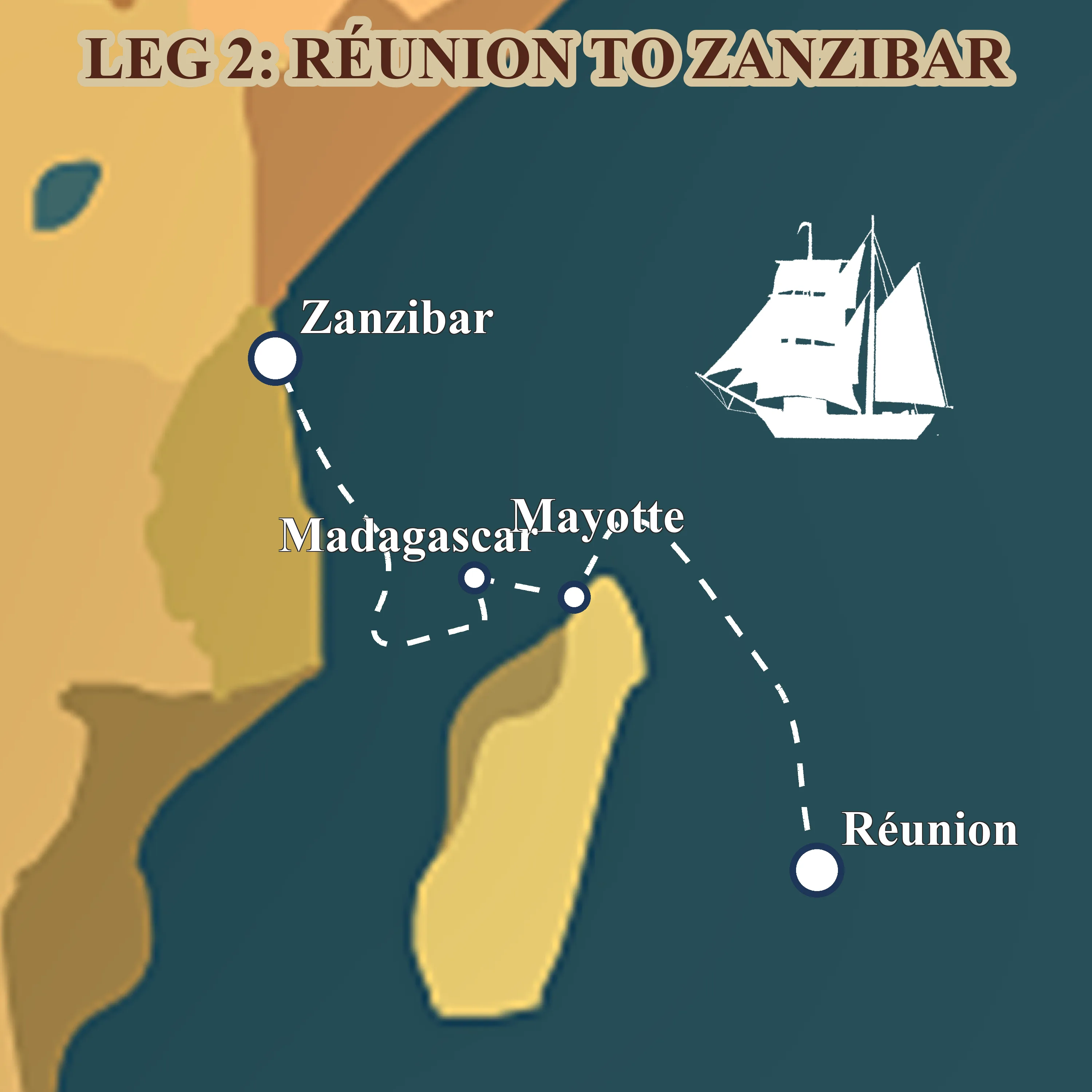
Leg 2: from Réunion to Zanzibar via Madagascar
Aug 2026 — Sept 2026 · Réunion, France → Zanzibar, Tanzania
Forty days across the western Indian Ocean, volcanic Réunion, lemur-haunted Nosy Be, the Mozambique Channel, and the spice-scented stone alleys of Zanzibar.
Read more about this leg → about Leg 2: from Réunion to Zanzibar via Madagascar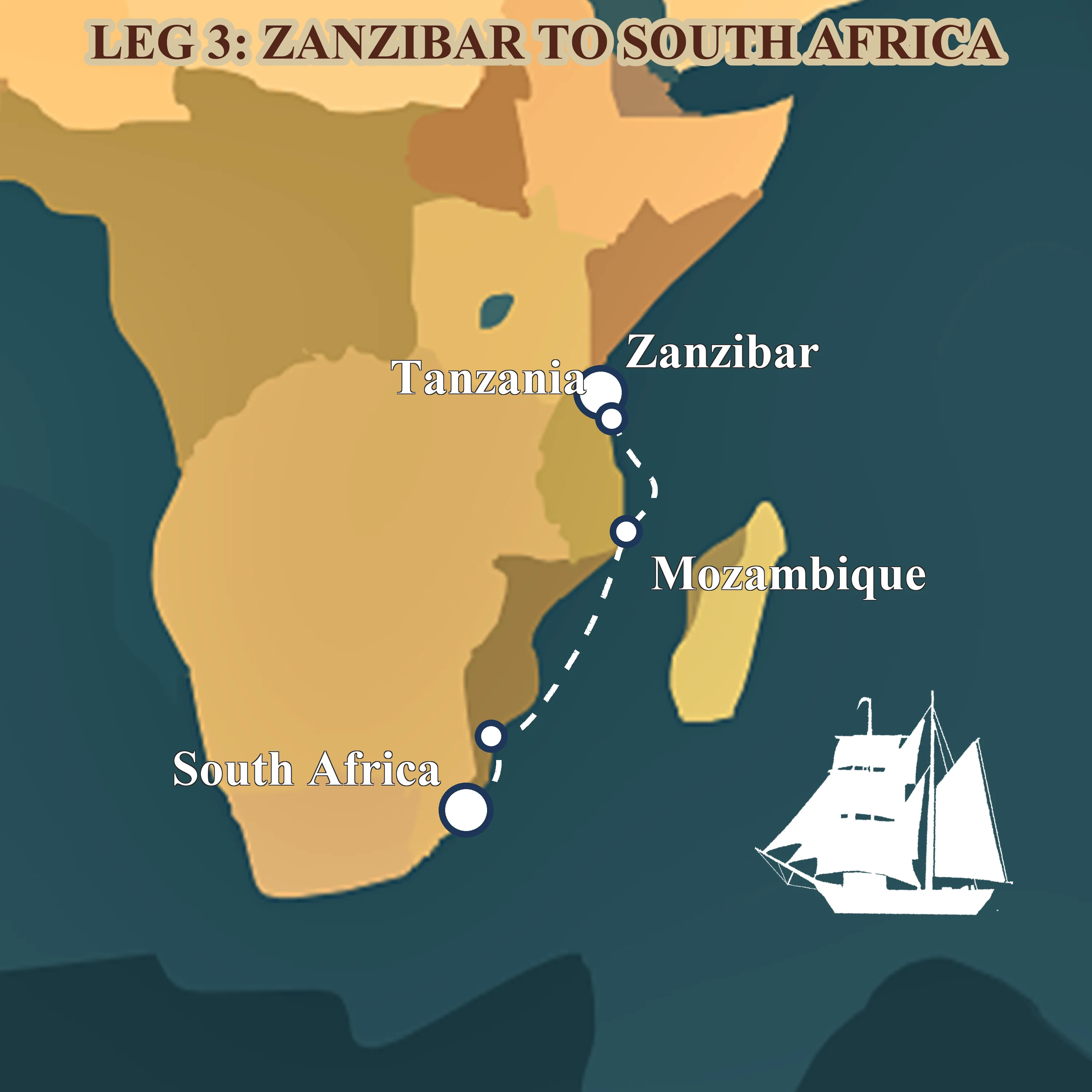
Leg 3: from Zanzibar to Durban down the Mozambique Channel
Sept 2026 — Nov 2026 · Zanzibar, Tanzania → Durban, South Africa
Sixty-three days coasting the African shore, spice islands, mangrove anchorages, Portuguese praças and the long trade-wind run down the Mozambique Channel to Durban.
Read more about this leg → about Leg 3: from Zanzibar to Durban down the Mozambique Channel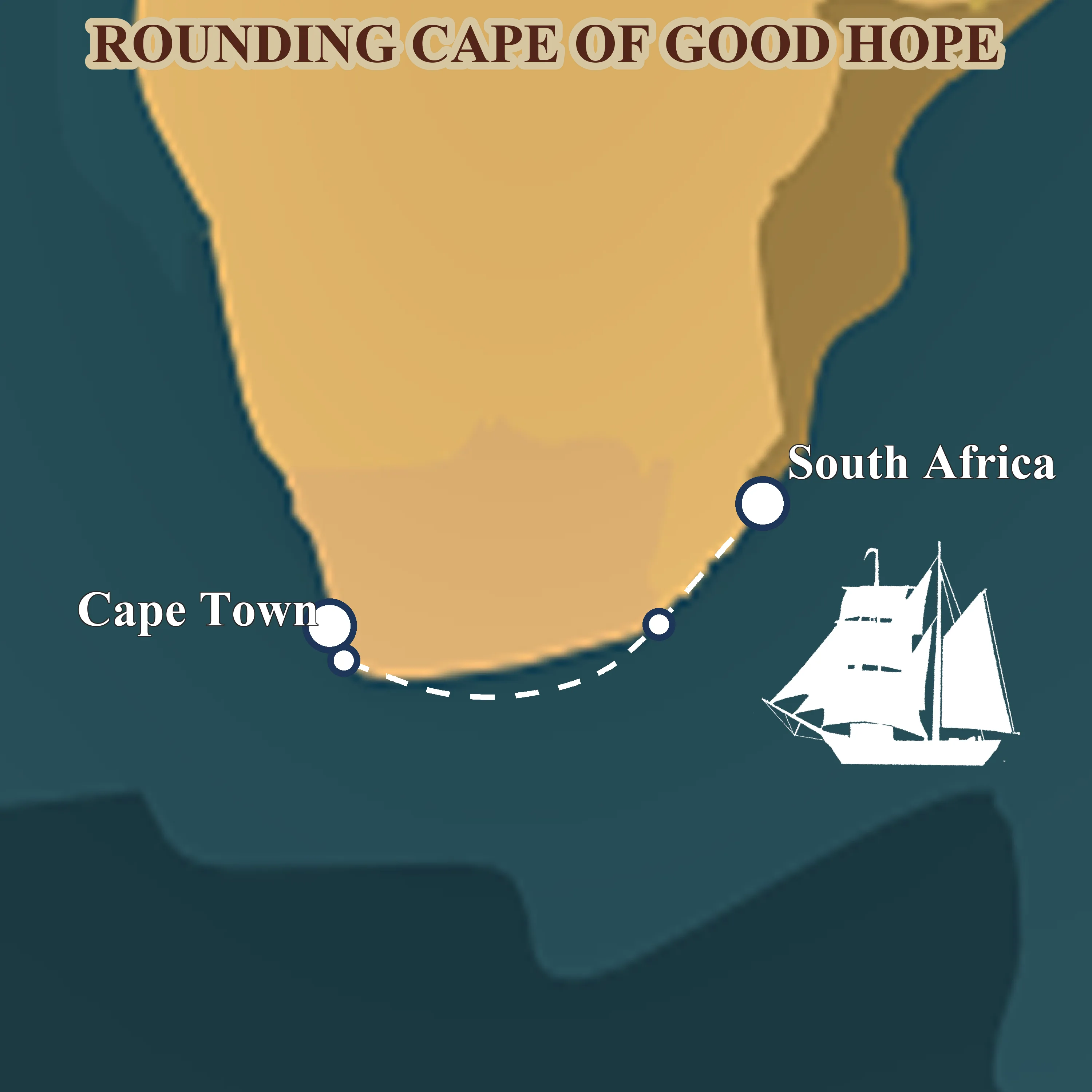
Leg 4: from Durban around the Cape of Good Hope
Nov 2026 — Dec 2026 · Durban, South Africa → Cape Town, South Africa
Thirty-eight days of serious seamanship, the Agulhas current, the Cape of Good Hope and the Southern Ocean at the tip of Africa, finishing quietly in Cape Town for Christmas.
Read more about this leg → about Leg 4: from Durban around the Cape of Good Hope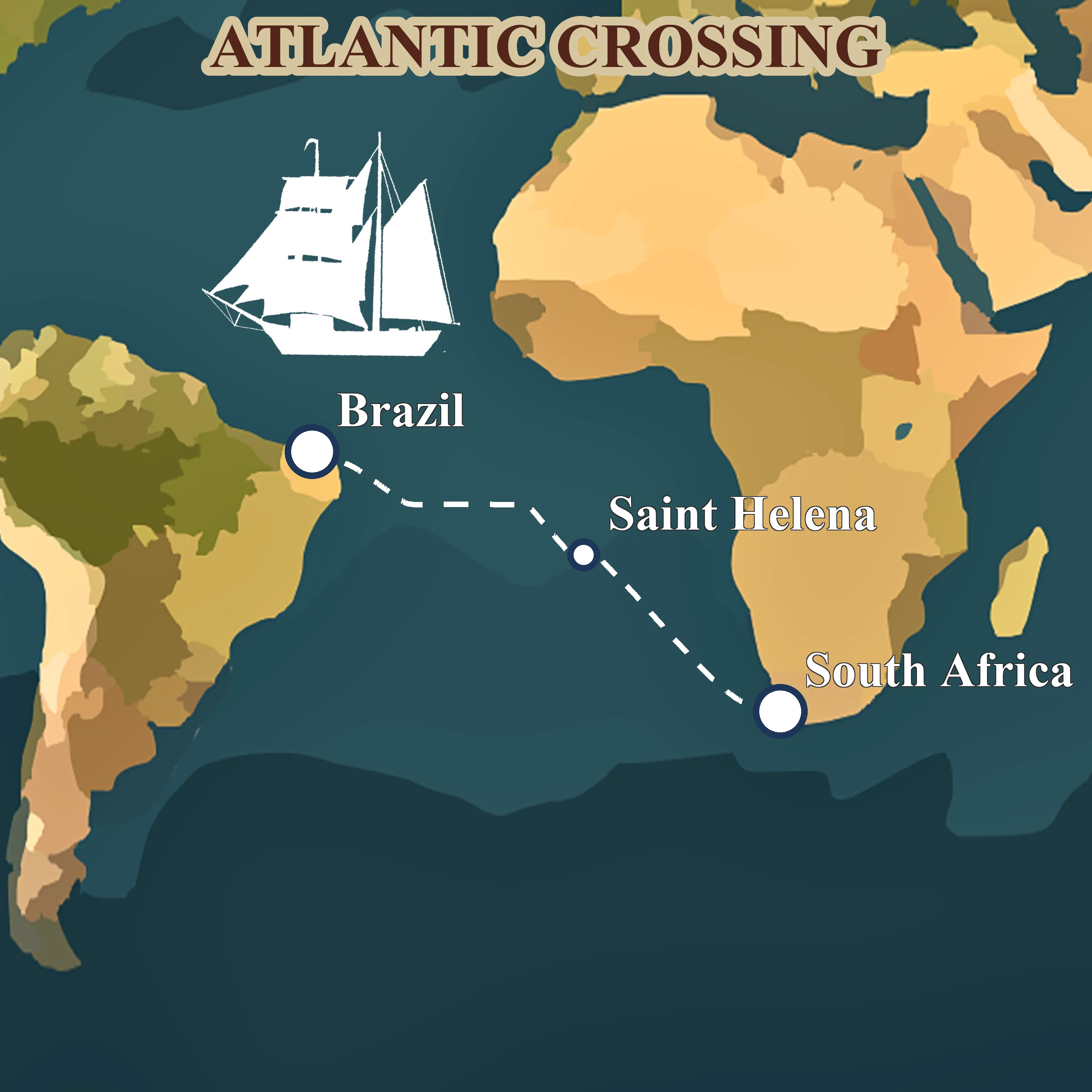
Leg 5: across the South Atlantic from Saldanha to Fortaleza
Jan 2027 — Mar 2027 · Saldanha Bay, South Africa → Fortaleza, Brazil
Forty-four days before the southeast trades, Napoleon's exile at St. Helena, the equator crossing, and landfall in tropical Brazil. The ocean chapter of the voyage.
Read more about this leg → about Leg 5: across the South Atlantic from Saldanha to Fortaleza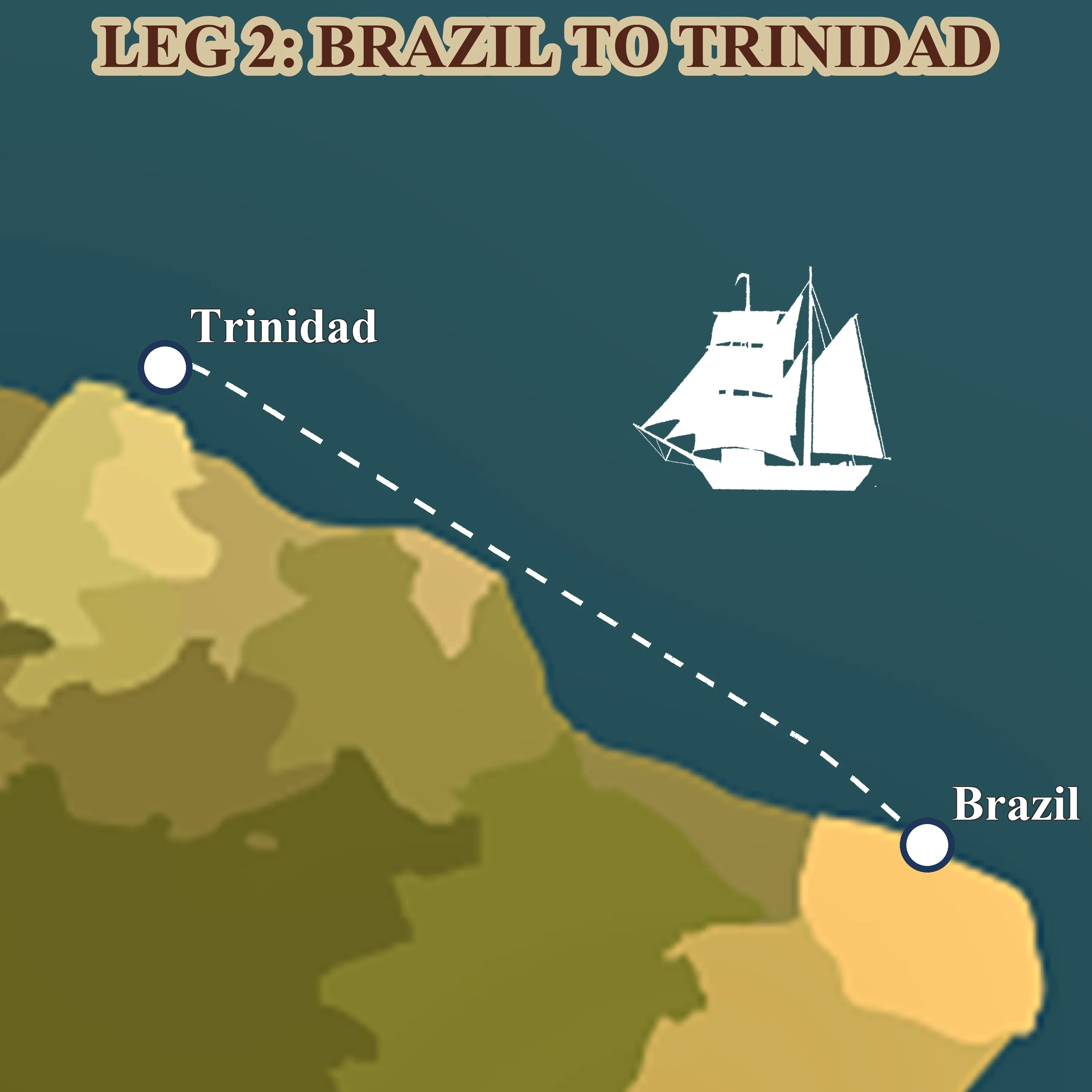
Leg 6: from Fortaleza to Trinidad along South America
Mar 2027 — Apr 2027 · Fortaleza, Brazil → Trinidad
A thousand miles of downwind trade running, the Amazon's brown water under the hull, the Guianas smudged on the horizon, and Trinidad's steelpan waiting at the end.
Read more about this leg → about Leg 6: from Fortaleza to Trinidad along South America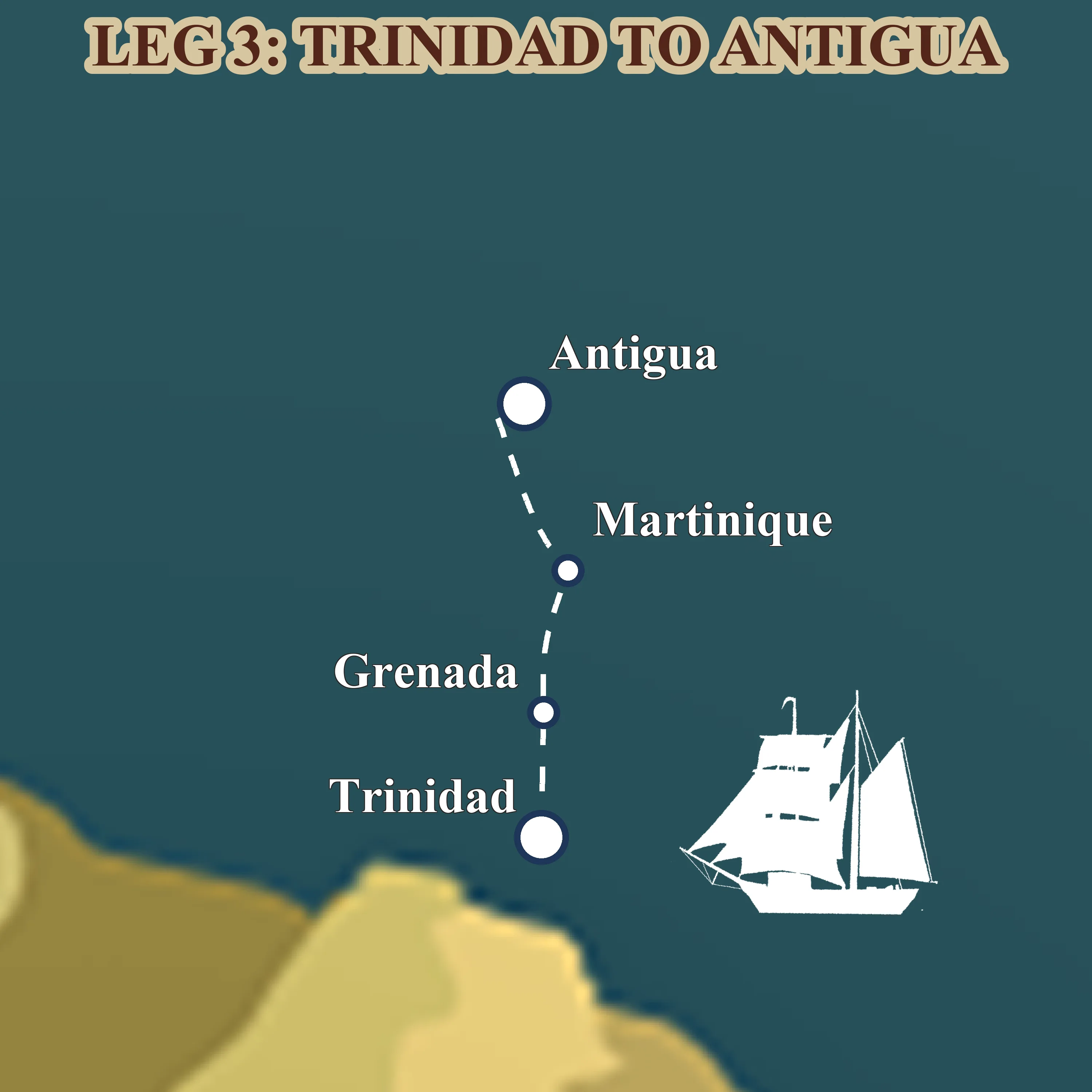
Leg 7: through the Windward Islands from Trinidad to Antigua
Apr 2027 — May 2027 · Trinidad → Antigua
Four weeks of short trade-wind daysails through the Lesser Antilles, turquoise anchorages, rum shops on the sand, French-Creole Martinique and the tall-ship scene in Antigua.
Read more about this leg → about Leg 7: through the Windward Islands from Trinidad to Antigua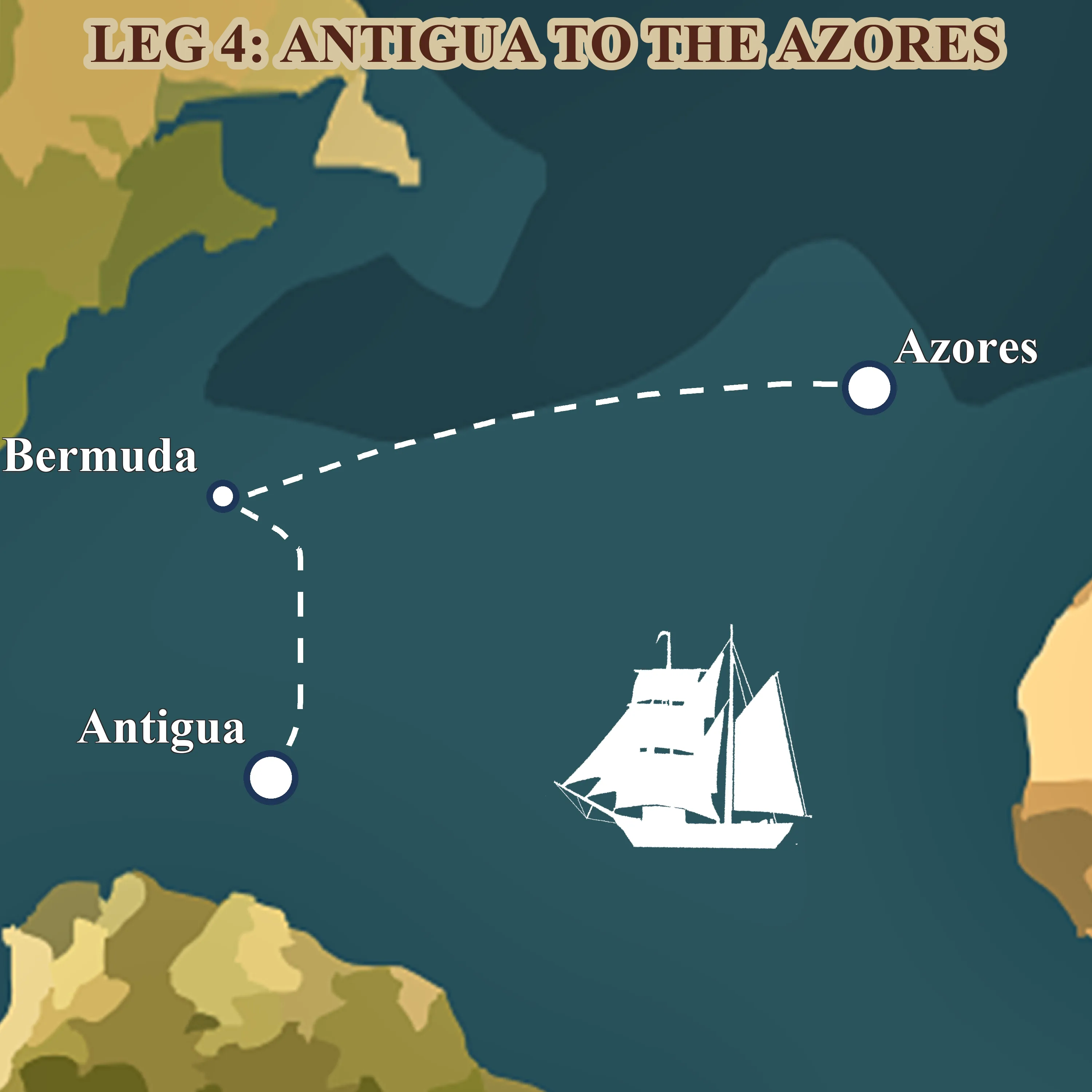
Leg 8: across the North Atlantic from Antigua to the Azores
May 2027 — Jul 2027 · Antigua → Ponta Delgada, Azores
Fifty-six days on the classic spring tall-ship route home, Antigua, a long reach to Bermuda's pink sand, then three weeks of open ocean to the volcanic Azores.
Read more about this leg → about Leg 8: across the North Atlantic from Antigua to the Azores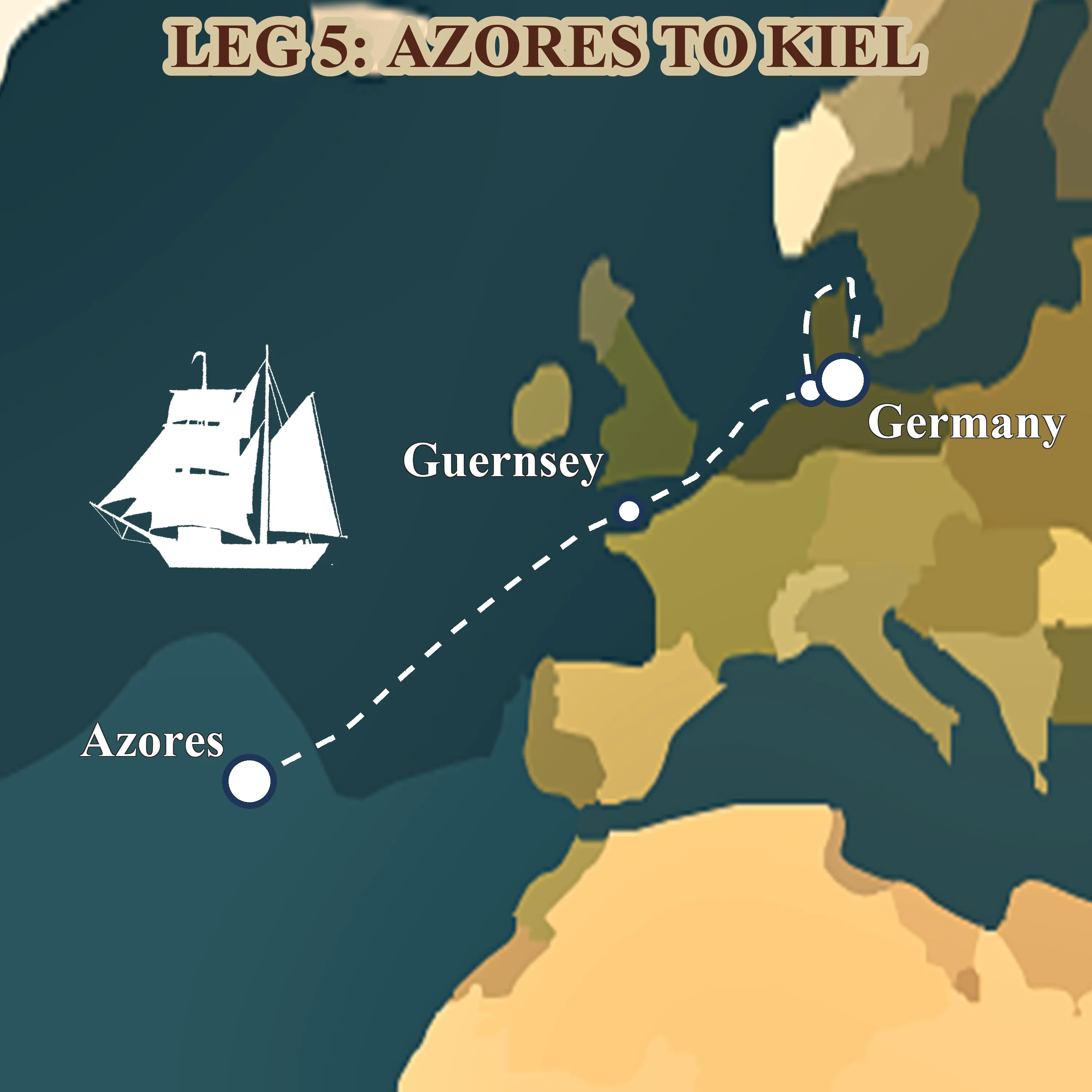
Leg 9: homecoming from the Azores to Kiel
Jul 2027 — Aug 2027 · Ponta Delgada, Azores → Kiel, Germany
The final 1,878 nm, from volcanic São Miguel to the Baltic, up the English Channel through the Dover TSS, past Helgoland's red cliffs and home to Kiel.
Read more about this leg → about Leg 9: homecoming from the Azores to KielAn old crew connection, NEPTUN's lineage to her
NEPTUN co-founder Anders Bischoff served two years' effective sea-time aboard Skoleskibet Danmark before NEPTUN existed. He learned the same Danish maritime training tradition NEPTUN now carries forward, the watch-try-do progression, the four-on/eight-off watch system, the celestial-navigation and meteorology curriculum, the rule that the ship is sailed by the trainees and not for them. None of that is unique to one ship; it is what Danish square-rig training has been since 1882. But the directness of the inheritance matters: NEPTUN is run by people who learned it from the institution that defines it.
The point of saying so is not to claim credentials. It is to set expectations. When a NEPTUN trainee climbs the rig in their second week aboard, it is because we know, from having done it ourselves on Skoleskibet Danmark, that they can. When the watch system is structured the way it is, it is because we tested every alternative as cadets and this one works. The non-profit, ten-berth, brigantine-scale model NEPTUN runs is a deliberate scaling down of the Danish state model, kept inside what a small organisation can sustain.
The other thing worth saying: there is room for both ships and there always has been. Skoleskibet Danmark trains 160 Danish cadets a year on a closed state programme. NEPTUN takes ten people of any nationality on each leg, on a nine-leg world voyage, with no prerequisites. Different audiences, same craft. If you are Danish, 17-23, and the merchant-marine pathway interests you, apply to Skoleskibet Danmark directly. If you are anyone else who wants to learn the same craft on a working square-rigger, that is what NEPTUN is for.
Sail in the Danish square-rig tradition
NEPTUN runs nine legs across 2026-2027, Indian Ocean, Atlantic, Caribbean, built around the same teach-by-doing model the Danish training ships invented.
Where you can see her
Skoleskibet Danmark is in active service as of 2026. Her home port is the Maritime Training and Education Centre in Frederikshavn, on the northern tip of Jutland, but most of any year she is away on a voyage. Her movements are public, and you can track her position via her IMO number 5086279 on the standard AIS sites if you want to know where she is right now.
She also turns up regularly at port-festival appearances around northern Europe, at Tall Ships gatherings, at major maritime anniversaries, and on courtesy calls during voyages. The official source for her schedule is her own site at skoleskibet.dk, which lists the season's training cruises in advance.
She was, however, involved in a brief incident in September 2022, when she was struck by USS Minneapolis-Saint Paul while being towed in port, an event that caused damage but no injuries, and from which she made a full return to service. She has been sailing actively ever since.
Atlantic and Indian Ocean, the legs that sail furthest
The ocean-crossing legs of NEPTUN's 2026-2027 voyage
If you want what Skoleskibet Danmark cadets get on a long passage, uninterrupted offshore time, celestial sights, weeks of routine, these are the NEPTUN legs that come closest.
Leg 5: across the South Atlantic from Saldanha to Fortaleza
Jan 2027 — Mar 2027 · Saldanha Bay, South Africa → Fortaleza, Brazil
Forty-four days before the southeast trades, Napoleon's exile at St. Helena, the equator crossing, and landfall in tropical Brazil. The ocean chapter of the voyage.
Read more about this leg → about Leg 5: across the South Atlantic from Saldanha to FortalezaLeg 6: from Fortaleza to Trinidad along South America
Mar 2027 — Apr 2027 · Fortaleza, Brazil → Trinidad
A thousand miles of downwind trade running, the Amazon's brown water under the hull, the Guianas smudged on the horizon, and Trinidad's steelpan waiting at the end.
Read more about this leg → about Leg 6: from Fortaleza to Trinidad along South AmericaLeg 8: across the North Atlantic from Antigua to the Azores
May 2027 — Jul 2027 · Antigua → Ponta Delgada, Azores
Fifty-six days on the classic spring tall-ship route home, Antigua, a long reach to Bermuda's pink sand, then three weeks of open ocean to the volcanic Azores.
Read more about this leg → about Leg 8: across the North Atlantic from Antigua to the AzoresFAQs
Common questions about Skoleskibet Danmark
When was Skoleskibet Danmark built?
She was launched in 1932 at Nakskov Skibsværft on Lolland, Denmark, and fitted out the following year. She has been in active training service almost continuously since 1933, the longest gap was the 1942-45 US Coast Guard period, when she was training cadets under American command instead of Danish.
Who operates Skoleskibet Danmark today?
She is owned and operated by the Danish Maritime Authority (Søfartsstyrelsen) and based at the Maritime Training and Education Centre in Frederikshavn, on the northern tip of Jutland. Her cadets are trainees on a state programme bound for officer roles in the Danish merchant marine.
How many cadets does she carry?
Eighty cadets aged 17-23 per voyage, plus a permanent crew of fifteen. Her original 1932 design carried 120; the 1959 refit reduced the cadet complement to the present 80 to give each trainee more space and individual training time.
Why was she stuck in the United States during WWII?
She had crossed the Atlantic to take part in the 1939 New York World's Fair and was still in US waters when Germany occupied Denmark in April 1940. Her Danish captain Knud Hansen judged that running home through a German-controlled North Atlantic was impossible. After Pearl Harbor he offered her to the US government, and she served as USCGC Danmark (WIX-283) until the war ended, training roughly 5,000 US Coast Guard cadets.
Can the public sail on Skoleskibet Danmark?
No, she is a closed state cadet-training programme. Berths are reserved for Danish merchant-marine cadets. If you want a comparable square-rig sailing experience open to anyone of any nationality, that is what NEPTUN exists for. See sail with us for how to join a NEPTUN leg as trainee crew.
What is the connection between Skoleskibet Danmark and the USCGC Eagle?
When the US Coast Guard acquired the German training barque Horst Wessel as a war reparation in 1946 and renamed her USCGC Eagle, many of the officers who were ready to sail her had learned their square-rig skills aboard Skoleskibet Danmark during her 1942-45 USCG service. The Danish ship, in effect, taught the early generations of Eagle's American officers the rig.
Is Skoleskibet Danmark related to NEPTUN?
Not institutionally, they are two separate Danish square-rig training operations. The connection is personal and pedagogical: NEPTUN's co-founder Anders Bischoff served two years' effective sea-time aboard Skoleskibet Danmark, and the watch system, training progression and seamanship curriculum NEPTUN uses come directly out of that Danish state-training tradition, scaled down to a brigantine and a ten-berth non-profit model.
Read also
- Georg Stage, Denmark's other training ship, the older sister, the foundation that has trained Danish sailors since 1882
- Famous tall ships still sailing today, the wider canon of full-rigged training ships in active service
- Watch systems on a tall ship, the four-on, eight-off rotation Skoleskibet Danmark uses, in detail
- How to learn traditional seamanship, the watch-try-do progression that Danish training ships invented
- About NEPTUN, the non-profit brigantine carrying the tradition forward, ten berths at a time
- Apply for a berth on a 2026-2027 leg
Want to sail with us? Brigantine NEPTUN is a non-profit training ship, every voyage takes 10 crew members through real ocean sailing, no experience needed. The Danish square-rig training tradition Skoleskibet Danmark embodies is what we run on NEPTUN, scaled down to ten berths and open to anyone. Apply for a berth or read about the voyages first.